Let Us Remember
Also, negotiations with Lebanon begin, and Iran's dire economic state.
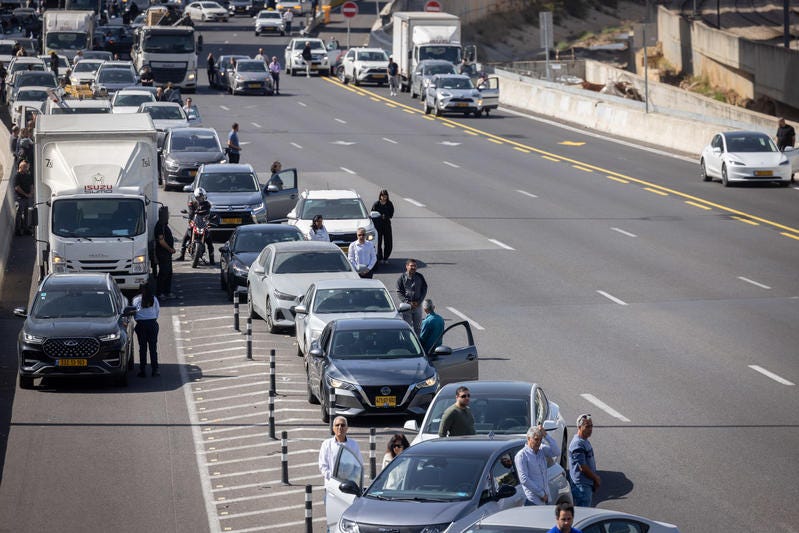
People stand still in Tel Aviv, as a two-minute siren is sounded across Israel to mark Holocaust Remembrance Day this morning. (Miriam Alster/Flash90)
It’s Tuesday, April 14, and Israel’s Holocaust Memorial Day. For the past two years, the wail of a siren has signaled a frantic scramble for shelter in Israel. This morning, however, the nation froze. In their cars, on bustling street corners, and within the quiet of their homes, Israelis stood in absolute silence for two minutes to honor the 6 million Jews murdered in the Holocaust.
Among those standing was Haim Shiloh, a 100-year-old survivor of both the Holocaust and the October 7 attacks. When the sirens blared that October morning at his home in Kibbutz Nirim, Shiloh sought refuge in his shelter as rockets devastated the homes around him. He survived the onslaught and was evacuated that night. Despite stating in an interview after October 7 that he did not believe he would live to see his home again, he returned to his kibbutz six months ago.
Two years after he was evacuated from his home, Haim Shiloh returns to the kibbutz.
Shiloh’s experience is part of a larger tragic reality. About 2,500 Holocaust survivors were directly exposed to the October 7 attacks, and approximately 2,000 were forced to evacuate. While most survived the initial violence, the toll of displacement was heavy; roughly 86 of those evacuated survivors died in the months that followed.
The most enduring label of the October 7 massacre is “the worst slaughter of Jews since the Holocaust.” The reality is that, despite millennia of persecution, the Holocaust is so immense in its scale that it comprises the entire vocabulary through which the Jewish people process catastrophe.
While the two events differ in magnitude, both have left an indelible mark on the Jewish and Israeli consciousness. They carry a shared message: a determination to thrive despite genocidal aspirations, a fierce commitment to survival, and—perhaps most importantly—a commandment of biblical weight to remember. The lives of survivors like Haim Shiloh are a testament to a spirit that refuses to be extinguished. Their story is a refusal to let the genocidal aspirations of the past or present have the final word.
The partisan and poet Abba Kovner captured this commitment and responsibility in his poem Let Us Remember:
We shall remember the day
The day in its noon
The sun that rose over the stake of blood
The skies that stood high and silent.
We shall remember the mounds of ash
Beneath flowering gardens.
The living shall remember their dead
For behold they are here before us.
Behold as their eyes stare around and about,
So let us not be silent
Until our lives are worthy of their memory.
(AI/I24)
“We’re not about to release the peace doves,” an Israeli official told The Times of Israel. As Israel prepares for its most senior in-person engagement with Lebanon in its 78-year history, expectations are being managed.
There is one problem preventing the flight of those doves—the actor that would inevitably attempt to shoot them down, and its continued ability to do so: Hezbollah. The threat the terror group poses was summarized well by a BBC headline this morning: “Lebanon seeks peace, but Hezbollah needs to be convinced first.”
Almost a year and a half after Israel agreed to a ceasefire on the condition that Hezbollah disarm, and three months after the Lebanese Army declared “mission accomplished” in southern Lebanon, Hezbollah remains very much a threat. The Lebanese government still lives in the shadow of its civil wars, fearing that a confrontation with the Shiite terror group would fracture Lebanon’s delicate ethnic coalition.
Whether the negotiations will succeed depends on one question: Is Lebanon entering these talks wishing to reclaim its sovereignty, or is it merely looking to avoid the consequences of having surrendered it?
The talks are a consequence of the latter. After escalating Israeli airstrikes in the country, Lebanese President Joseph Aoun made a public appeal for talks, and with some pressure from a U.S. administration wishing to avoid the disintegration of the ceasefire, Israel accepted. Yet, short of lending these floundering discussions a few more days of life, the bilateral talks will achieve nothing unless a solid plan and an ironclad commitment are made to disarm Hezbollah.
Hezbollah leader Naim Qassem gives a televised address in Lebabon, March 13, 2026. (Screenshot)
Hezbollah Secretary General Naim Qassem took to the airwaves last night to demand the government withdraw from the talks, calling them “futile.” The truth is that so long as someone as committed to armed resistance as Qassem continues to draw breath, that may well be true.
U.S. naval forces operating in the Pacific Ocean. (U.S. Navy)
According to Iran International, the Iranian Central Bank delivered a striking report to the regime. The report warned that unless current conditions change, the economic fallout from the recent war will drive inflation to 180 percent and leave 2 million people unemployed.
For context, the inflation rate that sparked mass protests in January is estimated to be between 44.6 percent and 46.5 percent, with peak estimates hitting 100 percent. The Central Bank is now bracing for a scenario nearly four times that baseline, and almost double the most extreme estimate.
Operation Roaring Lion was specifically designed to degrade Iran’s military capacity, but that effort inevitably targeted significant dual-use infrastructure. Most prominently, its petrochemical processing facilities and steel production plants, which collectively account for nearly 15 percent of Iran’s total GDP and over 60 percent of its non-oil industrial output.
One Iranian official warned that the scale of the destruction means the massive industrial facilities driving the economy will take months, if not years, to repair. The report from the central bank reportedly places the recovery time at 12 years. Without immediate sanctions relief, the official noted, the country “will face a disaster.” The damage inflicted upon factories and industrial hubs over the 40-day war has triggered a cascading chain reaction. Dozens of downstream companies reliant on these major facilities have been forced to halt production, throwing thousands more out of work.
A less discussed, yet devastating, economic impact of the conflict stems from the internet blackout. In the first half of 2025 alone, the value of Iran’s e-commerce transactions reached $65 billion. Very few businesses can survive a forced, 45-day closure. When the digital lights eventually come back on, the wreckage won’t just be visible on social media; it will be clear in the massively shrunken availability of online shopping.
None of these estimates include the consequences of Trump’s recent blockade, which threatens the last remaining financial lifeline of the regime—oil revenue, which accounts for 50 percent of its budget.
The reality that Tehran is desperately attempting to obscure behind its bravado and hollow declarations of victory is that it is limping to the negotiation table. The regime is seriously wounded, suffering from severe internal economic bleeding, and in desperate need of the balm of sanctions relief.
The goal for the Trump administration will be getting them to reveal thier condition.
English Editor: Ari Tatarka
If you enjoy the newsletter, you can show your support by becoming a paid subscriber—it really helps keep this going. I’m also offering a special monthly briefing for a small group of premium members. I’d love to have you join us—just click below to find out more.
Thanks for reading It’s Noon in Israel! Subscribe for free to receive new posts and support my work.


What about the water issue Iran faces?
Will history rhyme in Iran, something like “Marshall Plan?“
Plans for Trump Tower Tehran revealed.
In other news, Taiwan predicts annexation of mainland China.