Losing the Battle for Judea and Samaria
Also, Israel's Mount Rushmore.
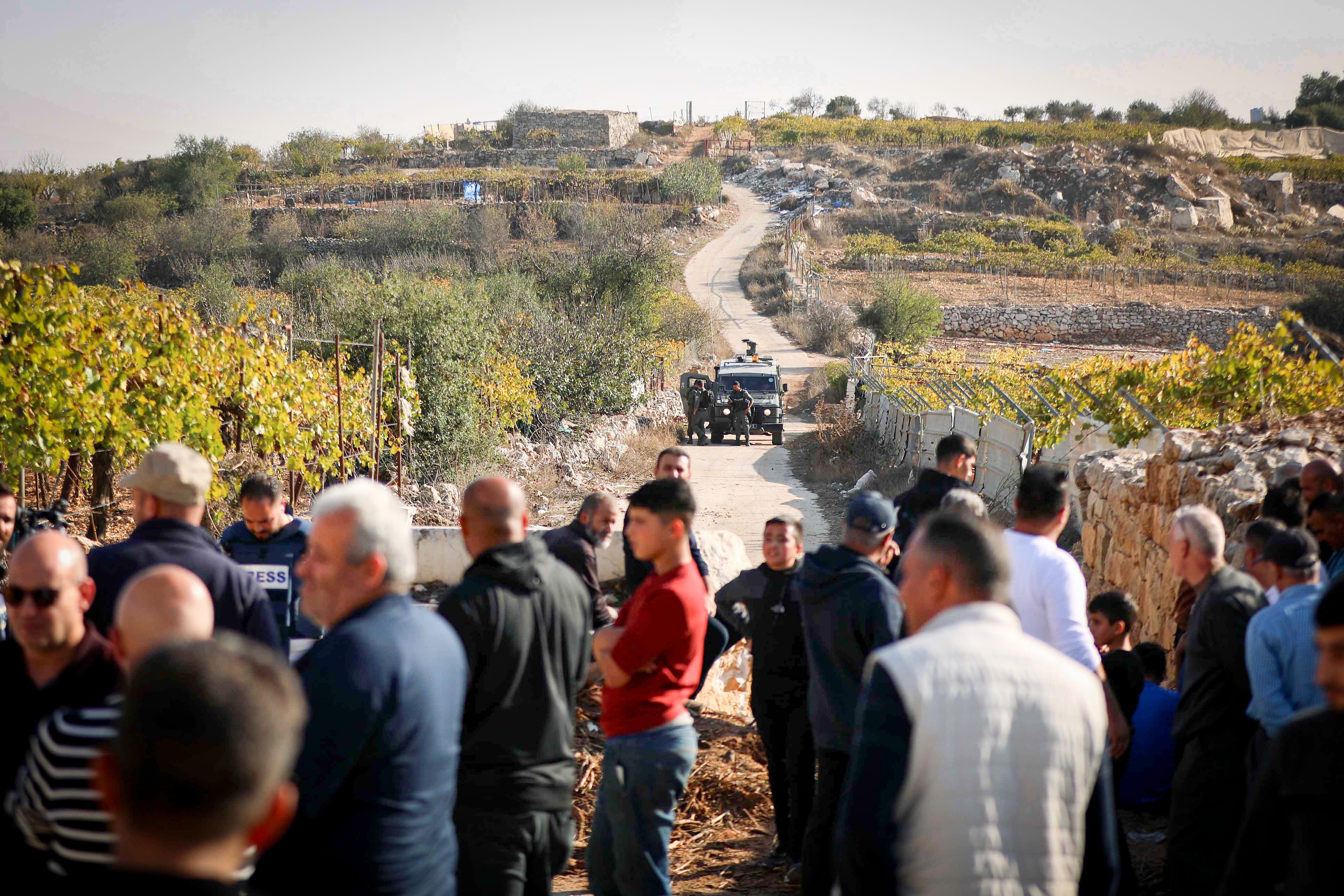
Palestinians stand guard against a settler attack in the town of Halhul, north of Hebron on November 20, 2025. (Wisam Hashlamoun/FLASH90)
It’s Thursday, August 13, and a battle is being fought in Israeli territory—and Israel is losing. Israel is not, technically, one of the combatants. It is losing nonetheless.
For four days, the most capable military in the Middle East could not clear a path for a family to reach its own front door. The family lives on the outskirts of Qusra, south of Nablus. On Sunday, settlers from the encampments seeded by the Tel Talpiot outpost sealed the entrance to their home and would not let them in or out.
The most damning verdict of the event comes from Israel’s most faithful friend, Mike Huckabee. The most pro-settlement ambassador in the history of the post, a man who will not so much as use the word “settler”—called the men at Qusra “Israeli terrorists.” He described what they did as a deliberate act of intimidation and harassment against the family, with “no excuse for such thuggish behavior.” One of the besieged homes belongs to an American citizen, and Washington is rightly furious.
The army moved to end it. But the plan leaked to the press, and by the time the troops arrived, dozens of activists were waiting, blocking the roads with boulders. That a handful of stones could stop a military that routinely penetrates through tens of meters of solid rock deserves an explanation.
Start with the obvious. These are not Hezbollah fighters or Iranian operatives. For all their open contempt for state authority, they are Israeli citizens, and overwhelming military force is not an option.
Then consider who actually showed up. The first forces on the scene were not Border Police or infantry trained for this, but Home Front Command reservists—a consequence of the manpower shortage the army has been running on for three years. They did not understand the scenario they had walked into. Some of them joined the prayer at the outpost, which has since been reported as solidarity. It was ignorance.
The state has also stripped the toolkit. Administrative detention against settlers was taken off the table in November 2024, and with it the only instrument that let the army remove known offenders quickly. That instrument was always controversial precisely because it required no evidentiary basis—but the alternative has proven worse. Most settler violence is incredibly difficult to prosecute: proving who broke a fence, stole sheep, or sprayed graffiti is genuinely hard, and Israel’s conviction rate for these offenses sits around the international average for such crimes.
Qusra should have been the easy case. The men outside those homes were sitting inside a closed military zone, and refusing to leave once ordered out by the authorities is a criminal offense in its own right. But without the men or the political backing to confront the reinforced settlers head-on, the IDF opted for the quieter option: dismantling the outpost overnight and arresting only one participant.
The lack of political support comes down to a fight over perception. When violent settlers attacked an army base, every figure on the right condemned it without qualification, Ben Gvir included. Even when the settlers weren’t turning their violence on the IDF—after the April escalation—Bezalel Smotrich too said such violence had to be uprooted at its source. But those condemnations followed burning cars and shattered windows. Qusra has produced no such images: harassment, siege, and obstruction, certainly, but little footage of outright violence. It isn’t that right-wing leaders support what is happening there; it is that, two months from an election, they are not confident their voters will draw the distinction.
Major General Avi Bluth, head of Central Command. (Chaim Goldberg/Flash90)
There is also the risk of theater. Just last week, Defense Minister Israel Katz announced on live television that he was removing Central Command chief Avi Bluth—punishment for the general’s insistence on pursuing a violent settler. The stunt blew up in Katz’s face. But no IDF officer or right-wing politician wants to find himself on the wrong side of a primary campaign.
Settler violence is a sensitive issue in Israel. Only a vanishingly small share of the settler population supports or takes part in such acts, but because the problem is exaggerated and used to obscure Palestinian violence against them, they bristle at hearing about it—even from Israel’s greatest friends.
But this is a serious moral and strategic problem, and it has to be confronted.
Israel feels like Teddy Roosevelt’s man in the arena—face marred by dust and sweat and blood, fighting on every front while the critics constantly point out how it stumbles. We can safely take Roosevelt’s advice, that they are not the ones who matter. But we have to be sure it is the critic we are dismissing, and not the man fighting beside us. Huckabee is just as caked in blood and sweat as we are. We ignore him at our own peril.
Prime Minister Benjamin Netanyahu leads the weekly Likud party meeting at the Menachem Begin Heritage Center in Jerusalem on March 14, 2016. (Yonatan Sindel/Flash90)
if we were required to quarry out the Israeli Mount Rushmore tomorrow morning, the workers most likely wouldn’t show up equipped with chisels and yellowing history books, but rather armed with the voting blocs of the latest poll. The figures in this table reveal a rather cruel truth about the nature of our national memory: Israelis don’t really cling to the past out of pure-hearted reverence — they simply conscript the dead into active reserve duty in the tribal wars of the present.
Menachem Begin does indeed look out from the mountain’s summit with 22 percent affection among the general public, but the deeper political story is hidden in the sector-by-sector breakdowns. Begin is the undisputed grand rabbi of the coalition (38 percent), of the Likud (35 percent) and of the religious public (41 percent). That said, the most surprising and fascinating figure in the table is the level of longing for Begin specifically among Gadi Eisenkot’s voters. This affection within the camp of the former chiefs of staff does not grow in a vacuum; it attests both to the distinctly right-wing roots that still exist there, and to the use of Begin’s statesmanlike figure as an effective nostalgic cudgel against the current Likud.
On the other side, Yitzhak Rabin (17 percent) functions precisely as the political mirror image. He is the patron saint of the opposition (35 percent), of secular Israelis (27 percent) and of the Arab sector (29 percent). With Rabin, the ballot slip in the poll has long since ceased to be merely longing for the man or for a diplomatic process, and has become the searing yearning of an entire camp for the old Israel and for the rule it lost.
And where did the man who founded the state disappear to? David Ben-Gurion scrapes the bottom with only 6 percent. This collapse is not happening because of historical errors, open political scores or the crossing of lines. The reason is far more prosaic and cruel: the time that has passed. The Israeli statute of limitations is working overtime. Millions of citizens were born, or immigrated to the country, decades after Ben-Gurion passed away. Without an active political base in the present to sustain the legacy, even the state’s founder gets pushed to the margins.
This is an excerpt from my weekly column in Israel Hayom.
English Editor: Ari Tatarka
If you enjoy the newsletter, you can show your support by becoming a paid subscriber—it really helps keep this going. I’m also offering a special monthly briefing for a small group of premium members. I’d love to have you join us—just click below to find out more.
Thanks for reading It’s Noon in Israel! Subscribe for free to receive new posts and support my work.


