Lucky Meeting Number Eight
Also, do Israeli primaries matter, and a welcome song drops.
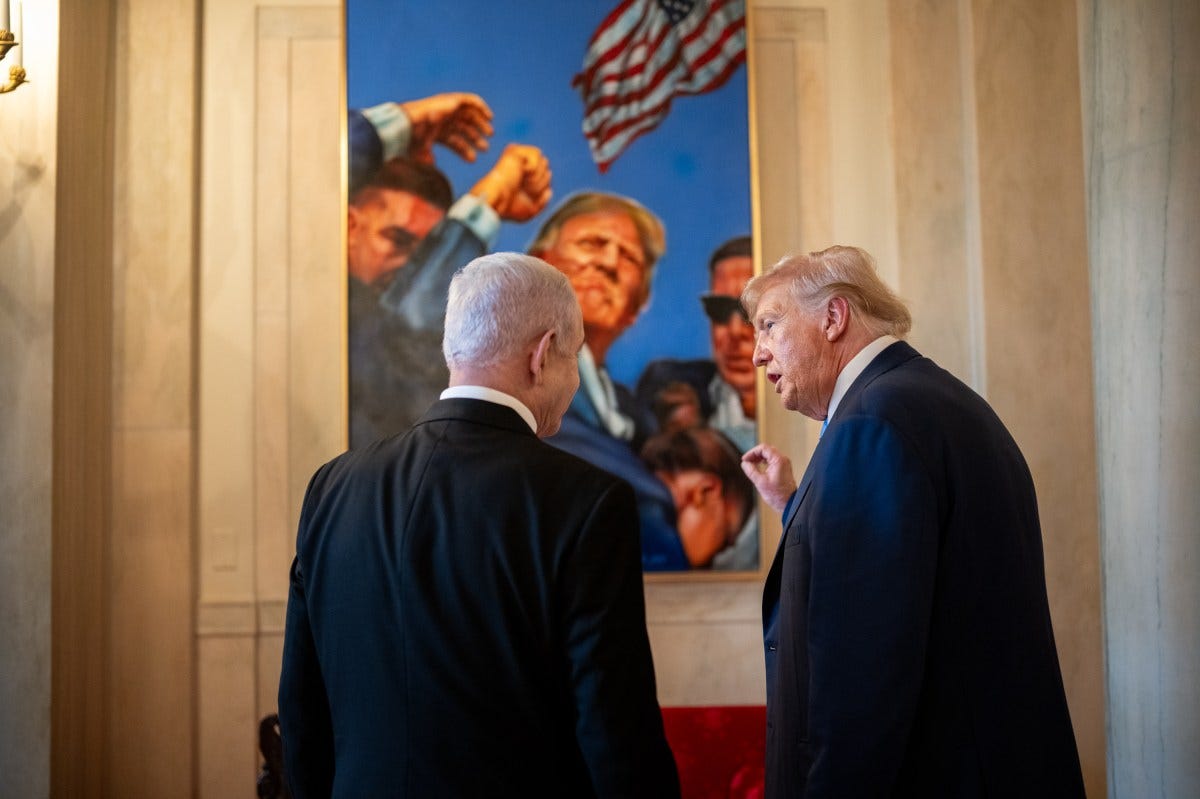
President Donald J. Trump Welcomes Israeli Prime Minister Benjamin Netanyahu to the White House, July 7, 2025. (White House)
It’s Tuesday, July 28, and in a rare move for Donald Trump, his meeting with Benjamin Netanyahu will be held away from the cameras. That says a lot.
There was real anxiety in Netanyahu’s office about another episode of what Trump called “great television”—a Zelensky-style confrontation, a blowup staged for the cameras. I don’t detect much grief from the prime minister’s office over the absence of footage.
The truth is that this is not a gotcha meeting, nor is it a Bidenesque “come to Jesus” moment. Since Trump called Netanyahu “f***ing crazy” in early June, things have improved—partly, at least, thanks to Iranian attempts to strain the allies’ connection to the point of breaking the MoU. The negotiations confirmed what Netanyahu told Trump on the eve of the memorandum of understanding: he doubted it would work, but if Trump wanted to try, he was behind him. A strategy not everyone in his Cabinet was willing to back, but one that has clearly been validated.
Netanyahu wouldn’t dare say it to the president explicitly, but the message is quite simple: I told you so.
Which leaves the question of what comes next. The image some will undoubtedly sketch—Trump dragging his feet on a return to war while Netanyahu tugs at his sleeve to go back in—is likely wrong. That movie already played. Five months ago, Netanyahu sat in the White House Situation Room and hard-sold precisely this war: a slide deck and a video reel of the leaders who would inherit a fallen Tehran, the missile program gone in weeks, a popular uprising, the ayatollah decapitated, a secular successor cued up. It didn’t work out, but neither did Trump’s plan once Bibi’s was abandoned. However good a salesman, Netanyahu doesn’t think he can—or particularly wants to—pull Trump into another confrontation.
Worth noting here: the clip Yair Netanyahu’s aides published on Instagram, in which Sara tells her husband she wants Trump to strike Lebanon as well. Netanyahu talks her down, gently.
The American position is that Iran is the priority. That is the mission. The question is how to pursue it. Israel will lay out two options. One: go back in, and this time strike Iran’s energy infrastructure and its remaining enriched uranium with full force. The other, if that road isn’t taken: hold the line—a blockade. No deal, and no war.
Assuming Trump has the patience for an inconclusive confrontation may be a mistake. He has had plenty of opportunities to slip into such a status quo, and at every one he has opted to twist the dial of escalation hard to one side or the other.
Netanyahu surely has his preferences. But I have no doubt he can work with either outcome.
Polling station for the Likud party internal elections in Jeursalem, July 27, 2026. (Chaim Goldberg/Flash90)
While Netanyahu was 10,000 feet up and several thousand miles from home, he successfully tightened his grip on his own party. Likud’s Central Committee—some 4,500 members—voted to let him personally reserve eight names in the top 29 of the Knesset slate ahead of the elections, handing the prime minister a say over around a third of the party’s realistic list.
There were days when the Knesset list deadline was just another day in the election system. No one got particularly worked up over whether the Likud list would have Yaakov Shmai or Yehoshua Matza, and in what position. Later, with the rise of personal politics, it became the most important day, with every party searching for stars. Today, it seems, it’s the same thing, only backward: a list is like a drainage system—you only hear about it when it’s causing problems.
And so, we should take with limited warranty the claim that 61 percent of the public thinks the list is very important in their voting considerations. More important than the party leader—and of course the bloc it belongs to. For whom is it actually more important? For Likud voters, at 74 percent. No wonder Netanyahu is negotiating with Knesset Finance Committee Chair Haim Katz more stubbornly over placement than Trump negotiated with Iran over nuclear talks (and meanwhile—with much greater success).
And for whom is the list least important? For haredim, among whom only 54 percent see it as a matter of high significance. They’re a captive audience, and accordingly, the United Torah Judaism list is both the oldest list in the Knesset and the most veteran. Actually, the freshest figure there is Yitzhak Goldknopf, a real estate magnate in his eighth decade of life. There won’t be placement and representation promises, just the same letter “Gimmel” and the same instruction from the rabbis.
This is an excerpt from my weekly column in Israel Hayom.
British singer Boy George at the Eurovision Song Contest 2026 in Vienna. (Wikimedia Commons)
“You say genocide, I say war / When you’re attacked, that’s what the army’s for.” That’s how the British singer and former Culture Club frontman Boy George opens his new pro-Israel song. The track, called “Od Nirkod”—Hebrew for “we will dance again”—was released straight to X and Instagram, captioned with a single word: #Shalom.
The title borrows the rallying cry of survivors of the Nova festival. The song leaves no doubt where its author stands. The song rejects the charge of genocide, faults musicians who wave Palestinian flags, accuses Israel’s critics of remembering the conflict selectively and never mentioning October 7, and closes—partly in Hebrew—by declaring that he stands with the Jews.
None of this is new. Boy George has grown steadily more outspoken in defense of Jewish communities since October 7. He refused to boycott this year’s Eurovision over Israel’s participation—he wouldn’t “turn my back” on his Jewish friends, he said—and competed for San Marino while other artists withdrew. He built Culture Club in the 1980s alongside the Jewish drummer Jon Moss and used to perform in a tunic reading “Culture Club” in Hebrew. After an antisemitic stabbing in London’s Golders Green earlier this year—he happened to be in the area at the time—he said Jewish people should know “we support them.”
The reaction split along the obvious lines. The British campaign group Stop the Hate UK thanked him for standing with the community; online, the track was branded everything from tone-deaf to significantly worse. How deep that frustration runs is hard to say. But Israelis have spent the years since October 7 editing their own playlists. For once, it’s someone on the other side who has to decide whether to give up the music.
The Nova festival’s official Instagram account kept its response to four words: “We will dance again.”
English Editor: Ari Tatarka
If you enjoy the newsletter, you can show your support by becoming a paid subscriber—it really helps keep this going. I’m also offering a special monthly briefing for a small group of premium members. I’d love to have you join us—just click below to find out more.
Thanks for reading It’s Noon in Israel! Subscribe for free to receive new posts and support my work.


Good for Boy George!