
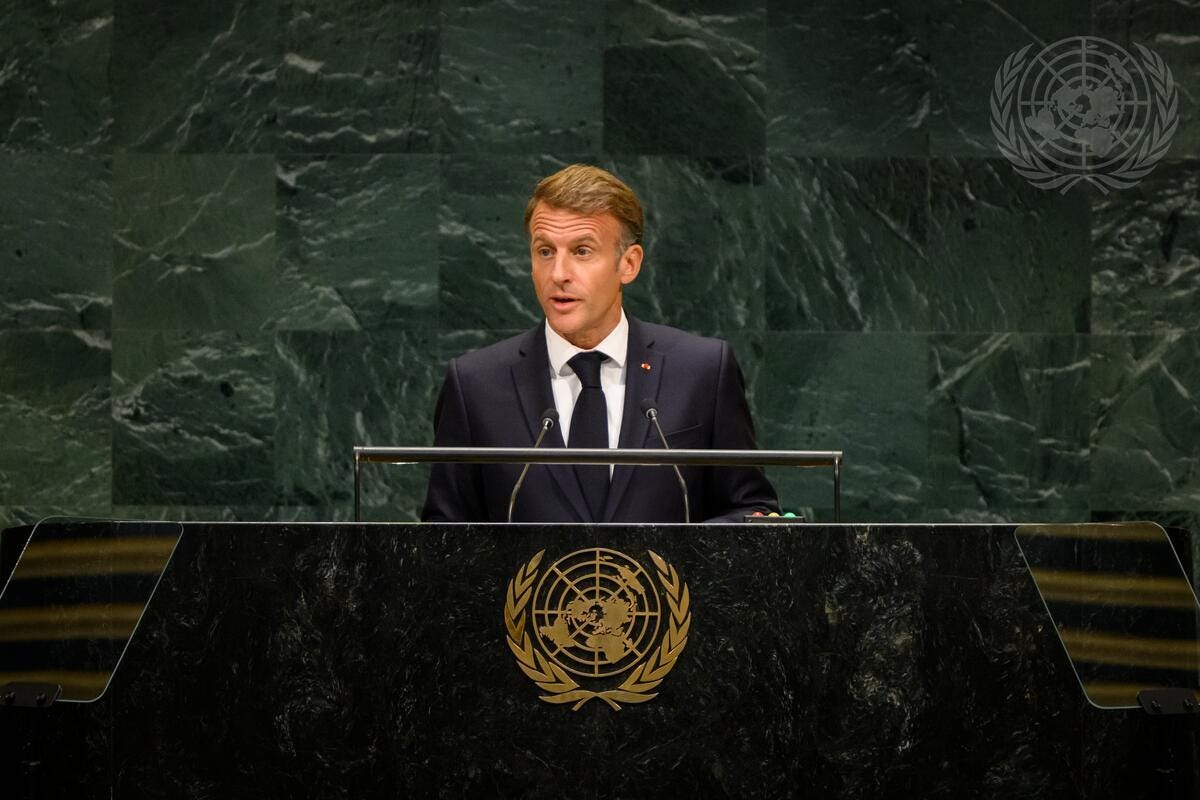
Emmanuel Macron, President of the French Republic, addresses the general debate of the General Assembly’s eighty-first session. (U.N. News)
It’s Wednesday, September 23, and in his last U.N. speech as France’s president, Macron chose to make a dramatic stand and deliver a statement the U.N. hadn’t heard in a full five minutes: Israel bad. The speech was in no way creative, original, or revelatory—except in the extent of French delusion.
Macron’s remarks were centered on what he called “the return of imperialism, of arrogance, the return of unrestrained force which knows no rules.” France has the first two in abundance but is incapable of the third; after all, there is nothing more imperialist and arrogant than explaining Israel to Israelis and nothing more restrained than its limp reaction to Iran closing the strait.
In defiance of the mountains of evidence and the experience of every Israeli, Macron insisted that “Hamas has never been very active in the West Bank.” What wonderful news. Perhaps the French president should call on the widow Meirav Shukrun and the six orphans created three days ago, to bring her the glad tidings that that the killers of her husband Netanel, a French citizen, don’t exist.
But his words do more than brush off the victims of Hamas’s terror; they lay bare the ideological point at the heart of a common approach to Israel. In an inversion of the infamous line from Orwell’s 1984, Macron-O’Brien is insisting to the world not merely that Oceania is not at war with Eastasia, but that Oceania was never at war with Eastasia. In that frame, the “violations” Macron claims are happening “day in and day out” in Judea and Samaria indeed have no cause and serve no purpose, because Israel is not at war with Hamas. The violation of the sovereignty of all of its neighboring states is indeed a “fateful error,” and the restriction of goods to Gaza is indeed “shameful” because Israel is not at war with Hamas.
Macron has stumbled onto the same sleight of hand those who accuse Israel of genocide have perfected: omit Hamas. Unfortunately for everyone in the region, and for the Shukrun family in particular, Eastasia exists, and it’s at war with Oceania.
Israeli security officials have been saying for months, on the record, that the Palestinian Authority is losing its grip on Samaria precisely because Hamas is growing stronger. Hamas in Gaza is smuggling in materials to rebuild its missile arsenal, and without Israeli action to tear Hezbollah out root and stem, it will devour Lebanon.
France, as Lebanon’s historical patron, should know better than anyone that ignoring a problem never solves it. Its absentee-parent approach let its charge slide into failed-state status while Hezbollah rose to a state within the state. And like an absentee parent, France prefers to reappear only once others have shouldered its responsibilities—to criticize, and to pretend it knows the way forward.
To be fair, insisting that Oceania is not at war with Eastasia is far easier than looking unblinkingly at the problems inside Palestinian society that make it incapable of becoming a partner for peace. Among them, but not limited to, the overwhelming popularity of Hamas and terrorism.
I am not claiming that Israel makes the wisest move at every turn. But when Macron asked whether we would rather “return to the law of the jungle, or in a civilized international society,” my answer is I would rather live in reality. Macron’s civilized society is a thin screen behind which Hezbollah runs rampant across Lebanon, Iran inches toward a bomb, and terror is politely declared not to exist. “Civilized society” is a luxurious illusion that countries who live without existential danger can indulge in. Israel lives, and has always lived, in the jungle, where it has been and likely always will be at war with terror.

Former Prime Minister Ehud Olmert and I in a special interview on my Hebrew podcast Listening Mode.
In a dramatic strike in September 2007, Israel destroyed a Syrian nuclear reactor at al-Kibar. That part people know. What they do not know—and what former Prime Minister Ehud Olmert revealed in a special interview—is that Israel might have missed the threat entirely were it not for one stubborn agent.
Her name was Anat. Fresh out of Mossad training, she made a strange choice: passing over Iran, the file everyone wanted, she asked for the Syria desk instead. The prevailing assumption was that Syria was yesterday’s enemy and Iran the real threat. Anat thought otherwise. She was convinced there was a nuclear program, and she meant to prove it.
“Stop confusing your mind,” one of her commanders told her. “We’ve already carried out two operations on Ibrahim Othman, and we haven’t discovered anything. There’s nothing; what do you want from us?” For her persistence she was rewarded with a disciplinary hearing—yet she stayed in the service, and eventually rose to a senior post. What saved her, on Olmert’s telling, was not vindication but Mossad chief Meir Dagan’s eccentric habit of pulling the people “who might tell me what others were not saying” into rooms well above their pay grade.
The rest is the story people already know, though Olmert filled in the details. The intelligence reached him in a meeting with Dagan, where, by his own account, he declared to his advisers: “There is a nuclear reactor in Syria, we will destroy it.” Roughly 2,500 people eventually knew Israel was watching the site, each one signing a declaration that a leak would trigger a Shin Bet investigation. Olmert held the sensitive meetings at his residence rather than the Prime Minister’s Office, precisely to keep the circle from widening by accident. George W. Bush’s line to him afterward, as Olmert remembers it: “The fact that it didn’t leak from you is a big deal. The fact that it didn’t leak from us—it’s a miracle.”
More revealing is where Olmert placed the reactor on his own scale of existential threats. October 7 and 1973 don’t qualify, he told me. “There is a difference between a few thousand Nukhba fighters and a nuclear bomb,” he said, arguing that a nuclear strike would have consequences “unlike anything we have experienced in our 80 years of existence.” He didn’t believe Assad would actually have used the weapon. “But it’s not a risk I can take.”
Olmert’s self-regard aside, the story carries a haunting parallel: a lone female voice in a skeptical establishment warns of imminent danger, only to be ignored and derided. In 2023, Anat’s role was played by the tatzpaniyot, the young women of the observation units—except their ending was the opposite of happy. Fifteen were killed at Nahal Oz in the attack they had warned of; seven were dragged into Gaza as hostages. The lessons of history, tragically, are seldom learned in time to prevent its worst disasters.
English Editor: Ari Tatarka
If you enjoy the newsletter, you can show your support by becoming a paid subscriber—it really helps keep this going. I’m also offering a special monthly briefing for a small group of premium members. I’d love to have you join us—just click below to find out more.
Thanks for reading It’s Noon in Israel! Subscribe for free to receive new posts and support my work.


"violation of the sovereignty of all of its neighboring states"
The evidently simple-minded President Micron was unable to say that Israel only violated the sovereignty of those states that are officially at war with it. Egypt, Jordan, UAE did not experience any violations of sovereignty by Israel.
Likewise, in WW2 the US and Great Britain only violated the sovereignty of states like Germany that were at war with them. Not that Micron would know anything about that since France threw in the towel early on and whimpered the rest of the war in cowardice.
Macron may have been brilliant as a young man but, then again, so was Nietzsche, until his brain snapped in middle age and left him an imbecile for the rest of his life. History repeating itself.
Ehud Olmert at least gets a star for the action he took against Syria's nuclear intentions.