It’s Noon in Israel: Military First Protestors Second
Also, Tucker Carlson's coming to Israel, Iran knew about the IDF strike ahead of time, and more.
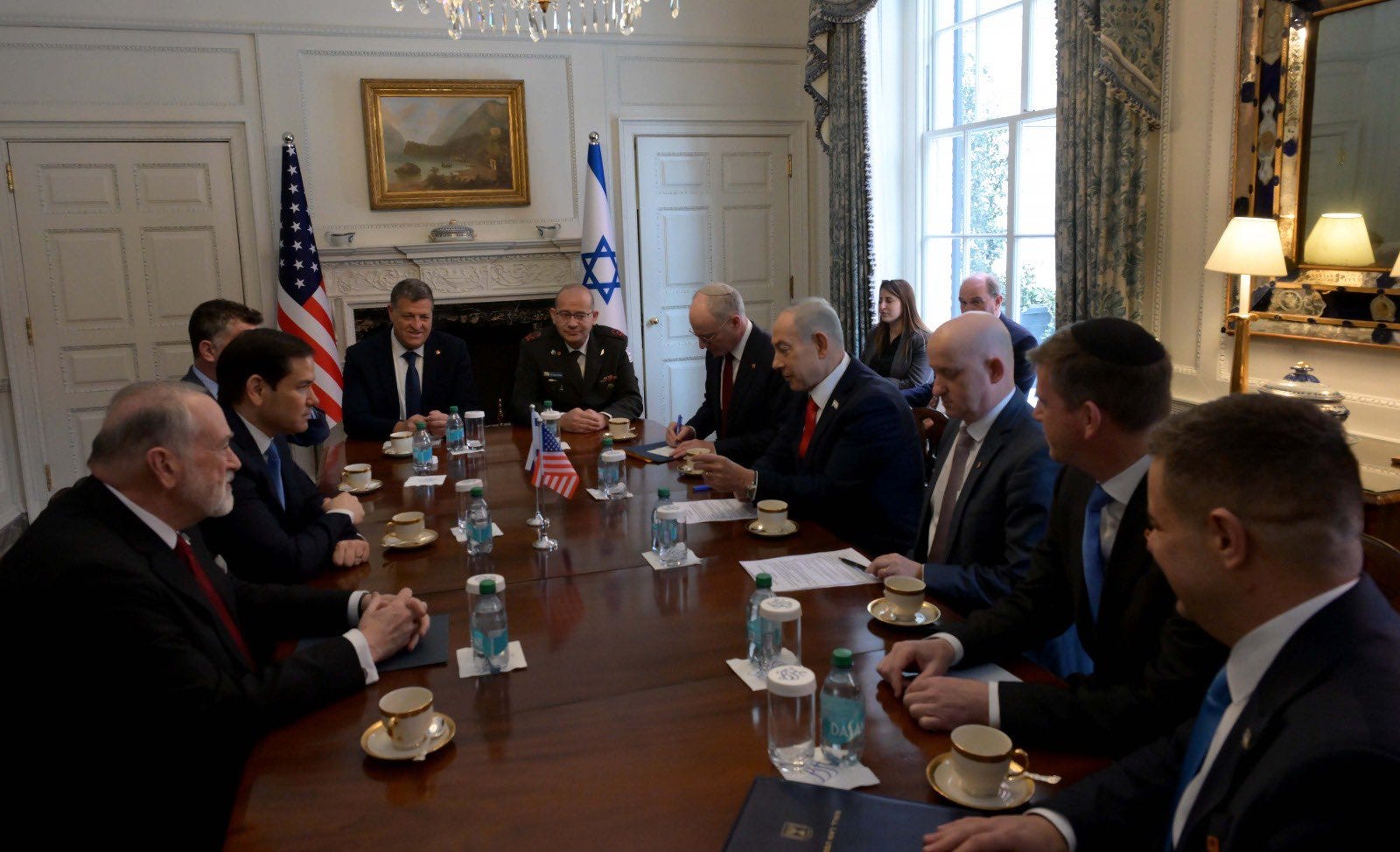
Benjamin Netanyahu meeting with Secretary of State Marco Rubio in Washington yesterday. (@netanyahu/X)
It’s Thursday, February 12, and Donald Trump and Benjamin Netanyahu’s meeting ended with Iran’s military as the diplomatic target. But what about the protesters?
Trump’s position appears to be America First—which means Iranian protesters second.
On the bright side, Trump is not interested in reviving Obama’s nuclear deal. But he also doesn’t seem to be seeking a regime declaration of surrender. His demands are threefold: end ballistic missile development, halt support for regional proxies and abandon the pursuit of nuclear weapons. The protesters, it seems, are a negotiating tactic.
That approach would explain Vice President J.D. Vance’s recent comment: “If the Iranian people want to overthrow the regime, that’s up to them.” The rest of the sentence is implied: “without U.S. support.”
That wasn’t the plan all along.
A month ago, the stated objective was to stop the regime from killing protesters. Now, with both the regime and the protesters perceived as significantly weakened, the focus has shifted: strip Iran of any weapons that threaten U.S. interests and let the Iranians sort out the rest.
That doesn’t mean Trump is neutral. If negotiations lead to the regime’s collapse, all the better. But that is no longer the goal.
So how did Bibi react to the shift?
I can’t imagine he was too distraught. Israel is far more invested in regime change than the U.S., but it will accept military castration if that’s what’s on offer. Still, I doubt he wanted to leave the meeting with that order of American negotiating priorities.
But don’t forget the other player: Iran. The regime is still fiercely clinging to its no-concessions-except-nuclear narrative, while continuing to incite against America in the streets. As I wrote last week, it is possible the ayatollahs are simply incapable of making concessions on any of these issues.
If they aren’t going to make a deal, Trump’s priorities will shift.
Tucker Carlson speaking to the Anglican Archbishop of Jerusalem, Hosam Naoum, in Jordan last week. (Screengrab used in accordance with Section 27a of the Copyright Law)
Israel has faced many difficult decisions over the past two and a half years of war; whether to allow Tucker Carlson into Israel was not one anyone expected. In the end, the government is allowing him to visit. Yes, seriously. Carlson is coming to the country of the Jesus-killing “hummus eaters.”
This comes a week after his anti-Israel trip to Jordan.
During his interview with the Anglican archbishop of Jerusalem in Jordan last week, Carlson sidestepped the archbishop’s point about Israel’s protections for Christian rights to focus instead on sporadic flashpoints. After lavishing praise on Jordan’s treatment of Christians, he pivoted to a familiar riff:
“How are Christians in the Holy Land doing? Are they thriving or are they suffering? And the truth has become pretty obvious over the past couple of years, which is, in Israel, they are not thriving.”
The claim doesn’t hold. Christian numbers in Israel have grown more than in any other country in the Middle East—from roughly 34,000 in 1948 to about 185,000 in 2024. That’s an increase of more than 440 percent.
If I’m being charitable, the point he may have been trying to make is that Christians have declined as a share of the population. But that’s largely the product of people like Tucker. Without the antisemitism he and his kind peddle, Israel’s Jewish population might not have had to grow from a total of 600,000 in 1948 to over 7.2 million today.
But let’s focus on Israel’s dilemma.
Option A: let Carlson in and pray the handful of radical Christians he finds don’t say something too bad. Option B: block him and give him a multiyear investigation into “What are the Jews hiding?” Israel chose A, and I can’t blame them. Carlson is like an antisemitic funhouse mirror; no matter how you approach him, he will make you look bad.
But honestly, I’m confused. I thought Tucker prefers visiting places like Russia and Iran—you know, countries that are actually guilty of war crimes.
Israeli fighters launching to intercept Iranian missiles in June 2025. (@iaf/X)
Iran knew about the Israeli first strike in June and did nothing? According to Finance Minister Bezalel Smotrich, Hezbollah spotted Israeli aircraft at the outset of the operation and warned Tehran—apparently to no effect.
At an activist conference yesterday, Smotrich revealed:
“The plan was for our missiles to hit at 2:00 in the morning, giving the planes a few hours to get there. At 23:30 at night we received intelligence that Hezbollah saw the planes and gave an alert to Iran.”
Despite apparently knowing, Israel managed to eliminate most of Iran’s senior nuclear scientists, the heads of the IRGC and take out most of the air defense in the opening salvo.
So what happened?
The regime may have hit the dictator’s dilemma: plenty of warnings, but nobody wanted to be the guy who tells the guy with all the power—and a gun—the bad news.
Alternatively—and less plausibly—Iran may have known and simply been unable to do anything in response. Targeting the Iranian air force was never going to deter Israeli F-35s, and shifting air defense assets on a two-hour timeline with neglected infrastructure is exceedingly difficult.
If they knew and did nothing, it’s probably because they didn’t grasp how deeply Mossad had penetrated every arm of the Iranian state. Israel’s intelligence feats in Iran were more spy fiction than reality, and it’s unlikely there was an Iranian Ian Fleming ready to predict that every senior officer and scientist was being tracked—or that an Israeli-run drone factory was churning out munitions inside Iran.
It is possible. In the 1973 Yom Kippur War, Israel was surprised by the Syrian and Egyptian attack, not when the tanks began to move but 10-hours before. The defeats on the Golan Heights and the Sinai that followed were because that simply wasn’t enough time to prepare.
The parallel with Iran isn’t coincidental. Israel vowed never to be caught flat-footed again. That resolve—renewed after the failure October 7—meant giving Tehran, at most, two hours to prepare.
One IDF reservist and a civilian have been indicted for allegedly using classified information to bet on Polymarket, pocketing hundreds of thousands of shekels. After a lengthy investigation, prosecutors charged the pair with serious security offenses, bribery, and obstruction of justice.
This is the dark shadow of the political-betting boom. Of course someone was going to build markets on “What will Trump do next?”—but that opens Pandora’s box to the deadliest form of insider trading. This pair are not the first to be suspected of leaking intel for prop bets; one anonymous user made off with $410,000 after predicting the unexpected capture of Nicolás Maduro.
The Israel Defense Forces is the country’s most trusted institution; that’s why scandals in the ranks detonate instantly. If ordinary political corruption eats away at public faith, financial corruption tied to classified operations is twice as deadly.
That’s not mentioning the security risk. If this spreads, Iran won’t need Hezbollah’s warning; they’ll just check the app.
If you enjoy the newsletter, you can show your support by becoming a paid subscriber—it really helps keep this going. I’m also offering a special monthly briefing for a small group of premium members. I’d love to have you join us—just click below to find out more.


About the surprise in the Yom Kippur War, I had read that, as you suggest, Israel in fact knew that something was coming but that Golda Meir bent to the U.S. demand not to preempt or even mobilize during that window lest this rather basic move at deterrence be seen as a “provocation” - sort of a “blame the Jew” argument giving Egypt and Syria a free pass. As a result, the IDF was essentially frozen in place, leaving its front lines undermanned.
Kissinger’s strategy seemed to be a confidence that Israel would ultimately prevail but would, along with Egypt and Syria, seek a diplomatic resolution to the conflict and, more importantly given this was during the Cold War, welcome these Arab states into the West’s anti-Soviet coalition.
That explains the arms surge to Israel - that all European countries except Portugal denied overflight and landing rights to - and required Nixon’s personal intervention to overrule Secretary Schlesinger’s interference and slow walking of the arms shipments.
Ultimately, Sadat did kick out the Soviet advisors but was horrified at Carter’s decision to have an international conference with the Soviets as a key party. To block that, he famously reached out to Begin (with, as I recall, Walter Cronkite playing a role). That led to the visit to Israel and, two years later, the Camp David Accords.
That’s my memory of it all, plus reading sources. It doesn’t make it true, but at least it’s a coherent narrative on the known facts.
You're exactly right; Israel was in a no-win situation with respect to Tucker Carlson. He despises Israel, and he clearly doesn't exactly love Jews in general. Yet, barring him would ironically have given him exactly what he wanted.