Money Can't Buy Qatar Love (or Peace)
Doha’s $12 billion bribe to Tehran won’t buy its way out of Donald Trump’s forced normalization trap.
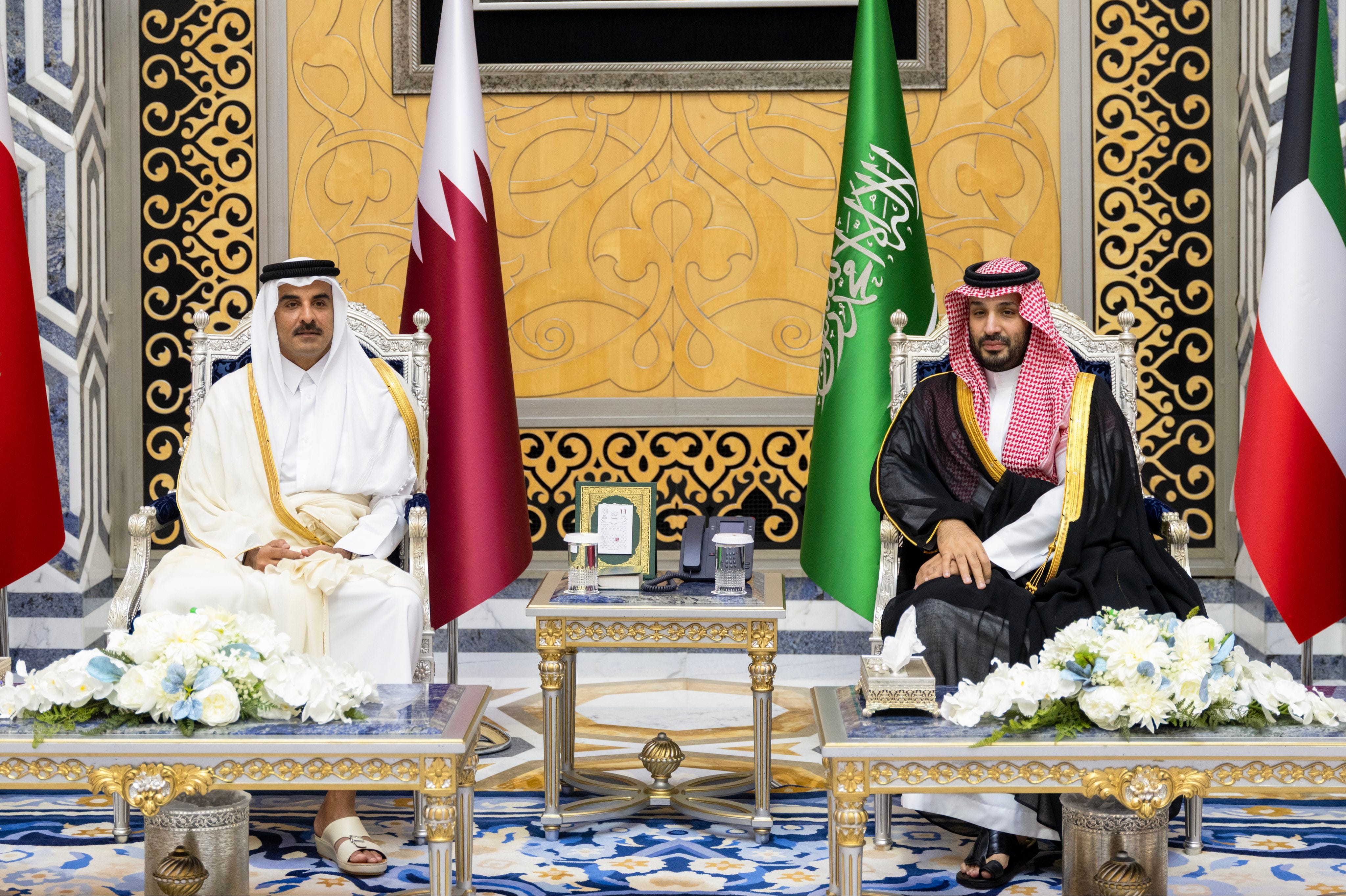
Qatari Emir Tamim bin Hamad Al Thani (left) and Saudi Crown Prince Mohammed bin Salman (right) sit together at a formal Gulf summit in April 2026. (@TamimBinHamad/X)
It’s Tuesday, May 26, and imagine you are a small country surrounded by larger, far more aggressive neighbors. You have one distinct advantage: trillions of dollars in oil and gas wealth. What do you do with it? You could buy a massive army, but you lack the population to staff it. You could pay off larger powers directly, but that relies on their financial interests permanently outweighing their strategic ones.
So instead, you buy influence. You make yourself so structurally vital that the geopolitical cost of destroying you becomes prohibitively high. You build the region’s largest news network. You cultivate backchannel contacts no one else has. You make yourself completely indispensable by offering neutral ground to sworn enemies, and you host massive American military bases to physically anchor your security. Congratulations. You are Qatar.
But what happens when that meticulously crafted influence isn’t strong enough to stop a war? Suddenly, you realize that all the money in the world cannot intercept a missile once it’s launched.
That’s the question facing the small Gulf state today. The foundation of its power—its natural resources—was physically crippled by the same actors it thought it had bought off. Iranian strikes slashed Qatar’s export capacity by 17 percent; the physical damage alone is projected to vaporize an estimated $20 billion in annual revenue. Unlike Saudi Arabia and the UAE, which have alternative pipeline infrastructure to bypass the Strait of Hormuz, Qatar is geographically trapped, with no way to route its remaining resources. Its entire export model has been severed for over two months. For a state where hydrocarbons make up 60 percent of total revenue (compared to the UAE’s 40 percent), this is catastrophic.
Worse, the war has simultaneously derailed Qatar’s attempt to build a post-hydrocarbon economy. For years, the state aggressively pursued a diversification strategy focused on tourism, international business, and high-end finance. That model relied entirely on the perception of regional stability to attract foreign capital and sustain a massive expatriate workforce. With missiles flying, that perception has shattered, triggering an exodus of multinational corporations. The IMF is now predicting an 8.6 percent contraction for the Qatari economy this year, and the long-term outlook remains grim. It is hard to muster much sympathy. Qatar spent decades paying off the region’s most dangerous radicals, assuming they could safely play with fire from behind the walls of a five-star hotel. Now, the hotel is on fire.
Thrust into a reality where they are functionally powerless, the Qataris faced two options: pour their remaining resources into permanently eliminating the Iranian threat, or desperately hedge and promote a diplomatic solution in an attempt to restore the status quo ante, returning to an ecosystem where they can resume their role as the ultimate middleman.
Qatar has opted for the latter.
According to my sources, Doha is offering Iran a $12 billion “loan,” ostensibly earmarked for humanitarian purposes, as a sweetener to persuade Tehran to accept the current U.S. ceasefire deal. Let’s be clear: this is neither humanitarian nor a loan. It is a straight bribe. The Iranian regime is teetering over an economic chasm. Even if the U.S. lifts the blockade on Iranian ports, Tehran remains completely insolvent. Without a massive infusion of cash to act as a liquidity bridge, the regime will fall into the abyss. Qatar is stepping in to ensure they survive, providing the cash Iran needs to sign the deal regardless of whether Washington unfreezes Iranian assets.
This is hardly a new strategy for the Gulf microstate. During the war, Qatar offered $6 billion—funds effectively belonging to the Islamic Revolutionary Guard Corps—in a direct bid to convince Tehran to halt its strikes on Qatari infrastructure. Truth be told, a $12 billion bribe is simply good economics; if it restores shipping through the Strait of Hormuz, the return to regular revenue will make that cost a rounding error.
Donald Trump boards Marine One on the South Lawn of the White House
But Donald Trump does not do favors for free. As he bluntly stated yesterday:
“After all the work done by the United States to try and pull this very complex puzzle together, it should be mandatory that all of these countries, at a minimum, simultaneously, sign onto the Abraham Accords.”
This demand has Doha sweating. Qatar had just pivoted back to its comfort zone—hedging and buying off adversaries—and now Trump is threatening to cement them explicitly into an anti-Iran axis. Unlike its neighbor Saudi Arabia, Qatar has no domestic “Arab Street” to worry about; its historical barrier to normalization has always been strategic and ideological.
Trump’s demand also exposes a glaring question for Israel: is this any way to build a relationship? After all, no one wants friends who only hang out with you because their parents forced them to. The entire experiment depends on the inner calculus of these alleged partners. Do they genuinely want to know Israel but require a parent’s mandate as cover to justify the relationship to their peers? Or are we just getting a room full of resentful, foot-dragging children?
For Israel, the question is this: will this be Egyptian or an Emirati normalization?
Upon arriving in Egypt, the first Israeli diplomatic delegation was abruptly evicted from their hotel under the guise of a sudden wedding, though the true cause was quiet pressure from local authorities. Relegated to a derelict substitute, ironically named The Dreamers, the delegation quickly saw their hopes for a warm cultural exchange evaporate. According to the first delegate, stifling security was placed around the eventual Israeli embassy, deliberately to signal that Israelis were unwanted and to show the public “the segregation of the loathsome.”
Cairo got exactly what it wanted—a Cold War realignment with the U.S.—while discarding what it didn’t want: civilian, economic, or tourist ties. That dynamic held until Egypt’s desperate thirst for natural gas changed the math. But even after Israel stepped in to keep the lights on in Cairo, the relationship remains ice-cold. Today, there are typically a mere 4 to 8 direct flights a week to Egypt. Contrast that with the UAE, which boasts 160 to 180 flights a week from Tel Aviv, making it the third most popular destination for Israelis behind Greece and the United States. If Saudi Arabia signs the paper, will they just pocket Trump’s diplomatic dividend and walk away like Egypt, or will they build bridges like the UAE? What Israel wants from normalization is friends, not non-hostile enemies.
For the Gulf, Trump’s demand exposes the fundamental question at the core of their strategic calculus: Palestinians or Persians? October 7 and the ensuing Gaza war massively inflated the weight of the Palestinian issue. However, Operation Epic Fury and the crippling Iranian blockade have caused a massive, rapid appreciation in the Persian threat. Ultimately, this binary is a dilemma for Saudi Arabia to solve. Qatar has historically bypassed the choice altogether by simply funding the worst elements of both. Now, however, Doha may face an entirely different dilemma: alienate the superpower guarding their front door, or infuriate the beast at their back window.
All of this, however, assumes a U.S.-Iran deal will actually materialize—a prospect that, despite Trump heralding a breakthrough, remains deeply uncertain.
The two sides are fundamentally at odds on the most important issue: nuclear enrichment. Iran has publicly refused to surrender its highly enriched uranium stockpiles or halt enrichment, consistently framing any U.S. demand for zero enrichment—or even a return to the 3.6 percent limit of the JCPOA—as an absolute red line. This makes Trump’s vow that the new agreement won’t be “anything like the JCPOA” particularly awkward to navigate. While Washington has reportedly dangled sanctions relief in exchange for the HEU stockpile, mediators told The Wall Street Journal over the weekend that Tehran is delaying, holding out for upfront, ironclad guarantees regarding its frozen assets before making any nuclear commitments.
A U.S. sailor observes a commercial vessel while enforcing the U.S. blockade against Iran. (CENTCOM/X)
Then there is the Strait of Hormuz. Tehran demands management over the waterway, while Washington insists on absolute freedom of navigation. The Iranian Foreign Ministry has attempted to rebrand its proposed transit tolls as “protection” or “environmental” fees, despite the fact that taxing an international waterway is blatantly illegal. Iran is the only power actively threatening civilian shipping in the Strait. This demand is less about maritime preservation and more akin to a mafioso dragging a baseball bat across a shopkeeper’s counter, demanding a premium to protect the merchandise from himself.
That brings us back to Qatar, safely back in its comfortable seat mediating between the West and terrorists. As Iranian negotiators arrive in Doha, Secretary of State Marco Rubio confirmed that talks are continuing, but Washington’s ultimate ultimatum remains set: it will be a good deal, or no deal at all.
My take: Qatar is always going to be Qatar. Their entire geopolitical identity is built on paying terrorists, and right now, their economic survival depends on buying a ceasefire. But given Tehran’s maximalist demands, Trump may quickly find this “historic” deal far less enticing than he projected. Furthermore, the prospect of forced Gulf normalization may prove to be a mirage. Even if Washington extracts some light commitment from the Saudis or Qataris, normalization doesn’t happen overnight and the process offers ample opportunities to add conditions or renege entirely.
English Editor: Ari Tatarka
If you enjoy the newsletter, you can show your support by becoming a paid subscriber—it really helps keep this going. I’m also offering a special monthly briefing for a small group of premium members. I’d love to have you join us—just click below to find out more.
Thanks for reading It’s Noon in Israel! Subscribe for free to receive new posts and support my work.


