MoU 2?
Also, Israel's greatest security threat.
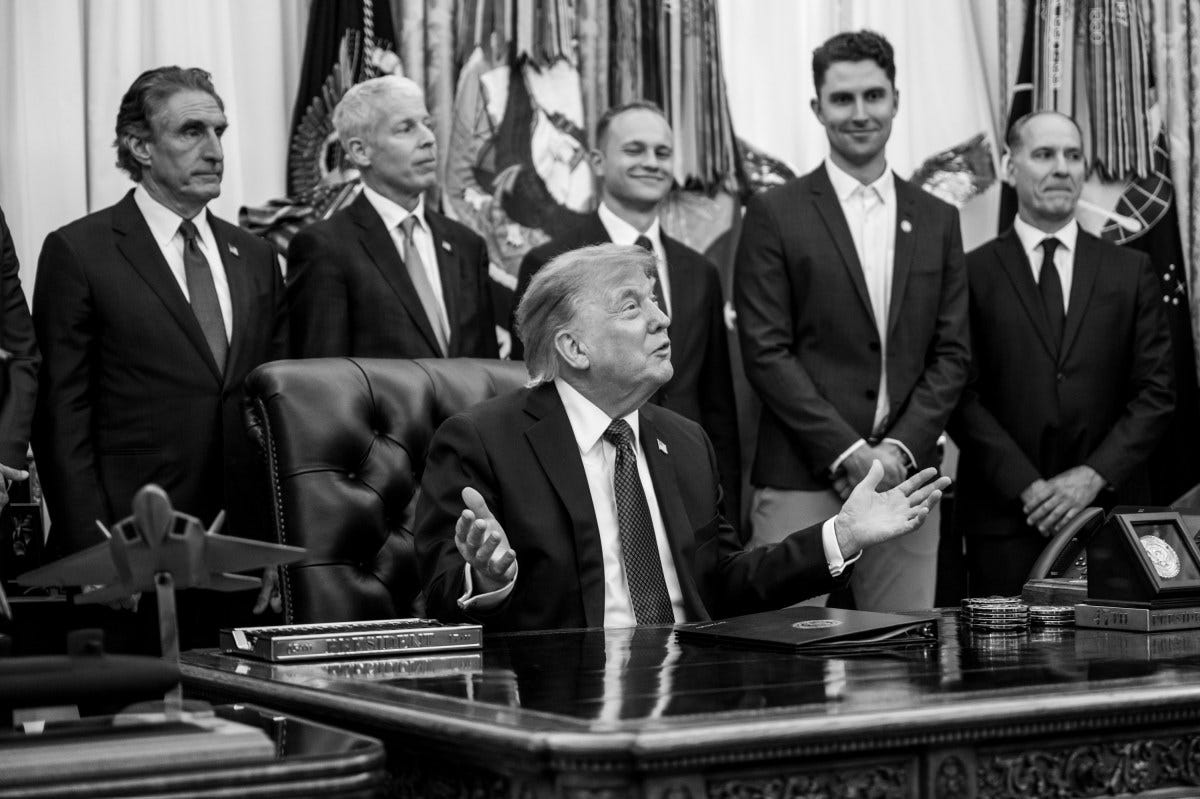
Donald Trump makes an announcement on American nuclear innovation. (White House)
It’s Sunday, August 2, and Donald Trump has called off a major attack on Iran because “the perimeters of a deal had been agreed to”—one that would open the Strait of Hormuz and end Iran’s nuclear threat. The phrase about “fool me once” comes to mind. I’m just not sure yet who should feel shame.
Before sorting the candidates, let’s examine the deal.
The attack meant for this weekend was to be the coup de grâce—a large joint U.S.-Israeli strike on the one area that has enjoyed immunity so far, Iran's energy infrastructure. Now, perhaps, it won't be needed. Resting on Trump’s declaration alone—a reopened Strait of Hormuz and a denuclearized Iran—the deal amounts to near-total victory.
I’m skeptical. Two weeks was floated as all that remained of April’s bombing campaign, but the two weeks since strikes resumed have been light by comparison—too light to have forced the Islamic Republic into its first diplomatic defeat. More likely, Trump is running a Beetlejuice strategy: summoning the terms of a deal into existence by saying its name enough times.
According to officials cited by Channel 12, Iranian Foreign Minister Abbas Araghchi agreed overnight to a compromise proposal drawn up by Qatari and American mediators to reopen the Strait. Under it, vessels entering the Gulf through Hormuz would transit Iranian waters; those leaving would transit Omani waters. It resembles an Omani proposal built on “voluntary transit fees or tolls” that Iran rejected three days ago for failing to “address Iran’s concerns.” The concern likely being that Iran wanted 100 percent of the Strait, not 50.
So far Oman has signed on to this newest iteration, but wants to know whether Araghchi’s consent also speaks for the Revolutionary Guards. Qatari mediators are still working with Tehran to ensure it does, likely with cash in hand.
Still, one should remember that before the war, traffic crossed freely between the two coastlines. If the compromise is that both the Iranians and the Omanis now impose tolls, we are further from freedom of the seas and closer to legitimizing Iran’s hold on the Strait.
Which brings us to the first candidate for being fooled a second time: Trump. If the president is conjuring a deal from thin air, the reason is plain: he bit off more than he could chew. As with his April threats of civilizational destruction, he has grasped that his latest promises of escalation were unlikely to bring the Republic to heel, and is hunting for an offramp that still points roughly where he wants to go. If this is de-escalation by any means necessary, then he has indeed been fooled a second time, and the shame is his. Then again, Trump might have learned caution from the MoU’s death, and so far he has said nothing about loosening the blockade or unfreezing assets.
Worth remembering here is a senior Israeli intelligence official’s estimate that, should the economic pressure hold, the Islamic Republic would not survive 2026. That was before the MoU and the several-billion-dollar reprieve the regime banked in the interim—yet he remains confident that a few more months would be enough to burn through those limited funds.
In which case, the one fooled may be the Islamic Republic. A standing blockade and a half-share of the tolls won’t begin to cover its deficit. And if it imagines Trump’s signature will shield it from American bombs the next time it fires on the Strait, it should find sturdier shelter. Then again, the other provisions of this agreement—an end to the blockade potentially among them—have not been forthcoming. As Trump used to say, “Iran has never won a war or lost a negotiation.”
The most likely candidate is us if we take Trump’s words on faith. After the oceans of ink spilled on clauses 7 through 9 of a now-binned deal, we should hesitate to treat another bargain between a fundamentalist regime and the most fickle president in memory as carved in stone. Otherwise, the shame is on us.
An explosive drone launched by Hezbollah is seen near the Israeli border with Lebanon during a Hezbollah attack in northern Israel, May 19, 2026. (Ayal Margolin/Flash90)
“So when will we eliminate the drone threat?” Chief of Staff Eyal Zamir was asked when Hezbollah was hitting IDF soldiers in southern Lebanon daily. He looked at his questioner with a pitying gaze. “Roughly around the time we eliminate the anti-tank or missile threat.” Zamir and Shin Bet chief David Zini believe the drone’s arrival on the battlefield is comparable to the tank’s arrival in World War I. “A weapon that showed up in the first campaign will be there in the second, the third, and until further notice.”
There is a common thread linking the steps the IDF is taking in the security zone, the holding of the Cabinet meeting at a secret location, the takeoff of “Wing of Zion” to Washington from IAF Nevatim Base of all places, and the mysterious trickle of reports about aircraft downed on their way “from the east” toward Israel—“their origin still being examined.” The common thread is the understanding that a battered Iran, stripped of its proxies, has found a possible way to reset the equation. Drones taking off from southern Lebanon are the only weapon in Hezbollah’s arsenal that has caused real loss of life. Why wouldn’t they try the same thing from Gaza, and above all from Judea and Samaria?
Iranian agents were hired en masse, but not a single one succeeded in getting close to senior figures in Israel. What if this time a swarm of drones crashes onto an officers’-course graduation attended by the prime minister, the defense minister and the chief of staff?
Zini is very worried about such scenarios, and it is fair to say that the drone danger sits at the center of his concerns these days—and it is not as if he is short on concerns. The polarization and division in Israeli society have bred deep suspicion toward the Shin Bet chief’s assessment about the inability to hold Netanyahu’s court testimony in the courtroom, for fear of Iranian missiles and drones. Here is a more fundamental question: why wouldn’t the logic of an aerial-strike threat apply to any public appearance at a time and place known in advance? During the dark years of containing Hamas in Gaza, a ban was placed on senior officials’ visits south of a certain line in the country. It should be no surprise if the same soon happens with every appearance by a prime minister: the beacon-lighting ceremony, a Ben-Gurion memorial, a tour of Ichilov Hospital. Take your pick. Holding this week’s Cabinet meeting at a secret location is only the trailer.
For decades the IDF has fought the rocket and missile threat on every front, doing everything in its power to block the leakage of the technology into Judea and Samaria. You can swap out the floppy disk (and floppy disks, in general, are worth getting rid of): rockets are out, drones are in. Why bother with an expensive, cumbersome system when you can easily smuggle, through the air, hundreds of tiny drones that do enormous damage?
That is exactly what happened from the Egyptian border, when drones came from Sinai into Israel and from there to Gaza bearing contraband. Like the old Soviet joke: for 20 years a man crossed the Soviet border with a truck full of sand, while the border guard sifted the sand every day and never found anything smuggled. After the guard retired, he ran into the driver by chance and begged to know what he had really managed to smuggle under his nose all those years. The driver smiled at him calmly and answered: “Trucks.”
This is an excerpt from my weekly column in Israel Hayom
English Editor: Ari Tatarka
If you enjoy the newsletter, you can show your support by becoming a paid subscriber—it really helps keep this going. I’m also offering a special monthly briefing for a small group of premium members. I’d love to have you join us—just click below to find out more.
Thanks for reading It’s Noon in Israel! Subscribe for free to receive new posts and support my work.


The whole thing is just ridiculous. Trump looks like a fool. He must know that Iran will sign anything and then do whatever they want. Is this about midterm elections? Most of us are just fed up. It’s like just do it already. Enough with the deals. Trump says there’s a deal and Iran says there isn’t. It’s just dumb and foolish on his part.
Trump is a chump. I predict, unfortunately, that he will leave office with Irans nuclear program intact, in control of the straight of Hormuz, and more motivated than ever to exact revenge. Which a radical Marxist neo-Democrat President will be more than happy to accommodate.