


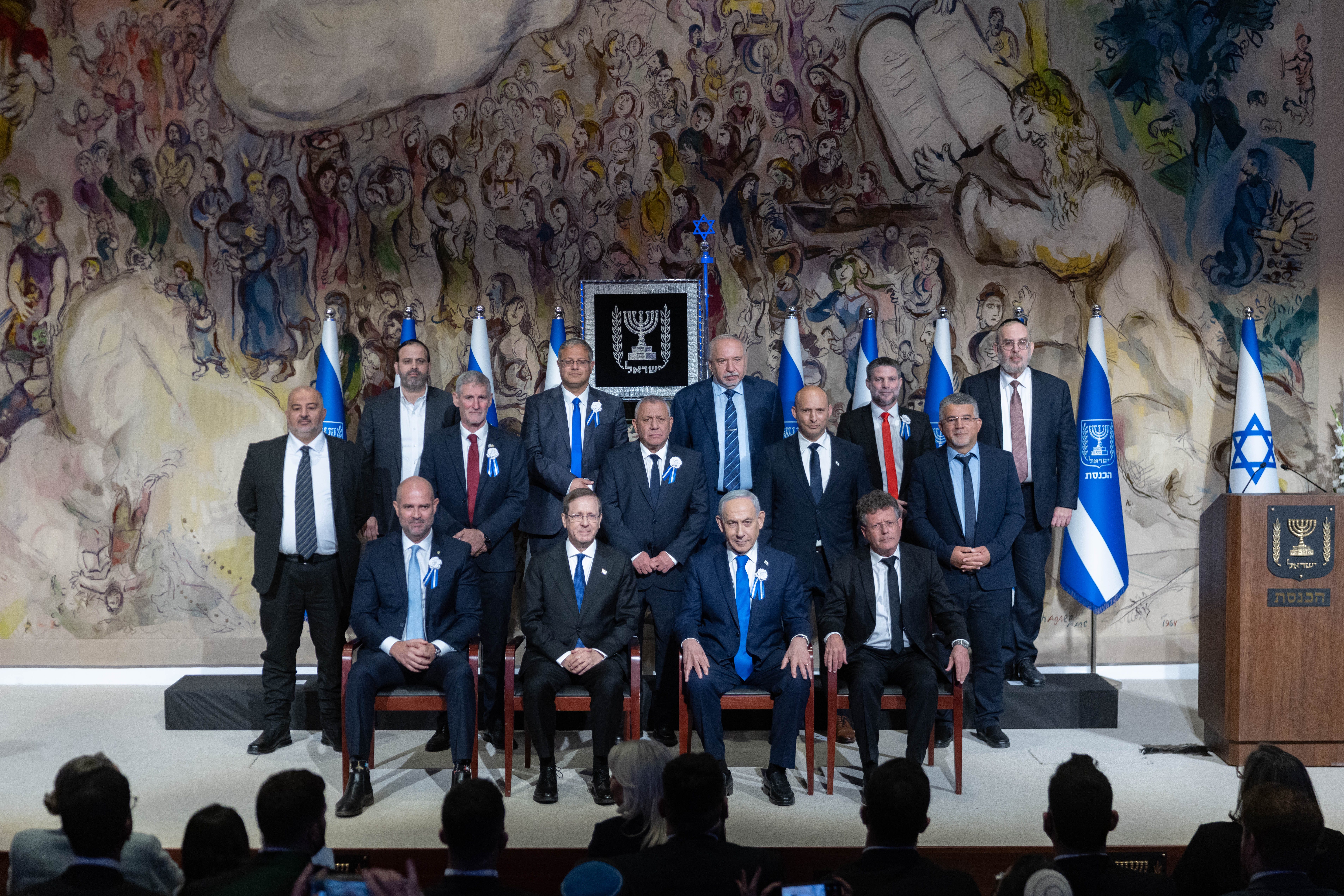
Faction leaders pose for a group photo following the swearing-in of the 26th Knesset at the Knesset in Jerusalem, November 10, 2026. (Chaim Goldberg/Flash90)
It’s Wednesday, November 11, and the group photo from yesterday’s swearing-in ceremony of the 26th Knesset reminds me of a wedding photo. One in which the parents are divorced, the children are estranged and two of the cousins weren’t invited but showed up anyway.
The ceremony itself didn’t diverge much from the formula.
It started off well. The entire plenum rose in a standing ovation when, despite the pain, newly elected Likud MK Elisha Madan, who lost both legs fighting in Gaza, stood on his prosthetics to take the oath of office.
Yet the goodwill was short-lived.
When Joint List chairman Yousef Jabareen stood to take his oath, Itamar Ben-Gvir shouted across the plenum, asking whether he was pledging allegiance to Hamas. After the MKs had pledged allegiance and Hatikvah began, the entire Joint List left the plenum rather than stand for the national anthem, prompting yet more yelling.
Ra’am Chairman Mansour Abbas stayed, as did United Torah Judaism’s Yaakov Asher. Testifying to their agnostic Zionist credentials, the two stood side by side without joining in the song.
Democrats MK Gilad Kariv found his own moment to storm out after Knesset Speaker Amir Ohana used his speech to declare that there could be no cooperation with anyone who spreads blood libels against Israel’s soldiers or calls the Jewish people invaders in their own land, a thinly veiled jab at Kariv’s own party leader, Yair Golan, and the Arab parties.
Still, the mood in the Chagall Hall reception was almost cordial. The family patriarch, President Isaac Herzog, had opened the ceremony with a plea to the plenum to do everything possible to avoid a repeat election, and after the numerous flare-ups tensions had relaxed.
With the Joint List’s walkout during Hatikvah still fresh in everyone’s mind, this was Benjamin Netanyahu’s moment to press his advantage: make the case that a shaky government propped up by anti-Zionists or draft dodgers was absurd when a more compatible partner was standing right in front of them.
Instead, Netanyahu delivered a wartime address at a wedding.
It began well. Netanyahu pleaded for the divided house to “put aside every other consideration and establish a national unity government.”
Then he turned on his prospective partner’s other suitors. He called Ra’am and the Joint List “supporters of terrorism who hate Israel.” He dismissed Mansour Abbas’s moderation, saying the two parties differ only over what state should rise “on the ruins of the Jewish state,” conveniently forgetting his own brief affair with the Arab leader in 2021. He even spared a few words for the Haredi cousins, warning them that the new suitor would promise them the world, but that a minute after a government with the left is formed, “all the promises will evaporate.”
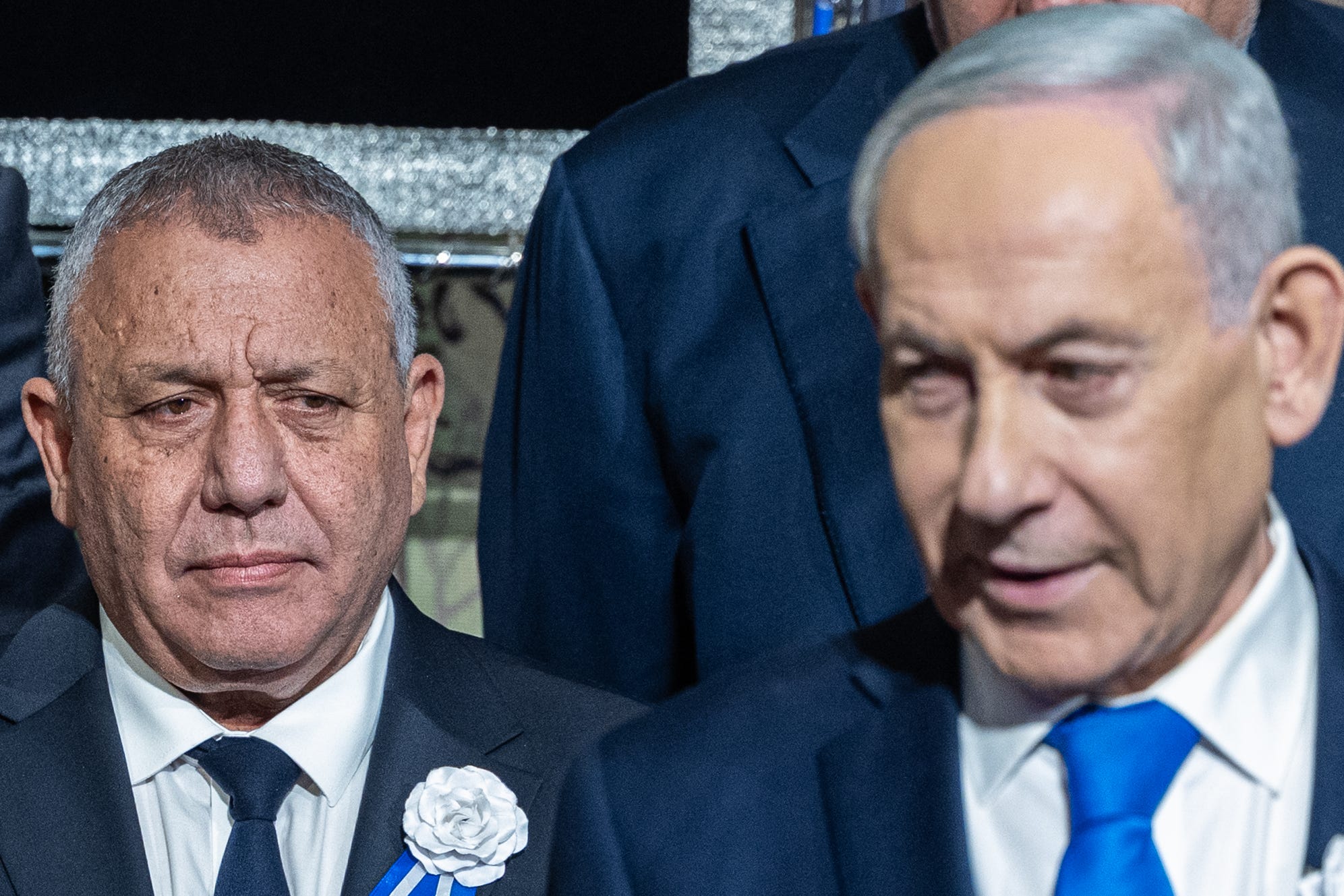
Prime Minister Benjamin Netanyahu and Yashar party leader Gadi Eisenkot at a ceremony following the swearing-in of the 26th Knesset at the Knesset in Jerusalem, November 10, 2026. (Chaim Goldberg/Flash90)
Like a poorly delivered toast, Bibi’s speech did more harm than good.
Gadi Eisenkot was infuriated by the “deranged, divisive, hate-filled and shameful speech” and canceled the next day’s negotiations with Likud. Naftali Bennett didn’t wait for the speech to end. Seated in the front row, he broke his post-election silence by heckling the prime minister mid-toast: “What about your Qatari advisers? What about October 7?” Netanyahu pressed on without answering. After the ceremony, Avigdor Lieberman quietly updated his social media cover photo, removing the slogan “End of Haredi rule.”
Now the flowers are wilting, the guests have all gone home and the hall is littered with half-empty glasses of white wine. What’s left?
This morning, Mansour Abbas offered a hint to Radio A-Shams: “a cooperation between the ultra-Orthodox parties and Ra’am, with a parliamentary safety net provided by the Joint List.”
It seems Bibi succeeded in creating a unity government.
The prospect of the whole family sitting at the same table appears slimmer than ever. But who knows? Family is family.

Israeli tourists look at a BDS stand with photos and Palestinian flags, calling to 'Free Palestine,' at Dam Square in central Amsterdam, Holland, June 24, 2016. (Hadas Parush/Flash90)
At this point, just the word “sanctions” with no greater context is enough to make most Israelis flinch. But for once, the news is good. Just not in the way it first appears.
On November 9, 13 Republican state attorneys general, led by Iowa’s Brenna Bird, sent a letter to the British and Dutch ambassadors in Washington, demanding that the two countries “rescind or halt implementation of the recently enacted trade sanctions against Israel or any component of Israel.” The measures in question are London’s new sanctions regime on settlement goods and services and the Dutch ban on settlement products that took effect in September.
Before we get to the bad news, let us briefly bask in the all too rare warm noise of support for Israel.
The attorneys general accuse London and The Hague of having “aligned themselves with the policy objectives of terrorist organizations like Hamas and Hezbollah.” The sanctions, they argue, “reflect a misguided attempt to control the domestic policy of another sovereign nation,” and Europe “would never tolerate a similar effort” aimed at itself. Then come the threats. Many of the signatories’ states have laws against doing business with companies that boycott Israel, so British and Dutch firms that comply with their own governments’ bans could find themselves shut out of state contracts and state pension portfolios.
Here’s the problem: by January, seven of the 13 signatories will be out of office, and four of their states will have Democratic attorneys general. Even if the remaining six carry the torch, the great wealth of Arkansas, Mississippi and Montana is unlikely to sway UK Foreign Secretary Ed Miliband. If economic pain moved him, he wouldn’t have sanctioned Israel in the first place. And if being a national embarrassment did, he’d have retired years ago.
Yet the letter has a second addressee: Vice President JD Vance. The day after the bluenami, Vance published his post-mortem, a four-point list of why Republicans lost, in which Israel featured, in one form or another, three times. The vice president seems convinced that the road to the White House runs through the cesspits of Tucker Carlson and online antisemitism.
Thankfully, many Republicans disagree. Several will likely challenge him for the nomination, and 13 more have just taken aim at the enemies of what they called “our closest ally in the Middle East.”
English Editor: Ari Tatarka
If you enjoy the newsletter, you can show your support by becoming a paid subscriber—it really helps keep this going. I’m also offering a special monthly briefing for a small group of premium members. I’d love to have you join us—just click below to find out more.
Thanks for reading It’s Noon in Israel! Subscribe for free to receive new posts and support my work.


I am seeing a groundswell of support for Marco Rubio in 2028, because of his experience dealing with world powers, especially Israel. JD Vance is the candidate of anti-Israel bigotry and is being exposed by his association with biblically ignorant politicians. America First cannot stand against Israel, our closest ally. So hold on, my Jewish friends. We are many, we are growing, and we stand with Israel. Pray that Hashem will guide us in these dark times to His light and love.
Bravo, Amit. I saw a copy of the letter only 13 of our brave States' Attorney Generals wrote & sent off to those ambassadors. If only more people would write to leaders & their staffs expressing righteous anger over boycotting Israel. In April 2009 I wrote a 2-page letter in French to then Pres Sarkozy thanking him for banning the burka & protecting women in France. One month later I received his two-page letter thanking me. I knew France's climate was not going to last, but I still treasure that encounter. Some of the reasons people do not engage are because of hopelessness, laziness and ignorance. And that is why many of us know we are in The Last Days. Praying unceasingly for Israel, for the lost to know and accept Adonai Yeshua and waiting to hear His call of 'Come up here!' - Bo, Yeshua, Bo! Am chai Ysrael <><