Netanyahu's Art of the Deal
Also, Israel becomes the U.S.'s safest base, and we dance again.
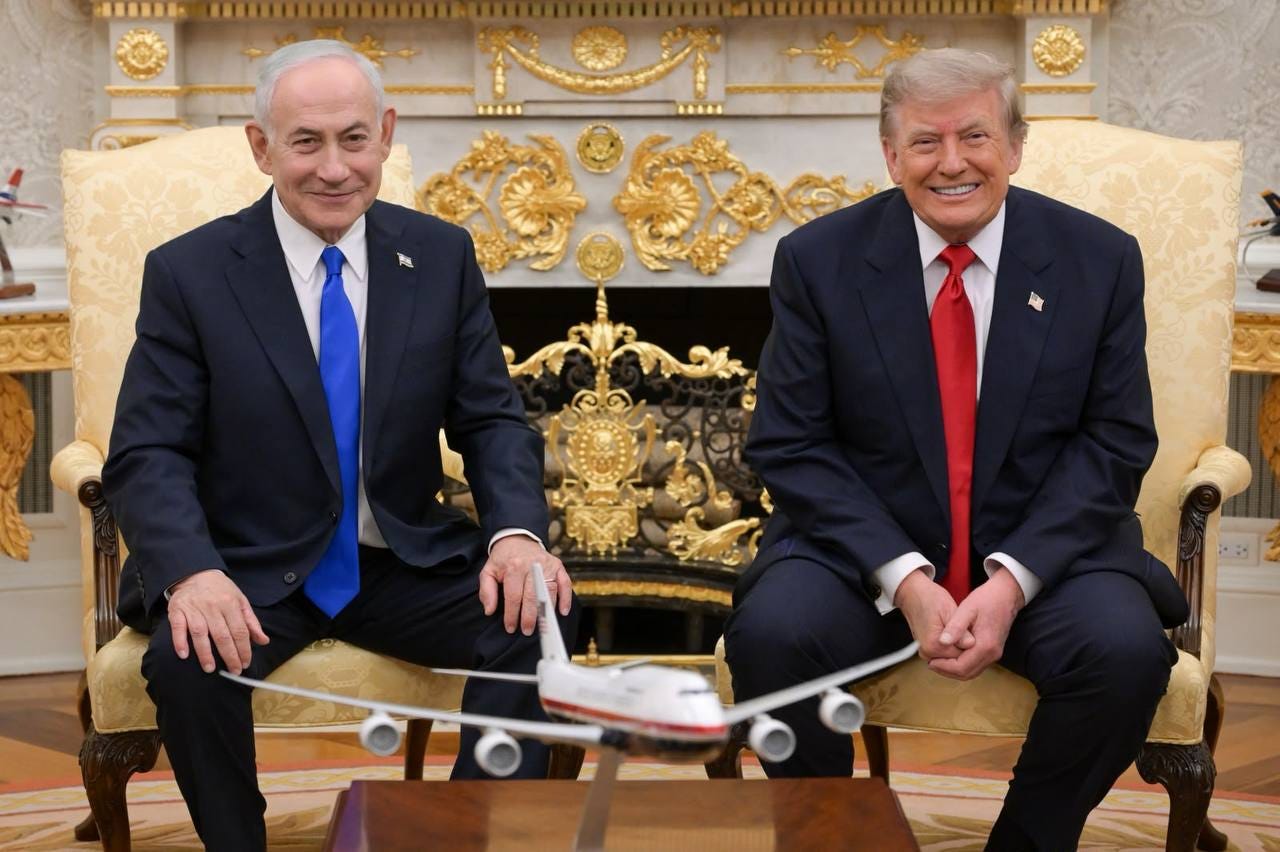
Donald Trump and Benjamin Netanyahu meet in the White House yesterday.
It’s Wednesday, July 29, and Netanyahu’s meeting at the White House was “excellent,” by his own account—“one of the best we’ve ever had.” The White House kept it terse, calling the talks positive and productive. But were they?
Those attempting to augur the future from these few words will come away with little. “Positive” and “productive” are used to describe virtually every meeting Trump has ever had, while the outcomes have varied wildly.
Better than asking what he received, it may be better to ask what Netanyahu requested.
My guess is close to David Makovsky’s, of the Washington Institute for Near East Policy. Netanyahu almost certainly did not fly in to talk Trump out of his preference for diplomacy and into renewed war; he assumes the regime will torpedo the diplomacy on its own. As Makovsky put it, this was “more of a Plan B meeting than a Plan A meeting.”
Instead, Netanyahu can spend his more limited capital with the president laying the groundwork for what happens once Iran scuttles Plan A—whether the next move is renewed economic pressure or, if it comes to it, kinetic action. The bonus is that he avoids the near-impossible task of forcing Trump into anything, least of all abandoning a “deal”—especially with Vice President J.D. Vance inches away. Rather than push, better to guide.
He also had no one-on-one time with Trump, and in a wider room I suspect he was extremely careful with his words. Even the February meeting—held quietly in the Situation Room—was leaked in such detail that it anchored a considerable chapter of Maggie Haberman and Jonathan Swan’s recent book on the Trump administration. Netanyahu has to assume it could happen again. He doesn’t want to hand Tucker Carlson a single quotable line—though a shortage of evidence has never slowed that kind of speculation, and certainly won’t if Trump decides on war.
Meanwhile, Iran launched a surprise ballistic missile attack on American forces in Jordan—every missile intercepted—hours after the meeting, and its first such strike since Trump paused his campaign on Friday to let diplomacy breathe. Unlike the last barrage on Jordan, this one is a show of weakness.
Until now, Iran’s attacks on U.S. bases were retaliation—answers to strikes on Iran. After a few days of quiet, it has restarted the cycle unprompted. The logic is simple. Both sides are running out of time, but on different clocks. Iran’s runs on resources; Trump’s—whatever the reports of munitions shortages suggest—runs on patience. Iran can afford to lose resources if the spending drains Trump’s patience faster. Quiet slows his clock. Silence is Iran’s worst enemy.
That is also why Netanyahu is not pushing for another military campaign. Such a campaign would drain Trump completely—and if the regime survived, as it is certain it would, then even amid the rubble it would have won. Iran thinks it can out-stubborn Trump. Netanyahu is working around that bet rather than trying the strategy himself.
Netanyahu is still playing for the grand prize, regime collapse. He has simply concluded that another military campaign may no longer be the way to get there.
US Air Force Boeing KC-135 Stratotanker aerial refueling aircraft are parked at Ben Gurion International Airport near Tel Aviv. (Chaim Goldberg/Flash90)
U.S. Secretary of State Alexander Haig famously called Israel “the largest American aircraft carrier in the world that cannot be sunk.” Yesterday, Defense Minister Israel Katz confirmed the carrier isn’t merely unsinkable—it goes unfired upon.
Speaking to Channel 14, hours before Netanyahu slipped through a White House side door, the minister revealed that American fighter jets, bombers and refuelers have been operating from Israeli air bases to strike Iran in recent weeks. And the best part? “The Iranians know.”
For the past few weeks Iran has been hammering Kuwait, Jordan and Bahrain for the apparent crime of aiding operations against the Islamic Republic. Israel was spared the chaos—seemingly because it kept its hands clean. Katz just revealed it hasn’t. Turns out Iran is simply too scared.
That is a complete inversion of the classic American role in the region. For decades the U.S. presence in the Gulf was the deterrent—the thing that made striking Riyadh or Abu Dhabi unwise. Now the American presence draws fire onto its allies, while Israel’s presence shields the Americans.
It is also a repudiation of Washington’s classic approach to the region. For years the instinct was to restrain Israel—to reassure the hostile regimes that they were firmly on the leash. Brandishing Israel as a threat was thought to antagonize the very governments America wanted to court, and to alienate everyone else. Turns out the opposite is true: a bad cop frothing at the mouth gives the good cop room to work. Israel wants to hit Iran’s energy infrastructure; Washington won’t allow it. Iran takes the good cop’s strikes without responding directly—because it knows who waits behind him, eager to join.
Few things could better advertise stronger U.S. cooperation with Israel than Iran’s hesitancy. During the war Israel invited the United States to relocate some of its regional bases onto Israeli soil. Israel offers the region’s best air defense and a military that can help the U.S. repel threats rather than watch them from the runway. Washington has been pulling squadrons and tankers out of the exposed Gulf bases and into Ben Gurion and Ramon, and is reportedly weighing whether to move its Bahrain, Kuwait and Saudi operations into the Negev outright.
Still, there are other considerations. The U.S. does not want to find itself based exclusively in Israel. Beyond the geographic inconvenience, Washington has no wish to inherit Israel’s own predicament—diplomatically isolated from most of the neighborhood. Bases scattered across other countries buy the U.S. access, but they also reassure the hosts.
It’s been just over five months since U.S. fighter aircraft first touched down on Israeli soil. At the time it looked like America coming to Israel’s defense. In the long term, it may turn out to have been the reverse.
Thousands attend a Nova Tribe party in Tel Aviv in memory of the victims killed by Hamas at the Nova festival on October 7. (Chaim Goldberg/Flash90)
Nearly three years after the October 7 massacre, the Nova community is launching a new concert series, “NOVA Live Concert.” For the first time since that fateful morning, the survivors, including all those taken hostage, will appear together at a single event.
The series follows “We Will Dance Again,” the mass gatherings at Tel Aviv’s Yarkon Park that drew tens of thousands. This time, the Nova community and the company are building a different format, weaving together electronic music, trance, rock and Israeli mainstream through one-off collaborations between artists sharing a single stage.
The organizers describe the project as another step in the community’s healing, framing music as the language that has always bound it together—a space of memory, connection and resilience rather than mere entertainment.
Personally, I’m not much for large festivals—but it’s hard not to be moved. Living in the modern state of Israel, one is forever caught in the air of the fulfillment of biblical prophecy. No less moving is the fulfillment of a far more recent vow, every bit as prophetic: We will dance again.
English Editor: Ari Tatarka
If you enjoy the newsletter, you can show your support by becoming a paid subscriber—it really helps keep this going. I’m also offering a special monthly briefing for a small group of premium members. I’d love to have you join us—just click below to find out more.
Thanks for reading It’s Noon in Israel! Subscribe for free to receive new posts and support my work.


Thank you for helping me understand whats going on and how to make sense of it. We will dance again is the most moving motto I could possibly come up with. So it was more or less like always when I read your piece: concern, smiles and at one point tears in my eyes. Thank you for keeping us posted ☺️🙋🏼♀️ and: I recomend Phillips P OBrien`s Newsletter … a different perspective, and (still) a good one.