It’s Noon in Israel: No Matter What Iran Will Say No
Also, Israel's milk wars heat up, and mourning the loss of a legendary pioneer.
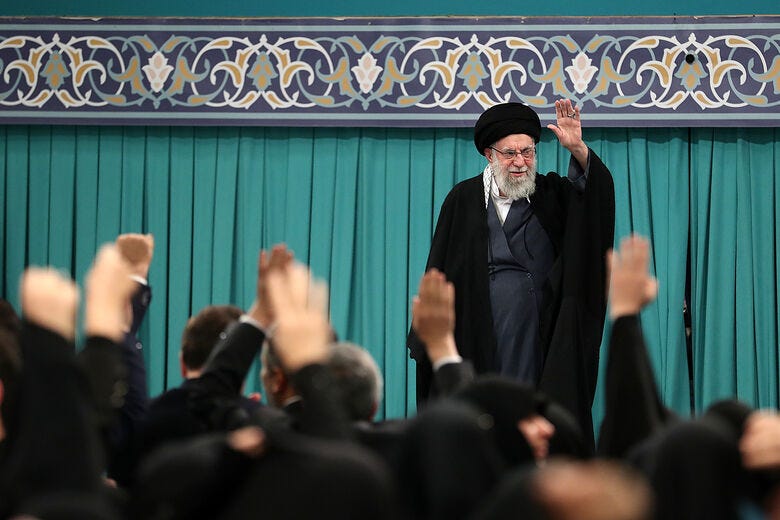
Ali Khameni meets supporters in January 2026. (Leader.ir)
It’s Wednesday, February 4, and let’s address the elephant in Donald Trump’s negotiation room: Are the Iranians even willing to make a meaningful deal? The answer is no. The regime is brittle—it will break before it bends.
But that begs the question: Why does the Trump administration—specifically U.S. Special Envoy Steve Witkoff—think they will?
During Witkoff’s meeting with Benjamin Netanyahu last night, he was briefed by senior intelligence officials that Iran has no intention of compromising on its nuclear ambitions, and that negotiations are being used to buy time before a U.S. attack. But no matter how many times they tell him, I don’t think it’s enough.
As Nadim Koteich points out in his excellent analysis, it isn’t just Trump and Witkoff’s real estate-inspired love of deals that’s driving the optimism. The error is one almost every Western leader makes by mistake—and economists concede as unavoidable.
They assume actors are rational.
Let’s look for a moment through the eyes of an economist:
The regime has suffered economic collapse, the thorough embarrassment and delegitimization of the June War, the destruction of its crown jewel—the nuclear project—and a bloody rebellion on the scale of the 1979 Iranian Revolution. And now it is presented with a deal that offers a chance at survival. From an economist’s perspective, agreeing is the only logical step.
But here the flaws of economic models and the chess-like approach to foreign policy emerge. They can never account for all the complexities and pressures of human systems.
Let’s start with Koteich’s first point, the theological time bomb Ali Khamenei is sitting on. The ayatollah has spent his life fleshing out the architecture of an Islamic divine right to rule—his doctrine of “Absolute Guardianship.”
It is entirely possible that Khamenei has drunk his own poisoned Kool-Aid and is convinced against concessions due to a divine inspiration in his mind. It is also possible he’s afraid of how well the precarious and controversial tower of Islamic rulings would endure an earth-shaking concession to the “Great Satan.”
His predecessor, Ruhollah Khomeini, managed to survive the blow of the negotiated end to the theologically charged Iran-Iraq War. In his words, he drank from the “poison chalice”—but that was after a national revolution and a harrowing war. Taking a similar sip today could be fatal.
But that’s not all.
Koteich also points out that the nature of dictators doesn’t speak in favor of concession. Totalitarian states live and die by the whims of the dictator, who very often kills the messenger. That results in Khamenei’s reality being filtered through sycophants and yes-men. He doesn’t want to see domestic opposition, so in his reports, protesters yelling “Down with the dictator” become an entirely American import. After 47 years of distortion, it may be unlikely he can return to reality enough to make concessions.
Now let’s step back from the monarch and look at the palace guards: the Islamic Revolutionary Guard Corps.
You may be under the impression that the IRGC opposes concessions for ideological or security reasons. But that assumes they are just a military organization—when they are so much more. The IRGC runs a “state within a state,” controlling about 40% of Iran’s GDP through monopolies across sectors including construction, finance and, most of all, oil.
If Witkoff demands the basic hallmarks of accountable government—transparency, banking normalization, and the rule of law—it presents a fatal threat. Koteich argues that if he demands the dissolution or distancing of the Iranian state from the Guard, that would be even more existential. The Guard and the regime are co-parasites feeding on the Iranian people, locked in a symbiotic relationship. One goes and the other will follow.
And it’s not like history gives the regime any reason to change course. Perestroika (restructuring) and Glasnost (openness) didn’t save the Soviet Union—they only accelerated its dissolution. Koteich argues that Khamenei has been presented with a crossroads: be like the progressive Soviet leader Mikhail Gorbachev and ignite a reform-led disintegration—or to act like Gorbachev’s predecessor and attempt a slow descent into collapse. Khamenei seems to have chosen the latter.
If he has, the task for the U.S. isn’t preparing an acceptable deal—but managing the inevitable decline and collapse of the regime.
Finance Minister Bezalel Smotrich. (Knesset.gov)
You shouldn’t cry over spilled milk—but should you abandon your principles over it? That’s the question being asked in Israel as Finance Minister Bezalel Smotrich attempts to strip back government control of the milk industry.
That’s right—the Israeli government controls the milk industry. It’s been more than 40 years since Israel’s once-dominant left wing dropped socialism from its platform, but you wouldn’t know it if you walked into a supermarket. Walk over to the milk aisle, and you’ll spot three or four varieties and a sign that limits your purchase to a few cartons—that is, if the shelves aren’t empty.
In Israel, the state’s control over milk is near total. It decides who can produce it, how many liters they’re allowed, and the price they can sell it for—while keeping foreign competition out. I’m lactose intolerant, but I imagine it gives the product a distinctly Soviet flavor. The centralized framework is a relic of Israel’s early socialist days, and milk isn’t the only product still under government thumb. Salt, eggs, certain breads—and until recently, butter—are all still regulated.
It’s worth noting that most of Israel’s successful economic policies of the past 40 years have involved the disposal of these artifacts and the unraveling of the strangling ropes of socialist regulation. But old habits and vested interests die hard—especially when they’re finding new allies.
Smotrich’s push to liberalize the dairy sector was inevitable. Israelis weren’t going to tolerate chronic, twice-yearly shortages forever. The resistance was also expected: dairy producers weren’t going to let go of a stable, protected market without a fight. What was less expected was the support they’ve received from lawmakers in the once-capitalist party known as Likud.
To be fair, that characterization of Likud may be too simplistic. Large political parties are often big tents. The difference in Israel is that each big tent is stamped with the face of its leader and their security policy. If that’s who you support, you’re in. When no other litmus test is required, economic positions were inevitably going to diverge.
The low standards, plus an electoral system that benefits medium-sized special-interest parties, is how Israel ends up in the bizarre position of sections the supposedly right-wing ruling coalition supporting socialist policy—and sitting with Haredi parties whose entire purpose for existence is to increase government payouts to their community. Meanwhile, the “right-wing” coalition’s opposition—such as Naftali Bennett and Yair Lapid, are proposing major economic reforms.
Nearly fifty years ago, Likud broke the Labor movement’s socialist monopoly on Israeli politics. Today, it’s defending a milk monopoly. What they say about people is also true of political parties: they either die on principle—or live long enough to become populist.
Yocheved Gold in an interview with Toldot Yisrael. (Screenshots used in accordance with Section 27a of the Copyright Law)
Last week, Israel lost a legend. So here is the story of woman who defied Hitler, witnessed Kristallnacht, helped settle the Negev, and survived the Hamas onslaught of October 7.
Yocheved Gold, born in 1923 in Halberstadt, Germany, slipped into the 1936 Berlin Olympic opening ceremony and was asked to hand flowers to Hitler. “Should I, a Jewess, give Hitler flowers? I did not agree,” she later said. She watched Nazism rise and begin its terrible reign—walking past shops smashed and graffitied, and synagogues desecrated.
In 1939, she escaped to Palestine and built a new life from scratch.
She moved with her husband to the dangerous border with Gaza, helping found Kibbutz Sa’ad, and becoming its nurse—with no formal training. Through four wars, countless fevers and scrapes, and personal loss, she remained. She finally stepped back from work at the age of 90, able to boast: “I am the oldest and most veteran in the kibbutz.”
It was far from easy. She lost her husband to illness in 1961 and a daughter in a tragic accident. Still, she cooked for the kibbutz, told stories and kept showing up.
On October 7, she was in her home near the strip, spending 30 hours in a shelter with her son before being evacuated to temporary accommodations near the Dead Sea. True to her iron spirit, she told her family: “I’m not ready to die in a hotel. Bring me home—and if I die, I die there.”
She didn’t die there. She returned to the kibbutz and spent two more years at home, reaching the age of 102—leaving behind children, grandchildren, great-grandchildren, great-great-grandchildren and a very proud country.
If you enjoy the newsletter, you can show your support by becoming a paid subscriber—it really helps keep this going. I’m also offering a special monthly briefing for a small group of premium members. I’d love to have you join us—just click below to find out more.


may yocheved’s blessed memory live on forever!