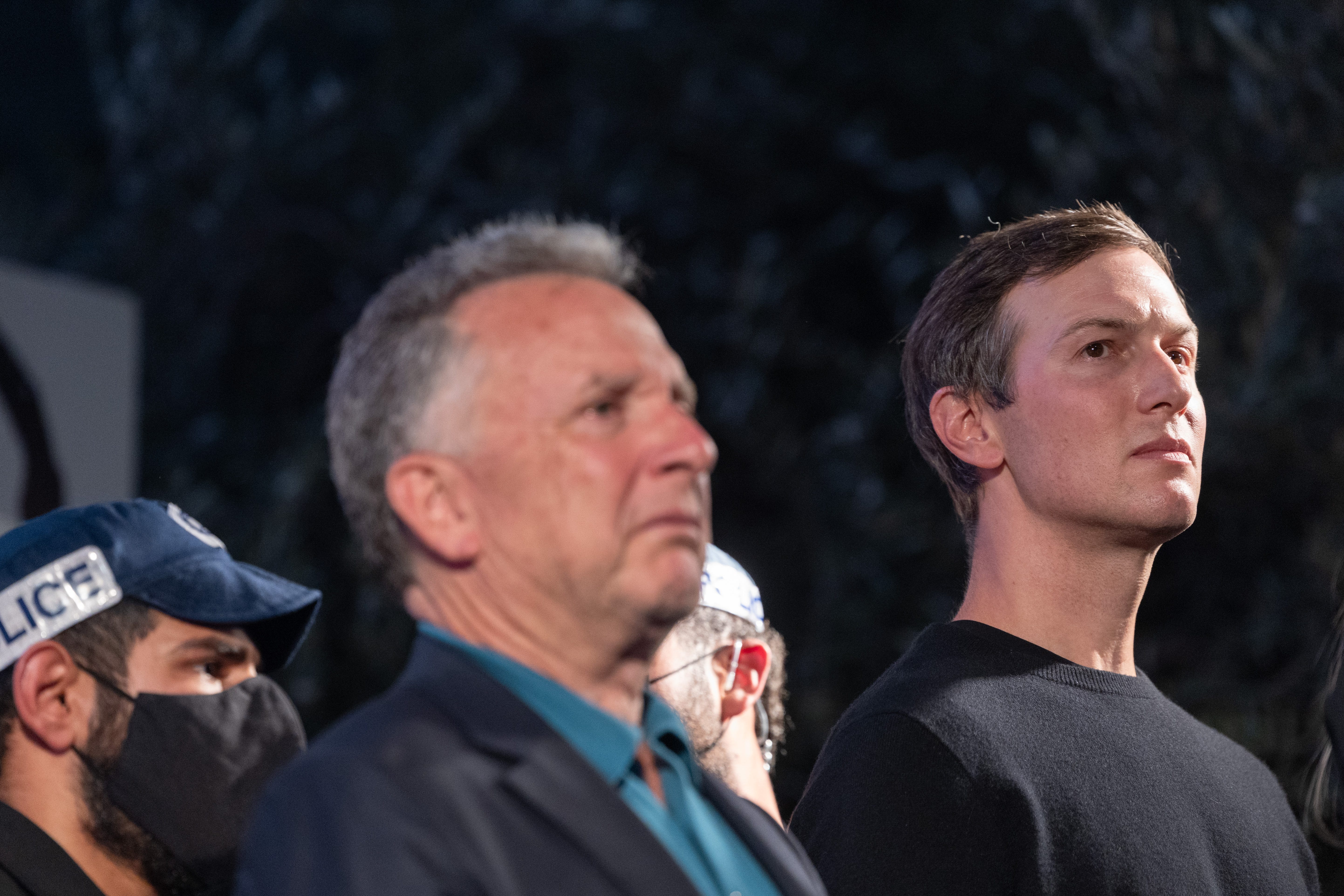
US Middle East envoy Steve Witkoff speaks at the weekly rally at Hostage Square in Tel Aviv, October 11, 2025. (Chaim Goldberg/Flash90)
It’s Sunday, August 30, and over the past year the Americans have talked with almost every lowlife in the Middle East. The Iranians are like the don of the crime family. Hamas is his debt collector, way down at the end of the chain, on some street in New Jersey.
While everyone fixates on the dons, the Americans are once again talking to the debt collectors. On the face of it, Hamas got a big prize: Jared Kushner met with senior figures of the murderous terror organization that murdered and kidnapped dozens of Americans on October 7. The Americans have an answer: last year we met with them to extract 56 hostages; now—the kidnapped Gaza Strip itself.
We’re not as naive as you think, they keep repeating. Time and again we said Hamas will have no weapons and no control over the Strip. The means matter less to us than the end. People forget the meetings with senior Hamas figures, they say. And in the same breath they note that a very, very senior figure in the defense establishment spoke directly, by phone, with the heads of the Nazi organization during the negotiations to free hostages. Why is it permitted for you and not for us, they say.
In Israel people are appalled at the thought of Qatar and Turkey being involved in the Strip. Contrary to what the opposition says, the two hostile states won’t send soldiers into the Strip. But their very presence on the oversight council—the body meant to determine whether Israel is meeting the agreement or not—is untenable, practically and morally.
Most of Israel’s concerns were laid to rest after some back-and-forth with the Americans. What remains is the fear that the international body, instead of demilitarizing Hamas, will separate the IDF from Hamas and effectively constrain Israel’s movements in the Strip.
At the White House they’re angry with Benjamin Netanyahu, but they’ve fallen in line with most of his demands. Trump himself has, for months now, pointedly refrained from declaring support for him in the election. But his people are preparing a victory image for Likud: a handover of weapons in the Strip, into American hands, before the elections. The payment, in the form of a partial withdrawal, will be on credit—after the ballot boxes close.
This is an excerpt from my weekly column in Israel Hayom.
Yair Netanyahu, son of Israeli Prime Minister Benjamin Netanyahu, arrives for a court hearing on his request for a restraining order against Haaretz journalist Uri Misgav at the Jerusalem Magistrate’s Court in Jerusalem, July 15, 2026. (Chaim Goldberg/Flash90)
“Iran targeted one of my sons. Iran tried to kill, to murder one of my sons,” Netanyahu told Channel 14 two weeks ago. Yesterday the Shin Bet confirmed that “there was a significant threat to harm Yair Netanyahu, and in light of this and after an assessment, a decision was made to urgently extract him along with his security team and return him to Israel.”
The prime minister’s elder son had been living in Hallandale Beach, north of Miami. According to Newsmax—which broke the story citing a U.S. law enforcement source—Israeli intelligence learned in December 2025 that Iranian operatives were “on the ground” in the Miami area, watching his residence and his routine. He was told to leave at once. The Shin Bet pulled agents from President Isaac Herzog’s detail—he was in New York at the time—and moved them to Miami to run the snap operation.
Yair had been signaling something himself. Last month he told a Jerusalem court he had changed his name to “Yonatan Hun” over a “serious security problem,” and that the new name had already surfaced on Iranian channels.
The frightening part is not that the regime wants to kill a prominent Israeli. It is that it attempted to do so on U.S. territory. For over a decade the United States has been the theater for an Iranian campaign of assassination and abduction—most of it run through the IRGC, most of it aimed at Americans.
It was not until 2011 that the intelligence community abandoned its working assumption that Iran would not strike inside the United States. That year a Quds Force operative, Manssor Arbabsiar, tried to hire a Mexican drug cartel to bomb the Saudi ambassador inside Café Milano, indifferent, by his own account, to the other diners the blast would have taken with him. Then-DNI James Clapper told Congress the plot showed that Iranian officials, perhaps as high as Supreme Leader Ali Khamenei, had “changed their calculus.” Since then, the Washington Institute’s Matthew Levitt counts 27 such plots on American soil.
In 2022 the Justice Department charged IRGC member Shahram Poursafi with trying to pay $300,000 to have former National Security Adviser John Bolton killed in Washington or Maryland, plus a $1 million offer for a second job understood to be former Secretary of State Mike Pompeo. Pompeo and former Iran envoy Brian Hook drew round-the-clock protection.
More recently, the target has been the president himself—twice. One IRGC asset, Farhad Shakeri, was ordered in the fall of 2024 to produce a plan to kill Trump within seven days and told that “money’s not an issue.” The other, Asif Merchant—the Pakistani operative the IRGC sent to hire killers—seems to contradict that premise, paying his supposed hitmen a mere $5,000 cash advance for the job. On the bright side, economic pressure seems to be working.
Iran’s war respects no borders, and it is against far more than Israel. Yair Netanyahu makes no policy and, unlike the former Trump officials, never has. Targeting him is about one thing—the thing every organization like the Islamic Republic exists to instill in its enemies: terror.
This week on Inside Call Me Back, Dan Senor and I take your questions: why I turned on Ben Gvir but judge Smotrich differently, why my brother came after me over settler violence, what Shas is really selling with that soldier-coming-home ad, and why no Israeli leader will say “two-state solution” out loud.
To listen to a sneak peek, click here.
English Editor: Ari Tatarka
If you enjoy the newsletter, you can show your support by becoming a paid subscriber—it really helps keep this going. I’m also offering a special monthly briefing for a small group of premium members. I’d love to have you join us—just click below to find out more.
Thanks for reading It’s Noon in Israel! Subscribe for free to receive new posts and support my work.


The co authors of the MOU with Iran claim to not be as naive as we think. One would have to be naive themselves to agree. Unfortunately there was a great deal of naivety on the part of Israel to sign such a stupid agreement.