Operation Roaring Lion Day 21: Netanyahu Pulls Ahead
Also, another look at October 7, and more.
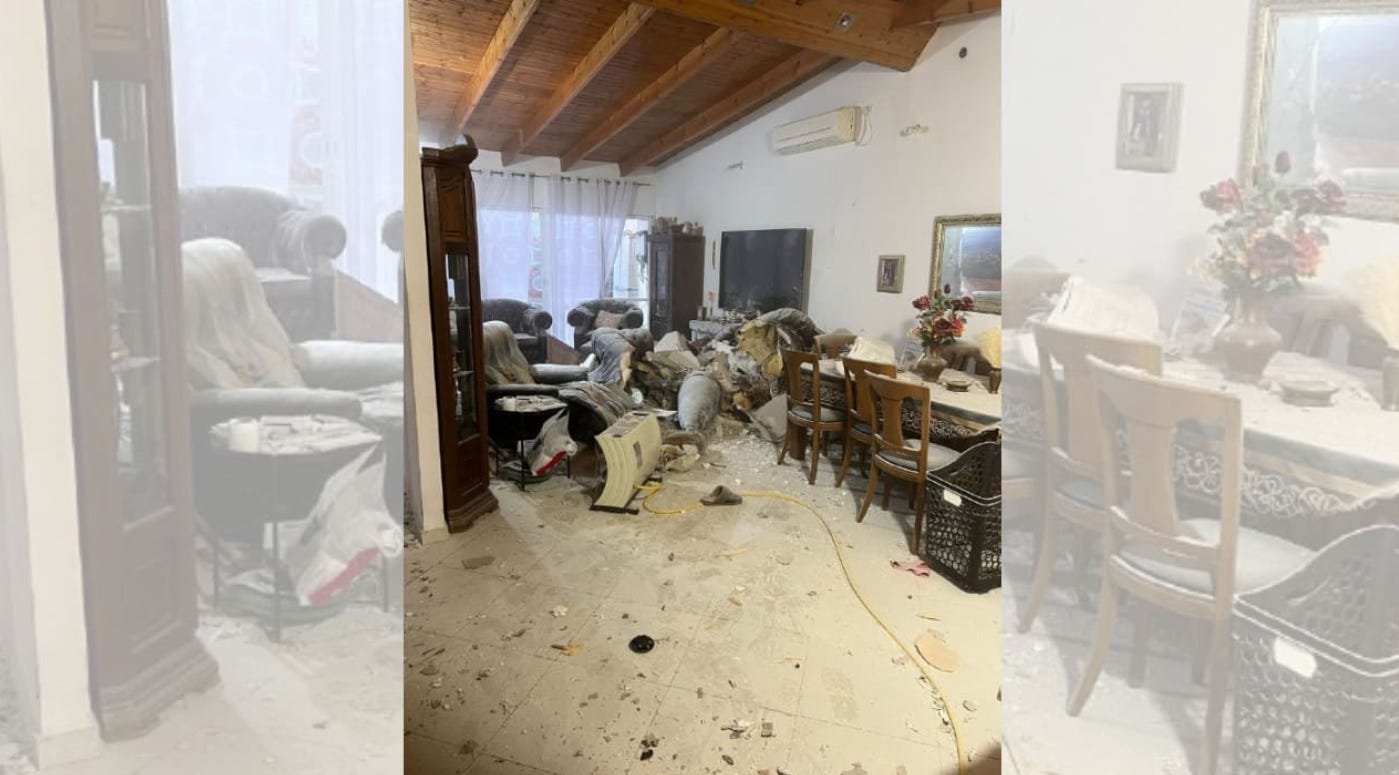
The aftermath of shrapnel falling on a residence this morning. (Magen Dovid Adom)
At his first in-person press conference since the war began, Netanyahu declared last night that Iran can no longer enrich uranium or manufacture ballistic missiles. "We will crush them to dust, to ashes," he said, adding that Israel is now a regional power—"and some would say a world power.”
A senior Air Force officer revealed that in 18 days of fighting, the IAF conducted aerial activity equivalent to an entire year of operational output—more than 8,500 strikes across Iran using over 12,000 munitions. In Tehran alone, approximately 3,600 bombs were dropped.
Iran launched additional missile barrages at Israel last night amid thunderstorms across the country, with some reports suggesting the poor weather was used to complicate Israeli air defense operations. Four further barrages followed this morning, targeting Jerusalem, central Israel, and the West Bank. Shrapnel struck a residence in Rehovot—the family was evacuated with no major injuries—and additional shrapnel damage was discovered at the oil refinery in Haifa, which had already been hit yesterday. Israel responded with strikes on Iranian regime infrastructure across Tehran in the early hours of Friday morning.
The IDF struck Syrian government infrastructure in southern Syria last night in response to attacks on Druze civilians, hitting a command center and weapons at Syrian military bases. “The IDF will not tolerate harm towards the Druze population in Syria,” the military stated.
Gadi Eisenkot, Benjamin Netanyahu and Naftali Bennet. (Jonathan Shaul/Ayal Margolin/Yonatan Sindel/Flash90)
The war Benjamin Netanyahu has been steering toward for his entire political career is now 21 days old. Has it changed his political prospects?
In terms of seats, not really. Likud has gained two, Gadi Eisenkot’s Yashar! has risen by one, and Bennett has lost one. Net the other shifts and the numbers look identical to the past few months: 51 seats for Netanyahu’s coalition, 59 for the opposition, and the Arab parties holding 10.
Where things get interesting is suitability for prime minister. Netanyahu has gained an additional six points over Bennett, stretching the lead to 16 points—44 percent to 28 percent. It is the largest advantage he has held at any point during this term.
The shift is unbalancing the opposition. For the first time, the opposition’s top candidate for prime minister is not Bennett but former IDF Chief of Staff Gadi Eisenkot. Netanyahu still leads him, but by a narrower margin—43 percent to 31 percent. Before anyone gets to face Netanyahu, the opposition has to have it’s own election.
A separate poll produced a more entertaining finding. How satisfied are Israelis with the war? Overall, a large majority are: 66 percent satisfied, 25 percent not.
But the breakdown tells a sharper story. Among those with a safe room at home, satisfaction is highest—73 percent satisfied, 21 percent not. Among those relying on a shared shelter, it drops slightly—67 percent satisfied, 31 percent not. And among those with no proper shelter at all, it collapses: only 23 percent satisfied, 51 percent not.
It turns out that the strongest predictor of support for the war is not your religious level, your party affiliation, or your opinion on Netanyahu—it is how much sleep you lost the night before.
Hamas, Islamic Jihad and thousands of People outside the house of Sinwar in Khan Younis January 2025. (Abed Rahim Khatib/Flash90)
The “Axis of Evil” always shared one goal for different reasons. The goal was simple: erase the State of Israel. For Iran and its proxies, Israel’s existence was a bone in the throat of their grand vision of leading the Muslim world. The democratic Western state stuck between Jordan and Egypt simply did not fit. Who needs, after all, a role model of free elections, human, and women’s rights?
For Hamas, Islamic Jihad, and the Palestinian Authority, the reason for erasing Israel was different. They believed, and still believe, that this land belongs to them, and that Israel’s existence physically obstructs the establishment of a Palestinian state from the river to the sea.
For a long time, there was no clash between these motives because the goal was identical. Except that October 7 changed everything. Sinwar, as has been revealed several times, saw that his dream of establishing a Palestinian state in place of Israel was fading away. The peace agreement that was nearly signed with the Saudis was, for him, the final nail in the coffin, and he feared it deeply. If the strongest state in the Sunni world normalized relations with Israel, who would remember him and his murderous struggle? He tried to enlist the Axis states to his side—and shared his plans with the Iranians and with Hezbollah—but unlike him, they were in no hurry.
The Iranians never cared about the Palestinians—they were the tool through which they tried to erase Israel; they did not care if, along the way, every last Palestinian was killed (famously Muslims have no immunity to nuclear radiation). They agreed with Sinwar, and even coordinated plans with him, but asked that he wait a little longer—once they had the nuclear bomb, they said, the war would look completely different.
After all, the question everyone has asked themselves since October 7 is what Sinwar thought to himself a minute before he sent the Nukhba force on its murder spree in Israel. Did he not know the response would be powerful?
After Rising and Roaring Lion, the answer is clear. Sinwar never thought he could defeat the State of Israel. All he wanted was to put the Palestinian state back on the table. Tens of thousands of dead Palestinians were worth the plan to him. He knew the response would be severe, and that within a short time it would exhaust all of Israel’s international credit. Then the Palestinians would once again become the classic victims. Unlike Nasrallah, who claimed that if he had known what Israel’s response to the 2006 abduction would be, he would not have gone to war, Sinwar was prepared to sacrifice all of Gaza’s civilians, and all of Gaza’s infrastructure, in order to bring about Israel’s diplomatic isolation and a swell of support for establishing a Palestinian state in which, he hoped, he could be the leader. He, too, did not particularly care about Iran.
His plan almost succeeded. Until a few months ago, the world was crying out for a Palestinian state. Except there were things Sinwar did not foresee. He did not foresee, for example, that the United States would elect a president who is the farthest thing from politically correct. Trump is what is known in professional jargon as a “troll”—someone who destabilizes the system and challenges it from unexpected directions.
He also did not appreciate the Israeli home front’s response—from his point of view, fragmented Israeli society would not withstand the expected losses in Gaza. He did not live long enough to see Israel’s willingness to absorb the losses in order to go all the way this time. And Sinwar also did not foresee the Iranian response—they preferred to wait for a shift in the global balance of power with the production of a bomb, and left Hamas almost alone.
And most significant of all: he did not believe Israel would once again embrace offensiveness and go to war against its enemies—that it would strike Hezbollah with blows the world could not imagine in the form of the pagers, the walkie-talkies, and the elimination of senior figures; that it would launch a proactive attack against the Iranians and set Tehran ablaze; and that it would enlist at its side the strongest military power in the world.
This is an excerpt from my weekly column in Israel Hayom
Before I go—thanks to you, the newsletter has reached #10 on Substack’s New Best Sellers list. In the middle of a war, during one of the most demanding news cycles I have ever covered, you chose to read, share, and subscribe. I am genuinely grateful.
A reminder to premium subscribers: your membership includes a free copy of my book It’s Noon in Israel and access to my monthly exclusive Zoom briefing—a chance to ask questions and go deeper on the stories shaping the region. The next one is planned for Thursday, and I hope to see you there.
Shabbat Shalom!
Nowruz Mubarak!
We’ll be back on Sunday
English Editor: Ari Tatarka
If you enjoy the newsletter, you can show your support by becoming a paid subscriber—it really helps keep this going. I’m also offering a special monthly briefing for a small group of premium members. I’d love to have you join us—just click below to find out more.
Thanks for reading It’s Noon in Israel! Subscribe for free to receive new posts and support my work.


Shabbat Shalom! 🇮🇱
Nowruz Mubarak! 🦁
Best weekend read! Thanks