Operation Roaring Lion Day 12: Where in the World Is Mojtaba Khamenei?
Also, Trump tries to send shipping straight through Hormuz, the war's new supporters, and more.
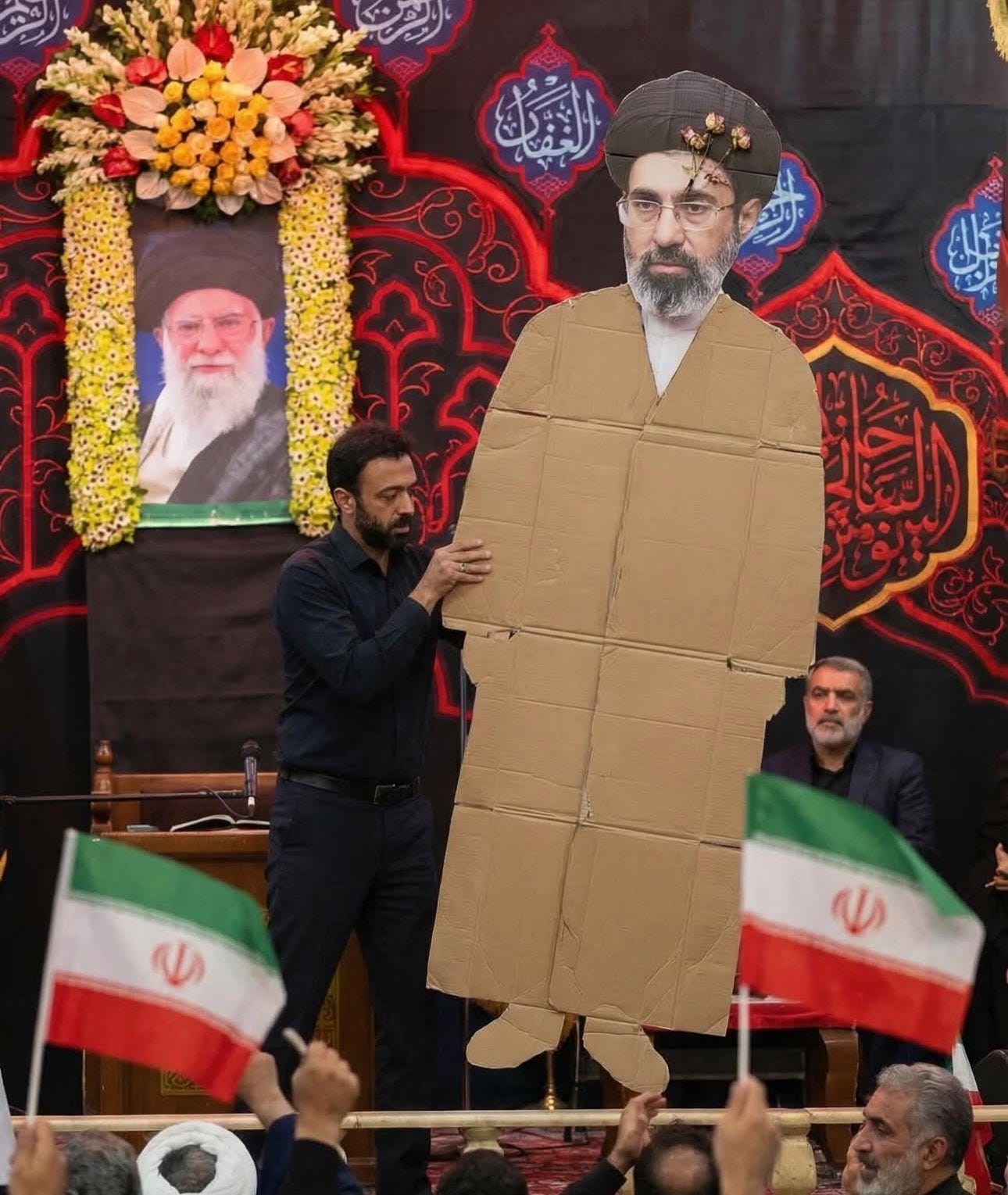
The cardboard cutout of Mojtaba Khamenie at the loyalist rally in Tehran.
It’s Wednesday, March 11, and the twelfth day of Operation Roaring Lion. Here are the latest developments while you were asleep:
Two ships were struck by unknown projectiles in the Strait of Hormuz this morning, frustrating the Trump administration’s attempt to reopen shipping through the vital waterway.
Last night, Netanyahu’s office released a statement addressed to the Iranian people, telling them, “In the coming days we will create the conditions for you to grasp your destiny.” The statement comes after a concerted targeting of the regime’s repression apparatus over the past couple of days. Yesterday, more than 170 munitions were dropped on IRGC and Basij targets in Tehran.
Unrelated to the war, the government approved the coalition funds, 771 million shekels in new funding whose allocation has not yet been determined. Among other items, 98 million shekels were designated for “preventing dropout” from ultra-Orthodox yeshivas—a code name for conscription.
Now, on to the details.
A picture of Mojtaba Khamenei taken in Tehran in October 2024. (Office of Supreme Leader)
After Joseph Stalin delivered a speech at a Communist Party conference, the hall erupted in applause. Party officials jumped to their feet and began clapping enthusiastically. But after a few minutes an awkward problem emerged: who would dare stop first? No one wanted to be the first to sit down and risk appearing disloyal. And so the applause continued—for eleven full minutes.
Dictatorships, in their rituals of loyalty, have a habit of slipping into the comically absurd.
Iran had its own comedic moment this week when a life-size cutout of Mojtaba Khamenei, held together with tape, was carried onstage to roaring crowds at the Tehran allegiance rally in Revolution Square. State media broadcast regime loyalists hailing and swearing allegiance to a cardboard Khamenei.
According to Iranian state media, Mojtaba Khamenei sustained leg injuries in the initial U.S.–Israeli strikes on Iran. The injury must be quite serious if a cardboard Khamenei cuts a more commanding figure than a wheelchair-bound Mojtaba.
But there is another possibility.
According to one report, there is a conspiracy: the strike did more than injure Mojtaba’s legs. The IRGC elevated its preferred candidate while Khamenei Jr. was in a coma and is still unaware that he has been made supreme leader. This theory rests on the fact that since his appointment two days ago, Mojtaba has not delivered a single speech, video address or even written statement. There is also the curious location of Iran’s interim leadership council’s first meeting last Thursday: a hospital corridor.
If Mojtaba is indeed incapacitated, the obvious question arises: who is in charge of the regime?
If I had to guess, a cadre of senior IRGC commanders.
The truth is that even if the conspiracy is false and Mojtaba is only suffering from minor leg injuries, that may still be the case. It is far from unheard of for the successor to a powerful dictator to serve primarily as a military figurehead. The regime needs Mojtaba to have a pulse, but not much more. In a Freudian slip early in the war, Iran’s foreign minister claimed that the attacks on neighboring states were “not our choice,” indicating that IRGC elements were acting independently of the government.
The regime’s official narrative is that Mojtaba is being kept away from the public for security reasons. Israel has already announced its intention to reunite the father with the son. But if this is truly about security, it is still a dangerous game. There are times when absence increases a leader’s mystique; a regime in crisis is not one of them.
Footage of the destruction of Iranian naval assets.
The most important asset the regime possesses for ending this war isn’t the radioactive material buried beneath the ruins of Isfahan, nor the machinery of repression in Tehran. It is a narrow strip of water between Iran and the Arabian Peninsula: the Strait of Hormuz.
Through this strait runs roughly one-fifth of the world’s oil and LNG. Shutting it down is the regime’s best chance of pressuring the United States to end the war early. Despite being stopped at almost every turn in its attempts to close the strait, Iran seems to be failing upward.
On March 2, a senior IRGC official declared the waterway closed to all shipping. On the same day, the United States confirmed it had destroyed all 11 of Iran’s warships in the Gulf of Oman. The past week has followed that pattern: Iran makes declarations, and the U.S. and Israel destroy its ability to carry them out. Yesterday the Iranians attempted to mine the strait, only to have 16 of their minelaying vessels sunk to the bottom.
Yet despite Iran’s inability to interrupt shipping militarily, it has managed to disrupt it.
Insurance premiums have more than tripled for ships navigating the waterway. Trump launched a $20 billion maritime reinsurance scheme on Friday to staunch the bleeding, but few companies are willing to take the risk. According to The Guardian, as of yesterday only two ships not linked to Iran or Russia had made the run. This morning two additional vessels were hit by projectiles in the strait.
Despite the U.S.’s military success, the Houthi strategy has proven true once again: you don’t have to close the strait to stop shipping. The mere possibility of an attack is enough.
There remains one tool left in the freedom-of-navigation toolbox: escorts. Trump has already said, “If it’s needed, we’ll escort them right through,” but so far the U.S. Navy has not been taking requests. There are two problems. Every ship used for escort duty is a ship not striking Iran and shortening the war, and all it would take is a single stray drone to make escorts similarly unattractive to commercial vessels.
There are alternatives. Saudi Arabia has a pipeline that bypasses the strait, and the United States still has its strategic petroleum reserve. But the former is nearing full capacity, and the latter comes with a domestic trade-off.
In the end, there is only one thing that can ensure long-term freedom of the seas: eliminating the regime.
Satellite imagery shows heavy damage to the Dubai port in UAE following an Iranian ballistic missile strike. (Shetach100)
Unique in this war is that, as it has gone on longer, it has gained more support. While that is not the case domestically in the U.S., the Iranians have been giving the entire region ample justification to get behind the campaign.
The threat of attacking neighboring oil infrastructure is one the Iranian regime has been waving liberally at regional rivals for years. They even followed through against the Saudis—but only indirectly through their Houthi proxies.
In the past two weeks, Iran has crossed that line with reckless abandon. Countries that were skeptical or outright opposed to the strike now find themselves directly in the line of fire.
No one knows this better than Israel’s closest regional ally, the UAE. If this war ends with Iran still standing, the Emiratis effectively become the region’s equivalent of Israel’s “frontline communities” along the borders with Gaza and Lebanon. If the regime feels violently inclined, they would be far easier to target than Israel.
The Iranians have been effective at communicating their message: no one is safe in the ayatollahs’ Middle East. So what option does that leave the Middle East, other than getting rid of the ayatollahs?
English Editor: Ari Tatarka
If you enjoy the newsletter, you can show your support by becoming a paid subscriber—it really helps keep this going. I’m also offering a special monthly briefing for a small group of premium members. I’d love to have you join us—just click below to find out more.
Thanks for reading It’s Noon in Israel! Subscribe for free to receive new posts and support my work.


It should be obvious that the regime of the Ayatollahs is nothing but a theocratically inclined group of thugs prepared to hold the world hostage to reach their goal. And they have never been shy about explaining what that goal is.
Politically, it’s the destruction of Israel, the forcing out of the U.S. from the region and the imposition of Iranian hegemonic control over an essential node of the world’s oil production.
Theologically, it’s about creating the chaos and violence that will speed the return of the Mahdi to return, destroy the infidels and see to Islam’s triumph. In fact, a week or so ago, NYC Mayor Zohran Mamdani openly prayed at a mosque for the Mahdi to unsheathe his sword to that end.
Yet, perhaps because the war is led by President Trump and Prime Minister Netanyahu, the chattering classes revert to the usual posture that the war aims can be achieved diplomatically because the war is not progressing like a video game on a timer.
It would be a neat parody were the stakes for the West not so high. It’s not only a malevolent Shi’a Twelver dictatorship that needs to go but a mode of thinking that has pervaded a self-satisfied elite in a West looking for an utopia rather than facing the world as it is.
Iran is gigantic - it’s the size of Alaska. And people don’t understand how tough it is to amass the intelligence and be able to reach and destroy a far flung entrenched military infrastructure, facilities, missile warehousing, mobile missile launchers scattered over such a vast area, and just how astounding the job the US and Israel have done in such a short time given the country’s vastness.