Operation Roaring Lion Day 18: Larijani Is Dead
Also, Iran ignores Jerusalem's golden dome protection, and more.
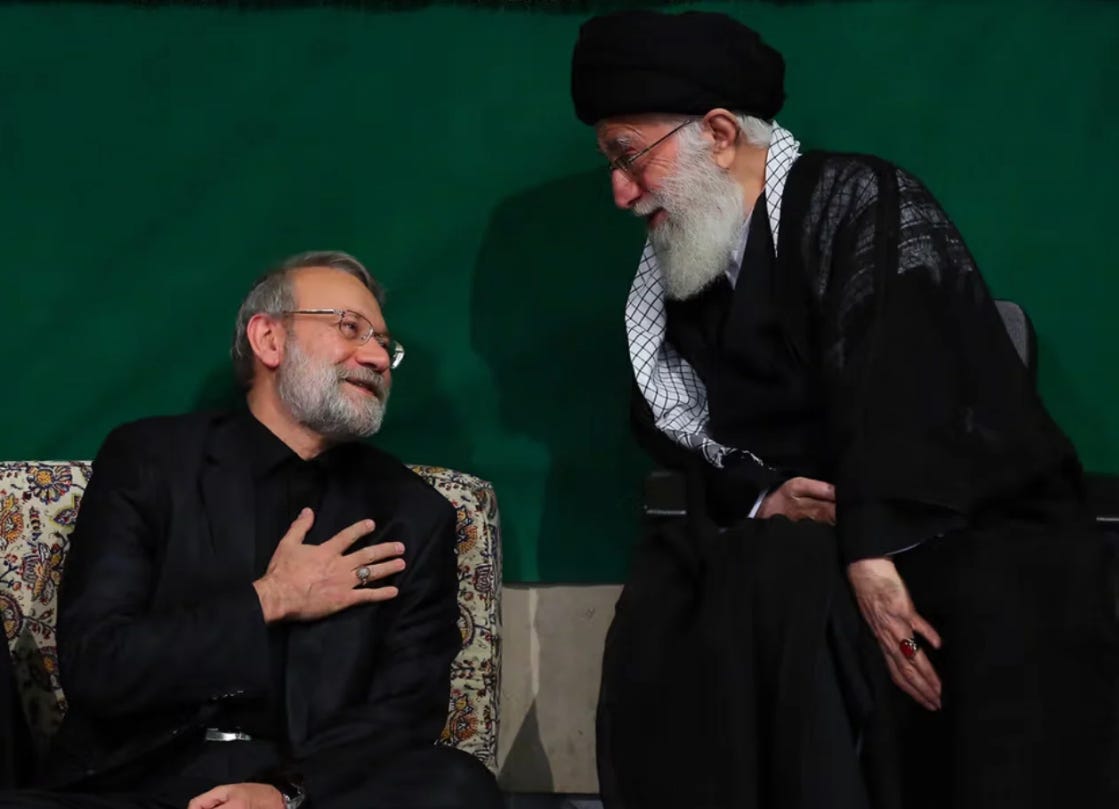
Ali Larijani sitting next to Supreme Leader Ali Khamenei during a religious ritual in 2016. (Leader.ir)
It’s Tuesday, March 17, and the eighteenth day of Operation Roaring Lion. Here are the latest developments while you were asleep:
Last night the IDF assassinated another batch of high-level regime leaders, including the head of the Basij forces, his deputy, and Iran’s most senior remaining military official, Ali Larijani.
The New York Times reported that in the days following Ali Khamenei’s assassination, Iran’s political establishment fractured over his succession. The hardline faction, led by the Revolutionary Guards commander, backed Mojtaba Khamenei. The moderate faction, led by Larijani and President Pezeshkian, opposed him, arguing the country needed a unifying figure—and that Mojtaba would simply be next on Israel’s list. Despite IRGC intimidation when the Assembly of Experts finally voted, a third of them voted against Khamenei junior. The Telegraph also reported that Mojtaba narrowly escaped death on the first day of the war, stepping out to the garden “to do something” moments before Israeli missiles destroyed the bunker where his father was staying.
Iran fired five barrages at Israel yesterday, sending missiles into the north, center, south, and twice at Jerusalem. Air defenses intercepted most of them, but warheads and debris still hit residential areas. A home in Rishon Lezion was damaged, fragments landed near the National Library and the Knesset, and a large chunk of an intercepted missile struck a home in East Jerusalem. In the Old City, debris came down near the Church of the Holy Sepulchre. Proving Israel’s worst enemy can often be itself, only one man in Jerusalem was wounded, because he touched a missile fragment.
Iran has not attacked any vessels in the Strait of Hormuz since March 12. That same day, anti-regime media published footage of a U.S. Navy F/A-18 Hornet firing its cannon at extremely low altitude over Chabahar, on Iran’s coast along the Gulf of Oman. The footage suggests U.S. forces have established at least local air superiority along parts of the Iranian coastline—enough to intercept drones and anti-ship missiles at low altitude and protect shipping.
The IDF is expanding its buffer zone in southern Lebanon. The 36th Division has pushed deeper into the south following massive airstrikes and artillery preparation, while another division has launched a separate operation in the eastern sector. Further expansion is being planned.
Now, on to the details.
Ali Larijani at last Friday’s Al-Quds Day march. (Screenshot used in accordance with Section 27a of the Copyright Law.)
Israel has beheaded the snake, again. In a strike unprecedented since three weeks ago, Israel eliminated senior regime figures, the head of the paramilitary Basij forces, his deputy, and most prominently, Ali Larijani—Iran’s most senior military official.
Since August 2025, Larijani had headed the Supreme National Security Council, Iran’s highest security body. Israel promoted him again last month, eliminating most of his superiors and leaving him as the highest-ranking security official still standing. Since that day, he had been viewed as one of, if not the most powerful man in the regime.
As head of the SNSC, he sat at the center of Iran’s war effort. After Israel beheaded the regime’s leadership, he was one of the few remaining figures capable of convening the emergency council—one he may not have participated in directly, but over which he almost certainly wielded significant influence. He was also likely among the shadowy IRGC commanders standing behind the maimed Mojtaba Khamenei, pulling the strings of the new supreme leader.
Larijani unwisely tempted Israel. On Friday, he appeared publicly in Tehran alongside the president and other senior officials at the Al-Quds Day march. Surrounded by civilians, he felt comfortable enough to mock Israel and the U.S. strikes on Tehran as signs of their “desperation.” The appearance was almost certainly choreographed by the IRGC to project continuity and resolve in a moment of pressure and collapse. Unfortunately for the IRGC’s PR team, they underestimated Israel.
Though I’m sure the New York Times will mourn the loss of another moderate, allow me to explain who this man actually was.
Like many in the IRGC, Larijani quietly embraced the luxuries of the West. Until last month, his daughter, Fatemeh Larijani, was an assistant professor at a university in Atlanta. His nephew Hadi is a professor at Glasgow Caledonian University’s technology center in the UK. Hadi’s brother Sina is a director at the Royal Bank of Canada in Vancouver.
While his family enjoyed the fruits of his corruption, Larijani was massacring Iranians for daring to want the same. His name is closely tied to the suppression of both the 2009 and 2026 protests. According to U.S. intelligence, he was a key architect of the crackdown that killed upwards of 30,000 protesters—greatly assisted by the other officials eliminated last night, such as Gholamreza Soleimani, head of the Basij, and his deputy.
With all the blood on his hands, I think I will quote Iranian-Australian broadcaster Rita Panahi’s statement after Khamenei’s assassination.
Panahi’s remarks were delivered in Persian, but roughly translated, I would like to say to Larijani, “Your father is a d*g, dirt be on your head and burn in hell.”
A missile fragment in Jerusalem following the Iranian attack yesterday. (Fire and Rescue Service)
If Trump has his way, the U.S. would be the second place enjoying Golden Dome missile protection—the first is the Old City of Jerusalem. Israel’s enemies have rarely respected the sanctity of civilian targets, but they have almost always respected the holiness of the Al-Aqsa Mosque and the Dome of the Rock on the Temple Mount. Until yesterday.
Last night, shrapnel from intercepted missiles fell heavily on Jerusalem—denting a car in the Old City parking lot and scattering fragments near the Church of the Holy Sepulcher, the Knesset, and the Temple Mount plaza. That is frighteningly close to one of the holiest sites in the religion of the regime, and coming just days after Iran’s Al-Quds Day march, the irony.
Does this signal a shift in the regime?
Well, they aren’t the first Islamists to struggle with the concept of hypocrisy.
After clashes around the Dome of the Rock in 2021, Hamas launched barrages toward the holy site and the city around it, claiming to “protect” it from Israel and launching Operation Guardian of the Walls in the process.
Then-Hamas leader Yahya Sinwar did so from a position of perceived strength—a “madman” play, demonstrating that he could not be deterred by the risk of collateral damage.
Unfortunately for Israel, on the Arab Street, Muslims launching a missile at the Dome of the Rock produce less outrage than Israel simply existing.
There is, of course, a significant difference between the point-and-shoot simplicity of Hamas rockets and the complexity of Iranian ballistic missiles.
What is clear is that Iran is trying to escalate by targeting more symbolic sites in Israel—perhaps the Knesset, or the Western Wall. Whether this is a show of confidence or an act of desperation is an open question.
There is another possibility: Iran is expanding its core strategy—chaos. I doubt the remaining ayatollahs would welcome the collapse of the Dome, but if it happened, they would likely expect the blame to fall on Israel—helped along, of course, by their own denials of responsibility. Iran has fired on nearly every country in the Gulf not because it believes it can dominate the region, but because disorder and confusion may buy it room to breathe.
Massacring Jews at the Western Wall may have been the goal. If the Dome is hit in the process, who cares? It’s just more chaos.
English Editor: Ari Tatarka
If you enjoy the newsletter, you can show your support by becoming a paid subscriber—it really helps keep this going. I’m also offering a special monthly briefing for a small group of premium members. I’d love to have you join us—just click below to find out more.
Thanks for reading It’s Noon in Israel! Subscribe for free to receive new posts and support my work.


Eye opening read. Thanks for the snarky remark about the New York Times. Plus having all that info deep into Iranian leaders show how compromised their sources are.
Good riddance