Operation Roaring Lion Day 20: The First Energy War
Also, Turkey gets sidelined, and more.
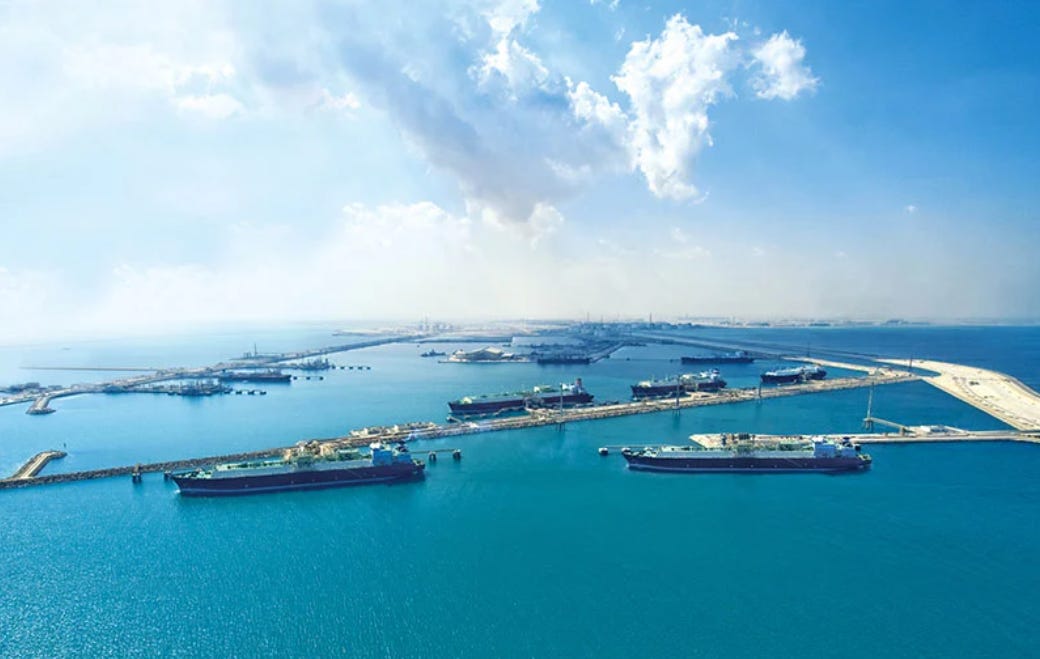
(QatarEnergy)
It’s Thursday, March 19, and the twentieth day of Operation Roaring Lion. Here are the latest developments while you were asleep:
Iran struck the world’s largest LNG export facility in Qatar, causing what Doha described as “extensive damage.” Oil markets reacted sharply, with crude surging over 10% to $118 a barrel. Qatar is the world’s second-largest LNG exporter, accounting for nearly 20% of global supply. Doha condemned the attack as a “dangerous escalation”—yet even after Iran struck its most important asset, Qatar stopped short of expelling the Iranian ambassador, settling instead for the lower-ranking attachés beneath him.
Iran's Revolutionary Guard issued evacuation warnings to oil facilities around the gulf before striking Saudi Aramco's SAMREF refinery—the only remaining export outlet for Gulf oil since the Strait of Hormuz is effectively closed. An industry source said the impact was minimal.
Three Palestinian women were killed and thirteen wounded when an Iranian missile struck a hair salon southwest of Hebron, in the first deadly Iranian strike on the West Bank since the war began—and the first to kill Palestinians.
Leviathan gas field in Israel. (Chevron)
While military commentators focus on flight paths and interception systems, historians will likely define the current campaign against Iran in entirely different terms: the first global energy war. This is not a war over territory, but over the ability of the West—and especially the Far East—to continue functioning.
At the center of the arena are oil prices. The spike in commodity market charts quickly translates into drama at gas stations in the United States and Europe. Those who thought natural gas would act as a brake to prevent economic escalation have discovered the opposite: gas is not moderating prices—it is becoming fuel that intensifies international pressure. This follows Qatar’s decision to halt liquefied natural gas production on the very first day of the war, a dramatic move for a country that holds a third of the world’s natural gas reserves.
The most significant pressure on the Trump administration is not coming from campus protesters, but from Taiwan, Japan, and South Korea. These three technological powers have made it clear to the Americans: if the energy market does not stabilize, the global semiconductor industry will suffer a severe blow. When chips are hit, everything is hit—from the smartphone in your pocket to the most advanced weapons systems. This is a supply chain that begins in the Persian Gulf and ends in factories in Taipei, and any disruption in Hormuz echoes all the way to Silicon Valley—especially as Trump has made clear that the chip war with China is the most important global issue of his presidency, and everything is judged in relation to it.
Here Egypt enters the picture, having become a key strategic player. Even before the war, Cairo secured massive quantities of gas for itself, and with declining domestic demand, a golden opportunity has emerged. The formula is simple: if Israel can continue supplying gas from the Leviathan field to Egypt without disruption, Egypt will be able to release around 25 LNG tankers to the global market, mainly to Asia. Egypt will profit from the price gap, Asia will receive the energy needed for chip production, and pressure on the United States will ease.
“The formula is simple: if Israel can continue supplying gas from the Leviathan field to Egypt without disruption, Egypt will be able to release around 25 LNG tankers to the global market, mainly to Asia.”
The West is looking for insurance. Of the 12 million tons of oil produced by Saudi Arabia and effectively “stuck,” 5 million already have a solution in the form of an old pipeline from the Persian Gulf to the Red Sea. It was built during the Iran-Iraq War and stood largely unused for decades, but it is now serving as a partial yet important solution.
The tactical solution is to forcibly reopen the Strait of Hormuz: the U.S. military has already struck the bunkers from which Iran controls the strait, and is simultaneously working to counter the mines deployed there by the Revolutionary Guards.
But the long-term strategic solution—the one that has already caused oil prices to drop sharply in contracts for two years and beyond—is the plan to double that pipeline and connect it to the ports of Haifa or Ashdod. This would be a historic shift: Saudi oil reaching the Mediterranean through an Israeli port, bypassing Iranian threats and creating a global energy security corridor. In short: the market anticipates short-term disruption, but a long-term solution that bypasses the Hormuz bottleneck and strips Iran of its most important strategic asset.
“This would be a historic shift: Saudi oil reaching the Mediterranean through an Israeli port, bypassing Iranian threats and creating a global energy security corridor.”
At the end of the day, international pressure to reopen the Strait of Hormuz for oil is significantly higher than pressure regarding gas. The world can “hold out” for about a week—perhaps ten days—of a closed strait; that is the maximum tolerance of the global economy. This is why Israel, in coordination with Trump, raised the stakes yesterday and has begun targeting Iran’s economy, signaling that blocking the strait will lead to the complete collapse of the ayatollah regime’s economic model. It is a high but calculated gamble.
If Trump reaches the end of March with oil prices stable—or even declining—a radical shift will occur across the entire region. If not, the Iranians can breathe easy.
Who will run out of oil first?
President Recep Tayyip Erdoğan speaking at an iftar dinner. (Office of President of Turkey)
In Ankara, a man suddenly woke up in the morning and discovered he is not quite as big as he thought. The year 2025 in the Middle East revolved around the question of whether Turkey was gradually becoming a strategic partner of the United States like Israel. Trump invested in Erdogan the way he invested in Netanyahu, brought him into civilian activity in Gaza, half-rebuked the Israeli prime minister in front of the cameras (“Erdogan is my friend, Bibi understands that”), and even announced that he would sell him F-35s, just like Israel.
Well, other F-35s are now starring in the skies of the Middle East. Turkey’s ruler thought Trump consulted him every step of the way, and yet a respectable regional war organized itself without him being in the loop. The man who presides over what is considered the most intimidating army in the Middle East discovered—along with the whole world—the capabilities and power of the Israeli Air Force and intelligence services, and the depth of cooperation with the U.S. military. Erdogan saw, and was astonished.
“Erdogan saw, and was astonished.”
The Turks’ distress is immense. The best-case scenario for them was and remains a weak Iran that, on the one hand, continues to sell them gas dirt cheap; on the other hand, curbs Kurdish expansionist ambitions; and on the third hand, cannot serve as a rival for regional control or, God forbid, even cooperate with Israel.
As if all that were not enough, they are very worried about the renewed romance between the United States and the Kurds, whom they detest, to the point of fantasies about conquering parts of Iran (imagine Israel waking up one morning to discover that Trump is in direct talks with the Hamas leadership so that they can invade Egypt with American weapons). Fortunately for him, the Kurds are still suspicious of the United States since they were sold out—though recently, to the Syrian regime.
Now, as Erdogan follows the news about the situation, he also has to deal with higher energy prices while Turkey’s inflation rises and interest rates are murderous.
The Turkish solution, uncharacteristically, is to sing songs of peace. The Turkish dictator who convinced himself and his people that Israel was about to attack Ankara because of a biblical fantasy keeps overlooking Iranian launches into his territory, imagining they are rain. He is trying to initiate negotiations, so far in vain. This week, the United States asked to use its base in eastern Turkey for the war, a Trumpian way of testing who is with us and who is against us. Erdogan nearly swallowed his tongue.
This is an excerpt from my weekly column in Israel Hayom.
To read this piece on my website click here.
English Editor: Ari Tatarka
If you enjoy the newsletter, you can show your support by becoming a paid subscriber—it really helps keep this going. I’m also offering a special monthly briefing for a small group of premium members. I’d love to have you join us—just click below to find out more.
Thanks for reading It’s Noon in Israel! Subscribe for free to receive new posts and support my work.


I am so sorry for the deaths of three Palestinian women killed and thirteen wounded when an Iranian missile struck a hair salon southwest of Hebron. I would look forward to the condemnation of this attack from any Pro-Palestinian activists. It would show good faith and sincerity to actually care about such people instead of using them pretextually as political talking points to condemn the west generally and Israel in particular.