Operation Roaring Lion Day 10: Khamenei's Buried Treasure
Also, Hamas gets an eviction warning in Doha, the symbolism behind the IDF's first fatality, and more.
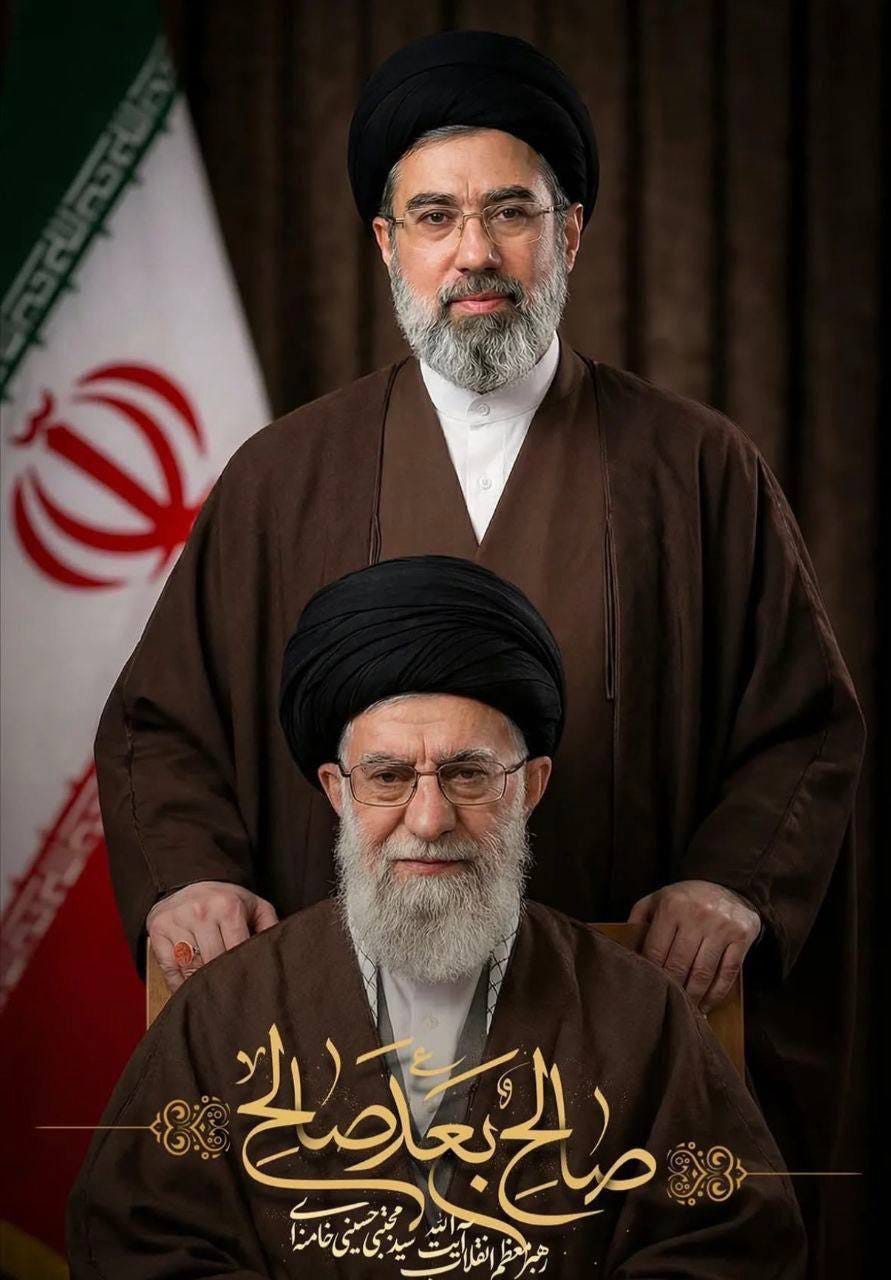
Mojtaba Khamenei behind his father, Ali Khamenei.
It’s Monday, March 9, and the tenth day of Operation Roaring Lion. Here are the latest developments while you were asleep:
It’s official: Mojtaba Khamenei, son of Ali Khamenei, is the new supreme leader of the Islamic Republic. Strange—I thought they got rid of the hereditary monarchy in 1979. Still, it is nice of the electors to try to reunite father and son.
Israel has sustained its first military fatalities of the war. Two soldiers from the Givati Brigade were killed by a Hezbollah anti-tank missile in southern Lebanon. The name of one of the fallen has been cleared for publication: Master Sergeant Maher Khatar, 38, from the Druze town of Majdal Shams.
Qatari officials have told the Americans that they will expel the Hamas leadership from Doha after Hamas refused to condemn the Iranian attacks. Hamas is nervous—losing support from both Qatar and Iran could be fatal. I do feel bad for the Qataris. It can’t be easy finding out that the people you’ve hosted all these years support terrorism.
Despite earlier promises, the ultra-Orthodox parties have reportedly agreed to pass the budget without resolving the Haredi draft issue, citing the war. Netanyahu has bought himself another month of survival. But if he doesn’t want his house of cards collapsing early, the draft question will have to be settled.
Now, on to the details.
Footage released by the IDF on June 21, 2025, showing the aftermath of Israeli strikes on Iran’s Isfahan nuclear facility. (IDF)
Deep beneath the ground near the Iranian city of Isfahan lies the ayatollahs’ treasure chest. Lead-lined, it contains Iran’s most valuable asset: more than 400 kilograms of 60 percent enriched uranium.
The world’s most radioactive buried treasure was entombed by the U.S. and Israel during the June war and is thought to be inaccessible without a large excavation effort. But according to a recent U.S. intelligence report, there remains a “very narrow access point” through which the Iranians—or the U.S.—could potentially retrieve the prize.
I’m not being playful when I say this is the treasure of the regime. It cost them hundreds of billions to create, and it is their most powerful weapon—though more in negotiations than in destructive potential. That makes it valuable to the U.S. and Israel as well: Take away the uranium and you remove a load-bearing beam in the regime’s infrastructure.
Fortunately, pulling up IRGC-branded moving trucks is not an option. The site is watched from above by the U.S. and Israel; any Iranian attempt at extraction would be met with an excessive amount of munitions.
An allied operation faces similar challenges. Four hundred kilograms of uranium doesn’t fit easily into a backpack. Any operation would require significant forces around the “very narrow access point” to repel what would likely be a substantial Iranian counterattack.
But Trump hasn’t ruled out sending in special forces, and rumors from both Israel and the U.S. indicate that such an operation is being considered.
Short of Trump walking into the presidential palace in Tehran, victory is a hard thing to photograph. But Netanyahu and Trump shaking hands in front of Iran’s enriched uranium would come pretty close.
Hamas leaders celebrating the October 7 massacre in their hotel room in Doha. (Screenshot used in accordance with Section 27a of the Copyright Law)
The Qataris have reportedly delivered an eviction warning to the Hamas leadership in Doha. After Iran struck their former ally, Qatar asked their guests to condemn the attack. In a serious violation of guest etiquette, Hamas refused.
Before we get too excited, let me remind everyone that Qatar has threatened to do this before. Multiple reports said Hamas leaders left for Turkey after a Qatari directive in April 2024, and there were rumors of Doha “reconsidering” Hamas’s presence in November 2023; March, May and October of 2024; and a few times in 2025 as well.
Hamas doesn’t seem to have many options for relocation. They require certain qualities in a host: friendly to terror, immune to Israeli strikes and willing to accept the stigma of their presence. There is no shortage of countries in the region with an agnostic view of terrorism; far fewer that Israel wouldn’t strike. But that last factor seems to be the trickiest to find. Even Turkey—which has no problem discreetly supporting Hamas and is the most immune to Israeli strikes in the region—is hesitant to take the American heat that would come with allowing Hamas leaders to walk in through the front door.
The truth is, it’s a great deal for Qatar. For the price of a few hotel rooms, they get to be a key player in one of the world’s most important negotiations. They are America’s go-to terror mediators, so hosting Hamas is more expected than scandalous. Then again, now that all the hostages have returned, Hamas’s value has depreciated somewhat. Still, I put the odds at 60-40 that they stay.
Qatar may keep them around, but that doesn’t mean it will advocate on their behalf or give them money. Hamas leaders are reportedly terrified that, with Iran looking unreliable, the loss of Qatari support would be a devastating blow to the organization.
Israel’s perspective has always been that among the terror groups on its borders, Hezbollah was the one most likely to collapse with the loss of Iranian support. Hamas existed long before Iran’s patronage, and it was widely believed it would survive after the Islamic Republic’s fall. But the panic among its leaders indicates it might be easier to dismantle an independent Hamas than previously thought.
It would be remiss not to mention that Iran seems to be more effective than Israel at disposing of Hamas leaders. When Israel struck Doha last September, Hamas had to change hotels. When Iran struck Qatar, Hamas suddenly found itself homeless.
Master Sergeant Maher Khatar (IDF)
Master Sergeant Maher Khatar, 38, was more than Israel’s first military fatality of this war; he was a symbol of a community coming to terms with the State of Israel.
Tucked into the southern foothills of Mount Hermon on the Golan Plateau, its eastern side set against the Israel–Syria border, sits the Druze town of Majdal Shams.
The territory was captured by Israel in 1967, and with the possibility that it might one day be returned to Syria, the Druze—as is their tradition—remained fiercely loyal to their state. The border became known as the “shouting fence” for how family and friends on either side communicated before telephones were widely accessible. When Israel tried to issue them identity cards, the population initiated one of the longest strikes in Israeli history.
This separatism remained the situation for decades. The residents received permanent residency but were exempted from conscription and maintained their Syrian citizenship. Despite the availability of Israeli citizenship, crossing the figurative border was taboo.
That was until tragedy struck—twice.
It began with a stray Hezbollah missile. It struck a soccer field in the town, killing 12 children. Almost a year later, massacres of Druze in Syria’s Suwayda province prompted thousands of Druze—including residents of Majdal Shams—to cross the border to fight Syrian forces.
Both tragedies were addressed by Israel in a uniquely Israeli way: solidarity and airstrikes.
Both had an effect. Applications for Israeli citizenship—especially among the youth—have risen sharply. According to local residents, the stigma around the practice has largely faded, and 20 percent of the Druze population of the Golan Heights are now Israeli citizens.
Israelis, like the Druze, did not hesitate to act when violence erupted in Suwayda. Almost every Israeli Jew had a Druze commander or fellow soldier during their service. There is a covenant with the Druze sealed by spilled blood.
We can only hope that the loss of Maher expands this covenant to the Druze of the Golan as well.
If you enjoy the newsletter, you can show your support by becoming a paid subscriber—it really helps keep this going. I’m also offering a special monthly briefing for a small group of premium members. I’d love to have you join us—just click below to find out more.
Thanks for reading It’s Noon in Israel! Subscribe for free to receive new posts and support my work.


We should remember and honor the name Maher Khatar long after Mojtaba Khamenei is dead and buried and his name forgotten.
The Druze are Israeli citizens. Of course they should serve as should all the Arab Israelis and the hipsters from Tel Aviv.