Operation Roaring Lion Day 31: Israel Offers to Replace Qatar
Also, the Knesset passes its first election-year budget in decades, fake drama at the Holy Sepulchre, and more.
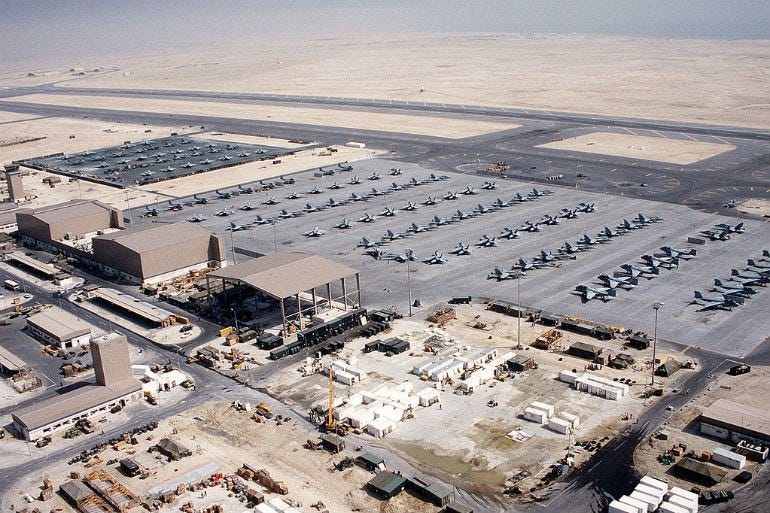
U.S. aircraft lined up on Shaikh Isa airfield, Bahrain, 1991.
It’s Monday, March 30, and the thirty-first day of Operation Roaring Lion. The global price of oil has reached $115, up two percent since yesterday. Here are the latest developments while you were asleep:
Spain has closed its airspace to US planes involved in attacks on Iran, going a step further than its earlier decision to deny American forces use of jointly operated military bases. The closure forces US aircraft to bypass Spain when flying to Middle East targets, though exceptions apply in emergencies. Economy Minister Carlos Cuerpo said the move reflects Spain’s stance of not participating in “a war initiated unilaterally and against international law.”
For the first time in his nearly 20 years as Prime Minister, Netanyahu successfully passed a budget in an election year—a milestone that secures the government through the end of its term. Even if the ultra-Orthodox were to withdraw from the coalition in the next legislative session and elections were called, the earliest they could be held would be September, making this the longest-serving government Israel has had since 1969. This historic budget came at a steep price: millions of shekels allocated to the Haredi sector.
IDF Chief of Staff Eyal Zamir has ordered the early removal of a battalion from Judea and Samaria, following an incident in which soldiers allegedly detained and assaulted a CNN crew while preventing them from filming at an illegal outpost. Soldiers were caught on camera stating that they were acting in revenge for the killing of settler Yehuda Sherman days earlier. The chairman of the Foreign Affairs and Defense Committee has demanded that Zamir reverse his decision.
President Isaac Herzog has responded to the Pardons Department’s recommendation regarding the pardon for Netanyahu. The department concluded that granting the pardon was inappropriate, but Herzog inquired politely—and firmly—whether it was legally possible despite its inappropriateness.
Now, on to the details.
Google satellite view of Al-Udeid Air Base in Qatar, 2019. (Google)
Israel has invited the United States to relocate some of its regional bases from countries such as Qatar to Israel. But that raises a question:
Why is the U.S. regional headquarters in a country that actively sponsors terrorism?
It’s a relatively recent development. For decades, Saudi Arabia served as the U.S.’s regional headquarters. It was from there—not Qatar—that the U.S. assembled forces and ultimately launched the Gulf War to liberate Kuwait. After 9/11 and the Iraq War, the U.S. sought a host with fewer political constraints and a location that would recruit fewer jihadists by being farther from Islam’s two holiest sites. Qatar fit the bill: no political complications, billions of dollars in subsidies, and the ready-to-use Al Udeid Air Base.
Now, more than twenty years later, Israel is positioning itself as the U.S.’s new home away from home. The Israeli security establishment sees an opportunity to “reshape the map” of U.S. military positioning in the Middle East.
There are several advantages to this move. For one, Israel has the strongest air defense in the region. The New York Times reported Thursday that missile attacks on Qatar have forced “many American troops to relocate to hotels and office spaces throughout the region,” with much of the land-based military “fighting the war while working remotely, with the exception of fighter pilots and crews operating and maintaining warplanes and conducting strikes.” Meanwhile, IDF forces haven’t missed a day of work.
Another advantage is the close alliance between the U.S. and Israel. They’ve been conducting joint operations, gone on foreign trips together, and built a relationship where coordination is seamless. Isn’t it time to move in together? After all, the U.S. and Israel share strategic goals in the region, and operating from Israel means the U.S. doesn’t risk hitting targets that would be rebuilt by the same country they launched from.
Qatar has not always been a cooperative host. In April 2025, Qatar (along with Saudi Arabia and the UAE) would not allow American warplanes to use Gulf bases or airspace to strike Iran. Earlier this year, a prominent Qatari royal called the U.S. “merely a tenant of a military base in Qatar” and warned, “do not act as if you are doing us a favor.” While this may have been largely rhetorical, Qatari sentiments have grown more ingratiating since missile strikes began, and it is not a sentiment the U.S. is likely to encounter in Israel.
But there are a few disadvantages as well, the most prominent being geographical. Israel is roughly 1,000 miles west of Qatar. Sure, that means fewer missiles can reach it, but it is more useful for the U.S. if they want to fly over Beirut—less so for strikes on Tehran.
Qatar also subsidizes the upkeep of its base to the tune of billions of dollars. Israel’s defense budget hit record highs this year, but an extra few billion is still significant for a country without endless oil wealth.
Regional allies are unlikely to be thrilled either. Some, like Turkey, would be opposed out of that early-2000s distaste for Israel, while others—Kuwait, the UAE, and Saudi Arabia—may object simply because it means American help is now farther away.
The U.S. and Israel are currently negotiating this proposal. U.S. Central Command is unlikely to fully relocate from Qatar, but there could very well be a new U.S. base established. As U.S. Secretary of State Alexander Haig famously said, Israel is “the largest American aircraft carrier in the world that cannot be sunk”—and the U.S. may finally be looking to put that to use.
A vote on the state budget at the auditorium in the Knesset last night. (Yonatan Sindel/Flash90)
Overnight the Knesset successfully passed the largest state budget in Israel’s history. Finance Minister Bezalel Smotrich called the NIS 850.6 billion ($271 billion) spending bill “a budget that takes care of everyone and fights the cost of living,” while opposition leader Yair Lapid called it “the greatest theft in the history of the state.” Whether Lapid is correct or not, this budget is historic.
For the first time in his nearly 20 years as Prime Minister, Netanyahu has successfully passed a budget in an election year—a milestone that secures the government against collapse through the end of its term. In his six previous terms, for one reason or another, he never reached this point. Even if the ultra-Orthodox were to bring down the coalition in the next legislative session, the earliest elections could be held would be September—just one month short of the government’s full term. This makes the 25th Knesset the longest-serving government Israel has had since 1969. That’s right: more than 50 years. Israeli politics has a long-standing tradition of chaos and self-destruction.
Yet history doesn’t come cheap. At the last moment, the coalition approved amendments allocating approximately NIS 800 million ($255 million) to Haredi programs and institutions. This was compensation for the ultra-Orthodox parties’ support, as they voted in favor of the budget despite the coalition not enacting the blanket exemptions from military conscription for yeshiva students that they had demanded.
According to Channel 13, the budget increased allocations to Haredi educational institutions by more than NIS 1 billion ($318 million). But the Haredim weren’t the biggest beneficiaries of the night—the defense budget received a NIS 32 billion ($10 billion) raise, bringing it to NIS 142 billion ($45 billion). That’s almost double the 2022 allocation.
Last night was also historic in that, for the first time, nearly the entire Knesset had to vote from protected spaces as Jerusalem came under fire. I’m not sure what Iran was planning on preventing the IDF from being funded, but firing missiles isn’t exactly the way to convince a country to cut its defense spending.
Latin Patriarch of Jerusalem Pierbattista Pizzaballa arrives to the annual Christmas Eve procession in the Church of the Nativity, in Bethlehem, 2025. (Wisam Hashlamoun/Flash90)
Yesterday, police prevented the Latin Patriarch of Jerusalem from praying at the Holy Sepulchre on Palm Sunday. Has Tucker Carlson’s fantasies finally become a reality? Has Israel finally started persecuting Christians?
Not quite.
I have a rule: whenever a minister is involved, the situation falls into one of two categories—House of Cards or SNL. This was SNL. Simply put, the police in the Old City didn’t fully understand the sensitivity of the issue and were following Home Front Command directives to prevent large gatherings. Before the situation could be clarified, the story went viral, and everyone started offering their takes—some claiming Israel was persecuting Christians, others, if Israeli, blaming the current government.
The whole issue was resolved within a day. This morning, police announced that limited numbers would be allowed into the Holy Sepulchre. For context, Home Front Command directives also currently prevent prayers on the Temple Mount or at the Western Wall, and neither has caused an international incident.
The Western Wall in Jerusalem is closed to visitors amid the war with Iran and ongoing missile fire toward Israel. (Yonatan Sindel/Flash90)
I’m sorry to disappoint Tucker Carlson, but Israel’s persecution of Christians remains in his fantasies.
English Editor: Ari Tatarka
If you enjoy the newsletter, you can show your support by becoming a paid subscriber—it really helps keep this going. I’m also offering a special monthly briefing for a small group of premium members. I’d love to have you join us—just click below to find out more.
Thanks for reading It’s Noon in Israel! Subscribe for free to receive new posts and support my work.


Pardon Bibi
Yeah, that headline sounds good -but only as long as they replace Qatar with something better😁