Operation Roaring Lion Day 39: An Explosion at 3am
Also, is Hamas ready to disarm? I leak sensitive intelligence, and more.
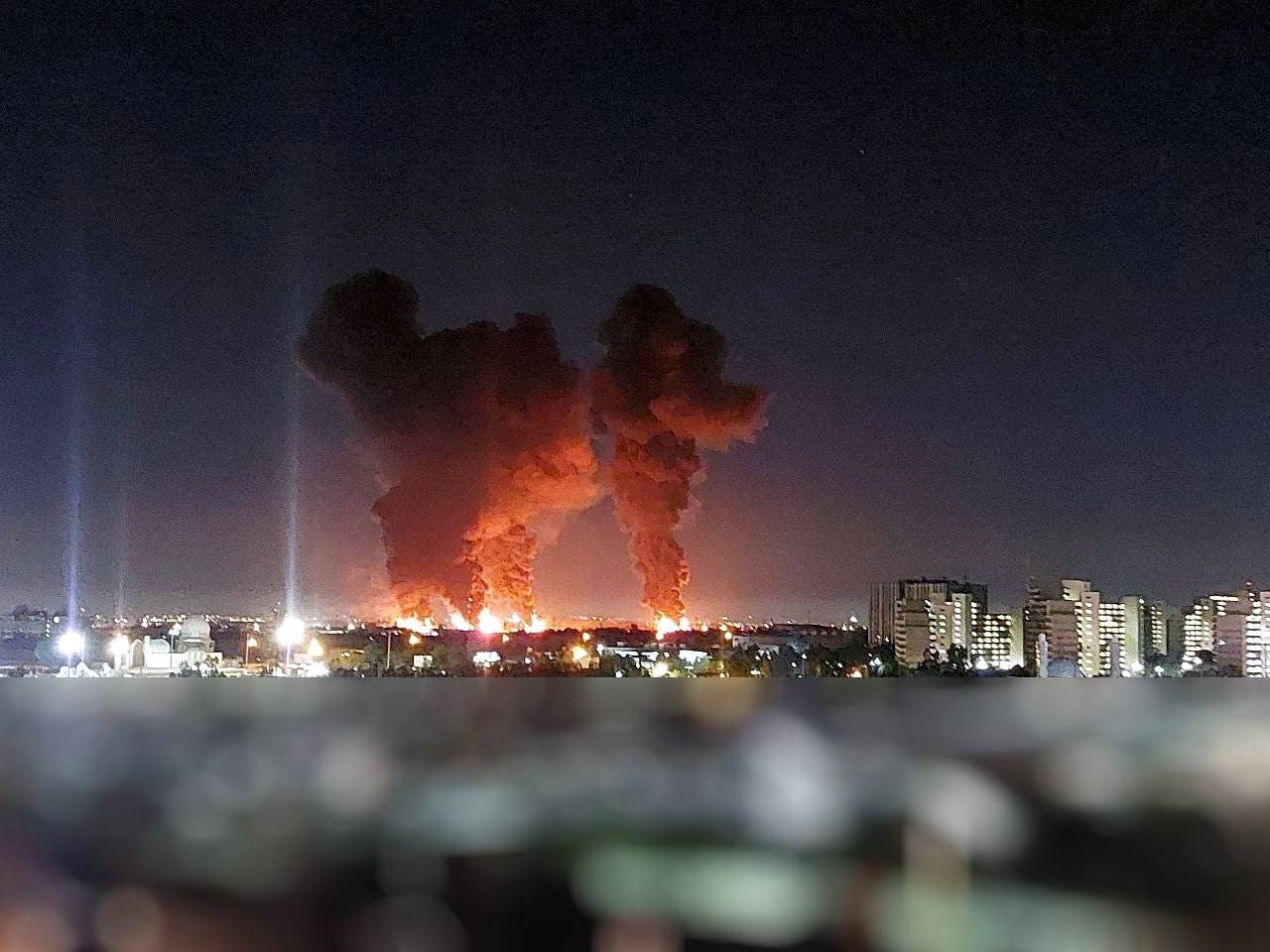
Fires in Tehran overnight.
It’s Tuesday, April 7, and the thirty-ninth day of Operation Roaring Lion. The global price of oil has reached $111, up 1 percent since yesterday. Here are the latest developments that occurred while you were asleep:
As Trump’s ultimatum enters its final hours, unconfirmed reports have emerged of multiple explosions on Kharg Island, Iran’s critical oil export terminal. The strikes appear to be American, but it remains unclear if they are intended as a warning shot or the opening salvo of an invasion.
The New York Times published Iran’s 10 conditions for ending the conflict: a permanent end to the war—not a temporary ceasefire—with a guarantee that Iran will not be attacked again by the U.S. or its allies; cessation of Israeli attacks on Hezbollah in Lebanon; a halt to fighting against all Iranian-backed forces in the region; the lifting of all U.S. sanctions on Iran; and the reopening of the Strait of Hormuz under new rules of safe passage. Iran is also demanding that each vessel transiting the strait pay a toll of approximately $2 million, with revenues shared with Oman and used in part to fund reconstruction of war-damaged infrastructure.
An exchange of fire near the Israeli consulate in Istanbul this morning left three people dead, two of whom were reportedly the assailants. According to the Turkish government, one of the attackers had ties to ISIS. The consulate itself is almost always closed due to the currently tense state of Israeli-Turkish relations, hence no Israelis were injured.
Yesterday, the Israeli Air Force struck Iran’s largest petrochemical facility in Asaluyeh, at the South Pars gas field. Defense Minister Israel Katz said the strike, combined with last week’s hit on a second major facility, has eliminated the capacity to process roughly 85 percent of Iran’s petrochemical exports, inflicting what he called tens of billions of dollars in economic damage. Katz said the petrochemical industry is a key financier of the IRGC and warned that continued aggression against Israel would lead to the “collapse” of Iran’s capabilities.
The Gaza Board of Peace has given Hamas until the end of the week to accept a new disarmament proposal. High Representative Nickolay Mladenov is set to meet Hamas officials in Cairo on Friday, and a follow-up meeting is scheduled for Tuesday.
The IDF has completed its deployment along the “anti-tank line” in southern Lebanon this morning—Israeli forces now control the line of commanding ridges from which they can prevent anti-tank fire toward Israel’s northern towns.
Now, on to the details.
An IDF fighter plane on its way to Iran. (IDF)
Standing on the edge of the Red Sea, the Egyptian army approaching, the Bible records that many of the Israelites wanted to turn back. According to rabbinic sources, one leader of the tribes, Nachshon ben Aminadav, stepped forward, throwing himself into the water, at which point the sea miraculously split. This is the miracle Jews will celebrate tonight on the seventh night of Passover.
While rabbinic sources place the historical event at midnight, this year’s point of no return will occur at 3:00 AM in Israel, when Donald Trump’s ultimatum to open the Strait of Hormuz—or incur his wrath—expires.
Unlike the enterprising Ben Aminadav, preparations have been made for this sea-splitting event. Yesterday, Israel targeted Iran’s largest petrochemical facility in Asaluyeh. Combined with last week’s hit on a second major facility, the IDF has taken out plants responsible for roughly 85 percent of Iran’s petrochemical exports. Today, an Israeli source indicated that railway infrastructure in Iran will be targeted next.
Trump has hinted at the consequences in store: “We have a plan… where every bridge in Iran will be decimated by 12 o’clock tomorrow night, where every power plant will be out of business, burning, exploding and never to be used again.”
(ChatGPT)
To top off the biblical scale of this punishment, the ultimatum expires at 8 PM EST. The devastation of Iran’s infrastructure will seemingly occur over a period of just four hours.
Last night, the regime rejected the 45-day interim ceasefire proposal put forward by Pakistan, demanding instead a permanent end to the war. The New York Times published Iran’s counterproposal: a permanent end to the war — not a temporary ceasefire — with a guarantee that Iran will not be attacked again by the U.S. or its allies; cessation of Israeli attacks on Hezbollah in Lebanon; a halt to fighting against all Iranian-backed forces in the region; the lifting of all U.S. sanctions on Iran; and the reopening of the Strait of Hormuz under new rules of safe passage.
That’s not all. Iran is also demanding that each vessel transiting the strait pay a toll of approximately $2 million, with revenues shared with Oman and used in part to fund reconstruction of war-damaged infrastructure.
Despite what can only be described as an impressive amount of Iranian chutzpah, I doubt Trump will agree. According to an Israeli source, there is division within the regime's leadership: civilian leaders have been pushing for acceptance of the ceasefire, but are being rebuffed by hardliners in the IRGC. Unless the civilians prevail tonight, there will be no ceasefire.
Thirteen hours remain.
We are in for an eventful night.
Board of Peace High Representative for Gaza Nickolay Mladenov addresses the UN Security Council in March. (Screen capture/YouTube)
The Gaza Board of Peace High Representative Nickolay Mladenov has given Hamas until the end of the week to accept a disarmament proposal, three sources told The Times of Israel. The plan includes five stages:
In the first fifteen days, a Palestinian technocrat committee takes security and administrative control of Gaza and begins preparatory steps for weapons collection.
Between days 16 and 40, Israel removes its heavy weapons and an international security force is deployed.
The most intensive phase, days 30 to 90, sees Hamas surrender all heavy weapons and military equipment and allow the destruction of its tunnels and military infrastructure.
From day 91 to 250, remaining weapons including small arms are collected and registered as Israeli forces begin a staged withdrawal.
The fifth and final stage concludes with “final verification” of disarmament, full Israeli withdrawal—except for a security perimeter—and the start of comprehensive reconstruction.
But the obvious question arises: Will Hamas accept?
The answer is an optimistic perhaps.
Were this a month ago, the answer would have been almost certainly no, but it has been a difficult 38 days for the terror organization. Its “parents,” Qatar and Iran, went through an explosive divorce in which Hamas was forced to pick a side. In the end, it chose a middle road, belatedly condemning the attacks on Qatar but still siding with Iran, incurring the wrath of the former and no reaction from the latter. In truth, Iran’s reaction has been hard to gauge; it has been too busy being pounded by the U.S. and Israel to formally express its feelings on the matter.
Meanwhile, Hamas’s godparent, Turkey, is finding itself in a situation for which it was completely unprepared. The aspiring regional power and U.S. ally is still trying to regain its bearings after Trump circumvented Ankara on his way to the largest war in the region in 20 years.
Hamas is alone—no funding, no nuclear deterrent forthcoming, and surrounded by an increasingly experienced IDF. It may be time for it to switch strategies.
It is still not guaranteed. The theme for the past two years of conflict has been Hamas’ impressive ability to endure intense pressure. Still, this may be the highest chance of disarmament since the first days following the ceasefire in October.
It appears that if you cut off the head, the arms will follow.
Trump promising to find and punish the person responsible for the leak in the White House press room last night. (Screenshot used in accordance with Section 27a of the Copyright Law)
“We’re looking very hard to find that leaker,” Trump said yesterday. “They basically said that we have one and there’s somebody missing. Well, [Iran] didn’t know there was somebody missing until this leaker gave the information.”
Newsweek, Firstpost, and the New York Post have all pointed the finger at me.
While I appreciate the attention, I fear it’s undeserved. I was not the first journalist to report that the pilot was missing, nor that he was injured. I suppose the accusations are a testament to my timely reporting, but the fact is that The Guardian and two Israeli channels broke the story before I did. I imagine “Israeli Journalist Endangers American Pilot” makes a better headline.
Almost three hours before I reported it, the story was circulating in Telegram news channels—in this case, a pro-Hezbollah channel. The timestamp in the screenshot is Israeli time: 15:22. My post went out at 18:20.
If you are looking for cutting-edge news that doesn’t breach national security, subscribe to my Telegram.
Chag Sameach! We Will be Back on Thursday.
English Editor: Ari Tatarka
If you enjoy the newsletter, you can show your support by becoming a paid subscriber—it really helps keep this going. I’m also offering a special monthly briefing for a small group of premium members. I’d love to have you join us—just click below to find out more.
Thanks for reading It’s Noon in Israel! Subscribe for free to receive new posts and support my work.


No Israeli journalist should have been involved in any such link which is a classic example of loose lips sinking ships
Setting aside the reasonable expectation that journalists will do journalism, we should operate with the belief that everyone knows everything. That was the successful approach taken by the CIA in this operation.