Operation Roaring Lion Day 9: Tehran’s Oil Goes Up in Smoke
Also, will Netanyahu retire after the war? Hezbollah goes from terror army to guerilla force, and more.
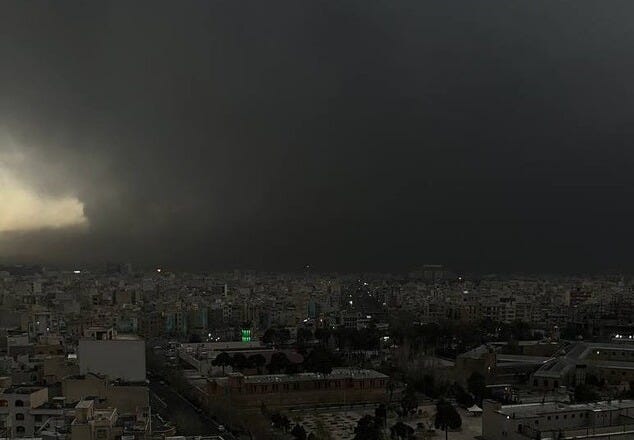
Black smog covers Tehran after Israel struck three oil depots last night.
It’s Sunday, March 8, and the ninth day of Operation Roaring Lion. Here are the latest developments while you were asleep:
For the first time in the war, the U.S. and Israel have begun striking Iran’s oil infrastructure. Three oil depots in western Tehran were allegedly hit by Israeli fighter jets, leaving the capital with poisonous rain, smoke clouds and fire in the sewage system. With Kuwait announcing a reduction in output and Qatar warning of major supply risks, the price of oil has shot up more than 14 percent since the beginning of the war to more than $90 a barrel.
After Iran fired more than 196 ballistic missiles at the country, the United Arab Emirates reportedly attacked Iran for the first time. According to an Israeli source, they have struck a desalination facility.
One soldier from the IDF’s Givati Brigade was killed by a Hezbollah anti-tank missile. This marks Israel’s first military fatality of the war and Hezbollah’s devolution from a terror army into a guerrilla force.
Meanwhile, the Mossad’s official Farsi account posted a bizarre question last night: “Why did Mojtaba Khamenei burn his father’s will?” Mojtaba survived an IDF strike earlier in the war and—despite no official announcement—is widely rumored to be in line as Iran’s next Supreme Leader. A source close to Ali Khamenei told Reuters in 2024 that the leader opposed a return to hereditary rule. If Khamenei Sr. put that objection in writing, his son may have found it necessary to erase the evidence. After Israel recently promised to “pursue every successor and anyone who seeks to appoint a successor,” Mojtaba may come to regret disregarding his father’s wishes.
After a British military base in Cyprus was targeted by Iran, the U.K. decided to send HMS Dragon to the island, only for the destroyer to be delayed because the “dockyard only works nine-to-five.” According to a report from The Telegraph last Wednesday, the ship will not arrive in the eastern Mediterranean for another fortnight—long after the ships of Britain’s historical rivals France and Spain.
Now, on to the details.
Aghdasieh oil depot east Tehran in flames last night.
Nestled in the Persian Gulf there is a tiny, five-mile-long stretch of land called Kharg Island. This dot in the middle of the sea contains the infrastructure that processes more than 90 percent of Iran’s oil exports, and by extension something like a quarter to a third of Iran’s economy.
Overnight, Israel struck three oil depots in western Tehran—the first time oil infrastructure has been targeted in this war. And you might be asking: why only now? Most of the regime’s revenue flows from oil pipelines; knocking them out would be a devastating blow to the ayatollahs.
There are three reasons.
You don’t burn your trump card on day one if you think you may need it on day ten. If Iran is still holding something back, leaving a large, vulnerable target untouched is how Israel and the U.S. maintain escalation dominance.
Oil prices are already climbing. With the Gulf states hesitating to ramp up production to compensate, taking Iran decisively out of the market risks hitting the global economy—and, more disastrously for Trump, Americans at the gas station.
The U.S. and Israel are thinking about the day after the regime. A post-ayatollah Iran, if it arrives, will need revenue on day one. Keeping the oil system mostly intact may serve as an American and Israeli “gift” to whoever takes up the reins—conditioned, like in Venezuela, on the U.S. determining their buyers.
So why strike now?
It’s a warning shot—reminding Tehran that it still has much more to lose. If Israel were truly going for the knockout blow, five bombs on one small island in the Persian Gulf is all it would take.
Benjamin Netanyahu meeting with Israeli Air Force pilots and ground crew last week. (@netanyahu/X)
“Now we turn our eyes to the next twenty-five years, which will bring us to the centennial of Israel’s rebirth,” said Prime Minister-elect Benjamin Netanyahu when presenting his government in the Knesset on the final debate day of 2022.
“In the next four years we will act so that by our hundredth year of independence Israel will be a thriving global power, strong and no longer questioned in its existence. To achieve this there are three major missions: the first is to thwart Iran’s efforts to develop an arsenal of nuclear bombs that threaten us and the entire world.”
“And what about the damage to the Supreme Court?” shouted MK Yorai Lahav-Hertzanu of Yesh Atid. His colleague Naor Shiri continued: “We also have limits. You can’t come here and make these lies.”
“These members are shouting that Iran will not destroy us with nuclear bombs—that it’s not important, that it’s minor,” Netanyahu replied. Then the protocol recorded the rhythmic chants of the incoming opposition: “Weak. Weak. Weak. Weak. Weak. Weak. Weak. Weak.”
Netanyahu was not the first to talk about Iran, and certainly not the only one. But he was the most consistent leader in Israel—and arguably in the world—in focusing attention on the threat. He did so while facing torrents of ridicule and accusations that Iran was merely a political spin. And above all, he was the one who led the IDF together with the United States—twice in one year—to eliminate the gravest existential threat to the State of Israel.
For that reason he justly deserves full credit for the historic alliance. All the opposition leaders’ statements this week, which carefully praised the security establishment while ignoring him, were a model of pettiness—and above all a political mistake. When credit is due, it is due.
What will Netanyahu do with the public credit he accumulates? In theory, if his life’s mission is nearing completion, perhaps he will not run again—finish his trial and retire. After all, elections do not reward completed missions, only future problems.
“A nice thesis,” says a Netanyahu associate, “but the prime minister’s car has only one gear: forward.” Trump is there until 2029, and Netanyahu intends to make the most of every day of the great alliance. In other words: he has no plans to start looking for a lecture circuit.
This is an excerpt from my weekly column in Israel Hayom
IDF forces in Lebanon last week. (IDF)
Three years ago, calling Hezbollah a terrorist group was controversial. The organization was the world’s most powerful non-state actor, boasting an army and arsenal larger and more deadly than that of Lebanon. What began as a small guerrilla force launching small-scale raids against Israeli positions in the 1980s evolved over the course of decades into what Obama’s defense secretary Robert Gates called “a state within a state,” with conventional capabilities to match.
Three years and an Israeli offensive later, the organization has lost 80 percent of its missile arsenal, most of its leadership, and much of its terror infrastructure. The organization is still capable of firing small barrages of short-range missiles into the Galilee, but the dream of reducing Tel Aviv to ashes went up with those missiles in a pillar of smoke.
In the Second Lebanon War in 2006, Israel often fought to take positions only for the well-trained Hezbollah fighters to melt away. In the third round in 2024, it faced a more degraded but still professional force—backed by tens of thousands of rockets and missiles. When Israel launched its fourth ground offensive last week, the battlefield was a flashback to the 1980s: small squads armed with anti-tank missiles and small arms, fighting like guerrillas again rather than the quasi-army Hezbollah spent decades trying to become.
Much of this is due to the 2024 offensive and subsequent ceasefire. Hezbollah has been forced to reposition the remainder of its forces deeper inside Lebanon under Israeli and Lebanese pressure. What’s left below the Litani River is isolated, undersupplied, and low on moral.
Over the past four days, Israeli Air Force aircraft have struck approximately 600 Hezbollah sites, employing roughly 700 munitions against terror infrastructure mostly above the Litani—and it doesn’t look like it will be letting up anytime soon.
It took 20 years of Israeli occupation of southern Lebanon and billions of Iranian dollars to build Hezbollah into what it was. Discredited and crippled as it is today, I imagine it will take more than 20 years to recover—if it survives at all.
The HMS Dragon in 2011 (Royal Navy)
“To be prepared for war is one of the most effective means of preserving peace.” George Washington said that in his first address to Congress in 1790. Less than a hundred and fifty years later Winston Churchill spent the years of German rearmament saying the same thing in a hundred different ways.
Today it seems the Americans remembered the lesson. The British—less so.
After Iran targeted a British military base in Cyprus last week, the UK resolved to reinforce the island with a destroyer—only to discover that the dockyard needed to outfit the ship “only works nine-to-five.” Quite a contrast to Churchill’s sixteen-hour days, and he managed those while half-drunk and chain-smoking.
The destroyer, HMS Dragon, won’t reach the theater for at least another week. The truncated working hours are reportedly the result of the Ministry of Defense trying to save £250 million on its port contract. At least now we can put a precise price tag on military readiness.
It feels almost cruel to mock the military impotence of the empire on which the sun never set now struggling to enter another time zone. But it’s hard to ignore a military that has more admirals than ships, and more horses than tanks.
While Britain is desperately scrambling to extend its dockyard’s working hours, the U.S. and Israel are continuing their week-long demonstration of military readiness in the skies of Tehran.
After this fiasco Churchill’s body might roll to Cyprus before HMS Dragon sets sail.
If you enjoy the newsletter, you can show your support by becoming a paid subscriber—it really helps keep this going. I’m also offering a special monthly briefing for a small group of premium members. I’d love to have you join us—just click below to find out more.
Thanks for reading It’s Noon in Israel! Subscribe for free to receive new posts and support my work.


One of the best, if not the best analysis of Israeli politics and the current war. Incredible writing. Praying Bibi stays to 2029. With Trump, personal relationships are paramount. Just hope the Israeli electorate understands this. Presently, there is no opposition figure that could develop a similar relationship.
What, no mention of the Lebanon raid to recover a 40-year old corpse?