Operation Roaring Lion Day 2: Tehran in Flames
Also, updates, a polymarketer with suspiciously good luck, and more.
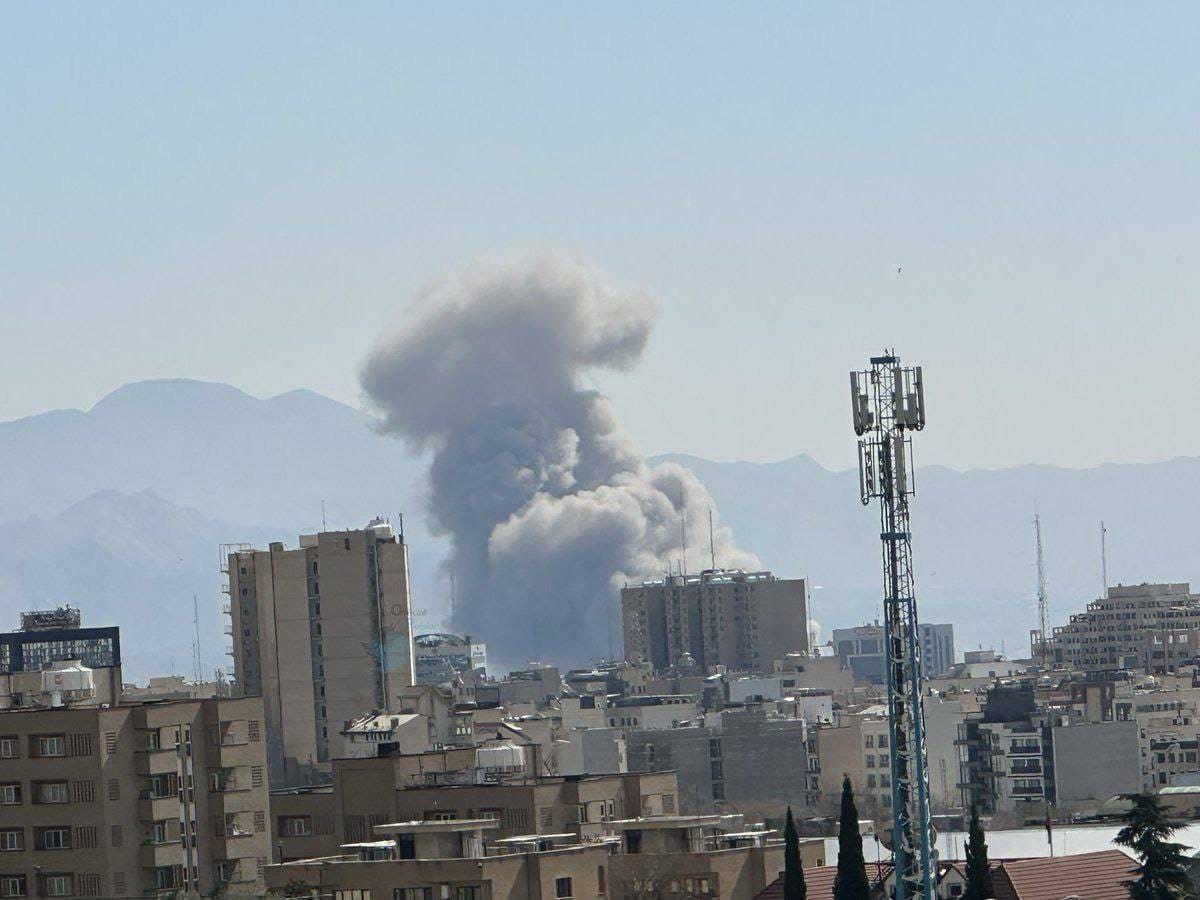
A ploom of smoke rising in Tehran after an Israeli strike this morning.
It’s Sunday, March 1, and the second day of Operation Roaring Lion. Here are the latest developments while you were asleep:
The regime admited that Supreme Leader Ali Khamenei was killed, eliminated in an Israeli operation on his compound. He was struck during a meeting with his senior advisers, who were also eliminated—an opportunity the U.S. and Israel were reportedly waiting “several weeks” for. This marks the first time Israel has eliminated an enemy head of state.
Iran has reportedly targeted Cyprus, adding the far flung island nation to the list of countries including Oman, Kuwait, Bahrain, Iraq, Qatar, Saudi Arabia and the UAE the regime has attacked.
The chief of staff of the Iranian army was confirmed killed this morning, adding his name to the lengthening list of military and regime personnel already eliminated. That list includes 40 commanders and senior officials of the regime killed within a single minute of the opening strike.
A missile made it past Israel’s air defense, striking Tel Aviv. One woman was killed, and 15 were lightly to moderately injured, including seven children. Forty buildings were damaged by the missile—more than 200 residents have been evacuated to hotels. Reports today confirm a second casualty: A woman around 60 years old died from shortness of breath on her way to a shelter.
The IDF is now striking regime targets in the heart of Tehran after laying the groundwork overnight for an air route to the Iranian capital.
Now on to the rest of the news.
In the days following October 7, a cabinet member wrote to me. He had just come out of a shocking meeting. “The country was in a dire state,” he told me. I asked him what he meant. He said: “We will now be busy in Gaza, we will also be busy with Lebanon—and in the meantime, the Iranians will race toward the bomb.”
In hindsight, this was not paranoia. They did move toward it. They were stopped once in June; they stumbled, fell and were hurt. The current Operation Roaring Lion is an attempt to ensure they stay down. At the outset of this conflict, the assumption was that there will not be a third opportunity. So Israel pulled from its arsenal a never-before-used weapon: the removal of an enemy head of state.
Over its 78-year history, Israel has had countless executive enemies—Gamal Abdel Nasser, Hafez al-Assad, Saddam Hussein—but aside from one planned attempt against Saddam that never materialized, Israel has never eliminated an enemy head of state.
This is the first time such a thing has happened. And it would never have happened were it not for the chain of events that began with the terrible tragedy, the horrific disaster and the grave failure of October 7. On that morning, who could have imagined the series of events that would lead to this clash of titans between two civilizations—Israel and Western civilization versus Iran and Islamic fundamentalism—to a moment in which Israel’s hand prevailed?
Israeli F-35 fighter jets fly in formation during a nuclear strike exercise in October 2021. (Israel Defense Forces)
Over the past 24 hours, in the largest-ever IAF attack, Israel and the U.S., have eliminated regime leadership, the scattered remnants of Iranian air defense and the first round of ballistic missiles and launchers. A great start, but what should we expect in the coming days?
Much of the same. In Iran, the forecast calls for sustained strikes on missile silos and launch sites, with recurring explosive storms targeting instruments of repression and the regime’s remaining leadership.
Yet to make their 50,000-foot appearance are the U.S.’s big guns—namely the B-2 and B-52 bombers. For the moment, they may be being held back so the U.S. has more cards to play in case of escalation. Or they could be being fitted for an attack on Iran’s remaining underground missile and nuclear facilities as you read.
As for the fighter jets, their task will be reminiscent of the effort to stop Saddam Hussein’s 1991 missile attacks on Israel and Saudi Arabia, known as “the Great Scud Hunt.” Hopefully this hunt will be more fruitful. Despite 2,500 coalition sorties, the Pentagon could not confirm even one Scud launcher destroyed after the first Gulf War. Thankfully, technology has advanced since then, and Israel has plenty of experience hunting this specific game.
In the past 24 hours, Iran has attacked more Arab states than Israel has in its entire history, including Oman, Kuwait, Bahrain, Iraq, Qatar, Saudi Arabia and the UAE. It also attempted to strike one non-Arab country, Cyprus. Aside from a British military base, I do not see why the Cypriots deserve Iranian attention. But perhaps the Arabs will learn a lesson after their recent attempts at Iranian conciliation: The Islamic lion will always bite the hand that feeds it.
Hunting down the missiles is critical. The Iranians have found a distinct lack of return on their proxy investment. So far, Zohran Mamdani, Rashida Tlaib and Hezbollah have provided the same support to Iran: a strongly worded condemnation. Given that Tehran pays Hezbollah nearly a billion dollars a year, I suspect it expected more from its explicit ally.
The Iranian air force is what might be kindly referred to as a joke, and compared with the U.S., its navy is similarly unserious, leaving its only two serious weapons, ballistic missiles and drones.
The most important task for Israel and the U.S. forces is clear: disarm the regime. Take out the launchers and stockpiles, and the regime will resemble the Black Knight from Monty Python and the Holy Grail—legless, armless and pitifully threatening to bite at the allies’ shins.
An suspiciously lucky user pocketed nearly $200,000 on Polymarket yesterday. The user, who goes by the nickname magamyman, had placed the bet on the attack occurring on that exact date weeks earlier, when the probability stood at just 17 percent.
Magamyman might appear to be just another lucky gambler, but his is no ordinary account. A few weeks ago, a reservist from a sensitive Air Force unit, Y.D., drew my attention to him. This gambler had previously changed his username after a series of highly unusual—and highly successful—bets, almost all tied to the precise dates of Israeli strikes. In total, he reportedly earned around 2.5 million shekels.
Notably, he correctly predicted the exact date of the Iranian strike on October 26, 2024, following Israel’s retaliation for Nasrallah’s assassination. He also placed a side bet that the strike would not occur on any of the preceding days—and profited handsomely from that as well.
According to internal inquiries, the October 2024 strike date had been finalized several days in advance—potentially early enough for someone with prior knowledge to act on it.
He also pocketed another hefty sum after accurately betting on the invasion of Syria following the regime’s collapse in 2024.
The gambler not only predicted the correct day for the most recent strikes, but also bet against any other date before February 28. Yesterday at 7:33 a.m., just before the strikes, the gambler significantly increased his position that an attack would take place that day.
Afterward, he changed his username again.
All inquiries by Y.D.—and by me in recent weeks—to the defense establishment have gone unanswered.
So what is it: insider information, extraordinary instinct or just unbelievable luck?
The lion of Tel Hai
In yesterday’s emergency edition, I mentioned the powerful symbolism of the strike beginning as many in Israel were hearing the verses commanding us to remember what the genocidal Amalekites did to us. But that is not the only symbolism behind Operation Roaring Lion.
Whoever coined the name remembered well what happened on this very day, the 11th of Adar, 106 years ago: Zionist hero Joseph Trumpeldor and seven of his comrades fell, alone, against a mob of Arab rioters while defending the settlement of Tel Hai. An iconic statue was erected on the spot—a proud lion roaring defiantly to the sky.
In a way, the Shabbat in which we read about the Amalekites, Shabbat Zakhor, February 28, was the day all Israelis knew deep down would be the day of the attack.
As always, the global press—and to a lesser extent the local press—served as an unwitting agent of deception. It depicted a rapprochement between the United States and Iran and a distancing by Trump from the prospect of a strike. But the furious speech by the president of the United States, in which he detailed the crimes of the ayatollah regime, showed that this was far from the truth—demonstrating that the name of the American operation, “Immense Fury,” was also not coined casually.
Benjamin Netanyahu on the phone last night, note the book on his desk.
There are very few precedents for wars fought with the level of coordination now seen between the armed forces of the United States and Israel. The leading example in American history is the war against Nazi Germany. The only example in Israel’s shorter history is the Suez Crisis, in which Britain, France and Israel acted together to capture Sinai.
Cooperation between Israel and the United States has reached an unprecedented historical peak precisely as Israel’s standing in American public opinion has sunk to its lowest level in many years—not only in the Democratic Party, which is almost a lost cause, but deep within the Republican Party as well.
Tucker Carlson, perhaps the most powerful antisemitic figure in the world after the death of Ali Khamenei, spent many hours in the Oval Office trying to dissuade his friend Trump from striking. The president listened but did not reveal that the decision had already been made. Both Tucker and Trump know—as does Netanyahu—that it is doubtful there will be another occupant of the Oval Office in the foreseeable future who will be such a friend to the Jewish state.
The whiskey and a Purim themed clown wig, in front of the Kirya.
One last thing. Last night at the IDF headquarters in Tel Aviv—the Kirya—they offered a celebratory toast, pouring what I can only imagine were generous shots from a whiskey bottle bearing the successfully eliminated Khamenei’s face on the label. This is part of an “Axis of Resistance” special batch, in which each bottle is stamped with the faces of Iran’s network of proxies. The 10-year-old Nasrallah edition was emptied, the Sinwar blend as well. Right before Purim, it seems the IDF is running out of liquor.
If you enjoy the newsletter, you can show your support by becoming a paid subscriber—it really helps keep this going. I’m also offering a special monthly briefing for a small group of premium members. I’d love to have you join us—just click below to find out more.
Thanks for reading It’s Noon in Israel! Subscribe for free to receive new posts and support my work.


I suspect the gambler in Polymarket is Pete Hegseth. I think he has back alimony to pay. All kidding side, who says the gambler is an Israeli and not someone at the Pentagon.
Thank you. Trying to get distilled info here in America, takes digging in multiple places. Case in point, news here are only reporting one casualty atm