Operation Roaring Lion Day 28: Bibi Sets a Timeframe
Also, the region after the war, the IDF chief warns of the army's collapse, and more.
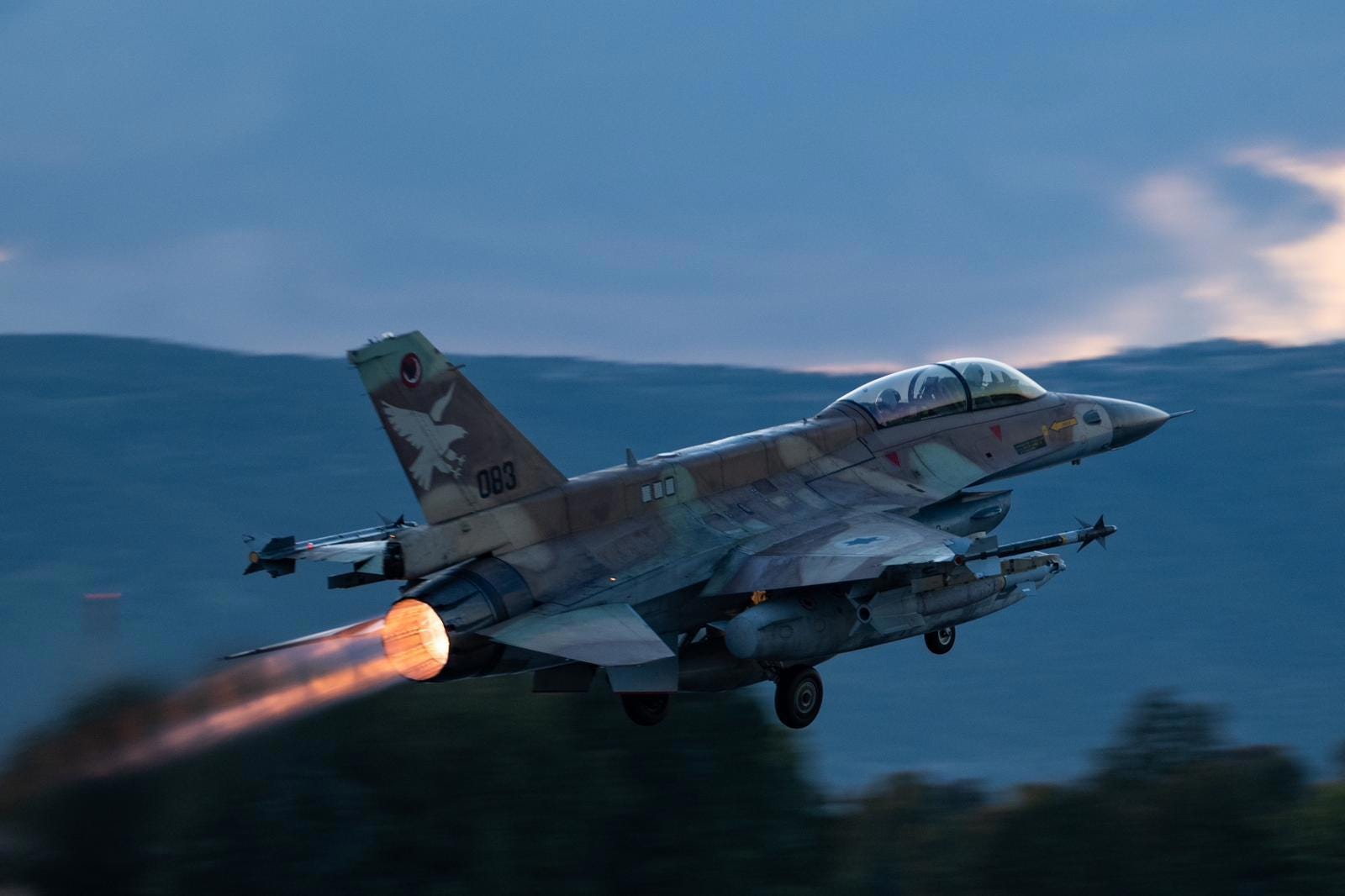
An IDF fighter plane on its way to a sortie in Iran. (IDF)
It’s Friday, March 27, and the twenty-eighth day of Operation Roaring Lion. The global price of oil has reached $109, up 51 percent since the start of the war. Here are the latest developments while you were asleep:
While Trump claims he’s working on a negotiated end to the war, the U.S. is considering deploying up to 10,000 additional ground troops to the Middle East, the Wall Street Journal reported yesterday. The force would likely include infantry and armored vehicles, supplementing the 82nd Airborne Division already in the region, in order to give Trump additional “military options.” Analysts suggest the 82nd Airborne is positioned with Iranian strategic assets—specifically Kharg Island—in mind. It remains unclear where the additional forces would be stationed.
Yesterday, Hezbollah fired over 100 rockets at Israel. Uri Peretz, 43, a father of four from Nahariya, was killed after not making it to a shelter in time. A man in his 50s was seriously wounded, and 13 others were lightly injured by shrapnel.
Sergeant Aviad Elchanan Volansky, 21, from Jerusalem, was killed recently when an anti-tank missile struck a tank belonging to the Golani Brigade’s combat team. Four additional IDF soldiers—two officers and two fighters from Battalion 77—were lightly injured in the attack. Aviad was the cousin of Elhanan Klein, may his memory be a blessing, who was murdered at the start of the war. He was named after his uncle, who was killed in the 2002 terrorist attack in Eli. IDF fatalities during this war have risen to 5.
Sergeant Aviаd Elchanan Volansky recently killed in Southern Lebanon.
Naftali Bennett gave his first interview in months last night, attacking Donald Trump’s pardon initiative, the Haredi draft law, and the conduct of the current war. “We’re not winning on any front—not in Gaza, not in Lebanon, and with Iran, we’ll see,” he said. Bennett also used the opportunity to map out his coalition red lines: he will not serve under Netanyahu, will not ally with Ben Gvir, the Arab parties, or the Haredim. He said he would consider Bezalel Smotrich’s Religious Zionist party—but only if Smotrich takes a hard line against ultra-Orthodox draft exemptions.
Now, on to the details.
Head of military intelligence Shlomi Binder. (IDF)
“How much time do I have?”
“Between an hour and two months,” Benjamin Netanyahu answered.
The question came from Shlomi Binder, head of AMAN—the IDF’s intelligence branch. It is the question no one seems able to answer: how much longer will this war go on?
“I don’t want to see it go on too long,” Trump told CNN on March 2. “I always thought it would be four weeks. And we’re a little ahead of schedule.”
Well—happy March 27. We’ve now reached the four-week mark, more than doubling the length of the June war. As for being “ahead of schedule”—to channel Ronald Reagan, you should never expect government to be on time.
“We have the capability to go far longer,” Trump added. After all, “I don’t get bored.”
Recent actions don’t suggest boredom—but they do suggest the war won’t go on “far longer.” The question is: how much longer? Judging by Binder’s question and Netanyahu’s answer, even Israel doesn’t know.
For all the theatricality of the war, the idea of an abrupt ending is surprising—if not a bit disappointing. It seems the Pentagon agrees, if for strategic rather than presentational reasons. According to reports, the Pentagon and U.S. Central Command are developing plans for a “finishing blow” against Iran.
Four main options are reportedly on the table:
Invading or blockading Iran’s oil chokepoint Kharg Island.
Seizing Larak Island, which anchors Iran’s control of the Strait of Hormuz;
Taking control of Abu Musa and two smaller islands near the strait’s western entrance.
Intercepting Iranian oil tankers on the eastern side of Hormuz.
The military has also prepared plans for ground operations deep inside Iran to seize enriched uranium from nuclear facilities.
After that kind of operation, Trump has options: he can go back into negotiations, dangling new assets, or call an end to the war unilaterally, with something major to show for it.
All of that takes time to prepare—time the global economy doesn’t seem willing to give Trump after his energy ultimatum. If only there were a way to calm the markets—perhaps by letting negotiations drag on and extending the deadline while the military prepares.
If only.
The foreign ministers of Baharian, Egypt, Israel, Morocco, UAE at the Negev Summit in March 2022. (U.S. Department of State)
“There is a messianic view that says Iran will collapse immediately and peace will come upon us,” Netanyahu said this week, as disappointment grew in Israel over reports of a possible end to the war. “But it doesn’t work like that. There will be improvement in percentages, not a knockout—not just with Iran, but mainly with the region. The most important thing is that now the whole world understands what we’ve been saying: Iran is a global threat.”
A “new Middle East”? The pessimists will say the world will return to its old habits—the moment the war ends, Qatar will resume pumping anti-Israel incitement through Al Jazeera, and Saudi Arabia will return to its distancing track of recent years. The optimists will tell you that this summer we’ll be visiting Tehran—and that we’ll get there by car through Saudi Arabia, with a Qatari ship ferrying us across the Persian Gulf.
But perhaps we should let go of the idea that Mohammed bin Salman or Al Thani will suddenly love us, and start thinking in terms of interests. Gulf states publicly insist they have no interest in war and reserve the right to respond (when does “reserving the right” end and responding begin?—asking for a friend), but behind closed doors they are urging Trump to go all the way.
What would reality look like in the UAE or Qatar—states that have invested hundreds of billions over decades branding themselves as global hubs of business and tourism—if, just 150 kilometers away across the Persian Gulf, a volatile neighbor capable of launching missiles at any moment remains?
In Joe Biden’s final year as president, there was much talk of a U.S.–Saudi defense pact. The claim was that Biden conditioned it on normalization with Israel. At the time, MBS was also engaging China, Russia, and Iran—signaling to Washington that he had other options. Those alternatives are far more tempting: they don’t demand minority rights, and they have no particular issue with dismembering journalists with a chainsaw. So why side with a distant state across the Atlantic?
It is no coincidence that both Trump and Hegseth have emphasized since the start of the war the strength of the U.S.–Israel partnership and the weakness of other states, which have refrained even from securing the Strait of Hormuz. Whether in coordination between Israeli and American pilots over Tehran or in intelligence cooperation the world has never seen, the message to the Gulf is clear: this is what a U.S. defense alliance looks like.
Meanwhile, Iran is trying to draw in Russia and China, but so far the assistance amounts to little more than a few Chinese defense systems and Russian statements. It is the missiles exploding in Isfahan and Shiraz that are resonating globally.
This cooperation is already shifting Gulf states. A dramatic statement by a UAE presidential adviser effectively buried the Arab League (“they only take aid but offer no support”) and signaled a turn toward deeper cooperation with the U.S. and the West. Open participation by the UAE and Qatar in the campaign—not quietly, but openly—would be a major force multiplier. That is what occupies Israel now.
This is an excerpt from my weekly column in Israel Hayom.
Ultra-Orthodox soldiers from the Hasmonean Brigade take part in a ceremony at the Western Wall in Jerusalem’s Old City, August 2025. (Chaim Goldberg/Flash90)
“I am raising 10 red flags,” said IDF Chief of Staff Eyal Zamir. The army is going to “collapse in on itself,” he warned the cabinet yesterday.
Two mistakes were made here. The first was Zamir’s choice of audience—the cabinet is so informationally airtight you could use it to strain pasta. The second was the rest of the world’s, which chose not to read the rest of the quote that contextualized the statement: “Right now, the IDF needs a conscription law, a reserve duty law, and a law to extend mandatory service.”
Despite widespread celebration on pro-Iran channels, Hezbollah may have to cancel its party plans. The IDF is not collapsing—at least not tomorrow.
So what is Zamir actually talking about?
Demand for soldiers is rising faster than recruitment. After October 7, the IDF has moved away from a technology-heavy approach and back toward a more manpower-intensive doctrine. Positions in Judea and Samaria, southern Lebanon, and Gaza all need to be filled. The conclusion is simple: it needs more soldiers.
For now, the IDF is managing with reservists—but at a heavy economic and social cost. For many, this is the seventh round of reserve duty since the beginning of the war. For some, that amounts to over 400 days away from their careers and families.
Which brings us back to Zamir’s audience—the government.
If they sense the threat, they are not showing it. A bill is currently making its way through the Knesset that would reduce mandatory service from 36 to 32 months. Yes, in the middle of a war, Israel is considering shortening service—largely because no Knesset member wants to be responsible for extending it.
And then there is the elephant with long sidelocks.
The Haredi draft bill continues to drift between life and death as support is given and withdrawn. Regardless of whether it survives, in its current form it will not meet the IDF’s needs. Like previous versions, it relies on recruitment targets. Despite there being more than 54,000 eligible Haredi youths, the IDF cannot absorb them all at once. Yet unlike previous versions, this law removes quotas for combat units and critically weakens enforcement mechanisms—ensuring that even those caught in the net may still avoid service.
The uncomfortable truth is this: the IDF is deployed at a scale not seen since the Six-Day War, but with a service structure being shaped for world peace.
So is the IDF collapsing?
The answer, unfortunately, is not yet.
On that happy note, Shabbat Shalom!
We will be back on Sunday.
English Editor: Ari Tatarka
If you enjoy the newsletter, you can show your support by becoming a paid subscriber—it really helps keep this going. I’m also offering a special monthly briefing for a small group of premium members. I’d love to have you join us—just click below to find out more.
Thanks for reading It’s Noon in Israel! Subscribe for free to receive new posts and support my work.


The Hasmonean Brigade holds out hope for an Israel where everyone pitches in. It is a thriving country, but thriving on a frontier where everyone needs to work to keep it secure. There's no alternative besides serving or suicide.
Why anyone thought there was going to be instant regime change in Iran when the IDF decapitated leaders, bombed and ultimately invaded and occupied Gaza and after over two years Hamas remains in power is beyond me.