Operation Roaring Lion Day 35: The Unknown Israeli and Iranian Behind This War
Netanyahu's quiet partner, Iran's crypto billionaire, and more.
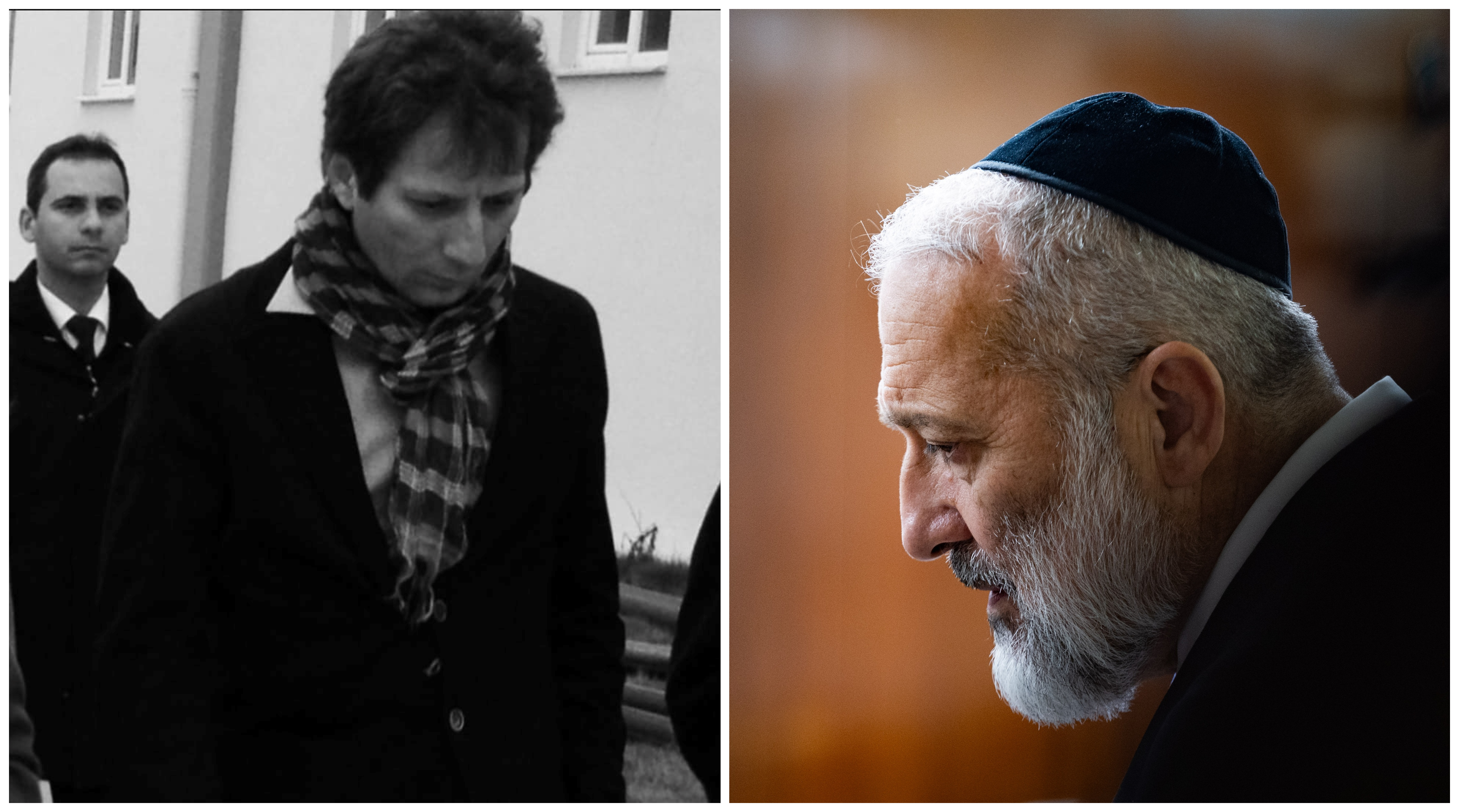
Shas chairman Aryeh Deri and Iranian billionaire Babak Zanjani. (Yonatan Sindel/Flash90/Babak Zanjani/Facebook)
It’s Friday, April 3, and the thirty-fifth day of Operation Roaring Lion. The global price of oil has reached $111, up eleven percent since yesterday. Here are the latest developments while you were asleep:
Donald Trump’s primetime address Wednesday night marked no significant shift in the war’s trajectory—as I predicted. The president reiterated four familiar positions: the war is necessary, it has effectively already been won, it must continue, and it will end soon. As of today, the original four-to-five week timeline has elapsed. Based on an IDF statement from March 15 indicating that up to three additional weeks of strikes were under consideration, the current estimate now points to a total campaign lasting seven to eight weeks.
Yesterday, the U.S. struck Iran’s largest bridge, collapsing the center of a newly built B! suspension bridge—a 136-meter-high, $400 million structure connecting Tehran and Karaj. According to a security source speaking to i24NEWS, the destruction was intended to cut off supply routes that bring drone parts and missiles to Iranian firing units that launch them at U.S. and Israeli forces. Trump shared footage of the strike on Truth Social, declaring, “The biggest bridge in Iran comes tumbling down, never to be used again,” and warning of “much more to follow” if a settlement is not reached.
Iranian media reported this morning that a second F-35 stealth fighter had been shot down over central Iran—echoing a March 23 claim previously denied by United States Central Command. As with the earlier report, there is no independent verification.
Now, on to the details.
Benjamin Netanyahu and Shas party chairman Aryeh Deri in 2020. (Yonatan Sindel/Flash90)
Passover 1990. The parks are empty and people are staying home—not because of Home Front Command restrictions, but due to early warnings of an unprecedented event: the fall of a government. The broadcast on Channel 1—the only channel at the time—began as a festive program for the swearing-in of a new left–ultra-Orthodox government led by Shimon Peres, weeks after that same coalition had unexpectedly toppled the unity government led by the right-wing Yitzhak Shamir. Minutes and hours passed, and it became clear that no vote would take place.
Thirty-six years later, on Passover, it’s not even clear what all the fuss was about or who the main players were. Nearly eighty of the 120 Knesset members from that time are no longer alive. The dust of forgetting has settled on many of them, including the two central figures, Shamir and Peres. Not long ago, I spoke before several hundred teenagers in Samaria. When I asked who knew who Peres was, only half raised their hands. When I was their age, he was the most famous—and infamous—person in the area.
Only two figures remain with us from that time. One was then the youngest MK and is now the longest-serving: Benjamin Netanyahu. The second wasn’t even an MK but steered the drama: his name is Aryeh Deri.
As the man closest to the leader of Jews of middle eastern origin, Rabbi Ovadia Yosef, Deri was present at the moment when a marginal, impoverished Jerusalem neighborhood—one that had never known the benefits of community centers—suddenly became the focus of attention from the nation’s elite.
In 1992, Deri was the left’s great and improbable hope—a lottery win without buying a ticket. It was no coincidence that in the first elections after the death of the beloved Menachem Begin, Shas, the party focused on Middle Eastern Jews, surged into the Knesset. Shamir failed to connect with the most neglected voters, and four seats for Deri became six.
Without Rabbi Ovadia backing the party, many might have voted for Meir Kahane’s movement; without Deri, they might have become a satellite of Likud. But the young, sharp, sophisticated politician led them toward a willingness to sit with the left. He instinctively understood what academia would only grasp a decade later: as the dispute over the territories intensified, the ultra-Orthodox parties—lacking a formal position—became the balance of power.
Peres understood this earlier. He offered Shas a remarkable deal: massive funding for education, government ministries, even a national radio station. But Deri told Labor leaders something they missed: “I can help you bring down Shamir, or help you form a Peres government—but not both.” Labor used that leverage to topple Shamir in a no-confidence vote—the first and only time in Israeli history—and no more.
It’s common to mark the turning point in relations between the ultra-Orthodox and the left at the Oslo government of Yitzhak Rabin and Peres, where Shas was a senior partner. But that’s not quite accurate. The rule set in 1990 was that the ultra-Orthodox ultimately lean more toward the right. They are a balance—but not a neutral one. That’s why they joined Rabin only after he already had 61 seats, and similarly with Ehud Barak in 1999 and Ehud Olmert in 2006. That’s also why, at that critical moment in 1990, Shas did not ultimately bring Peres to power—leading to one of the greatest disappointments of his career.
Passover 2008. Aryeh Deri, now out of prison for financial crimes, plans a comeback—first considering a run for mayor of Jerusalem, then returning to Shas leadership. Netanyahu is alarmed. As Likud leader, he fears the collapse of his bloc. He works to support then-Shas chairman Eli Yishai. To Netanyahu, Deri is a predator, not a partner. Likud works behind the scenes to block his return. Even legislation is proposed to bar convicted politicians. When Deri returns anyway and takes control of Shas, distrust continues for years. In 2014, when Netanyahu is forced to govern without the ultra-Orthodox, Deri publicly backs opposition leader Isaac Herzog—but likely without real intent.
Passover 2026. Prime ministers don’t turn their backs on anyone—but if there’s one person Netanyahu fully trusts, it’s Deri. Both are veterans of decades in politics. Today, Deri is almost single-handedly responsible for the survival of the right-wing bloc and Netanyahu’s government during some of Israel’s most difficult years.
After October 7, Deri receives quiet offers—from within Likud and beyond—promising him “half the kingdom” if he helps topple the government. He rejects them outright. Ironically, he has no personal gain: he served as minister for only 20 days before the High Court forced him out. New elections might benefit him, but he refuses.
The alliance is now unbreakable. They barely even speak—it’s no longer necessary. The bond between Likud and Shas is ironclad. There are reasons: Deri’s belief that his past cooperation with the left led to his legal troubles; solidarity with Netanyahu against the judiciary; and his broader national perspective. Unlike other ultra-Orthodox leaders, Deri sees the bigger strategic picture.
There is also a structural shift: as the Palestinian issue fades and questions of identity take center stage, the ultra-Orthodox are no longer a swing factor. They are firmly embedded within the right-wing bloc.
On the eve of major events—whether military or political—Deri often knows what’s coming. Before the Iran strike, he was the only ultra-Orthodox leader aware. Before “Roaring Lion,” he tried to prevent a coalition collapse, knowing what was ahead.
Does he enjoy it? Probably not. But Netanyahu should be praying three times a day that Shas stays. The right-wing bloc has survived past defections—from Avigdor Lieberman to Naftali Bennett—but it would not survive another. And as long as Deri remains, it won’t happen.
This is an excerpt from my weekly column in Israel Hayom
Babak Zanjani addressing shareholders in 2025. (Babak Zanjani/Facebook)
More than almost any of the generals and military figures, there is one man whose elimination might truly cause the regime to topple. The man could have been a Silicon Valley billionaire; instead, he joined the Revolutionary Guards: Babak Zanjani, the architect of Iran’s crypto-based sanctions-evasion system.
Zanjani’s is a fascinating story: the son of a railway worker with no higher education who became a businessman and built a global empire of dozens of companies across Turkey, the UAE, Malaysia and Tajikistan—designed specifically to bypass sanctions. In 2013, he was arrested for allegedly embezzling $2.7 billion from state oil revenues and sentenced to death—but the sentence was never carried out. It turned out the architect of its shadow economy was more valuable to the regime alive than dead. Before and during his arrest he was a media fascination, and was the most famous prisoner in the history of the Islamic Republic. After his gamble on the explosion of crypto netted major returns for the regime, Zanjani was released under supervision in 2025.
According to Makor Rishon’s Pazit Rabina, Israel has declared the first crypto war, and Zanjani is the enemy. He has been identified as the “beating heart” of Iran’s shadow economy—the man who converted oil revenues and financial assets into digital assets, enabling the Revolutionary Guards to continue funding terror even under the heaviest sanctions.
Earlier this week, Defense Minister Israel Katz, in cooperation with the U.S. treasure department, signed an administrative order designating Zanjani’s crypto wallets and oil tankers as terror assets. The order grants Israel and the U.S. legal authority to freeze and seize billions of dollars across global trading arenas. Yet well-informed sources warned that the effort is “too little, too late.”
Despite the concerns, the official designation of Zanjani as a “terror entity” is far more than linguistic. According to Rabina, investigations recently uncovered two major crypto exchanges in the U.K. under his control—“Zedex” and “Zedexion.” According to estimates, since 2022 they have processed transactions worth more than $94 billion, mainly using stablecoins pegged to assets like the U.S. dollar or gold. That means that despite investing in a notoriously unpredictable asset, the Islamic Republic was largely insulated from market volatility.
The striking detail is that Zanjani didn’t need to work that hard—Rabina reports that he used fake identities and AI-generated images to create fictitious executives for these companies. One such persona was a smiling Caribbean woman whose image was traced back to a Shutterstock database.
Even when Iran was largely cut off from the global banking system (SWIFT), Zanjani’s crypto services allowed it to continue covert defense purchases, transfer funds quickly and—most importantly—keep exporting energy via a sanctions-free mechanism that converts oil into digital assets.
Zanjani’s bitcoin exchanges are only the financial side. To produce the bitcoin Iran was trading, it first had to be mined—a process requiring enormous electricity consumption. You may remember that before this war, Tehran was experiencing regular power outages; part of that can be attributed to the diversion of resources to the IRGC’s massive crypto farms.
Even with the mechanism in hand, Iran needed a customer to buy its oil—that’s where China comes in.
Beijing is the largest consumer of Iranian oil, purchasing around 90 percent of its exports. The oil is sold at discounted prices to small Chinese refineries, with payments made in yuan or crypto to bypass Iran’s lack of access to SWIFT. By declaring Iran-linked digital wallets illegal, the U.S. disrupts China’s ability to pay cheaply and covertly for oil, forcing it into more complex and costly alternatives.
This is also where the second half of the executive order targeting oil tankers comes in. Iran’s “dark fleet” is composed of dozens of tankers transporting Iranian oil to Chinese ports. These ships often disappear from global tracking by disabling or manipulating their transponders, later reappearing with altered identities or spoofed signals. Labeling them “terror assets” means no insurance, docking or refueling services, significantly increasing logistical costs and operational risks for China.
To defeat the Islamic Republic, Israel and the U.S. understand that victory will demand both financial and kinetic pressure. Cutting off the regime’s financial lifelines will take more paperwork than bombs—but if Zanjani ever steps into the open, the air force might still be able to lend the treasury a helping hand.
English Editor: Ari Tatarka
If you enjoy the newsletter, you can show your support by becoming a paid subscriber—it really helps keep this going. I’m also offering a special monthly briefing for a small group of premium members. I’d love to have you join us—just click below to find out more.
Thanks for reading It’s Noon in Israel! Subscribe for free to receive new posts and support my work.


insightful as always
Has it been reported in Israel what was reported in the NY Times several weeks ago: That David Barnes promised both Trump and Netanyahu that when Israel executed the several Iranian leaders on the first day of this war that Iranians would immediately rise up and overthrow the government. The only thing more unbelievable than this absurd prediction is that rational leaders could have accepted it……
Meanwhile, trumps initial prediction of 2 to 4 weeks, stretches out with no real end in sight. If trump does send in the ground troops to take an island or islands (the obvious purpose of the forces presently assembled) this lunatic venture will go on for months if not longer.
Meanwhile Asia totters on the verge of recession and support for trump in the US where midterm elections come in November, which had been in the 40s now reaches the 30s. The mind boggles.
Well, at least Putin is happy. Trump has accomplished the ancient KGB dream of destroying NATO. All that money Putin spent getting Trump elected twice was a wise investment.