Operation Roaring Lion Day 26: What's in the Box?
Iran sends Trump a mystery gift. Also, the regime demands victory at the negotiating table, racism in the prime minister’s office, and more.
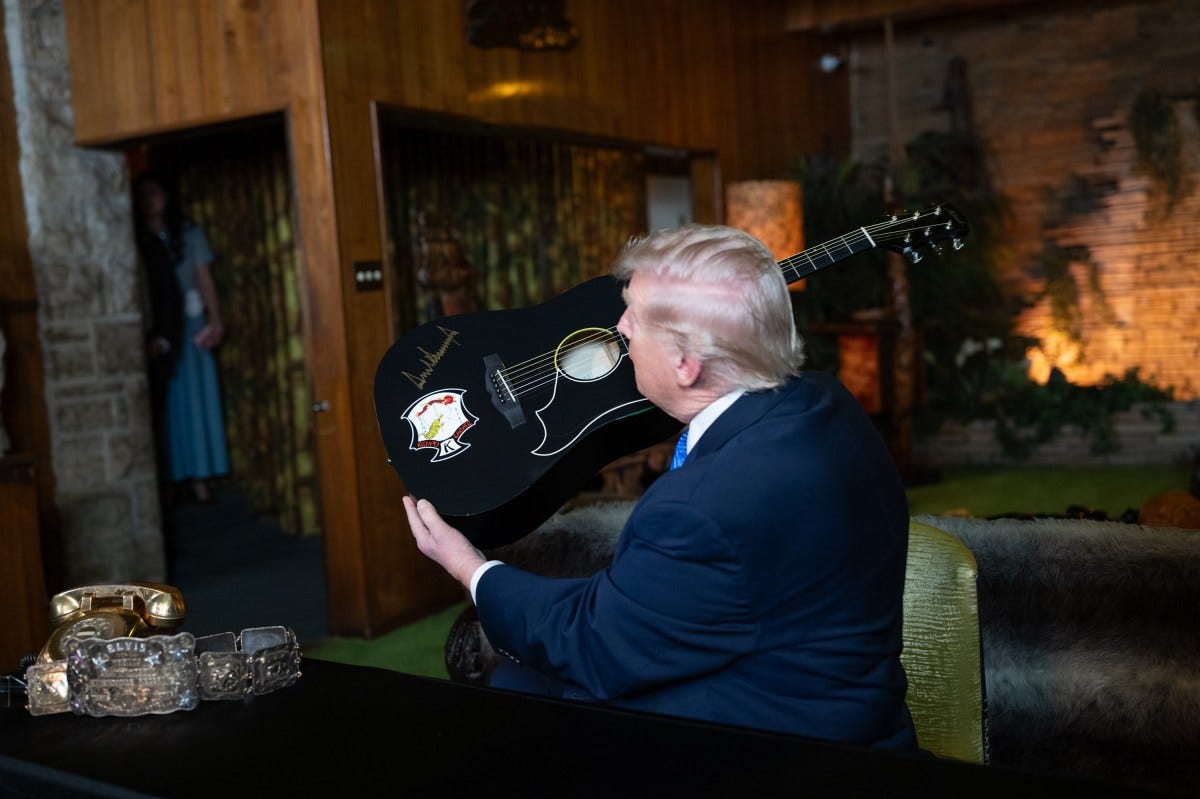
Donald Trump during his visit to Memphis, Tennessee yesterday. (Whitehouse)
It’s Wednesday, March 25, and the twenty-sixth day of Operation Roaring Lion. Here are the latest developments while you were asleep:
Iran has set an extremely high bar for ceasefire negotiations. The IRGC’s demands include the closure of all U.S. bases in the Gulf, reparations for strikes on Iran, a Hormuz transit fee arrangement, an end to strikes on Hezbollah, the lifting of all sanctions, and the preservation of its missile program. A U.S. official called the demands “ridiculous and unrealistic.” The two sides are not in direct contact—messages are passing through Arab intermediaries.
Yesterday, Lebanon declared Iran's ambassador persona non grata, ordering him to leave by March 29 and canceling his diplomatic status over interference in Lebanese internal affairs. The Lebanese government also recalled its own ambassador from Tehran for consultations. Meanwhile, Hezbollah's leadership and Parliament Speaker Nabih Berri personally asked the Iranian ambassador to stay.
The Times reported last night that the British Navy will lead the “Hormuz Coalition” to reopen the straits. Britain will also deploy mine‑clearing capabilities alongside the United States and France.
According to The New York Times, Saudi Crown Prince Mohammed bin Salman has urged Trump in recent days to press on with the war against Iran, calling it a “historic opportunity” to reshape the Middle East. In a series of conversations over the past week, bin Salman pushed for accelerating military action—including strikes on energy infrastructure and possible ground operations—arguing that only regime change could eliminate the “long-term threat” to the Gulf.
After pressure from Washington to take action on the issue, the government will approve the establishment of a unit in the Ministry of Defense to deal with the hilltop youth, with a budget of 130 million shekels for the next three years.
Now, on to the details.
The golden pager gifted to Donald Trump. (GPO)
When Netanyahu walked into Donald Trump’s office for the first time during the former’s second term, he brought a small gift: a golden beeper embedded in a piece of cedar, dedicated to “our great friend and greatest ally.” Trump was delighted. What followed was a warm meeting, described by the Israeli delegation as “beyond our expectations and dreams.” The lesson? Trump likes gifts.
Of all the Israeli lessons, and Israel has taught them many, Iran seems to have taken this one to heart. Trump revealed yesterday that Iran had sent him a gift—and that he liked it. They know their recipient, he said, because “it’s worth a lot of money,” and is supposedly related to oil and gas. But here is the most important part: the gift, he suggested, showed him that he is “talking to the right people.” Unless that box contained the comatose body of Mojtaba Khamenei, I’m skeptical.
We can try to shake the box and guess what’s inside. It could be stakes in Iran’s oil industry—an attempt, Intel-style, to align Trump’s interests with their own, making him think twice before destroying his “assets.” Or perhaps it’s favorable reconstruction contracts—American companies rebuilding what American forces have just destroyed. There’s also a real chance it’s something more symbolic, a gimmick like the golden beeper, Qatar’s plane, or María Machado’s Nobel Prize. Trump has said it’s not nuclear-related, so we can rule out a lead-lined gift box of enriched uranium.
In the end, we don’t know. What we do know is that it doesn’t bode particularly well. The Iranians clearly understand their audience.
Then again, Qatar’s gift of a new Air Force One didn’t stop Trump from bringing down the hammer on Doha during talks with Hamas—or cause him to bring it down on Israel after strikes on the Gulf state.
It’s a bad sign—but after the last three weeks, faith is about the least Trump deserves.
US Special Envoy Steve Witkoff and Jared Kushner meeting with Oman’s Foreign Minister, Sayyid Badr Hamad Al Busaidi at the negotiations in Geneva in February.
Trump has said countless times that the Iranians “have never won a war but never lost a negotiation.” Judging by their demands for a ceasefire, those do appear to be entirely distinct realities in the Iranian mind.
According to The Wall Street Journal, Iranian representatives have signaled to the Trump administration that they have set a very high bar for re-entering negotiations.
Let’s start with the most extreme.
They are demanding the closure of all American bases in the Gulf and reparations for attacks on Iran. That falls just short of Osama bin Laden’s demand that the U.S. vacate the entire Middle East—though, to be fair, that terrorist organization did more damage to America than Iran has in the past 26 days of war.
Other demands include:
A new order for the Strait of Hormuz that would allow Iran to collect transit fees, as Egypt does with the Suez Canal—ignoring the small detail that one is an engineering project requiring maintenance, while the other is simply geography.
Guarantees that the war will not restart, along with an end to Israeli strikes on Hezbollah—something Israel is unlikely to accept under any circumstances.
The lifting of all sanctions on Iran.
And permission to retain its missile program without any limitations, right after proving, contrary to their own claims, that they have missiles that can hit Western Europe.
This list of conditions implies three things:
The Revolutionary Guards have consolidated power within the fractured regime and are just as hardline as their predecessors.
They believe they are winning.
There will be no agreement.
A U.S. official reportedly called the demands “ridiculous and unrealistic.” A fifth grader would likely agree.
This kind of posturing will not bring the war to a close in five days. It is honestly brave of them to try again after having an almost month-long demonstration of what happens when they try to drag out negotiations.
As a very senior Israeli official told me yesterday, “It’s highly doubtful that the Iranians’ minimum will meet Trump’s maximum.”
It seems he was right.
Ziv Agmon and Benjamin Netanyahu. (GPO)
At a Labor Party rally on the night of June 27, 1981—two days before the Israeli election—the entertainment, comedian Dudu Topaz, cracked a joke, referring to Mizrahim—Jews of Middle Eastern origin who largely supported Likud—using the slur “chach-chachim.” He handed Likud the election.
The next day, Likud leader Menachem Begin scrapped his planned closing speech and focused entirely on the remark. He repeated Topaz’s words, memorably mispronouncing the entertainer’s name.
Begin then invoked two Irgun fighters—members of the pre-state underground he commanded—who had taken their own lives rather than be executed by the British: Moshe Barazani, who came from Iraq, and Moshe Feinstein, who was Ashkenazi.
“Ashkenazim? Iraqis? Jews! Brothers! Fighters!” Begin declared.
He turned the moment into an indictment of what he portrayed as the left’s elitism and discrimination against Israel’s Mizrahi population—and it worked.
It is difficult to overstate the importance of Likud’s alliance with Mizrahi voters. It has underpinned nearly every electoral victory the party has achieved and remains its most important constituency today.
In 2015, during another election, Israeli artist Yair Garbuz described a small group “taking over the country,” listing “amulet-kissers, idol worshippers, and grave-bowers”—thinly veiled references to Mizrahim—alongside “thieves” and “corrupt” figures. Netanyahu seized on the moment, creating his own Begin moment, and again rode it to victory.
Within Likud, there are disagreements on sovereignty, economics, and security policy. But there is one clear third rail: Mizrahi racism.
And that brings us to last night.
Ziv Agmon was not a widely known figure, sitting far outside Netanyahu’s inner circle. October 7 changed that. Two years of war, alongside the legal troubles and departures of other senior advisers, elevated him rapidly. What began as an external role in the wartime communications apparatus evolved into spokesperson, then chief spokesperson, and eventually acting chief of staff.
During the war, he became the gatekeeper—standing between Netanyahu and the outside world, and at times even between him and members of his own office.
Which is why what happened is so striking.
Last night I published remarks Agmon made in conversations over the past two years—comments disparaging Likud, Netanyahu himself, and most importantly Mizrahim.
Among them: that “Netanyahu is finished” in the wake of October 7; that “the stupid female MKs” understand that “only flattery works” with Sara Netanyahu; and criticism of Yair Netanyahu for undeservedly receiving a diplomatic passport.
He was also quoted attacking other Likud members: “We should publish a job ad for rapists and murderers for the Likud list, since we already have a thief, a burglar, and a kidnapper.”
Insulting the Netanyahu family is unusual for someone in Agmon’s position—but not politically fatal. Criticizing Netanyahu and Likud is, after all, 50 percent of the Knesset’s job as well as a national pastime. Had he stopped there, he might have survived politically.
But he touched the third rail.
Agmon reportedly referred to MK Nissim Vaturi as a “baboon” and MK Eli Revivo as a “retarded Moroccan,” adding that “it’s unclear how these people get elected to the Knesset.”
That may sound like crude political rhetoric, but in Hebrew, the term kof (“monkey”) carries a deeply loaded and offensive connotation—close to the N word in English.
The Prime Minister’s Office issued a statement on Agmon’s behalf denying the allegations, particularly those of racism.
Agmon also reportedly attempted in the past to cross political lines and secure a spot on Benny Gantz’s list, saying: “I want a place on Gantz’s list. I’m honestly much more suited to him than to the monkeys.”
It hardly needs to be said—that seat is no longer available.
English Editor: Ari Tatarka
If you enjoy the newsletter, you can show your support by becoming a paid subscriber—it really helps keep this going. I’m also offering a special monthly briefing for a small group of premium members. I’d love to have you join us—just click below to find out more.
Thanks for reading It’s Noon in Israel! Subscribe for free to receive new posts and support my work.


