Operation Roaring Lion Day 25: The Away Game Trump Chose to Play
Also, drama in Israel’s defense establishment, my CNN appearance, and more.
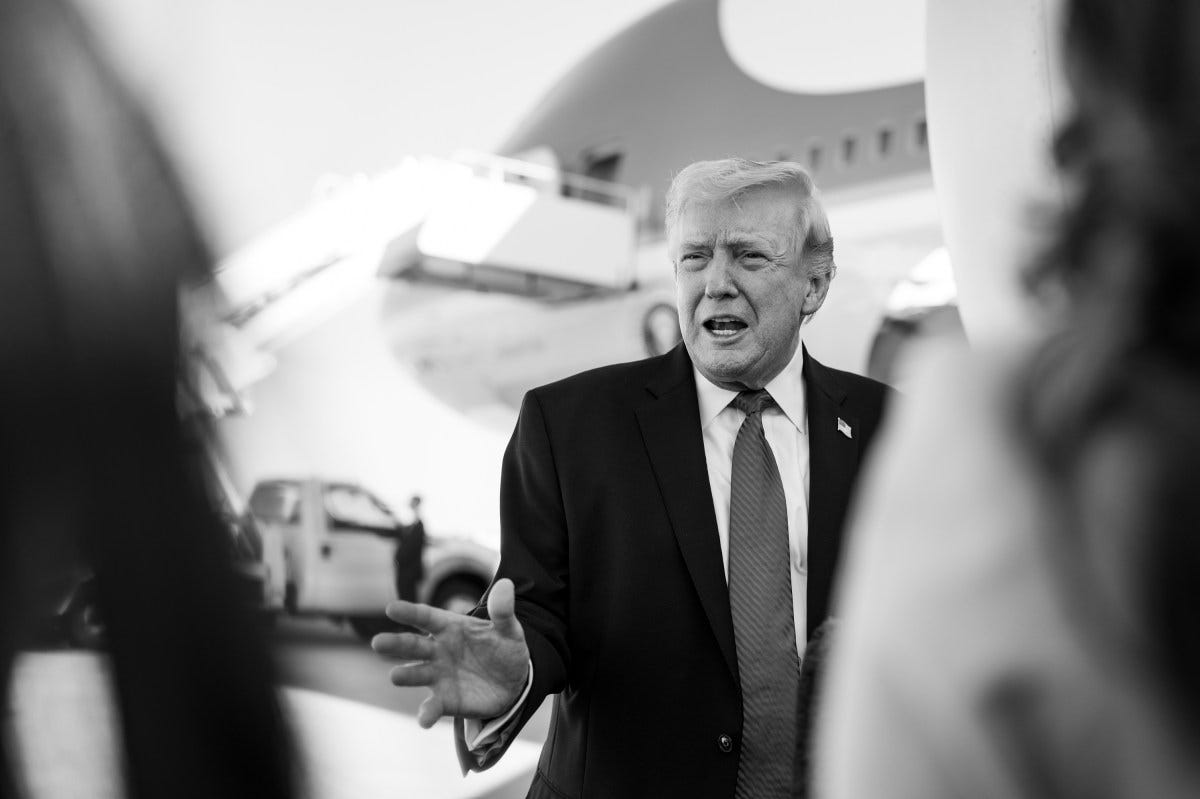
Donald Trump boards Air Force One at Palm Beach International Airport in West Palm Beach yesterday. (whitehouse.gov)
It’s Tuesday, March 24, and the twenty-fifth day of Operation Roaring Lion. Here are the latest developments while you were asleep:
Trump extended his deadline for an Iran deal to March 27, saying Tehran has agreed to cease uranium enrichment, relinquish existing stockpiles, and remain “low-key on the missiles.” Netanyahu said Trump told him the U.S. sees an opportunity to “leverage the military achievements of the war” to secure all strategic objectives through an agreement. Meanwhile, Iranian parliament speaker Ghalibaf publicly rejected reports of U.S.-Iran negotiations on X—despite reportedly being the official leading Iran’s diplomatic engagement with Washington. The denial may say more about internal Iranian politics than about the state of the talks: Ghalibaf has quietly consolidated enormous influence since the war began, making him both the man most likely to be negotiating and the man with the most to gain from denying it.
Vice President JD Vance will be joining U.S. Special Envoy Steve Witkoff in Pakistan to pursue indirect talks with Iranian officials, specifically Iran’s Foreign Minister Araghchi, with Islamabad serving as both mediator and summit venue. Markets responded immediately—oil retreated below $100 a barrel on news of the pause. Tehran is demanding guarantees, base closures, and compensation, while Israeli officials are warning that negotiations could either buy Iran time or fall short of U.S. red lines.
According to the AP, Israel used one of Iran’s oppression apparatuses—its extensive system of street cameras—to track and kill Supreme Leader Ali Khamenei. According to intelligence officials briefed on the operation, nearly all of Tehran’s traffic cameras had been hacked for years, with footage streamed to servers in Israel. Algorithms mapped the daily movements of senior officials—their routes, parking spots, and security details—allowing Israel to plan the strike months in advance and expedite it once it was confirmed that Khamenei and his top officials would be at the leadership compound that morning. The irony is stark: the instrument of Iranian oppression ultimately became the tool to end its dictator.
Three suspects have been arrested and indicted following the near-fatal lynching of a Jewish teenager in Huwara in January. On January 25, the Shin Bet received intelligence that the teenager had entered the Huwara area and been violently attacked by local residents—left unconscious, with his attackers believing he was dead. There has been a notable uptick in settler violence; to see my take on it, watch the end of the CNN interview at the end of the newsletter.
Now, on to the details.
Donald Trump boards Air Force One at Palm Beach International Airport in West Palm Beach yesterday. (whitehouse.gov)
A very senior Israeli official told me last night, “It’s highly doubtful that the Iranians’ minimum will meet Trump’s maximum.” To put it simply: expectations in Israel for a negotiated end to this war are currently close to zero—and here’s why.
Trump has said something consistently about Iran for years: they have never won a war, but they have never lost a negotiation. So why would he suddenly leave his home field—the battlefield, where he is the strongest player in the world—to play an away game, negotiations, where the Iranians are world-class operators? He would only do so if there were a great deal to gain.
Look at the Hamas example. In a recent round of negotiations, Hamas agreed to something few in Israel thought possible: returning all the hostages while retaining control over most of the Gaza Strip. If something comparable is on the table with Iran—shutting down uranium enrichment, transferring enriched material out of the country, halting missile production, reopening global shipping lanes, even alternatives to the regime—then Trump has an incentive to go all in.
There are just a few problems.
The first is that, aside from a likely comatose patient, Iran effectively has no functioning supreme leader. If Trump signs an agreement somewhere like Pakistan, will the Revolutionary Guards suddenly fall in line? There is a very real possibility that IRGC units—already operating with a degree of independence—would undermine any agreement, if more senior hardliners do not sink it first.
Another issue is that this is a double gamble. The first bet is ending the war itself. The second is that any agreement Iran accepts cannot simply end the fighting while returning them to the same dire situation: no money, soaring inflation, and restricted oil exports. They will demand sanctions relief. In other words, Trump would have to promise that relief is on the way—which, in practice, means helping the regime survive. When Trump said “help is on its way” in January, I don’t think he intended the ayatollahs to be the recipients.
It is hard to see that happening.
To be fair, the war plans were always written in chalk—liable to be wiped away at any moment by a Trump-branded eraser. But the assumption in Israel has been that Trump’s goals are broader than Israel’s, more ambitious, and unlikely to be satisfied by what the regime can realistically put on the table.
So what is happening in Israel now? A great deal of reflection. In essence, a renewed debate over whether it was wise to go along with Trump on the inciting incident for negotiations: the strike on Iran’s gas infrastructure last Wednesday.
Israel, in coordination with the United States, struck a major Iranian gas facility. Within minutes, roughly 40 percent of its capacity was in flames. It was a signal—what might be called a “knock on the roof,” or in this case, a “knock on the gas.”
What happened next? Qatar became alarmed and pressured Trump to halt further strikes on gas facilities. From the Iranian perspective, this was interpreted as weakness—as evidence that Trump is vulnerable on energy.
And so in Israel, some are now asking: at that time, should we have given Trump two options—either we don’t strike at all, or we strike and finish the job?
Mossad agents operating in Iran during the June war 2025.
It all began on June 13, 2025, when for the first time in its history, the Mossad released a video of its agents operating deep inside Iranian territory. In general, there’s no love lost between the IDF and the Mossad, but this was a serious challenge.
It’s not that the video wasn’t accurate. But in the military, there was a sense that this was an exaggerated attempt to claim credit relative to what the Mossad had actually done. The Mossad, for its part, said: no—you took credit for certain things; we took credit for ours.
When the June war was over, the IDF claimed that the Mossad was in charge of 1 percent of the successes. The Mossad strongly disagreed, claiming much more than that.
So far in this war, there are those in the defense establishment who believe the military achieved 120 percent of the objectives it set for the operation, while the Mossad, to put it mildly, is still far from 100 percent. Who knows, perhaps the Mossad is preparing another video, it would be one of thier first non-Farsi productions in a while.
Yesterday I joined CNN’s Zain Asher and Bianna Golodryga on One World to discuss the latest developments in the Iran war. Enjoy!
English Editor: Ari Tatarka
If you enjoy the newsletter, you can show your support by becoming a paid subscriber—it really helps keep this going. I’m also offering a special monthly briefing for a small group of premium members. I’d love to have you join us—just click below to find out more.
Thanks for reading It’s Noon in Israel! Subscribe for free to receive new posts and support my work.


I thought it was a ruse, that Trump wanted a relief in the oil and stock markets until Friday when
trading stops.
Credit seeking is more likely to destroy a nation than external threats.
Trump will not pursue a new regime, that is the responsibility of the Iranian people. US interest is to eliminate the threat for a reasonable future period of time.