Operation Roaring Lion Day 11: "The War Is Almost Over"
Also, Hezbollah sues for peace, Israelis angry after soldier who destroyed monument is suspended, and more.
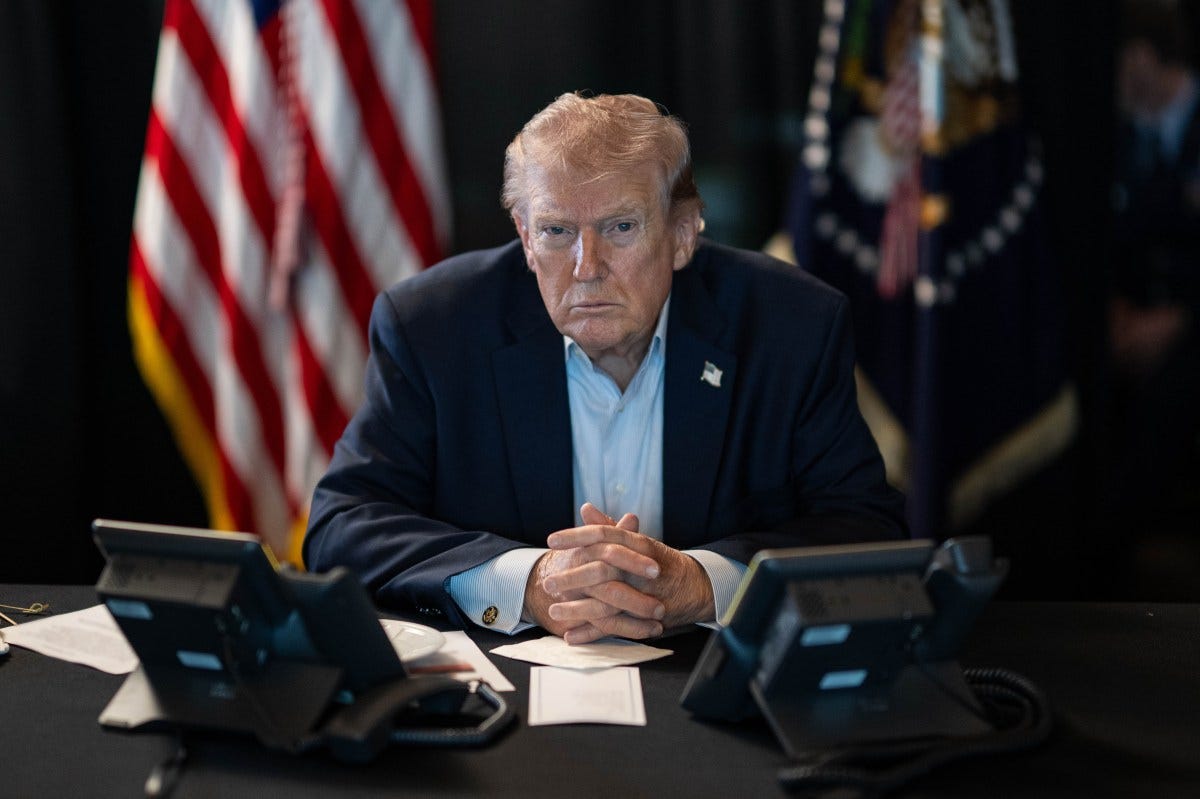
Donald Trump in the situation room at the beginning of Operation Epic Fury. (whitehouse.gov)
It’s Tuesday, March 10, and the eleventh day of Operation Roaring Lion. Here are the latest developments while you were asleep:
Last night Trump made a significant statement in an interview with CBS, claiming that “the war is almost over”—a notable shift from the original estimate of “four to five weeks.” Is Trump changing direction? The conflicting statements are raising questions.
Hezbollah has communicated that it would like to begin negotiations for a ceasefire. Discussions are underway in Israel on the matter, with the key question being whether to launch a broad operation to eliminate the organization or to pursue a strategic gain by severing the connection between Iran and the Lebanese terror group.
Yesterday, two civilians were killed at a construction site in Yehud by an Iranian cluster munition. Israel’s death toll from Iranian missile fire has now risen to 12. Still, Israeli and U.S. suppression of Iranian missiles appears to be succeeding, as the number of missiles has dramatically decreased.
(OpenSourceIntel)
Now, on to the details.
Donald Trump at the transfer of remains of Six U.S. soldiers killed in the Iran war.
Last night Donald Trump told CBS that “the war is almost over.” According to the president, “we are far ahead of the original estimate we made.”
The early victories were impressive—but not that impressive. Israel still fears a repeat of the June war, when targets were left untouched after Trump’s patience for the campaign was exhausted. At the start of this war, he spoke of a “four to five week” timeline. Israel is hoping for something around that to exhaust it’s target bank.
So the question now being asked is: Will Trump end the operation early?
Let’s track the timeline behind the timeline.
March 1: Trump says in an interview that the war might last “four to five weeks.”
The regime begins thinking it can hang on that long, so, according to my sources, IDF Chief of Staff Eyal Zamir and Benjamin Netanyahu send a message to Trump urging him not to give firm dates.
March 2: At a Medal of Honor ceremony, Trump says the war is “projected at four to five weeks,” but “we have the capability to go far longer than that.”
Success in Iran continues apace, so he maintains the message.
March 5: Trump tells Time magazine, “I have no time limits on anything.”
Markets start getting nervous as oil prices rise as Gulf states begin announcing production cutbacks.
March 7: Trump assures reporters that the war is “moving ahead of schedule,” but again refuses to give a timeline.
Oil nearly hits $110 a barrel, the highest level since 2022.
March 9: Trump tells GOP lawmakers this is just a “short-term excursion,” and then delivers the dramatic line to CBS: “The war is almost over.”
Trump is stuck between two pressures.
On one side, the Iranians hope to wear Israel down—which is why recent statements from Trump, Netanyahu and the IDF chief of staff emphasize that they are far from exhausted.
On the other, rising oil prices and economic instability pull Trump to signal that the end is near.
So which Trump do we believe? Trump also said in a press conference yesterday that ending the war will be a “mutual” decision with Netanyahu. A senior Israeli official also tells me everything will be coordinated—and that there is still work to do.
As far as I can tell, Trump has invested a week and is likely to invest a few more; he is in for a penny and intends to stay for the pound.
The U.S.’ chronic Iraq syndrome has his electorate craving timelines. That gives Trump a choice: shorten the war and treat the symptom or take his time and potentially cure the disease.
An IDF soldier operating in Southern Lebanon last week. (IDF)
After only a week of Israel’s offensive, Hezbollah is trying to tap out. Overtures from senior Hezbollah figures have been passed to Israel through the Lebanese government with the goal of reaching a negotiated ceasefire in the north.
This presents Israel with a dilemma.
On the one hand, there is the option of launching a broad campaign to eliminate the organization entirely, rather than settling for Hezbollah’s current capabilities of targeting the entire north and reaching as far as Tel Aviv.
On the other hand, there is a great strategic opportunity: severing Iran’s ties with Hezbollah.
In November 2024, when Israel agreed to a ceasefire, aside from ending the devastation of Israel’s north, the great strategic achievement was severing Gaza from Lebanon. What is now being discussed would be similar but on a much larger scale.
This is the arm that the Iranians have been constructing for more than 30 years so that it would serve them on the day of reckoning. That day came—and their great weapon against Israel is trying to lay down its arms.
Hezbollah has proved itself to be a bad investment of historic proportions, so bad that even if the regime survives, there is a serious question as to whether it will keep shoveling money into this Lebanese dumpster fire.
Not to mention that the last ceasefire only ceased one side’s fire. The destruction wrought on Hezbollah—what may have cost both civilian and military lives in 2024—was instead bought for free through airstrikes over the course of 2025.
To those who say, “Wait a minute, they will still be there for next time,” I would answer: People often describe Hezbollah as a “tentacle” of the Iranian octopus, but at this point it is more like the tail of a lizard. Once you cut off the head, the tail may keep wriggling, but the lizard isn’t a threat.
Whenever Israel wants, it can squash what remains underfoot. Hezbollah has lost its greatest asset of survival, the passivity of Lebanon.
The past two years have stripped away the illusion. Hezbollah isn’t defending Beirut—it’s defending Tehran. And lately, it’s been doing a poor job of the latter.
IDF soldiers attempting to destroy a monument to Yasser Arafat near the city of Jenin last week.
What if an Allied soldier were caught on video taking a sledgehammer to a Hitler monument? How would Americans react?
I imagine there would be claps on the back, perhaps even applause. After all, that’s his job.
So imagine the outrage among Israelis after an Israeli soldier, caught on camera destroying a monument to Yasser Arafat, was punished with a suspension.
This may sound extreme to Western ears, but you must understand who Arafat is to Israelis. The world’s memory of Arafat is the Arab man in fatigues, wrapped in a white and black keffiyeh shaking hands with Yitzhak Rabin on the White House lawn, but Israel’s memory is longer. Israelis remember the thirty years before—and the ten years after—the Middle East’s version of Chamberlain’s “peace in our time.”
Let’s begin before the handshake. From the birth of the PLO in 1965 until its supposed “moderation” in 1993, Arafat was the smiling face behind every infiltration, every bombing, every hijacking that plagued Israel. Arafat was Israel’s arch-terrorist, responsible for more Jewish deaths than anyone between Hitler and Sinwar.
Arafat was also the first “foreign leader” to visit Israel’s current arch-enemy, the Islamic Republic, after the revolution. The meeting between radical secularists and radical zealots was made warm by their mutual aim: the destruction of Israel. One operative in his PLO, Anis Naccache, even claims credit for proposing the idea that later became the IRGC.
Then came the First Intifada and the secret discussions that led to the White House lawn. Rabin initially refused to extend his hand to Arafat and required Bill Clinton to nudge him into initiating the handshake. Rabin’s pained expression tells much about Israel’s perception of the terrorist, and he would later recall being physically ill at the act.
Yitzhak Rabin shakes hands with Yasser Arafat on the South Lawn of the White House following the signing of an initial peace accord in 1993.
But the picture came out clean, and the world cemented Arafat in its consciousness as a moderate.
Then the peace process. He raised Israel’s hopes to unprecedented heights only to walk away from the table and, at least in Israeli memory, reward their efforts at peace with a years-long rolling October 7.
Buses and hotels exploded across Israel. Thousands of innocents were killed in the Second Intifada. All the while, the once “partner in peace” sat in his compound in Ramallah, watching his bloody creation.
In an image representative of Israel’s complex relationship with the man, then–Prime Minister Ariel Sharon sat in his office beneath a photograph of Arafat shaking Rabin’s hand while shouting orders to besiege his Ramallah compound during Operation Defensive Shield in 2002.
That brings us to today.
Whatever one may think about the desecration of monuments, Israelis saw something different. Much like an Allied soldier smashing a Hitler monument, what Israelis saw was the IDF doing its job: eliminating terrorists.
What’s inside the ayatollahs’ “treasure chest” buried under Isfahan? What are the chances of a U.S.–Israeli operation to retrieve it? And what is happening on Israel’s northern border?
I answered all these questions and more in a special episode of Call Me Back with Dan Senor and Fred Kagan.
English Editor: Ari Tatarka
If you enjoy the newsletter, you can show your support by becoming a paid subscriber—it really helps keep this going. I’m also offering a special monthly briefing for a small group of premium members. I’d love to have you join us—just click below to find out more.
Thanks for reading It’s Noon in Israel! Subscribe for free to receive new posts and support my work.


Regarding the killed construction workers, may they rest in peace, a relative who lives in Modiin told me there is construction work going on opposite his apartment building, and the workers carry on even during sirens!
First time that guy use a sledge?