Operation Roaring Lion Day 33: Trump Won't Surprise Israel
Also, Israel wants to say "enough", an anniversary worth celebrating, and more.
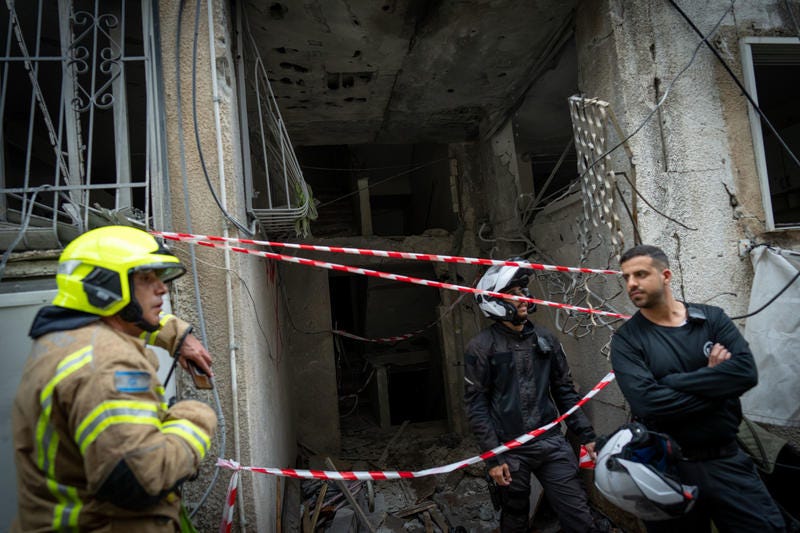
Israeli security and rescue forces at the scene where a missile fired from Iran toward Israel caused damage in Bnei Brak this morning. (Flash90)
It’s Wednesday, April 1, and the thirty-third day of Operation Roaring Lion. The global price of oil has reached $100, down four percent since yesterday. Here are the latest developments while you were asleep:
Ten people have been hospitalized following a missile impact in the city of Bnei Brak this morning. Two young children were badly injured—one critically, the other seriously. The mother of one and the father of the other are both being treated in moderate condition. Six additional children are undergoing medical evaluation.
The United States has reportedly attacked the former U.S. Embassy in Tehran, which had become a gathering point for Revolutionary Guards and Basij fighters. This is the same building in which 52 Americans were held by the regime for 444 days during the 1979 hostage crisis.
Yesterday, Pakistan and China jointly published a five-point initiative to end the conflict in Iran, calling for an immediate ceasefire, the start of negotiations, a halt to attacks on civilian targets, the reopening of the Strait of Hormuz, and a final peace agreement grounded in the UN Charter.
Now, on to the details.
Donald Trump delivering remarks at a meeting of the National Republican Congressional Committee. (White House)
The media has spent the past year playing a terrible game of Mad Libs. When faced with the headline “Trump set to announce ___,” they tend to fill in the same kinds of answers: “he is sick of Bibi,” “ending the war early,” or the classic, “he is done with Israel.” Usually, Mad Libs answers are accurate or funny; so far, the media has been neither.
Tonight at 9 p.m. ET, Donald Trump is set to deliver an “important update on Iran.” At 4 a.m. Israel time, most Israelis, including the leadership, will be away from their phones, either asleep or still celebrating the first night of Passover. When they eventually wake or finish the Passover meal and check their updates, I am certain they will not be blindsided by the announcement.
Most likely, Trump announces that despite the great victories already achieved, more is required to finish off the Islamic Republic. He confirms that he is still open to a diplomatic settlement, but nothing has manifested so far, and critical infrastructure remains a target. If so, that would suggest he is sticking to the original plan: another two to three weeks of strikes before transitioning to the protest phase.
Least likely, he announces a unilateral end to the war. The uranium is yet to be retrieved or more deeply buried beneath Isfahan; Kharg is still in Iranian hands, and the Strait of Hormuz remains closed. Any one of these facts would cast a shadow on Trump’s declaration of victory; all three make victory difficult to make out. Yet even if Trump chooses to declare victory regardless, Israel more broadly would be surprised, but the leadership would not. As a senior intelligence source told me last week, Israel is prepared for this outcome and still believes it can pull out a win if U.S. forces remain in the region during the protest phase.
Part of his speech will certainly be devoted to calming oil markets. Trump’s rhetoric may have a chaotic tone, but there is a clear rhythm to his comments, balancing between explosive threats and assurances that the war is almost over. So far, he has succeeded. If I had asked an expert at the outset of the war what prices would look like if barely any oil passed through the Strait of Hormuz for almost a month, $100 would be far from the estimate. Since markets are open for two more days, I would imagine Trump’s dovish side will be present tonight.
After 33 days of the closest cooperation in the histories of both countries, I think we can say with confidence that no matter how the media reacts to Trump’s comments tonight, Israel will not be surprised.
People clean ahead of the Passover holiday in the ultra-Orthodox neighborhood of Mea Shearim in Jerusalem. (Chaim Goldberg/Flash90)
Tonight, millions of Israelis will set down their brooms and mops, call an end to the frantic cooking and cleaning, sit down, and tell the story of the Exodus. Many of those Israelis thought they would be somewhere else this year. Aside from those who ironically drove to Egypt to escape Israel for Passover, Israelis are stuck at home—some even barred from visiting family in more heavily bombarded parts of the country.
Residents prepare for the Passover holiday inside a shelter in the northern city of Kiryat Shmona, with assistance from the International Fellowship of Christians and Jews (IFCJ). (Ayal Margolin/Flash90)
Part of the beauty of Passover is that in its wealth of stories, parables, and traditions, it offers powerful lessons for every new generation. There is one section of tonight’s liturgy in particular that feels especially fitting in this moment: the strange and repetitive poem “Dayenu.”
Apart from being the musical low point of the night, the text retells the story of the Exodus, but at every pivotal moment it returns to the refrain, declaring that if God had stopped there, it would have been enough.
“If He had taken us through the sea on dry land, and had not drowned our oppressors in it—Dayenu, it would have sufficed us!
If He had drowned our oppressors in it, and had not supplied our needs in the desert for forty years—Dayenu, it would have sufficed us!
..If He had given us the Torah, and had not brought us into the land of Israel—Dayenu, it would have sufficed us!”
The absurdity is that at no point was that true. Had God not drowned their oppressors in the sea, they would have returned to slavery. Had He not provided for them in the desert, they would have starved. Had He given them the Torah but not brought them into the land of Israel, they would have wandered the desert.
Over the past two and a half years, Israel has had several moments—either in appreciation or exhaustion—when we have wanted to say “Dayenu.”
Had we crippled Hamas and not dealt with Hezbollah—Dayenu.
Had we dealt with Hezbollah but not launched Rising Lion—Dayenu.
Had we launched Rising Lion but not followed up with Roaring Lion—Dayenu.
The Seder warns us that “in every generation, they rise to destroy us,” but this generation has felt especially crowded.
Yet a Jew standing at the far side of the Sea of Reeds, watching their oppressors drown, may justifiably say Dayenu, not knowing how much further they still had to go. Israel today may want to say “Dayenu,” and indeed there is much to be thankful for, but there is still much that needs to be done.
To paraphrase the final line of the night: Next year in a peaceful Jerusalem.
Aside from Passover, there’s something else worth celebrating. Almost every morning, six days a week, for the past 55 weeks, It’s Noon in Israel has landed in your inbox. I take real pride in bringing you the clearest, most unfiltered view of Israel and the region—and I’ve genuinely enjoyed writing it. I hope you’ve enjoyed reading it just as much.
It has been a hectic year—one of the busiest of my career—and I am deeply grateful that you chose to follow along. The year ahead promises to be no less eventful. I hope you will continue reading.
Happy Passover! We will be back on Friday.
English Editor: Ari Tatarka
If you enjoy the newsletter, you can show your support by becoming a paid subscriber—it really helps keep this going. I’m also offering a special monthly briefing for a small group of premium members. I’d love to have you join us—just click below to find out more.
Thanks for reading It’s Noon in Israel! Subscribe for free to receive new posts and support my work.


חג כשר ושמח
עם ישראל חי 🇮🇱
Happy Passover, Amit!