Operation Roaring Lion Day 24: Kharg First Then Hormuz
Also, Trump's bizarre ultimatum, Qatar tries to opt out, and more.
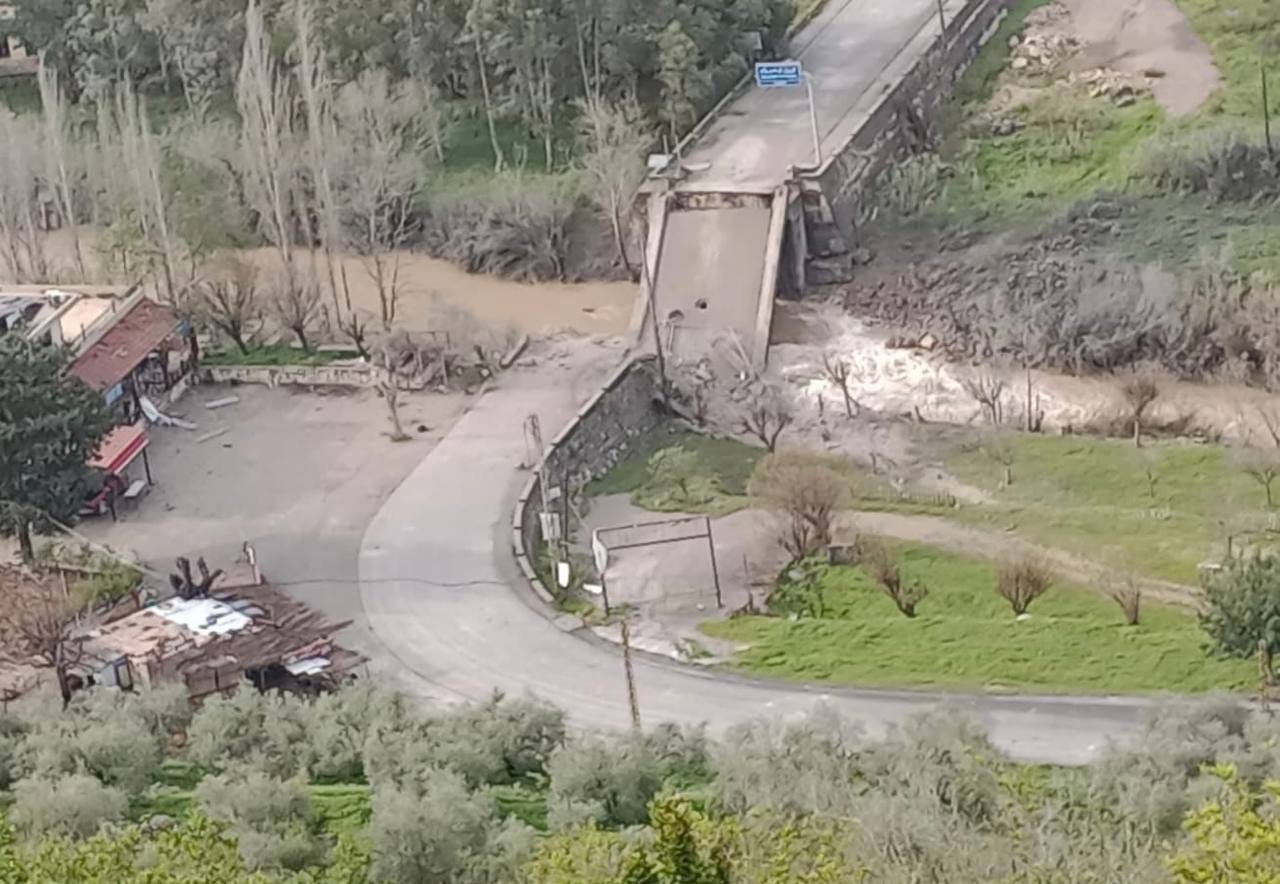
A bridge in Lebanon destroyed by an Israeli air strike.
It’s Monday, March 23, and the twenty-forth day of Operation Roaring Lion. Here are the latest developments while you were asleep:
The Washington Post reported that Iran’s new Supreme Leader, Mojtaba Khamenei, is injured, isolated, and unresponsive, according to intelligence officials from both Israel and the United States. Despite his apparent incapacitation, Israeli officials say the remaining clerical leadership and the Revolutionary Guards have managed to consolidate their grip on the country. Both the U.S. and Israel assess that Mojtaba is still alive; intelligence indicates that senior Iranian officials have attempted to arrange face-to-face meetings with him—efforts that have so far failed, reportedly for security reasons.
Netanyahu and Defense Minister Israel Katz have ordered the destruction of all bridges over the Litani River in an effort to cut off Hezbollah’s supply and movement routes. The IDF has more than doubled its troop deployment along the northern border, expanded ground operations—eliminating dozens of fighters and seizing weapons—and is conducting targeted raids on evacuated villages to dismantle Hezbollah’s military infrastructure.
Trump’s ultimatum expires at 7:44 PM EDT (1:44 AM Israel time). Iran must fully reopen the Strait of Hormuz or the United States will begin striking its power stations.
Now, on to the details.
Israeli fighters on a sortie to Iran. (IDF)
It seems that after securing concessions over the Panama Canal, Trump has developed a fondness for critical waterways. Israel and the United States have now settled on a new war goal: ending the conflict with the Strait of Hormuz under American control—not just temporarily.
The operation appears to have two parts. The first is seizing Iran’s most valuable card—the small island in the Persian Gulf that processes over 90 percent of its oil exports: Kharg Island. The second is securing the strait itself.
The question is how. The plan seems to combine Marine forces expected to arrive on Friday, ongoing airstrikes targeting Iran’s naval and drone capabilities, and advanced monitoring technologies to prevent any disruption to shipping.
The operation is expected to take roughly two to three weeks. That gives Israel enough time to complete the destruction of the remaining military industry and regime targets.
An adviser to the president of the UAE asked an interesting question today:
“Where are the joint Arab and Islamic labor institutions, chief among them the Arab League and the Organization of Islamic Cooperation, while our countries and peoples are subjected to this treacherous Iranian aggression? And where are the ‘major’ Arab and regional countries?”
His answer was even more revealing:
“In this absence and impotence, one cannot later speak of the decline of the Arab and Islamic role, or criticize the American and Western presence.”
If the day comes, in a few weeks, when the United States seeks to establish more permanent infrastructure to control the waterway, it seems the UAE will not be complaining—and may even do more than that.
Donald Trump last week. (whitehouse.gov)
On Saturday night, Trump gave the regime 48 hours to reopen the Strait of Hormuz—or the United States would begin striking Iran’s power plants, starting with the largest one. It is a strange ultimatum.
If a decision has been made to target what might be called the assets of the Iranian people—the infrastructure meant to outlast the ayatollah regime—then the power stations currently supplying electricity to hospitals and homes are not the right place to start. And if the goal is to pressure a fundamentalist regime, it would be far more effective to strike at the core: the oil industry, or to permit Israel to strike their gas facilities again.
That is why there are rumors that this is a more sophisticated move—an attempt to create the conditions for negotiation. The idea would be to step back from the power station threat and extract concessions in return. The problem is that, on the Iranian side, there is not really anyone to negotiate with. I say this with an asterisk, because no one knows what will happen when Trump’s 48-hour deadline expires at 7:44 PM EDT. What is clear for now is that the ultimatum does not appear to be developing into the kind of pressure that produces a breakthrough.
But with all the chaos surrounding the strait, the original focus of the war seems to have been forgotten. What about the 400 kilograms of enriched uranium buried beneath Isfahan?
There are two options.
The first is an operation to capture the facility. The issue with that plan is not access—the United States and Israel have well-established air dominance, and it follows that a deployment is possible. The problem is what comes next. It would likely take time, and excavation, specialized equipment, and sustained troop presence. All the while the IRGC will be sending wave after wave of troops and drones at the U.S./Israeli force.
The second option is to strike the site and the bury the uranium deeper underground. Theoretically if it would take two weeks for the Iranians to access the material now such a strike could extend that timeline to months. At that point, any attempt to extract it could be monitored and interdicted, since large-scale excavation would be nearly impossible to conceal.
So the question is: if this option exists, why wasn’t it done earlier?
The answer is fairly straightforward. The preferable outcome is to remove the uranium from Iran altogether. If that is not possible, the next-best option is a deep American strike—because only U.S. capabilities are capable of burying that material permanently beneath the mountain.
Qatar’s Prime Minister and Minister of Foreign Affairs Participates in Consultative Ministerial Meeting of Foreign Ministers of the Group of Arab and Islamic Countries on Iranian Aggression last week. (@MofaQatar/X)
A man with a hammer sees everything as a nail. And for a country used to solve all its problems with money, even ceasefire is a product
After Iran sent more than 327 ballistic missiles, 15 cruise missiles, and 1,699 drones at Qatar, the latter is now suing for peace. On its own initiative, Qatar is attempting to negotiate an end to the U.S. war with Iran. If that fails—and it is expected to—it reportedly has a backup plan: pay Iran to stop attacking.
The alleged offer is $6 billion—a relatively modest sum—reportedly held in Qatar and tied to the Revolutionary Guards, in exchange for a halt to Iranian strikes.
Appropriately, having to bribe your way to safety from a former ally is immensely embarrassing—both for the Qataris and for the joint creation of Iran and Qatar: Hamas.
To be fair, this was the response of a Qatari diplomat to the allegation:
“Qatar has not offered any economic or other deal to Iran in exchange for stopping the attacks. Such claims are complete fabrications and represent an attempt to drive a wedge between Qatar and the United States. These efforts,” the diplomat added, “will not succeed.”
English Editor: Ari Tatarka
If you enjoy the newsletter, you can show your support by becoming a paid subscriber—it really helps keep this going. I’m also offering a special monthly briefing for a small group of premium members. I’d love to have you join us—just click below to find out more.
Thanks for reading It’s Noon in Israel! Subscribe for free to receive new posts and support my work.


BTW, you don't need to destroy the actual power generating plants, which would take years to rebuild. Instead, you can knock down just a few key electrical high-tension transmission towers, which can put the electrical grid out of commission for the entire country. Those towers can be rebuilt in a few weeks. You just need to determine which of the towers are the key interconnection points of the grid that connects all of the generating plants in the country. It is a solution that sends a message and creates chaos for a few weeks, while being relatively easier to repair. Given the freedom of air assets over the country, just a few small precision missiles fired from a fighter jet can bring down a few key transmission tower interconnection points.
The latest news in the US is that Trump announced he is negotiating with Iran and has put off tonight’s deadline. The US is about to exit this unpopular war.