Operation Roaring Lion: A Victory Nonetheless
Also, the Iranian damage assessment, the Lebanon dilemma, and more.
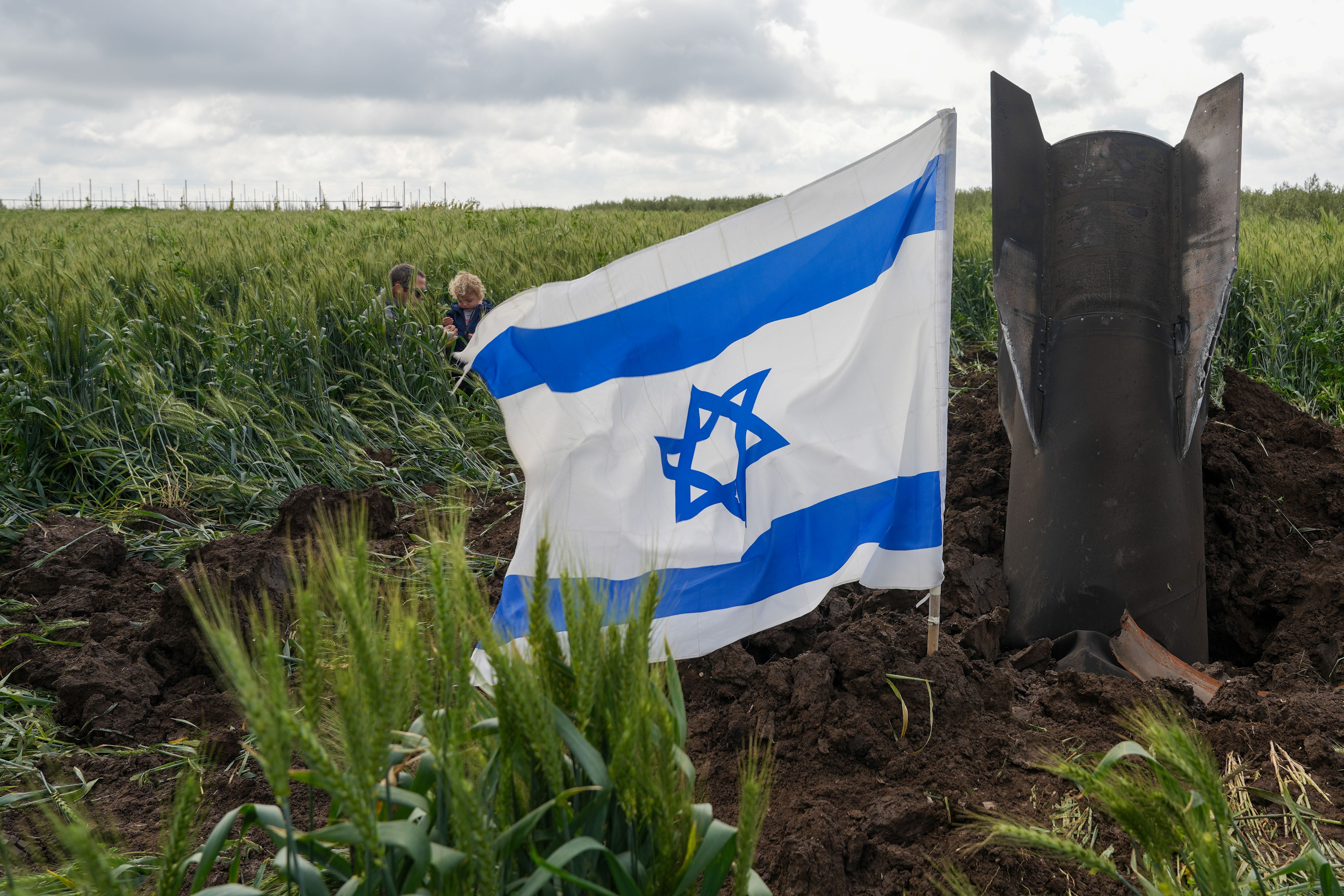
A fragment of a missile fired from Iran toward Israel, intercepted by Israeli air defense systems, seen lodged in the ground in the Golan Heights. (Ayal Margolin/Flash90)
It’s Thursday, April 9, and Operation Roaring Lion is over. For the last time, here are the latest developments while you were asleep:
President Donald Trump ordered U.S. naval, air, and ground forces to remain deployed around Iran, describing the posture as “armed monitoring” and warning of a “bigger, and better, and stronger” response if the ceasefire is breached.
Vice President JD Vance will lead the US negotiating team in Islamabad this Saturday, joined by envoys Steve Witkoff and Jared Kushner. Iran is said to prefer Vance at the table, having accused Witkoff and Kushner of misrepresenting Tehran’s positions in previous rounds.
Hours after a two-week ceasefire with Iran came into effect, Israel launched its largest wave of strikes against Hezbollah, codenamed “Eternal Darkness”—50 fighter jets dropping 160 bombs on 100 targets across Beirut, the Beqaa Valley, and southern Lebanon within ten minutes. Targets included command centers, intelligence headquarters, rocket and naval units, and assets of the elite Radwan Force.
Now, on to the details.
IDF Chief of the General Staff LTG Eyal Zamir overseeing the wave of strikes against Hezbollah yesterday. (IDF)
Israel’s lesson from October 7 is that intentions do not matter—capabilities do. For years, the IDF ignored the terror monster rising on its borders and instead focused on whether the enemy intended to attack or whether it was in its interest to do so. Similarly, although it is tempting to dwell on the current sentiments in Tehran, it is ultimately irrelevant. The critical question is whether Iran currently has the capability to pose a real threat to Israel.
The answer, after 39 days of war, is: less than it did thirty-nine days ago.
In practical terms, Iran promised it would not sign a temporary ceasefire—and it did. It said the Strait of Hormuz would not reopen—and it reopened. It swore to include ending the war in Lebanon—and Hezbollah suffered hundreds of casualties yesterday. This is what remains of the Iranian axis that once cast a long shadow across the Middle East.
The Iranian “victory image,” encouraged by broad segments of the international media, argues that Iran survived ten rounds against the heavyweight world champion and lives to tell the tale.
The question is what that survival is worth.
After the 2006 Second Lebanon War, Hezbollah Secretary-General Hassan Nasrallah used the draw with Israel to receive a blank check from his Iranian patrons and build the most formidable proxy in the axis of resistance.
What will Iran now do with this sense—real or fabricated—of survival?
After Operation Rising Lion, every available Iranian dollar was invested in rebuilding the ballistic missile array, seen as the only effective deterrent for Israel. The result was a relatively quick recovery, but also enormous public anger that was suppressed at the cost of massacre. Now there is far more to rebuild and far fewer dollars: should Iran buy a new navy, an air force, invest in missiles, rebuild Hezbollah, which is groaning under a heavy deficit, or invest domestically to calm a population whose situation has only worsened? The condition of the former Iranian empire is dire, and there are no signs of improvement on the horizon.
The Gulf states that were attacked by Iran have been taught a lesson that they will not soon forget. They are not Israel, accustomed to rounds of fighting every year or two. Generations of Emiratis, Qataris, and Saudis will carry the trauma of running to unprotected spaces while tourism, stability, and energy went up in flames. Israel stands to gain greatly from this anti-Iranian coalition, which was effectively forced off the fence and is unlikely to return to it soon. One can hope that Trump and Netanyahu are now engaged in tying the Gulf states into a more stable and public alliance.
The end of the war also marks the opening of the Israeli election campaign. Netanyahu, who hoped to ride the fall of the Iranian regime all the way to preserving his own rule in Israel, now faces a more complex task than he expected.
There is a sense of sourness among the public over the gap between hopes of toppling the regime and the war’s uncertain outcome. The bigger challenge is on the northern border, where public sentiment is harsh—and rightly so—after promises that Hezbollah had been defeated. Opposition leaders have identified this and are competing with one another in describing what they call a disgraceful historic failure, hoping voters will connect more with that than with Netanyahu’s promises of total victory. For the prime minister, toppling Iran in the coming months is a task of supreme importance not only strategically, but also for his political survival. Everyone hopes the Iranian regime will fall soon; Netanyahu would prefer before October 27.
U.S. Air Force crew chiefs perform pre-flight checks on a B-2 Spirit stealth bomber prior to a mission. (CENTCOM)
The 13-hour countdown has ended, and the smoke is beginning to clear over what remains of the Islamic Republic’s infrastructure. Following an unprecedented barrage of more than 11,000 American strikes and 5,000 Israeli strikes, Iran’s military capabilities have been reduced to a mere fraction of what they were on February 28. Yet even as the dust settles, the familiar reality that has haunted the U.S. military for decades is emerging: tactical achievements do not equal strategic victory.
The physical toll on the regime is staggering. The core of Iran’s military and intelligence leadership was essentially wiped out: the Chief of Staff, the Minister of Defense, and the Commander of the Revolutionary Guards were all eliminated. The heads of the intelligence apparatus and two leaders of the military nuclear program are dead. This is to say nothing of the regime’s central pillar and symbol, the Supreme Leader.
Furthermore, the state’s most critical assets have been reduced to rubble. Iran’s military industry, its steel production, and the petrochemical plants that served as the regime’s economic lifeline were crippled, offering no near-term recovery capability.
Regardless, Tehran is already looking toward a five- to 10-year force buildup scenario. Its future strategy is clear: invest in what works—the missile program and the capacity to close the Strait of Hormuz. Tactically, that demands moving all production facilities for drones and missiles underground and protecting their investment by drastically improving air defense.
Which brings us to the new battlefield: the negotiation table in Islamabad.
Trump’s demands are absolute: halt uranium enrichment, stop the ballistic missile program, end proxy support, and hand over 450 kg of enriched uranium. Iran, despite suffering from grievous internal wounds, is confidently marching to the table with its 10 points in hand. It is demanding transit fees for the Strait of Hormuz, security guarantees, and a mechanism for economic rehabilitation.
Chances of a successful agreement appear slim, but momentum, once lost, can be difficult to regain.
For Israelis, the ceasefire leaves a sour taste. While both the U.S. and Israel repeatedly stated that regime change was not an explicit war aim, the Israeli public was hoping its 39 days of sirens and bomb shelters would end on a more definitive note.
The truth is, unless the regime is overthrown by its own people, or a watertight agreement that ends the Iranian threat with a Lebanon-style enforcement mechanism is established, this is not the end.
Hundreds of weapons discovered inside a school in Southern Lebanon during a special forces operation. (IDF)
The first 24 hours of any ceasefire are rarely quiet. But last night in Lebanon, Israel issued a deafening statement: in one place at least, it is still at war.
As part of Operation Eternal Darkness, 50 fighter jets dropped 160 bombs on 100 targets across Beirut, the Beqaa Valley, and southern Lebanon within just 10 minutes, targeting command centers, intelligence headquarters, rocket and naval units, and assets of the elite Radwan Force.
The massive scale of the strike was a product of three main factors. The first is that it simply became possible. With so many fighters withdrawn from Tehran’s skies, the IDF had the option to concentrate military force in Lebanese airspace. Second, the strikes served as a definitive statement of Israel’s interpretation of the ceasefire—namely, that it does not apply to Hezbollah. Third, if Trump were to impose a ceasefire in the north to preserve his ceasefire in the east, Israel wanted to ensure its final strike was devastating and decisive.
So far, Trump has sided with Israel’s interpretation, stating that Lebanon “was not included in the deal” and describing the ongoing fighting as “a separate skirmish.”
Pakistan and Iran claim otherwise. Iran’s Foreign Minister Seyed Abbas Araghchi wrote on X that, “The Iran–U.S. Ceasefire terms are clear and explicit: the U.S. must choose—ceasefire or continued war via Israel.” No one expected Iran to celebrate the continued degradation of its most important proxy; the real question is what Tehran is willing to risk for their ally.
Iranian negotiator Mohammad Bagher Ghalibaf has already declared negotiations “unreasonable” under the current conditions. Furthermore, the IRGC has claimed that shipping in the Strait of Hormuz has been halted and will not resume until Israel’s attacks in Lebanon cease. Israel does not seem intent on ending its campaign, so the question becomes: who will break first?
The answer is about far more than interpretation of the ceasefire agreement; it is a fundamental question of whose strategy survived Roaring Lion. If Iran breaks and leaves its proxy at the mercy of Israel, then the Axis of Resistance has officially broken. The Iranian guarantee becomes as worthless as their currency, and its proxies will have to chart their own courses, if not disintegrate altogether. Conversely, if Israel concedes, then it has surrendered its post-October 7 security doctrine: never allow threats to build up on the borders.
In the post-Roaring Lion world, only one doctrine can survive.
English Editor: Ari Tatarka
If you enjoy the newsletter, you can show your support by becoming a paid subscriber—it really helps keep this going. I’m also offering a special monthly briefing for a small group of premium members. I’d love to have you join us—just click below to find out more.
Thanks for reading It’s Noon in Israel! Subscribe for free to receive new posts and support my work.


There is a highly symbolic way to announce Iran’s defeat. Saudi Arabia needs to announce that it is joining the Abraham Accord.
Since Sinwar’s main justification for the October 7 pogrom was to prevent just that, what better way to show that he and his Iranian patron have utterly failed?
I'm betting that, and I am sick to have to write this, Trump is spinning this (very poorly) as some kind of Triumph. It's not. Yet. Sadly, he has put Vance (Tucker Carlson) in charge of the negotiations. Sheez. Like putting Maw Maw up against the Persian Civilization. The clock is ticking and he has given away at least another 2 weeks needlessly. Every day gets closer to the midterms and we all know its not going to be 2 weeks. There will be another extension and another. We'll know for sure if he's lost it, when he throws Israel under the bus with cluster munitons raining down, forcing them into the ceasefire to mullify the IRGC hardliners. That will let Hezbollah off the hook, insuring a strategic defeat in favor of Iran's proxies, stranglehold on the Strait of Hormuz, and the whole Gulf. Just when the IDF is freed up to get things cleaned up close to home. Oh, I hope I'm wrong.