Operation Roaring Lion Day 38: War Not Peace
Also, Israel's real goal in the north, and more.
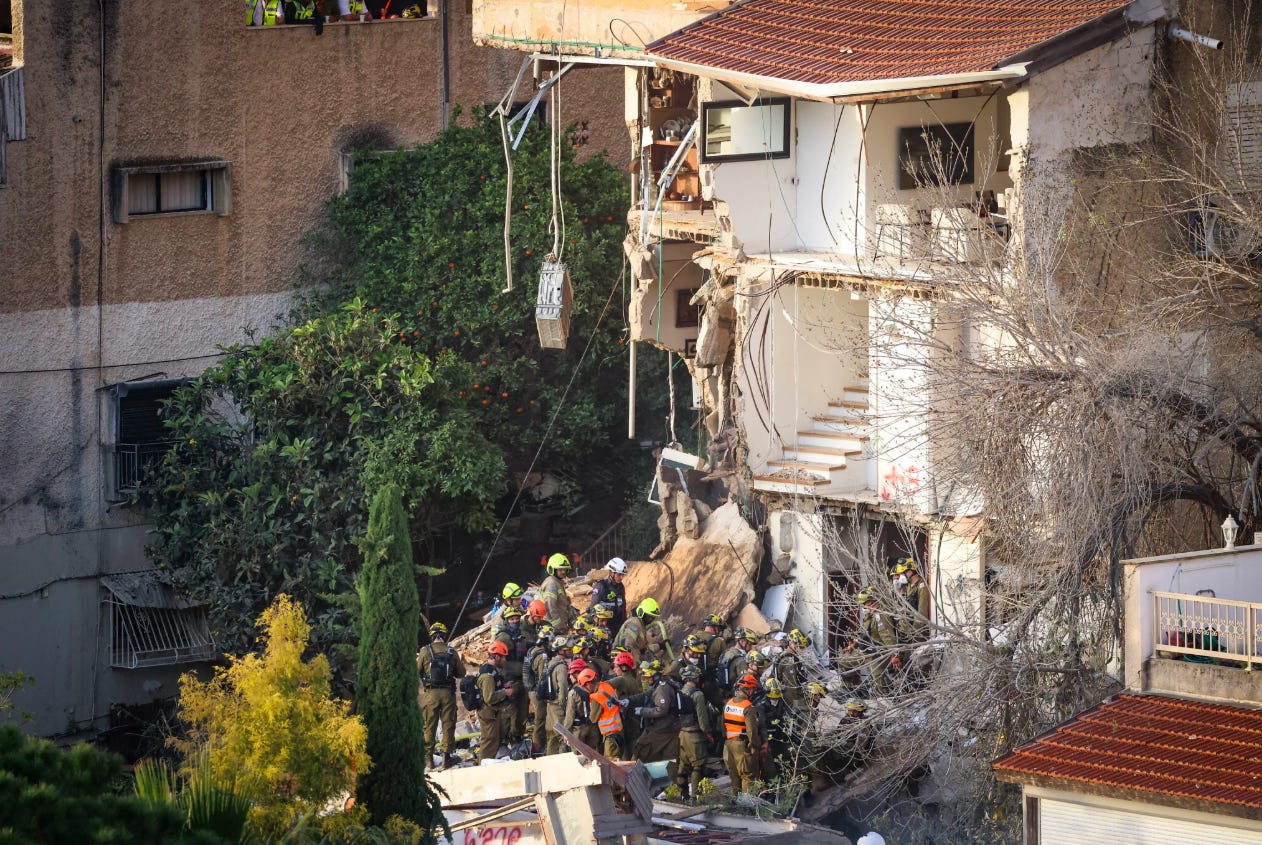
Israeli rescue forces search the scene where a ballistic missile fired from Iran struck a building in Haifa this morning. (David Cohen/Flash90)
It’s Monday, April 6, and the thirty-eighth day of Operation Roaring Lion. The global price of oil has reached $108, down less than a percent since yesterday. Here are the latest developments that occurred while you were asleep:
A source told Reuters that Pakistan’s army commander spent the night in direct contact with U.S. Vice President Vance, envoy Witkoff, and Iranian Foreign Minister Araghchi. The emerging proposal calls for an immediate ceasefire and reopening of the Strait of Hormuz, followed by direct talks in Pakistan within 15–20 days to reach a broader agreement. An Iranian official responded to the report, saying they are reviewing Pakistan’s proposal, but Iran would not agree to open the Strait of Hormuz for a temporary ceasefire.
Four bodies were recovered from the rubble of a Haifa residential building struck by an Iranian ballistic missile yesterday, with rescue teams still searching for two additional missing people, including a child and an elderly person. An 82-year-old man who was seriously wounded has undergone surgery and remains sedated and ventilated; his 78-year-old wife is hospitalized in good condition. A 10-month-old baby was among the lightly wounded.
Iran’s Revolutionary Guards have confirmed the killing of Major General Majid Khademi, head of the IRGC’s Intelligence Directorate, in a U.S.-Israeli strike. Khademi, who had served in Iran’s intelligence and security apparatus for nearly five decades, was responsible for surveillance of Iranian citizens and for orchestrating attacks against Jews worldwide.
Now, on to the details.
Donald Trump hosts a Cabinet meeting in March. (White House)
Donald Trump has issued a 24-hour extension, giving the regime until tomorrow at 8 p.m. ET to reopen the Strait of Hormuz. The extension appears to be tied to the prospect of negotiations. According to sources familiar with the talks in Islamabad, the United States and Iran are discussing terms for a potential 45-day ceasefire (though Reuters puts it at 15–20 days) that could lead to a permanent end to the war.
The mediators are discussing a two-stage framework:
Stage One: A 45-day ceasefire during which negotiations would take place to end the war.
Stage Two: A final agreement to officially end the conflict.
This proposal strikes a somewhat dissonant tone. For the past two weeks, reports of negotiations have spanned from outright denial to thoroughly unenthusiastic. Apart from Trump’s triumphalist rhetoric claiming Iran is begging for peace, there has been very little indication that a deal is actually forthcoming. The sources familiar with the talks are largely in harmony with previous statements: according to them, the chances of reaching even a partial agreement in the next 48 hours are low.
But let’s suppose the optimists are vindicated. Would Stage 1 just become the new status quo? After all, Stage 2 in Gaza is about five months behind schedule and seems far from manifesting in the foreseeable future.
Not likely. The difference with Iran is that the strategic incentives actually lean toward continuing the war. In Gaza, a stalled peace agreement makes sense: Israel was willing to stop in exchange for the hostages and control over 58 percent of the territory, while Hamas was just happy to crawl out of its tunnels to rule over a shrunken “Hamasistan.”
But Iran is a completely different equation. Even if Tehran acquiesces to negotiations and unblocks the Strait of Hormuz, settling for an unnegotiated truce doesn’t add up. Without an agreement Iran will just hit the reset button on its ballistic and nuclear programs while keeping 20 percent of the global oil market as a passive hostage. Sure, the surviving regime leaders might go to sleep every night wondering if tonight is the night their house goes up in flames, but for the moment, they survive.
Trump might run a victory lap over the smoldering ruins of their military infrastructure, but the takeaway would be glaringly obvious: he couldn’t drag the war across the finish line.
I believe a much better indicator of Trump’s true intentions than the extension is the somewhat vulgar threat he fired off right before it:
“Tuesday will be Power Plant Day, and Bridge Day, all wrapped up in one, in Iran. There will be nothing like it!!! Open the Fuckin’ Strait, you crazy bastards, or you’ll be living in Hell – JUST WATCH! Praise be to Allah,”
I don't think Trump is converting to Islam anytime soon, but I do think he is focused on opening the Strait permanently. Judging by the rhetoric, force isn't just on the table if necessary—it's the preferred option.
IDF troops of the 226th Reserve Paratroopers Brigade operate in southern Lebanon. (IDF)
Since Hezbollah joined the Iranian campaign, the IDF has struck more than 3,500 targets in Lebanon, hitting hundreds of command centers, weapons depots, and launchers across the country. Meanwhile, ground forces have expanded their offensive, pushing deeper and degrading infrastructure south of the Litani River.
There is good news and bad news.
First, the good news.
The IDF has identified “significant cracks” in Hezbollah’s command and control, specifically between the central leadership in Beirut and units on the ground in southern Lebanon. Morale is reportedly plummeting; reservists are failing to show up, and some operatives have fled north to avoid confronting IDF forces.
Then, the bad news.
According to the IDF, Hezbollah can still sustain a fire rate of roughly 200 launches per day—including rockets and drones—and will be able to do so for about five more months. Despite strikes on its stockpiles, the group still holds hundreds of launchers, nearly all deployed north of the Litani River, outside the range of the ground offensive. These assets are largely embedded in private homes and dense civilian areas, making them incredibly difficult to target from the air.
Yet despite slightly stiffer resistance than expected, the IDF is still achieving its objective.
What is that objective? As a senior military official noted on Friday, it isn’t Hezbollah’s total disarmament. The goal is to significantly weaken the terror group and remove the threat to residents of northern Israel.
That might seem contradictory—after all, an armed Hezbollah is, by its nature, a threat—but more critical to Hezbollah’s potency than its rockets is its patron. Iranian funding makes up somewhere around 70 percent of Hezbollah’s budget. Without Iran, Hezbollah is a paper tiger, if it isn’t cast into the dustbin altogether.
That begs the question: Why divert resources to fight the tentacle if you are fighting the head of the octopus?
The current operation is part insurance, part assurance. Israel wants to ensure that whatever Hezbollah becomes after its patron falls, it won’t be at Israel’s doorstep, while reassuring a thoroughly traumatized population in the north that a future safe from constant bombardment is possible.
English Editor: Ari Tatarka
If you enjoy the newsletter, you can show your support by becoming a paid subscriber—it really helps keep this going. I’m also offering a special monthly briefing for a small group of premium members. I’d love to have you join us—just click below to find out more.
Thanks for reading It’s Noon in Israel! Subscribe for free to receive new posts and support my work.


Force is the option, and regime change the goal.
While his intentions are usually a bit murky, it occurs to me that President Trump’s line “May Allah be praised” is his way of saying to the Iranians that even your god is in our side and listens to us.
The media commentary that this constitutes some grave (and, as they have long since determined that Trump is an imbecile, unknowing) insult to all Muslims, seems off the mark.
The bottom line remains the same when you are dealing with ideological fanatics. Like the living leaders of the Iranian regime, Hitler had no interest in ending what he saw was an existential war for the survival of his “Aryan” nation. But unlike Hitler, given their religious views, suicide is not an option. More’s the pity as that means they are happy to take down the Iranian people with them.