Operation Roaring Lion Day 7: The Hyundai That Launched the War
Also, why the UAE took the heaviest blows, the Kurd plan, and more.
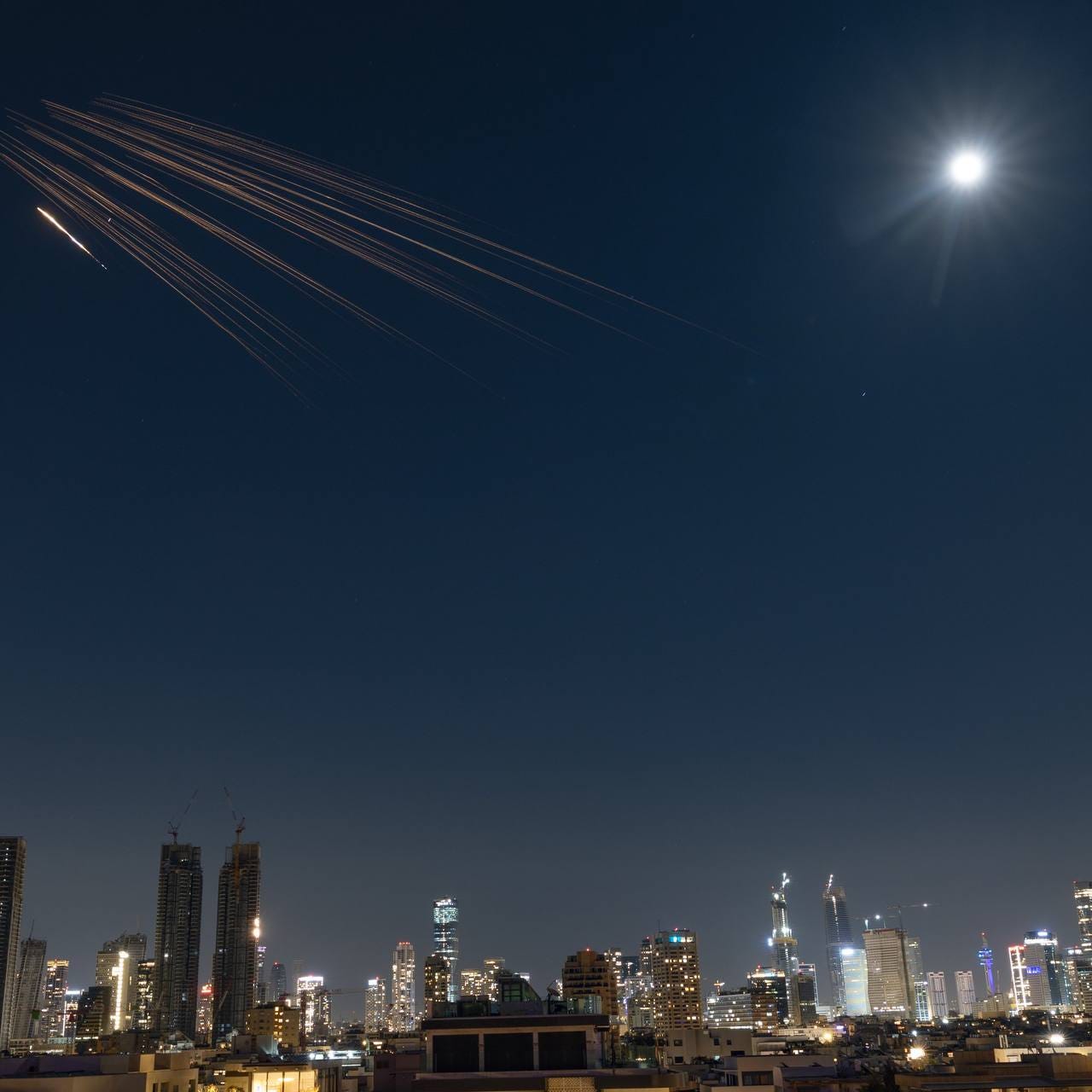
Cluster munition falls on Tel Aviv last night. (Haim Goldberg)
It’s Friday, March 6, and the seventh day of Operation Roaring Lion. Here are the latest developments while you were asleep:
Last night, the IDF announced it had rendered more than 300 Iranian missile launchers inoperable. The result showed up immediately: only nine missiles were launched at Israel. The last two carried cluster munitions, splitting into 24 smaller submunitions—terrifying to watch on X, but with no damage reported. For the first time in a week, Israelis slept through the night.
The UAE is reportedly planning to freeze billions in Iranian assets after Iran fired more than 196 ballistic missiles at the country.
On another front, after three months and several nudges from the American president, the Justice Ministry’s Pardons Department will not wait for the Attorney General’s input. In the coming days, it will submit its recommendations regarding Netanyahu’s pardon to the president.
Despite several alarm interruptions, Israel’s public broadcaster released the country’s 2026 Eurovision entry, “Michelle,” last night. The singer, Noam Bettan, says the upbeat track is about an unhealthy relationship—and the moment when you realize you have to get up and walk away when things aren’t working. “In the past few years, Israel sent a lot of ballads,” Bettan said, “and the country was waiting to be happy.” He’s right about the mood. Israelis are “looking for a different kind of energy,” he added. “We want to be happy. The whole country is thirsty for it.”
Now, on to the details.
A large billboard reading “Together we will win” with the Israeli and US flag, seen on the Ayalon highway in Tel Aviv during the Israel/US war with Iran. (Miriam Alster/Flash90)
The first tool used in Operation “Roaring Lion” was a used Hyundai i10—unwashed, scratched from parking. The Israeli deception operation before the strike included sending all the top IDF General Staff officers back home for Friday night dinner. After all, the neighbors watch the parking lot to see whether the general’s car is there; if it is, the attack must not be imminent. And so the head of the Planning Directorate, slipped away from the meal and made his way in his assistant’s second-hand car all the way to the command bunker.
It is already an open secret that Israel had planned a complementary operation against ballistic missiles around this coming June, marking a year since “Operation Rising Lion.” The new development was that the United States expressed interest in joining a campaign to bring down the regime. The Netanyahu–Trump meeting held at Mar-a-Lago on December 29 dealt mainly with finalizing a joint strike in the summer. Netanyahu returned from there, gathered a handful of senior officials and informed them.
That day will be remembered in history. By chance, just hours before the meeting in Florida, protests began in Tehran. At first they were too small for Netanyahu and Trump to take seriously. But a few days later it was decided to seize the opportunity, increase the stakes, move the attack forward and expand it significantly. The wheels of the dual war machine began turning quickly.
In fact, too quickly. Trump was very eager to deliver a crushing blow to the ayatollah regime. He therefore announced to the protesters that help was on the way. Israel had to restrain him and convince him—through the head of the Mossad—that such a premature strike would cause more harm than good. They succeeded, but then a new problem emerged: the president began to worry that the mission might be too big for Israel. It required another flight by Netanyahu to dispel those concerns, followed by an urgent meeting with IDF Chief of Staff Eyal Zamir. He landed in freezing temperatures, carrying on his classified computer a fifty-slide presentation—the war plan.
In the United States there is order: instructions come from above and are implemented without a High Court and without the infamous left-wing NGO B’Tselem. Still, it helped that the commander of CENTCOM, Admiral Brad Cooper, is one of the U.S. military’s greatest experts on Israel. When Sinwar was eliminated, he opened a bottle of champagne to celebrate. After last June’s war he launched his own inquiry to understand the Israeli operation and what the Americans could improve. What began as theoretical study turned into operational preparation. The operation was originally meant to begin the previous Friday, but a combination of less-than-ideal weather and last-minute issues in the U.S. military caused a delay.
Back to the deception plan: the idea was simple and brilliant. For weeks Military Intelligence and the Air Force had been placed on full alert, aircraft loaded with bombs—wearing down Iranian vigilance. And precisely in the final days the readiness was lowered, supposedly, signaling that it would not happen now.
Saturday morning is a particularly opportune time for military surprises in the Middle East.
This is an excerpt from my weekly column in Israel Hayom.
To read on my website click here
Iranian missiles impact Bahrain’s oil infrastructure yesterday.
I do not know which international source leaked, just before the attack, that the Saudi ruler was pushing with all his might for a strike against Iran. But whoever did so possessed both natural malice and perfect timing. One can only imagine the hysteria in Riyadh when the truth was revealed publicly: while Saudi Arabia condemned the aggressive Israelis, its ruler Mohammed bin Salman was urging them to strike the great Shiite enemy.
Then the war began. Saudi Arabia’s major oil facilities were attacked, and Israel began receiving requests from Riyadh to strike specific targets in Iran to prevent further danger to the kingdom’s flagship industry. Inciting publicly, pleading privately. Whoever decided to expose them did the world a favor.
The Gulf states took hits this week unlike anything they had experienced before. For so many years they walked a tightrope—until the ayatollahs cut it beneath their feet. The countries for whom stability is the highest value suddenly starred across the globe with columns of smoke and echoes of explosions.
The United Arab Emirates took the heaviest blow. Close to two-thirds of all the missiles and drones launched by Iran were aimed there.
A senior Emirati official told me this week, that there are five reasons for this. First, we are closer. Israel is dealing with the long-range ballistic missiles, leaving the shorter-range missiles for us. Second, we are more international. Images of the Burj Khalifa surrounded by smoke or of a burning port near the artificial palm-shaped island echo around the world. Third, Iran believes we are more vulnerable, because ninety percent of the population are foreign nationals and our economic model depends heavily on foreign investors and tourism. Fourth, because we are a Muslim state that represents everything Iran is not—the almost only state in the Middle East that exports oil but does not export terrorism. Fifth—and most important—because of you. Relations with Israel have changed the Middle East. They were aimed first and foremost at the Iranian axis. Nearly six years later, Iran is trying to settle the score.
The past two years have been difficult for Israel’s efforts to integrate into the region. The war in Gaza made life unbearable for the Abraham Accords countries and prevented others from joining them. It also helped Turkey and Qatar—the Muslim Brotherhood’s patrons—extend their influence over additional countries that normally would have been wary of extreme Sunni movements.
But perhaps something good will come out of this. Iran’s violent assault on the Gulf states reminds millions in the Arab world that the divide is not between Jews and Muslims, but between fanatics and moderates. And the strong bond between Israel and the United States may weaken the Turks, who had already begun warming up to the idea of becoming the rulers of the Middle East. Gaza took—Tehran will give.
This is an excerpt from my weekly column in Israel Hayom.
To read on my website click here
Yesterday, I appeared on CNN to discuss the war’s latest developments.
American and Israeli soldiers fighting the same war.
Every Shabbat, after the Torah is read, a sequence of blessings follows—one for the sick, one for the community, another for the welfare of the state. Last week, when services were interrupted by the first missile barrage, we said one blessing with special fervor: the prayer for the Israel Defense Forces.
But after a week of unprecedented cooperation, Israel’s won’t be the only armed forces being prayed for in thousands of synagogues across the country.
I’d like to share the blessing:
May He who blessed our ancestors—Abraham, Isaac, and Jacob—bless the soldiers of the Israel Defense Forces and our brave friends, the soldiers of the United States Armed Forces.
They stand guard over our land and the cities of our God, from the border of Lebanon to the desert of Egypt, and from the Great Sea to the approach of the Arava desert, and in every place they are — on land, in the air, and at sea.
May the Lord cause our enemies who rise against us to be struck down before them!
May the Holy One, blessed be He, protect them and save them from every trouble and distress, from every plague and illness, and send blessing and success in all the work of their hands. May He subdue our foes beneath them, and crown them with the crown of salvation and the wreath of victory.
And may it be fulfilled in them, as it is written: “For the Lord your God goes with you to fight for you against your enemies, to save you.”
And let us say: Amen.
Amen.
Shabbat Shalom!
We will be back on Sunday.
If you enjoy the newsletter, you can show your support by becoming a paid subscriber—it really helps keep this going. I’m also offering a special monthly briefing for a small group of premium members. I’d love to have you join us—just click below to find out more.
Thanks for reading It’s Noon in Israel! Subscribe for free to receive new posts and support my work.


Shabbat Shalom!
Shabbat Shalom and be safe!