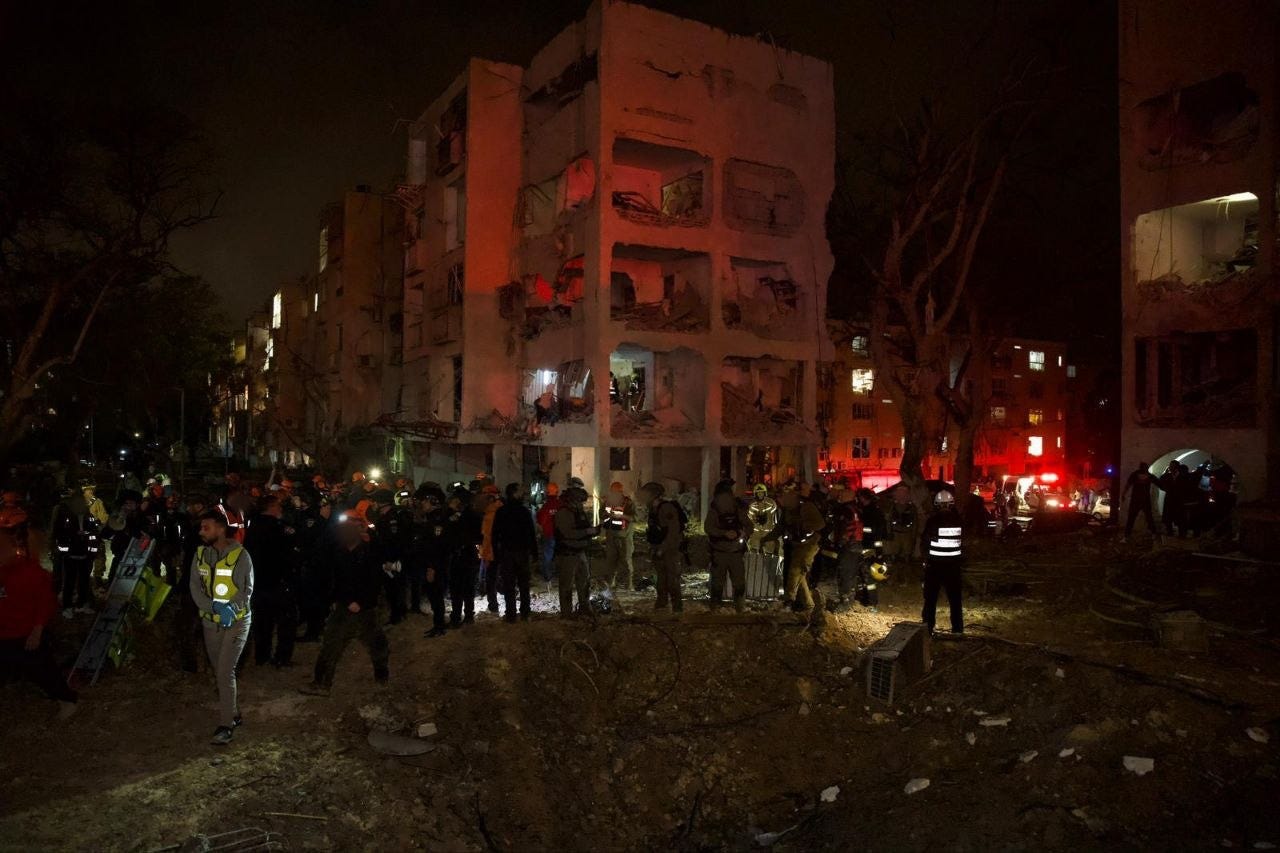
Operation Roaring Lion Day 23: 200 Injured by Iranian Missile
Also, Iran starts to act like its proxies, and more.
It’s Sunday, March 22, and the twenty-third day of Operation Roaring Lion. Here are the latest developments while you were asleep:
Last night Iranian ballistic missiles struck the southern cities of Dimona and Arad, injuring nearly 200 people—11 of them seriously—after Israeli air defenses failed to intercept two missiles. Iran said it was targeting Israel’s Negev Nuclear Research Center near Dimona, claiming the strikes were in retaliation for an alleged U.S. attack on Natanz, which the IDF denied. As a result of the attacks, in-person schooling—which had resumed in certain areas of the country—has been canceled for the next two days.
Fifteen people were wounded—most lightly—in an Iranian missile strike on central Israel this morning. The ballistic missile carried a cluster bomb warhead, scattering bomblets across a wide area.
Trump threatened last night to destroy Iran’s power plants “starting with the biggest one first” if the Strait of Hormuz is not fully opened within 48 hours. The ultimatum follows signs of growing international acceptance of Iran’s position. Iranian Foreign Minister Araghchi told Japan’s Kyodo News that Tehran has begun talks with Tokyo about possibly allowing Japanese-linked vessels through the strait. Meanwhile, Iran is reportedly considering a separate proposal to levy transit fees on ships passing through—an attempt to monetize its grip on the waterway.
The Pentagon is deploying a second amphibious ready group to the Middle East in as many weeks—adding roughly 2,200 to 2,500 troops. This follows last week’s deployment of a 5,000-strong force based in Japan, bringing total U.S. troop levels in the region to approximately 50,000.
Iran fired two ballistic missiles at the joint U.K.–U.S. base at Diego Garcia in the Indian Ocean—and missed. One missile failed in flight; the other was intercepted by a U.S. warship. The attempted strike revealed something significant: the missiles traveled roughly 4,000 kilometers, double Iran’s previously declared self-imposed limit of 2,000 kilometers—putting most of Western Europe within range.
Now, on to the details.
Drone footage from Arad last night. (United Hatzalah)
After a night in which nearly 200 people were injured by two missiles that evaded Israeli air defenses, one could be forgiven for thinking the war has entered a dangerous new phase. Thankfully—and tragically—it is simply a matter of statistics.
Two missiles aimed at Israel’s nuclear research facility fell on the nearby cities of Dimona and Arad in the same night, creating the impression that holes have opened in Israel’s air defense. But the numbers tell a different story. Of the nearly 500 launches toward Israel over 23 days of war, only six have resulted in direct hits—an interception rate of roughly 99 percent. No system is perfect, and eventually there will be a bad night. Last night, the system didn’t run out of interceptors, it simply missed.
Most of the damage and injuries throughout this war have been caused by shrapnel rather than warheads. The mayor of Arad put last night in perspective: “the impact was, relatively speaking, not severe”. The missile buried itself in the ground; the buildings sustained blast damage, but no one was killed.
Last night was a statistical reminder, not a turning point.
IDF forces in Southern Lebanon. (IDF)
They say that over time, people grow to resemble their dogs. Three weeks into this war, Iran is starting to look a lot like its Axis partners. Like in Gaza, they hide beneath hospitals and move from target to target in ambulances. Like in Beirut, they are no longer trying to defeat anyone, only to wear them down. Like the Houthis, they launch a single missile every so often and boast with AI videos of widespread destruction in Tel Aviv.
It is a self-deception that has succeeded. The Iranians are genuinely and sincerely convinced that there are hundreds dead, that Tel Aviv lies in ruins, and that Netanyahu is missing. It will take a few more café videos to convince them that Benjamin is still alive.
The prime minister (or his avatar, if one is to believe the Iranians) believes that Trump needs many more achievements in this war than Israel does. Israel’s war aims are regional: nuclear capabilities, missiles, terror proxies. America’s war aims include severing the threat Iran waved around for decades and has now been pushed to use: closing the Strait of Hormuz and sending oil prices soaring. The Gulf states are pressing Trump to eliminate that threat once and for all. They do not trust a future regime not to extort the entire region and the world with the threat of shaking the energy market.
And so Israel finds itself helping the United States achieve that goal. The rationale, beyond returning a favor for a favor, is clear: every joint action against Iran frames the Middle East as a story of fundamentalists versus moderates, not Jews versus Muslims. The broader implications of the event are only beginning to emerge. For example, Qatar’s warnings to senior Hamas figures that the Palestinian issue is dropping off the agenda and that they must immediately choose which side to support. For example, the expanding IDF operation up to the Litani River. Is this a temporary, isolated event? Soldiers who went deeper into Lebanon this week should think again, and remember that IDF forces have now been on the summit of the Syrian Hermon since the end of 2024, with no expiration date.
Trump, a man with no sentimentality for old borders, already shook the Middle East when he agreed in principle to recognize Israeli sovereignty over parts of Judea and Samaria in the framework of the Peace to Prosperity plan, and when he supported mass emigration from Gaza. The mass migration from southern Lebanon has already happened. The only question is whether he will give Israel merely de facto approval of its new northern border or de jure approval as well.
This is an excerpt from my weekly column in Israel Hayom.
English Editor: Ari Tatarka
If you enjoy the newsletter, you can show your support by becoming a paid subscriber—it really helps keep this going. I’m also offering a special monthly briefing for a small group of premium members. I’d love to have you join us—just click below to find out more.
Thanks for reading It’s Noon in Israel! Subscribe for free to receive new posts and support my work.


I am planning on going to Israel to volunteer. It is clear to me that the only support the Islamic cultures have come from people who need the oil. It's only a matter of time before the oil runs out and the desert takes them all. The Islamic death cults will be forgotten and vanish from history.
I’m not sure you realize that here in the US this is an unpopular war and likely only to become more so.