It’s Noon in Israel: Operation Roaring Lion Day 3: Hezbollah Commits Israel-Assisted Suicide
Also, updates, will Trump back out early? And much more.
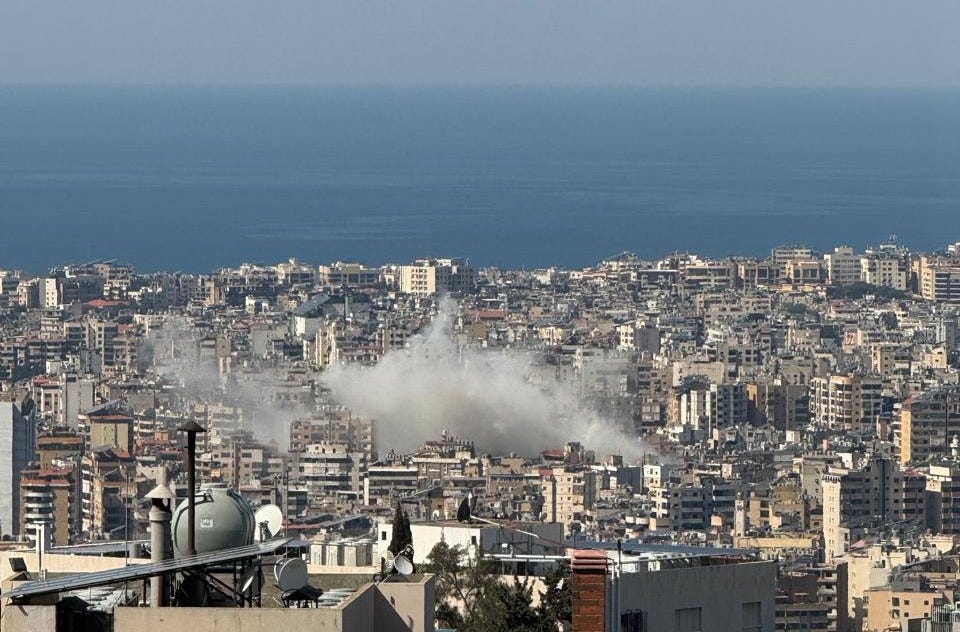
The IDF’s targeted strike in the Dahiya neighborhood of Beirut this morning.
It’s Monday, March 2, and the third day of Operation Roaring Lion. Here are the latest developments while you were asleep:
Hezbollah decided to strike Israel in revenge for the assassination of Ali Khamenei, launching a token attack of three missiles and a few drones. Israel responded to the poke with a swift blow to the face, sending the terror group flying. Israel has begun an offensive campaign against the terror group that is expected to last several days, targeting dozens of Hezbollah sites across Beirut and southern Lebanon.
A second Iranian missile fell, this time in the city of Beit Shemesh, destroying four apartment buildings. Dozens of Israelis were wounded, nine were killed, and 11 are still missing. Along with a 102-year-old man who died from injuries sustained while seeking shelter, and an elderly woman and her Filipino caregiver killed in the first impact in Tel Aviv, Israeli fatalities now stand at 12.
Iran’s attacks across the region have expanded, with missiles fired at Cyprus, a French naval base in the UAE, and Saudi oil infrastructure. The last time Iran targeted Saudi oil—through the Yemen-based Houthis—it temporarily knocked out half of the kingdom’s production capacity and triggered a vulnerability crisis that led to Saudi rapprochement with Iran. This time, the outcome appears less conciliatory, as the Saudis have expressed willingness to support the American strike.
Patterns from Gaza repeat themselves, as the international media blamed Israel and the U.S. for an explosion at a school in Iran that reportedly killed 150 people—an explosion which the IRGC now admits it had caused. Will this accusation be publicly withdrawn? Probably not. Did the media believe the regime significantly faster than they believed the protesters? Of course.
The American Embassy in Kuwait was reportedly hit by an Iranian munition, and three American F-15E fighter jets crashed in Kuwait, apparently due to friendly fire.
Former Iranian President Mahmoud Ahmadinejad, a Holocaust denier, was confirmed to have been eliminated in the opening strike.
Now, on to the details.
Hezbollah’s drone being intercepted this morning.
Hezbollah is like a driver approaching an orange light, unable to decide whether to brake or accelerate. Time after time, they end up creeping into the intersection, trying to do both—only to find themselves on the wrong side of Israeli traffic when the other light turns green.
On October 8, 2023, Hezbollah’s former chief Hassan Nasrallah was faced with two options: join in Hamas’s war on Israel, flood the Galilee with his special forces and attempt to reduce Tel Aviv to a pile of ash, or stay out of it and watch as Israel dissects its Gazan ally. Nasrallah chose a third option: a small-scale conflict in which Hezbollah symbolically participates by lobbing the occasional missile, but never enough to incur Israel’s full wrath.
It was a great strategy in the short term. Israel felt pressed and panicked, so it reacted instead of acting, evacuating tens of thousands of its citizens from the north and keeping the conflict on a slow boil. That worked for Hezbollah until Israel decided to raise the temperature.
Apparently, indecision was not beaten out of the organization during Israel’s 2024 offensive or any of the other thousands of strikes since the ceasefire because, faced with the recent Iranian strike, Hezbollah hesitated. It initially decided to pay dividends on the tens of billions of Iranian investment dollars in the form of a strongly worded letter of condemnation. When Khamenei’s elimination was confirmed, it decided to take action in the form of a symbolic barrage of three rockets and a few drones.
Hezbollah was hoping for Israeli forbearance. After all, they could not simply stand by and do nothing while their patron was attack, so it likely assumed Israel would absorb the attack, issue a token response, and allow Hezbollah to remain on the sidelines—lobbing the occasional missile to signal loyalty to the cause.
The problem? Israel has no mercy left for the weakened organization.
Overnight, Israel targeted dozens of Hezbollah sites across Beirut and southern Lebanon and plans to expand the offensive in the coming days. According to the IDF, “all options are on the table.” That may include a ground invasion and has explicitly included Hezbollah Secretary-General Naim Qassem himself.
Personally, I believe the offensive will remain limited. After all, what is the point of expending enormous effort on a tentacle when you are actively bombing the head of the octopus? The prevailing belief in Israel is simple: if Iran falls, Hezbollah will not be far behind.
Hezbollah’s mistake yesterday was believing that after two and a half years of war, Israel was the same country. It isn’t.
Israel made a commitment in the past few years: people calling for the destruction of Israel will be taken at their word and dealt with as such.
Let’s hope that after this round, Hezbollah gets the message.
Donald Trump in the situation room at Mar-a-Lago on Saturday night.
Rumors have been circulating that members of the Iranian regime have reached out to Trump to return to diplomacy. Should Israel be concerned about the possibility that Trump will tap out early?
Short answer: No.
The first thing that must be said is that there is an abundance of recent, medium-term and long-term evidence to show that everyone should proceed with extreme caution when it comes to gaps between Israel and the U.S., and between Donald Trump and Benjamin Netanyahu.
The most recent example is that while the world reported on distancing and Trump’s indecision in the negotiations preceding the strike, in truth the decision had already been made for weeks.
Let’s suppose that hypothetically Trump were looking to bow out early. The logical move for U.S. forces would thus be to focus only on their “core” interest, that being the nuclear sites. Ballistic missiles are certainly problematic for America’s regional allies and bases, but they threaten Israel far more than the U.S.
Yet last night, we got confirmation that the B-2 bomber squadron that destroyed the Natanz nuclear facility in June dropped its payload on ballistic missile factories instead. Not only that, at the outset, Trump tied the war aims to the destruction of Iran’s ballistic arsenal, blocking his early path out.
Last night, he further eroded that escape route. He told The Atlantic that his decisions regarding the length of this war are tied to the Iranians taking to the streets.
Even the Iranian foreign minister came out yesterday in mourning, claiming that they were on the verge of an agreement until Trump came along and bombed the negotiating table—not exactly a move someone looking to return to his seat at such a table would make.
But there is a valid concern. Trump, after all, does not have unanimous support in the United States, not even in his own party. Operation Midnight Hammer had the benefit of being in, out and successful before Tucker Carlson could take to X to build momentum behind his prophecies of doom.
But Trump, like the symbol of his party, is an elephant. When set in a direction, it will take a vast amount of force to shift him.
The moment he stood at the crossroads two months ago and told the protesters that help was on the way, he was given the option to intervene or risk being not just as bad as Obama during the 2009 Green Movement, but worse for overpromising. Trump chose the path that would cement his legacy, and no amount of isolationist alarmists will dissuade him from taking it to the end.
Now there appear to be two strategies being considered.
The first is that in a few days—in which supposed fantastical things are planned—the strikes will end, the protesters will come out and overthrow the regime. The other option is that they attempt to strike simultaneously while protesters come out to maintain pressure on the remnants of the regime.
Either way, Trump is clearly not looking to get off at the next exit.
(IDF)
As part of the initial blow of Operation Roaring Lion, Israel eliminated 40 commanders and senior officials of the regime within one minute. Included in that number were Khamenei, his senior advisers and his son-in-law, not to mention all the senior military figures and, as we found out yesterday, former Iranian President Mahmoud Ahmadinejad.
Israel’s goal is clear: kill the leadership, the potential replacements for the leadership, and the replacements for the replacements for the leadership, in order to pave the way for something more positive.
Of all the leaders struck, one prominent name remains alive: Iranian President Masoud Pezeshkian.
Pezeshkian already has the rare distinction of being a surviving senior Iranian official after the June war. But that was not due to luck or survival instinct. Reports indicate that he was almost eliminated accidentally in June. Israel did not know he was in the area and was not happy to hear about the close call.
Now, if you are an enemy of Israel, being left alive means one of two things: You were working with the Mossad, or Israel wants you where you are.
The second option fits with the belief of senior American officials that the Iranian president is like the vice president of Venezuela—that is, someone within the regime who can carry out America’s wishes.
One possible outcome of this conflict is that protesters rise from below and overthrow the regime. A second possibility is that some hard-liner within the regime inherits power and maintains the ideology. But there is a third option: power falls to a pragmatist who can carry out change from the top.
Former Iranian president Mahmoud Ahmadinejad.
I do not mean to echo The New York Times’ style after its glowing obituary for Khamenei, but it is difficult to express the cultural impact of Mahmoud Ahmadinejad. Few foreign leaders were as recognizable to Americans in the late 2000s as the former president.
During that time, he was prolific, interviewed by Larry King and George Stephanopoulos. He even addressed Columbia University in a heavily protested televised event, where he answered one question about LGBTQ treatment in Iran by saying, “In Iran, we do not have this phenomenon. I don’t know who has told you we have that.”
Without getting into how he would likely be received on Columbia’s campus today, Ahmadinejad even received the highest acclamation of U.S. cultural notoriety, being parodied on Saturday Night Live. Even after the strike I’m not sure if I will get the image of Ahmadinejad-Fred Armisen lying on a piano being serenaded by Andy Samberg out of my head.
Fred Armisen as Mahmoud Ahmadinejad lying on a piano in a red dress being serenaded by Andy Samberg. (Screengrab used in accordance of Section 27a of the Copyright law)
The most striking fact about his assassination is that Ahmadinejad’s whereabouts were only known because he had been under house arrest by the regime. A few weeks ago he tried to carry out a coup to take Iran in a more hardline direction.
I cannot imagine that the millions of people in the 2000s watching him on TV, watching him spew hatred and propaganda, could have foreseen that almost two decades later he would be eliminated in history’s first joint U.S.-Israel operation, unprecedented in its scope and effectiveness.
Jewish families, wearing costumes, read aloud from the Megillah, or The Book of Esther, as part of the custom of the Jewish holiday of Purim, when it is tradition to dress up. The festival of Purim commemorates the rescue of Jews from a genocide in ancient Persia. (Yossi Zeliger/FLASH90)
In a war replete with symbolism, hearing about all of the spiritually and historically profound moments can get tiring. From the heroic last stand at Tel Hai inspiring the name Roaring Lion, to the spiritually resonant decision to strike during Parshat Zachor, where we read about the attempted genocide carried out by the Amalekites there are many examples. But we cannot ignore the Purim festival-themed elephant costume in the room.
In October 2000, Spanish Prime Minister José María Aznar arrived in Tehran to meet with Ali Khamenei, Iran’s supreme leader. Here I quote from Eran Hermoni’s excellent book From Auschwitz to Tehran:
“Aznar entered the room where the meeting had been scheduled to take place, a spacious room filled to the brim with impressive Persian carpets. But to his surprise, he did not see Khamenei near the armchairs designated for seating. He noticed Khamenei standing at the side of the room, preparing tea for himself. Aznar approached and stood beside him. Seeing that he was slow to speak and preoccupied with preparing his cup of tea, Aznar decided to open with some small talk to break the ice and asked: ‘Sir, what is Iran’s national agenda?’ Khamenei did not reply and continued stirring his tea.
Aznar thought to himself that perhaps his question had not been sufficiently clear, and so he asked Khamenei in simple and direct terms: ‘Sir, when you wake up in the morning, what is the first thing you think about?’ At that point, while stirring his teacup, Khamenei answered him in simple words: ‘To eliminate Israel.’”
As I write this, I fast in remembrance of the heroism of Queen Esther in the story of Purim. Tomorrow we will celebrate the victory of the Jews over a group of genocidal Persians, as we have for the past 2,000 years. At the climax of the story, Esther appears before King Ahasuerus, who declares in a line made sharper by recent events, “Let the evil plot that he devised against the Jews recoil on his own head!”
If you enjoy the newsletter, you can show your support by becoming a paid subscriber—it really helps keep this going. I’m also offering a special monthly briefing for a small group of premium members. I’d love to have you join us—just click below to find out more.
Thanks for reading It’s Noon in Israel! Subscribe for free to receive new posts and support my work.


Can you provide a source for the IRGC taking responsibility for the hospital bombing? I looked but didn't see anything.
This is a “strike while the iron is hot” moment.
2-1/2 years ago, Bibi and Israel had to reserve ammunition and human strength in order to survive while constrained by the handcuffs of unreliable support from its greatest and strongest potential ally.
The support is there RIGHT NOW. And as you’ve pointed out in this article, that support is going to be aggressively challenged from within the U.S.
I am blown away by the Israelis. The capability in all realms from invention to warfare to technology to contributions to medicine to the arts to unlimited philanthropic improvements in the world.
NOW is the time (because munitions replenishment commitments from the U.S. are solid currently- not to mention serious backup in the form of some dominating military operations that we, the U.S. will handle) to DECIMATE Hezbollah and destroy its war-making capability- set it back 100 years- NOW.
Don’t miss this opportunity.
And together let’s do the same to Iran’s capabilities also.
Then maybe we stand a chance of having a real move toward peace and coexistence- both of which will perpetually need to be enforced- because fanatical ideology is never going away.
I fear the day that the left is able to assume US power again. That’s the day the world will immediately begin to slip back to its less desirable conditions.