Operation Roaring Lion Day 6: Israel's New Rules of Engagement
Also, the coalition expands, the Kurdish offensive, and more.
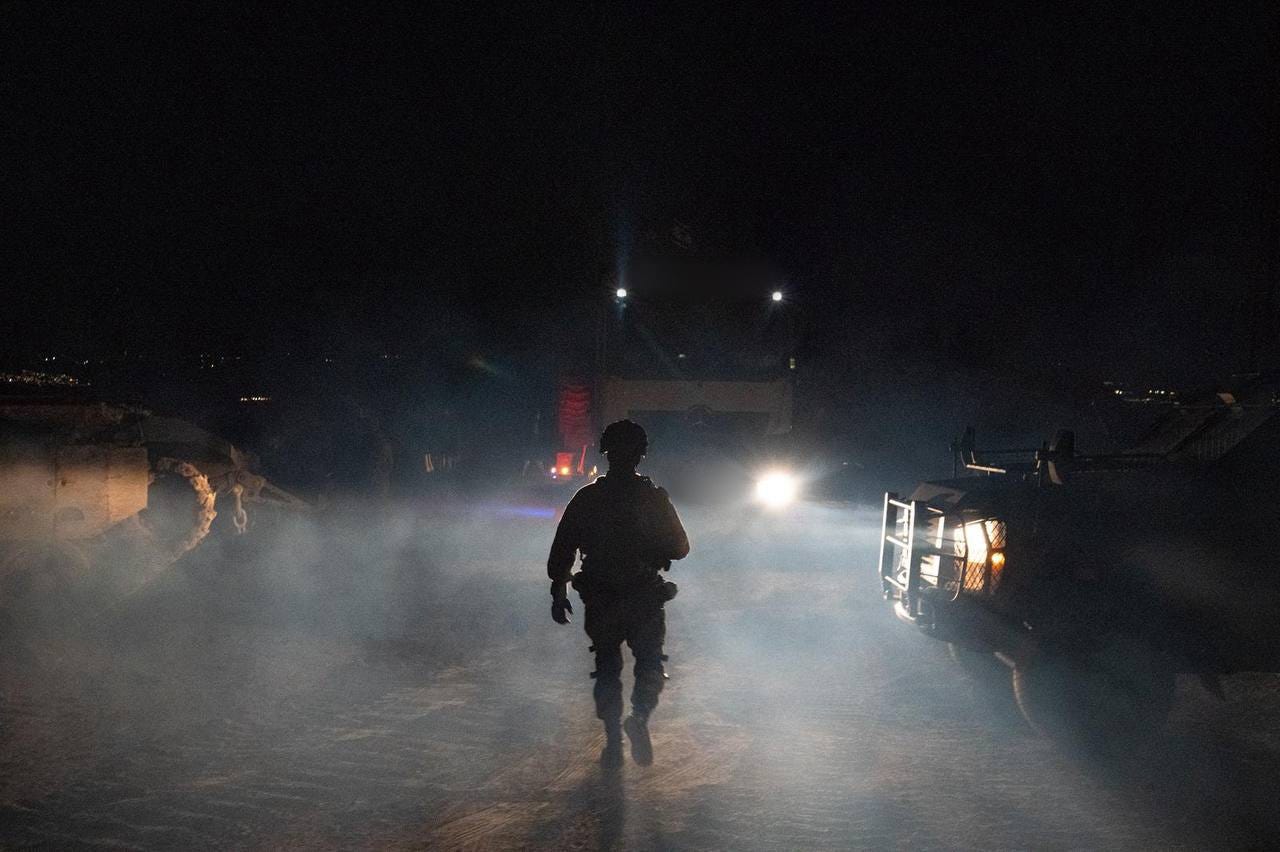
Israeli soldier at one of the strategic points in Southern Lebanon last night. (IDF)
It’s Thursday, March 5, and the sixth day of Operation Roaring Lion. Here are the latest developments while you were asleep:
Following a U.S. request, thousands of Kurds are reportedly preparing a campaign along Iran’s northwestern border. Over the past couple of days, Israel and the U.S. have been laying the groundwork—hitting dozens of military positions, frontier posts, and police stations along Iran’s northern border regions. The intention seems to be a diversion: pull the IRGC’s attention away from the protesters. But it could also make the largely Persian protest movement nervous—nothing spooks a national uprising like the scent of fragmentation.
On the coalition front, the Azeri city of Nakhchivan has been struck by drones, injuring two. Azerbaijan’s Foreign Ministry said it reserves the right to take “appropriate response measures.” Spain—after initially refusing to allow U.S. access—reportedly folded following Trump’s threats of economic penalties, though Madrid is now denying cooperation. Still, Spain is sending a warship to defend Cyprus after it was struck by Iran on Monday. Italy has also announced it will send “naval assets” to the island.
The first rescue flights bringing Israelis home from abroad are set to land today, and Israel is preparing to reopen its airspace for outbound flights on Sunday. Under the current conditions, only 50 passengers will be allowed on each departing flight. Checked luggage won’t be permitted in the aircraft hold, and departures will be paced by the arrival of incoming rescue aircraft.
Inside the country, Home Front Command has eased restrictions: all areas are moving from a strict policy level to a limited policy level. Gatherings of up to 50 people are permitted, and offices may reopen—so long as employees can reach a standard protected area in time. Much to my kids’ relief, school remains closed.
Israel’s campaign in Lebanon continues apace, despite French President Emmanuel Macron calling on Israel to “refrain from a ground maneuver.” Overnight, the IDF eliminated two senior Hezbollah commanders. Hezbollah leader Naim Qassem asked rhetorically last night, “Do you think a single barrage justifies a war?” Israel’s answer is a definitive yes.
Strikes on ballistic missile facilities have reduced Iranian ballistic missile launches by 86 percent since February 2. After a lull of more than seven hours, there were three separate missile alerts in under two hours last night. No impacts were reported. Israel’s fatalities remain at 11.
Now, on to the details.
Israeli F-16s on their way to bomb Iran. (IDF)
The Israeli defense establishment realized as early as the night between October 6 and October 7, 2023, that something was stirring in Gaza. They knew, yet they did nothing. The paralyzing fear was “miscalculation”: the worry that if the IDF moved forces, Hamas would interpret it as an escalation, fighting would ignite, and the coveted “quiet” would be shattered.
This was Israel’s state of mind in 2021. The head of the Shin Bet compared it to a patient whose vital signs were all in decline. When a person fails to exercise their muscles for an extended period, they become a couch potato. Decades of containment, restraint, and forbearance caused Israel to appear more vulnerable than ever in the eyes of its enemies.
Two and a half years later, Israel stands at the pinnacle of its power in the Middle East. This transformation occurred only after it shed every rule it had gradually adopted since the 1980s.
While the official name of the military is the “Israel Defense Forces,” its most impressive achievements have historically been recorded during preemptive strikes, the kind not seen for decades. The army had been forced into cumbersome urban warfare against terror groups; the leadership avoided retaliating against missiles fired at its territory by the ruler of Iraq, and later by Hezbollah and Hamas. All of this ended when the terrible price of that policy was revealed on October 7th.
These are the new rules of the game:
First, the enemy exists in exactly two states: the pursuer or the pursued. For years, Israel shied away from targeted assassinations and proactive operations, granting terror leaders and Iranian officials the time and peace of mind to plot against it. The reality is the exact opposite: when they are busy running for their lives, they have no time to plan how to take ours. There is a sense of poetic justice in the fact that Khamenei, the man behind the assassination attempts on Trump and Netanyahu in the summer of 2024, was eliminated by them in the winter of 2026.
Second, when an enemy announces their intention to destroy you, believe them. It isn’t election rhetoric (since there are no elections); it isn’t lip service or empty words. “Death to America” and “Death to Israel” are not mere slogans for the town square—they are operational blueprints.
Third, ignoring small security problems invites larger ones. Israel fled Gaza because of IEDs and shooting attacks, only to receive two commando divisions and the world’s largest tunnel network. It withdrew from Lebanon because it couldn’t stomach the cost of 20 fallen soldiers a year; in exchange, Hezbollah entrenched itself on the border with a missile arsenal rivaled by few global powers.
Fourth, there is no true modus vivendi with terror organizations. There is no way to soothe murderous ambitions through “gentleman’s agreements,” international guarantees, or economic incentives. Israel tried this in Gaza, and the result was catastrophic.
Fifth, when you do respond, abandon the “equation” method. For years, the enemy fired rockets and Israel replied with “proportional” force. This normalized the legitimacy of firing on civilians, kidnapping, and invasion. That changed after October 7th. Hezbollah leader Hassan Nasrallah thought he was still playing by the old rules, launching a few rockets daily. It ended with his elimination, the decapitation of his organization’s leadership, and the destruction of 80 percent of their missile stockpile.
Sixth, when you are the strong side, the enemy is the one who should fear a miscalculation, not you.
Finally, and most importantly: Fundamentalists always accumulate weapons to use them, not to deter. For years, Israel ignored the vast ammunition depots in Gaza and Lebanon under the assumption they would simply “rust away.” They didn’t.
All these lessons were fully applied in the operation launched this Saturday. Israel simply cannot accept the continued existence of thousands of ballistic missiles and production facilities, where every launch sends half the country into shelters and threatens mass casualty events. It cannot tolerate a regime that continues, even today, to fund its greatest enemies with billions of dollars annually.
President Trump’s decision to strike Iran alongside Israel proves that good ideas are infectious. Obama’s America truly believed the Iranians could be appeased with economic benefits. Clinton’s America made peace with a violent North Korea and received a nuclear North Korea in return. Biden’s America pushed for agreements that would have left Hamas as the sovereign ruler of the entire Gaza Strip.
Contrary to the isolationist instincts often attributed to the MAGA movement, Trump understood perfectly that Iran is a danger to regional peace, and by extension, world peace. The Ayatollahs’ criminal attacks on the peaceful Gulf States and Cyprus serve as a grim testament to what they would have done had they been allowed to develop nuclear weapons. Above all, this is the one war that will save us from the necessity of many others. The entire world now sees what happens to those who spent 47 years shouting “Death to America” and “Death to Israel,” only to suddenly discover that America and Israel were finally listening—and taking notes.
To read this article in the Wall Street Journal click here.
A Kurdish fighter in Iraq. (Screenshot used in accordance with Section 27a of the Copyright Law)
Separatism is a dirty word in Iran. Persians—the largest ethnic group, which dominates the state’s institutions—have always been hypersensitive about the country’s ethnic makeup. What does this mean for the planned American-Kurdish offensive?
First, context.
Depending on the survey, ethnic Persians make up anywhere from roughly 48 to 60 percent of the population; the rest are minorities. The largest of those are the Azeris (estimated at 16–30 percent) and Kurds (roughly 7–10 percent). Both the Kurds and the Azeris briefly tasted independence under Soviet patronage in 1946, and large parts of these communities have never quite lost the hunger for it.
For years, the regime has warned the Persian population that the U.S. and Israel would try to inflame ethnic tensions to bring down the country, especially since Mossad is widely believed to recruit heavily among non-majority communities.
Indeed, that was a strategy floated in the past. But now there is a prospect even better than disaffected minorities: the majority.
The predominantly Persian protesters aren’t trying to liberate the Persian heartland from the ayatollahs—they want Iran unified and intact with a different government.
Which suggests that the U.S. and Israel—eager not to alienate their best shot at real regime change—have likely sought (and perhaps received) assurances that the Kurdish actors now planning an incursion would help topple the regime without pressing for a breakaway state inside Iran’s borders.
Zooming out from the ethnic context, it’s impressive that the U.S. has managed to get “boots on the ground” in Iran without triggering a domestic bout of Iraq PTSD. Special forces and intelligence personnel are almost certainly embedded within Kurdish forces, helping direct, coordinate and maximize U.S. support, but their participation will likely go unnoticed by the electorate.
After years of fighting ISIS, al-Qaida and other threats in Iraq, Kurdish forces are among the region’s best trained and most organized. Add U.S. and Israeli air support and intelligence, and you have a combination that can go a long way against a demoralized IRGC.
The best part? This won’t be the last surprise up the U.S. and Israel’s sleeve.
If you enjoy the newsletter, you can show your support by becoming a paid subscriber—it really helps keep this going. I’m also offering a special monthly briefing for a small group of premium members. I’d love to have you join us—just click below to find out more.
Thanks for reading It’s Noon in Israel! Subscribe for free to receive new posts and support my work.


brilliant thoughtful succinct analysis, and you get to troll the nyt readers as a bonus with your truth bombs.
tragic to note the deaths because of the Syrian appointment of The wanted dictator, the Kurds deserve justice and more consistent treatment hopefully and inevitably they can push back against the appointed isis entity in Syria and give him what is due, and to be empowered to push back against erdogan and that big unused army that inexplicably is in NATO as NATO denied its relevancy after British bases were attacked in Cyprus thus denying the reliability or relevance of the biggest bureaucratic entity in Europe, NATO headquarters in Brussels is astounding in its scale similar to the 15,000 employee embassy in Beirut sitting on 40 acres what do they do all day sucking money from everyone everywhere accomplishing nothing and getting in our hair?
Does France's military advice sound even sillier in the original French?