Operation Roaring Lion Day 27: Trump's Three Choices
Also, Iran learns from Hamas, Israel's annoying German, and more.
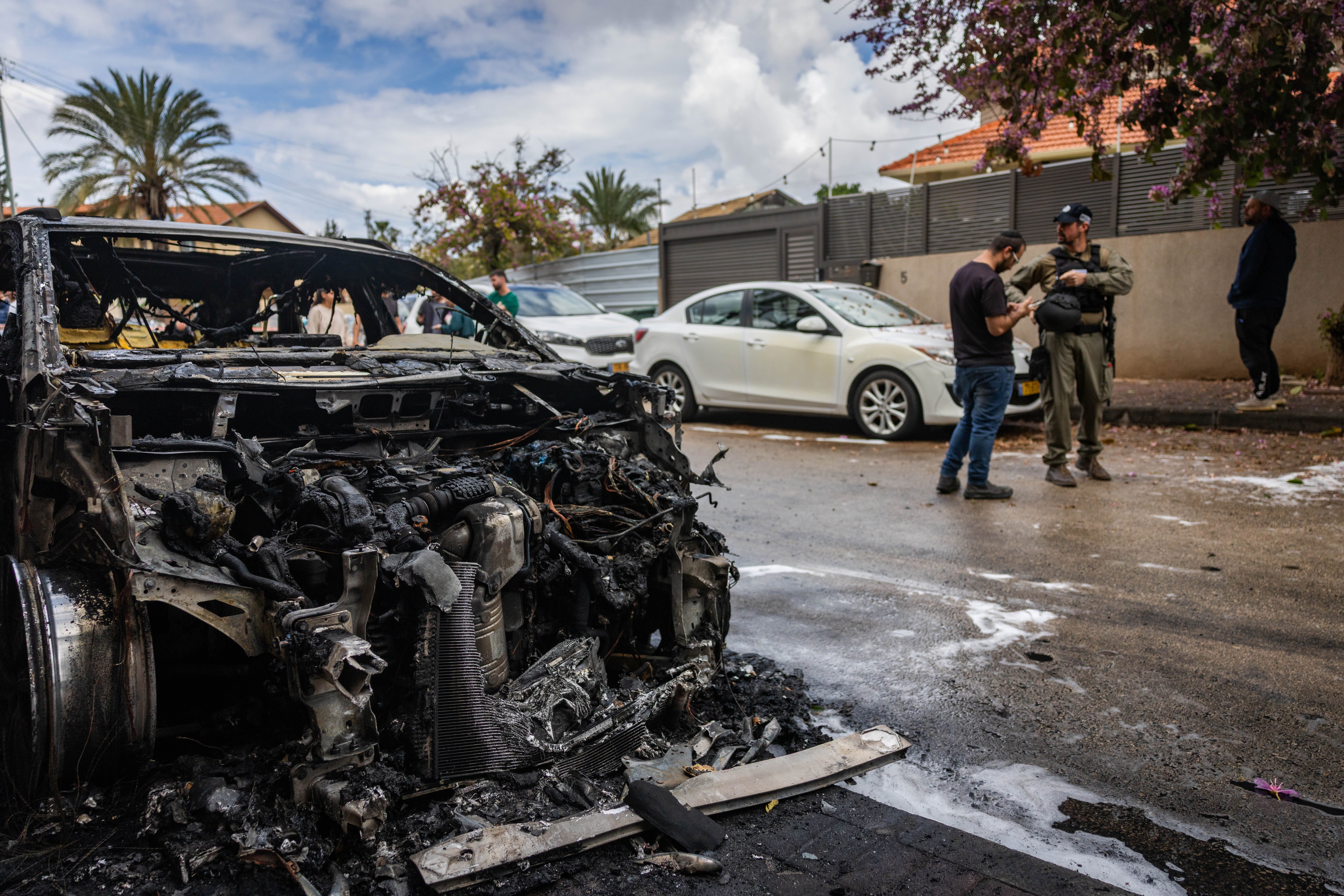
Israeli security and rescue forces inspect the damage at the scene where a missile fired from Iran toward Israel caused damage in Ganei Tikva, northern Israel this morning. (Yonatan Sindel/Flash90)
It’s Thursday, March 26, and the twenty-seventh day of Operation Roaring Lion. The global price of oil has reached $106, up 45 percent since the start of the war. Here are the latest developments while you were asleep:
The Pentagon and U.S. Central Command are developing plans for a "finishing blow" against Iran, according to four senior American officials and sources familiar with internal discussions. Four main options are on the table: invading or blockading Kharg Island; seizing Larak Island, which anchors Iran's control of the Strait of Hormuz; taking control of Abu Musa and two smaller islands near the strait's western entrance; and intercepting Iranian oil tankers on the eastern side of Hormuz. The military has also prepared plans for ground operations deep inside Iran to seize enriched uranium from nuclear facilities. Donald Trump has not made a decision, and the White House describes all ground options as "hypothetical"—but sources say he is prepared to escalate if diplomatic talks fail to produce results soon.
Trump claimed this morning that despite Iran’s public posture of merely “looking” at the U.S. proposal, Tehran is privately “begging” for a deal. He closed with a warning: Iran had better get serious about negotiations, because once it is “too late” there will be “no turning back.”
Iran’s ambassador to Japan made clear today that Tehran will not accept a U.S.-imposed peace plan. “It’s not the Americans who will determine anything. It’s Iran,” he said, adding that any unilateral imposition is “not acceptable.” The statement comes as Tehran continues to publicly deny that negotiations with the United States are even taking place.
Staff Sergeant Uri Greenberg, 21, from Petah Tikva, a fighter in an elite Golani Brigade unit, was killed in battle in southern Lebanon. Israel’s military fatalities have now risen to three.
Uri Greenberg who fell in Southern Lebanon this week.
The Wall Street Journal reports Iranian Parliament Speaker Qalibaf and Foreign Minister Araghchi were removed from the U.S. and Israel’s assassination target list for “four or five days” ahead of the negotiations in Pakistan.
Now, on to the details.
Donald Trump disembarks Marine One on the South Lawn of the White House. (whitehouse.gov)
As we approach the weekend the war has come to a crossroads. Donald Trump has three paths available:
Continue with his current direction and we end this war with a negotiated settlement.
Return to his original plan and continue pounding the regime.
Walk away altogether, a unilateral ceasefire.
Let’s look down the path of negotiation.
The United States is offering a clear exchange: extensive sanctions relief in return for the removal of all enriched uranium, the dismantling of Iran’s nuclear program, limits on Tehran’s ballistic missile capabilities, and the cessation of support for regional proxies—including Hezbollah, the Houthis, and Hamas.
Meanwhile, the Islamic Republic is writing its Christmas list.
The closure of all American bases in the Gulf and reparations for attacks on Iran. It wants a new order in the Strait of Hormuz that would allow it to collect transit fees. It is asking for guarantees that the war will not restart, along with an end to Israeli strikes on Hezbollah, and the lifting of all sanctions. As for its ballistic missile program—no limitations at all, despite having just demonstrated capabilities that reach well beyond its previously declared range. Nuclear material is not even mentioned, but it is hard to imagine Tehran agreeing to let it leave the country.
A party that believes it is losing does not make demands like these. Either the regime is so hardline that it cannot see the house collapsing around it, or it believes it has more leverage than it appears, that Trump cannot sustain this campaign.
Needless to say, Santa Trump will not be delivering this year.
If the massive chasm between the two positions can somehow be bridged, then a limited deal is possible. In exchange for partial sanctions relief, the regime agrees—on paper—to constrain its nuclear and ballistic ambitions, drops its demands over the Strait of Hormuz, and offers vague commitments to rein in its proxies. Most importantly, it receives assurances that this will not happen again in eight months.
No one in the region is satisfied—but they adjust, returning to a strategy of containment for a weakened, unstable Iran.
The second path is a return to war.
This is the most likely. Strikes continue, the United States moves on Kharg Island. Iran tries its hardest to keep the Strait of Hormuz closed, while Trump resorts to less diplomatic options to open it. After several more weeks of strikes, the conflict transitions into a protest phase—with the U.S. or Israel providing close air support to internal opposition.
There is also a third, least desirable path: Trump walks away entirely and a unilateral ceasefire emerges.
Despite public statements to the contrary, Iran would accept this outcome. Yes, it has dreams of reparations and sanctions relief—but what it truly seeks is survival. What it loses in the arrangement is security, every day they spend rebuilding infrastructure they know planes can return at any time to bury them in rubble. Even so, you don’t look a gift stay on a death sentence in the mouth.
The only reason for Trump to choose this path is if Iran’s calculation proves correct—that the economic cost, particularly to global markets and Gulf states, becomes too high, and he has to withdraw. If it is simply fatigue, that is harder to justify stopping now. One more week could see Kharg Island seized and the uranium buried even deeper beneath Isfahan.
And what about Israel?
According to a senior security source of mine, Israel could accept an early end—provided the U.S. maintains a strong military presence in the region to support a potential protest phase. If the war ends through negotiation, protests are unlikely. If strikes continue, they are more likely. And if the war ends suddenly and unilaterally, it will depend—a perceived chance of renewed U.S. intervention could tip the balance.
After this weekend we will know which path Trump has chosen.
Supreme Leader Ayatollah Ali Khamenei meets with the head of the Political Council of Hamas, Mohammed Ismail Darwish and senior officials of Hamas in Tehran, February 2025 (leader.ir)
It is tempting to try to assess what to expect from negotiations between the United States and Iran based on previous rounds between the two sides. But perhaps the better lesson comes from another corner of the Middle East: Gaza.
There, as here, Trump used the exact same threat on the enemy (“to open the gates of hell on them”), and there too Israel suddenly discovered that he was conducting direct negotiations with them. For many, this was proof that Trump had thrown Israel under the bus, that he was unstable, and other worn-out clichés. But the truth was different: Netanyahu’s Israel and Trump’s United States had the same goals—returning the hostages and demilitarizing Hamas. The gap was over the means. Israel believed in military force as the sole solution; Trump believed negotiations could also work.
The U.S. president was right, to Israel’s surprise. He secured the return of all the hostages while the IDF still controlled most of the Strip, leaving demilitarization for later.
As in “Hamasstan,” so in Tehran: there is full agreement between Netanyahu and Trump on the end state—no uranium, no missiles, no proxies, and no regional domination. The disagreement lies in whether this can be achieved through talks in Islamabad. “We won’t create difficulties on this issue,” Netanyahu said this week. “We’re already being accused on the fringes of the Republican Party of dragging America into war—why give them reason to think we sabotaged negotiations?”
Where might a gap emerge? If, in this case too, some demands and concessions are deferred to later stages—such as ending cooperation with proxies or dismantling the missile industry. The “fifteen-point document,” for example, states that the U.S. would lift sanctions according to a timetable and Iranian compliance—very similar to the Hamas model.
But there is a fundamental difference that complicates this scenario. Hamas is like the creature in Alien—it changes forms: sometimes a government, sometimes an army, sometimes a guerrilla organization. Iran is a state. It cannot, and will not, survive in such uncertainty. It demands its reward here and now: guarantees of no further attacks, that Israel will not strike Hezbollah, that sanctions will be lifted and billions will flow. In other words—not a return to February 28, but an entirely new reality. And that, quite simply, Trump cannot accept.
This is an excerpt from my weekly column in Israel Hayom.
The Brandenburg Gate lit up with the Israeli flag. (German Mission to Israel)
Germany is known for the high quality of its exports—but there are exceptions. Foreign Minister Gideon Sa’ar reprimanded Germany’s ambassador to Israel, Steffen Seibert, this week over a tweet that lumped together condemnations of Hezbollah, Iran, and settler violence.
“His obsession with Jews living in Judea and Samaria prevents him even from condemning the murder of a Jew by a Palestinian. It’s good to know that soon another ambassador will come—one who will strengthen the ties between Germany and Israel.”
Sa’ar was accused of seriously harming a close friend of Israel and damaging Israel–Germany relations.
As for the first accusation, the old saying applies: “Tell me who your friends are, and I’ll tell you who you are.” Seibert was defended by Haaretz and by the left-wing Democrats party—hardly a surprising coalition, given his support for organizations such as Breaking the Silence and other left-wing NGOs. He had already crossed a political line in 2023 when he attended a Supreme Court hearing on judicial reform.
But the more interesting question is whether any real damage will be done to Israel–Germany relations. Unlikely.
In his previous role, Seibert served as the spokesman for Angela Merkel—the political rival of current Chancellor Merz’s predecessor as head of the German right.
If anything, the frustration with Seibert’s antics may draw Jerusalem and Berlin closer together.
English Editor: Ari Tatarka
If you enjoy the newsletter, you can show your support by becoming a paid subscriber—it really helps keep this going. I’m also offering a special monthly briefing for a small group of premium members. I’d love to have you join us—just click below to find out more.
Thanks for reading It’s Noon in Israel! Subscribe for free to receive new posts and support my work.


„In his previous role, Seibert served as the spokesman for Angela Merkel—the political rival of current Chancellor Olaf Scholz.“
… Friedrich Merz :)
Bibi doesn't believe the mullahs are honorable or that their agreements can be trusted. He'd rather degrade them militarily. Trump doesn't believe they can be trusted either but has a political limit in the amount of war at his disposal.