It’s Noon in Israel: Operation Roaring Lion Day 5: Iran Is Running Out of Missiles
Also, updates, the new effortless coalition and more.
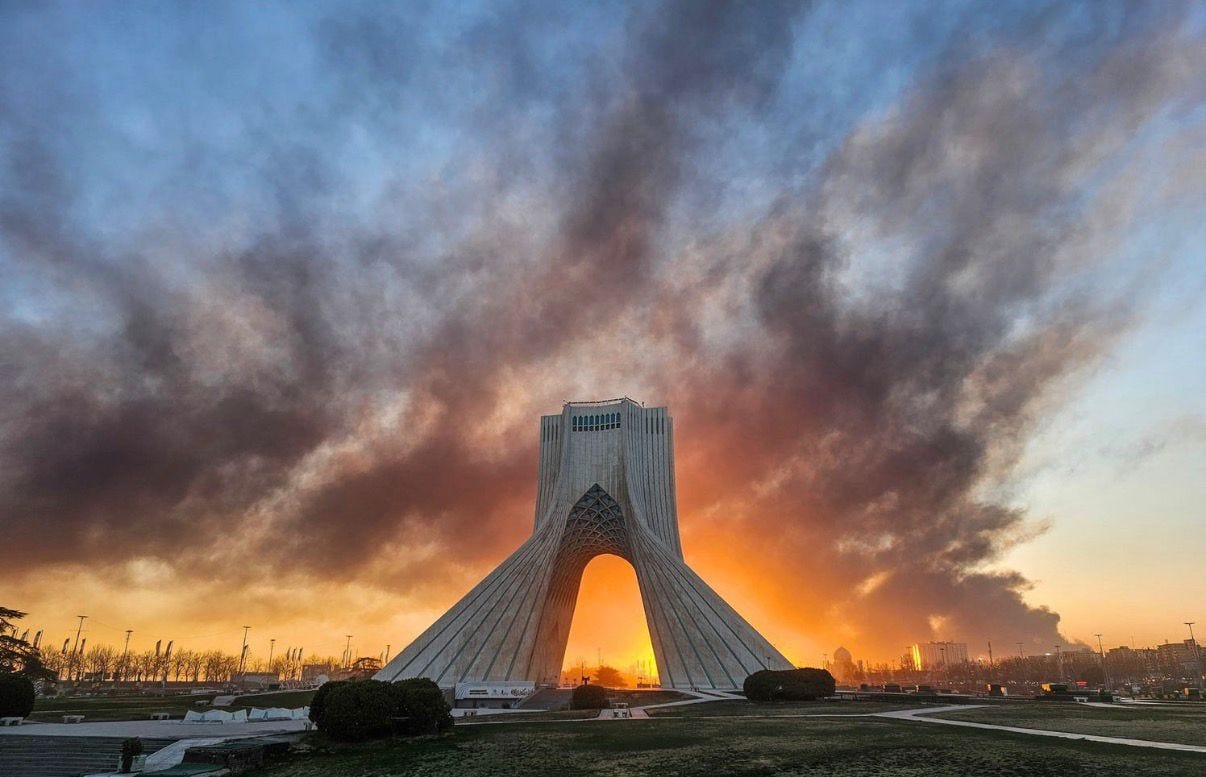
Smoke from strikes in Tehran billows behind the Azadi Tower at sunset.
It’s Wednesday, March 4, and the fifth day of Operation Roaring Lion. Here are the latest developments while you were asleep:
Israel and the United States have massively degraded Iran’s offensive capabilities. On Day 1, Iran managed to fire around 350 ballistic missiles. Day 2: ~175. Day 3: ~120. And on Day 4, only ~50. Don’t forget what I said on Monday: “Take out the launchers and stockpiles, and the regime will resemble the Black Knight from Monty Python and the Holy Grail—legless, armless and pitifully threatening to bite at the allies’ shins.”
(Eyal Ofer)
The world’s terror power couple has started fighting. After sustaining damage from Iranian drones and missiles, Qatar has reportedly struck back. In typical Qatari style, the official statement was ambiguous, assuring its former allies that “Qatar has not been part of the campaign targeting Iran,” while also insisting it is “exercising our right in self-defense.” Whatever they need to tell themselves. Qatar is the most surprising member of the growing anti-Iran coalition.
Israel has eliminated Rahman Mokadam, head of the Islamic Revolutionary Guard Corps’ special operations division, and the man behind the assassination attempt on Trump on the eve of the 2024 presidential election.
According to a statement by the Sri Lankan military a submarine attacked an Iranian Navy ship near the coast of Sri Lanka, 101 people are missing.
An Israeli F-35I fighter recently shot down an Iranian fighter jet over Tehran’s airspace. If confirmed, this would be the world’s first shootdown of a manned fighter jet by an F-35, and the first kill by an Israeli fighter pilot since 1982.
It seems Israel got tired of eliminating the candidates and just went for the source. Yesterday Israel struck three of the 88 council members while they were casting ballots to choose the next Supreme Leader. Despite casualties—and the ballot box seemingly going up in flames—opposition sources claim that Ali Khamenei’s son, Mojtaba, has been named Iran’s new Supreme Leader.
While Israeli fighters fly over Tehran, Attorney General Gali Baharav-Miara is pushing forward in her quest to remove Internal Security Minister Itamar Ben-Gvir, the minister in charge of the police. The lack of self-awareness is almost impressive: a legal system that is routinely late in its responses is suddenly four whole days early—because, as we all know, the country urgently needs to know right now what’s happening with Ben-Gvir.
Now, on to the details.
The port in Dubai after an Iranian attack. (Shetach 100)
During the last major coalition war, the First Gulf War, Washington spent months building the coalition. Iraq invaded Kuwait on August 2, 1990, but the war itself only began in January 1991. For roughly five months, the United States invested enormous effort and capital in assembling a coalition of more than 30 countries. One of the guiding principles was that Arab states would participate—while Israel would remain on the sidelines.
Israel’s then-Prime Minister Yitzhak Shamir made what was arguably the most difficult decision: to hold back. Even though Saddam Hussein fired Scud missiles at Israel, Jerusalem refrained from responding militarily in order not to fracture the Arab coalition. For years afterward, that decision was simply known as “restraint.”
What we are seeing now is almost the exact opposite. Here the war begins immediately, and only afterward does the coalition form. Arab states, including those that do not have formal diplomatic relations, are joining a coalition that clearly includes leadership from both the United States and Israel.
There are developments that would once have seemed unthinkable: Qatar, and possibly Saudi Arabia as well, appear to be part of the emerging alignment. Just yesterday there was even discussion that Germany might join—something that, historically speaking, would be extraordinary.
This coalition is being built in a completely different way. Instead of long diplomatic work before the war, the war itself is what is creating the coalition.
I thought I’d send Tucker Carlson a message, after all it’s never easy for the children when parents fight.
Celebration in the Palestinian city of Shechem (Nablus), Saturday night.
Speaking of Saddam Hussein and his Scuds, there are a few moments from that time that are burned into the Israeli psyche. One was every school and channel teaching how to strap on a gas mask and the futile practice of taping shut the safe room in case the missiles carried chemical weapons. Another was the streaks of flame over the Tel Aviv skyline as U.S.-supplied Patriot batteries tried and often failed to intercept incoming fire. The moment I remember most vividly is hearing the shouts of “Beloved Saddam, strike Tel Aviv” from my home in Samaria rising from nearby Palestinian villages.
Like moths to a rocket flame, when Iran sent missiles in October 2024, June last year, and again this week, we hear a similar refrain.
It’s hard to understand why the Palestinians seem incapable of learning lessons. Their support for Saddam didn’t endear them to the Arab world. In the aftermath, some 300,000 to 400,000 Palestinians were expelled from Kuwait and other Gulf states—an episode of mass Palestinian expulsion often skipped.
More than 30 years later, an entirely new generation, and still no lessons learned. Gaza has been turned into the largest exhibit as to what happens to those who try to destroy Israel—and yet when missiles fly overhead, the impulse to cheer seems irresistible. Crime doesn’t pay, and neither does terrorism. Until Palestinians are ready to absorb that reality—and until the world is willing to reinforce it instead of laundering it—peace, like their violence, will not succeed.
A wedding last night in the Dizengoff Center parking lot in Tel Aviv (Haim Goldberg).
The number of missiles may be decreasing, but what my friend Dan Senor calls the Start-Up Nation has already adapted. So far, inventions during this war have included a dating app to find single people in bomb shelters near you and an algorithm to predict your chances of showering before the next round of missiles arrives.
Meanwhile, for one couple in Tel Aviv, the bomb shelter became a surprise change of venue for their wedding. Undeterred, they celebrated surrounded by the shelter’s cots and all of Israeli society. Of all the pictures that have come out of this war—from Lebanon, Tehran, to all over the Gulf—to me this may be the most powerful.
The couple enter the underground shelter. (Avishag Shaar-Yashuv)
If you enjoy the newsletter, you can show your support by becoming a paid subscriber—it really helps keep this going. I’m also offering a special monthly briefing for a small group of premium members. I’d love to have you join us—just click below to find out more.
Thanks for reading It’s Noon in Israel! Subscribe for free to receive new posts and support my work.


I doubt the groom is Israeli. At my daughter's wedding at the Nemal in Tel Aviv, I was the only guy with a tie, except for the rabbi who was also American.
I don't see a mention of the nuclear facility (Minzadehei) hit by Israel, arguably a pivotal point in this war.
Is it still classified in Israel? Because it is widely available elsewhere.