Operation Roaring Lion Day 4: The Fourth Lebanon War
Also, updates, Iran tries and fails to block the Strait of Hormuz, and more.
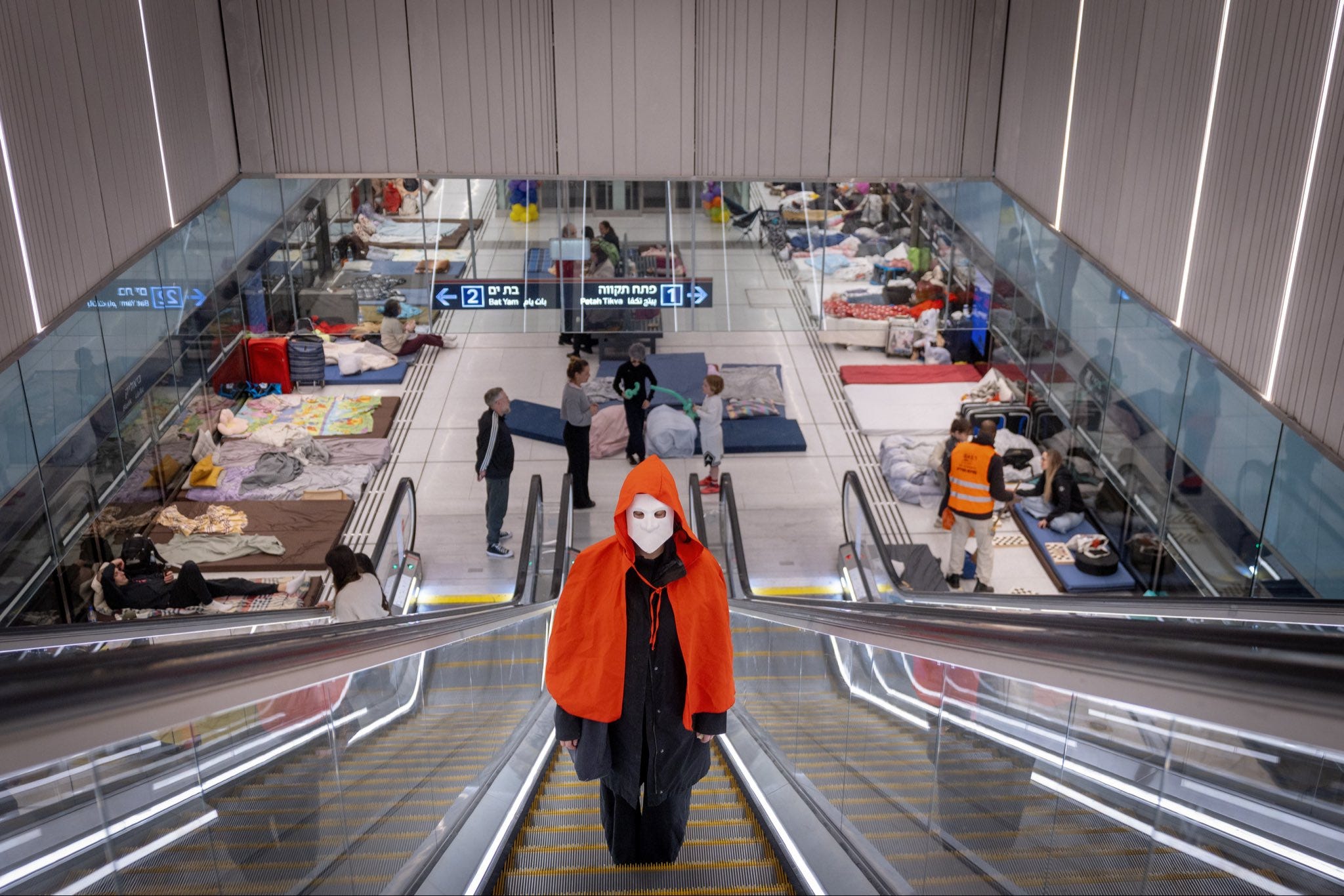
A person in a Purim costume exits Tel Aviv’s underground metro station, where residents have been sheltering during the recent missile barrages. (Haim Goldberg)
It’s Tuesday, March 3, and the fourth day of Operation Roaring Lion. Here are the latest developments while you were asleep:
The U.S. has reportedly destroyed all 11 of Iran’s warships in the Gulf of Oman, blocking one path to its attempted disruption of global trading routes. To quote Trump, “But other than that, their navy is doing great.”
After striking more than 70 Hezbollah weapons depots and rocket-launching sites, as well as other targets overnight, the IDF launched a ground invasion of southern Lebanon for the fourth time in Israel’s history. The goal of this operation appears to be a security zone along Israel’s border.
Since Saturday, the price of oil has increased to more than $80 a barrel. Markets heavily reliant on shipping in the Strait of Hormuz, such as Japan and South Korea, have taken hits of 2.3 percent and 5 percent, respectively. Meanwhile, the shekel strengthened against the dollar by two points, and the Tel Aviv Stock Exchange had its best day in almost five years. It reveals an important fact: The biggest thing holding Israel’s economy back is the threat of Iran and its proxies.
A missile impacted in the north this morning, lightly injuring five Israelis. Israel’s total fatalities remain at 12. Unfortunately, the number of American fatalities overnight has risen to six.
Now, on to the details.
IDF Chief of Staff Eyal Zamir holds a situational assessment following Hezbollah rocket fire on northern Israel yesterday. (IDF)
Yesterday, I wrote that Hezbollah’s decision to join the war amounted to Israeli-assisted suicide. To be fair to the terror group, its calculations were based on outdated assumptions. Hezbollah was operating on the Israel of two and a half years ago, cautious and eager to avoid escalation.
If it had taken a poll of Israelis beforehand, most would have warned it to expect a massive aerial response. Fewer, perhaps, would have predicted what now appears to be the beginning of a ground invasion and aspirations for a new security zone.
First, context.
Israel’s history with Lebanon is complicated.
In 1982—the year I was born—Israel invaded southern Lebanon. The war devolved into a fiasco, ending in a retreat to a security zone and years of attrition at the hands of a new small guerrilla force called Hezbollah. Eighteen years after the invasion, I was an army reporter, watching the last soldiers leaving the security zone, grinning and waving flags.
They were smiling because by then Israelis were desperate to leave. The war had become deeply unpopular—a costly, grinding investment that killed dozens of young men a year. Twenty-six years and two Lebanon wars later, Israelis have come to question that decision.
But we should address the elephant in the room: Would this invasion have started if Hezbollah had not gotten involved?
The answer seems to be yes—just later.
Hezbollah’s token attack was not sufficiently threatening to launch an emergency ground invasion. Long before this war, it was widely assumed Israel had plans for a decisive campaign against Hezbollah. The group simply moved up the execution. In doing so, it granted Netanyahu quite a favor. Starting wars is always more politically costly than expanding them. Hezbollah’s entry may have left him with sufficient capital for a renewed Hamas offensive in the months ahead.
So far, the IDF has been authorized to seize “additional commanding areas in Lebanon,” though the boundaries remain undefined. What seems clear is that the objective is an IDF security zone. Israel is not interested in it’s northern population relying on a U.N.-branded protective umbrella to stop rockets. Historically, such umbrellas have had a tendency to shelter the wrong people.
The destruction of an Iranian vessel last night.
Yesterday, an IRGC commander declared the Strait of Hormuz closed, warning that Iran would set ablaze any ship attempting to pass. Within hours, three U.S. and British oil tankers were attacked and left burning.
Also last night, the U.S. polished off the 11 Iranian warships around the strait, eliminating one of Tehran’s primary tools for disrupting shipping. The last time Iran’s navy took that kind of beating, it was also from the U.S., in 1988’s severely lopsided Operation Praying Mantis.
During the June war, Iran’s naval forces emerged largely unscathed for two reasons: They were mostly beyond the effective range of Israeli fighters, and freedom of navigation was not Israel’s central priority. Those are not constraints the United States shares.
For Israel, a spike in global oil prices has always been the price of doing business. For Washington, patron of freedom of the seas and central node of the global economy, it is a political constraint that determines how long and how hard it can fight. Which is why yesterday, almost in passing, Trump slipped in a new war goal: not just the missiles, not just the nuclear program, not just the proxies—but the Iranian navy as well.
Iran’s reputation has taken a severe blow in the past four days, but in economics reputation matters less than risk. Even the currently waterlogged Iranian navy has managed to rattle markets. Shipping disruptions have already begun. According to Jeremy Nixon, CEO of Ocean Network Express, the backlog is affecting roughly 10 percent of the global container fleet. We already know it does not take a world-class navy to send insurance premiums soaring—just ask the Iran-backed Houthis.
Closing the Strait is a major escalation. It is a step Tehran did not take in June, and it signals something increasingly obvious: Iran is playing for broke. It has lashed out across the region, targeting every country with the exception of Lebanon and Syria. An embattled Islamist regime is dangerous—but also finite. If the Strait of Hormuz is the most powerful lever Iran has left to pull, that is a bit of good news for the region.
IDF headquarters, the Kirya, in Tel Aviv (Beny Shlevich)
Perhaps the greatest surprise of the war so far is that it was a surprise. Despite the thousands of tons of American firepower floating menacingly in the Arabian Sea, the regime seems to have been caught in its beds, in some cases literally.
There are several factors that contributed to this advantage.
The most effective intelligence weapon at Israel’s disposal goes by the code name Donald Trump. The American president has reached a stage where when he says something, it can be interpreted in almost any direction because there are precedents for every possible outcome.
Within Israel, the intelligence operation was called Alone in the Desert and comprised several objectives. I’ll mention just four.
First, parking at IDF headquarters, the Kirya: Officers were instructed to disperse and avoid their usual parking spots. Whether the concern was satellite imagery or Iranian agents on the ground, the goal was to deny the Iranians visual cues that might suggest something major was underway.
Second, the lights at the Kirya. In recent days, passersby noticed an unusual number of lights on, as though the compound were operating at full capacity through the night. In the past, that may have been a signal—until automatic systems were installed to keep Iran guessing.
Third, the chief of staff was reported to be at home—a very different signal than if he were visibly present at headquarters during a moment of heightened tension.
Fourth—and perhaps most intriguing—the leaked satellite images showing American F-22 fighter jets stationed at Israel’s southern Ovda Air Base.
The pictures were bait, and Iran took it, focusing its attention on what was happening in the south and diverting attention from preparations at other bases around the country.
That at least partially answers how Iran was taken by surprise, but one thing remains a mystery: How did they manage to find that many parking spaces in central Tel Aviv?
A Purim party last night in a basement parking garage, captioned: “Minus five in Ramat Gan.” (Haim Goldberg)
Today is the festival of Purim, and if you expected celebrations to be canceled, you probably have not met an Israeli. We all predicted what would happen: If there was a war on Purim, fine—Purim goes indoors. Tel Aviv did not disappoint.
Purim marks the day the Jews rested and celebrated after overcoming a Persian attempt at genocide. Unfortunately, this year we are still busy with that task, but we are celebrating early.
Whether out of profound historical awareness or the simpler joy of the tradition to dress up and drink into incoherence, in streets and bomb shelters across the country Israelis are embodying that phrase at the end of the Book of Esther: “The Jews enjoyed light and gladness, happiness and honor.”
If you enjoy the newsletter, you can show your support by becoming a paid subscriber—it really helps keep this going. I’m also offering a special monthly briefing for a small group of premium members. I’d love to have you join us—just click below to find out more.
Thanks for reading It’s Noon in Israel! Subscribe for free to receive new posts and support my work.


Chag Purim Sameach!
Great insight as usual.
IDF should mark business tycoons linked the regime and attack all the business interest on ground.