Operation Roaring Lion Day 17: Trump Invites Allies to Hormuz
Also, Hamas tries to abandon ship, Netanyahu is alive, and more.
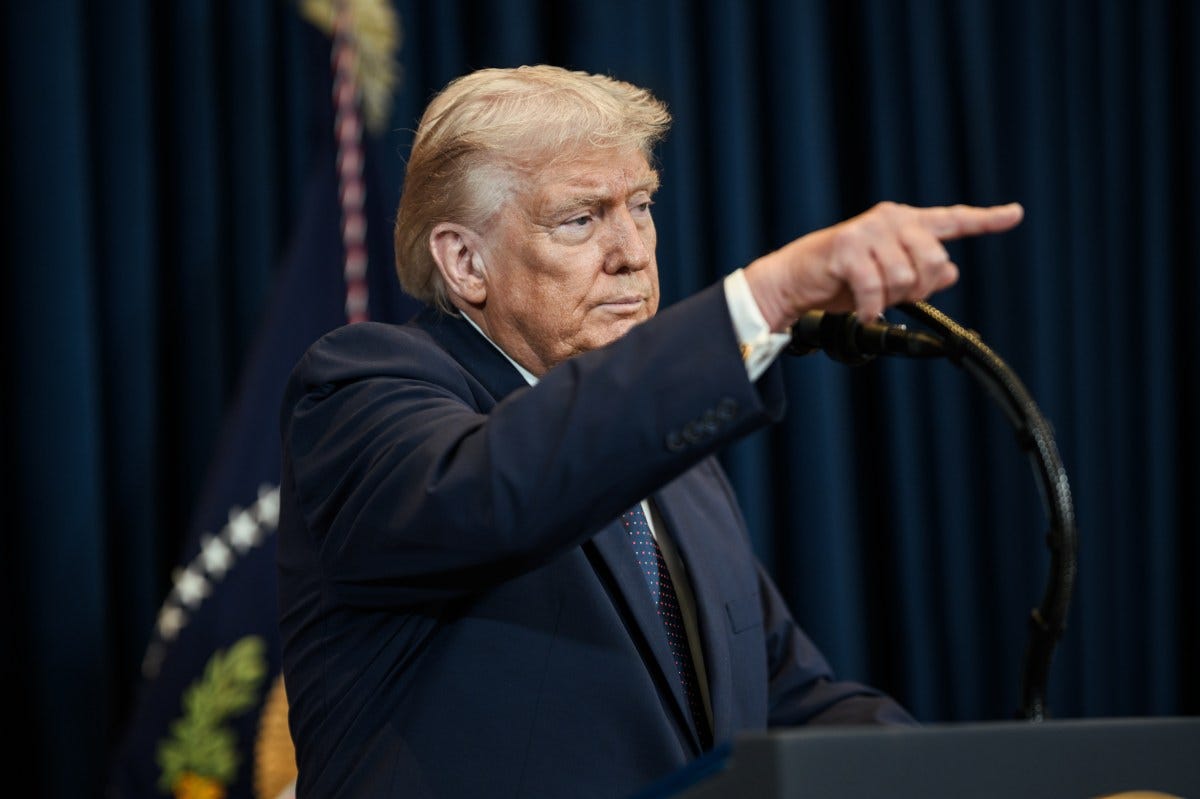
Donald Trump delivers remarks at a press conference last week. (whitehouse.gov)
It’s Monday, March 16, and the seventeenth day of Operation Roaring Lion. Here are the latest developments while you were asleep:
Trump announced on Truth Social yesterday that “many countries, especially those affected by Iran’s attempted closure of the Hormuz Strait, will be sending warships, in conjunction with the United States, to keep the Strait open and safe.” He specifically called on China, Japan, South Korea, France, and the UK to contribute naval assets. So far, no country has confirmed participation.
Iranian officials are working to obscure Tehran’s responsibility for drone and ballistic missile attacks on Gulf states—likely in an effort to drive a wedge between the United States, Israel, and their Gulf partners. Foreign Minister Abbas Araghchi implied to UK-based Arab media yesterday that the attacks were in fact U.S. and Israeli false-flag operations, while simultaneously offering to form a committee to investigate whether thier strikes on Gulf civilian infrastructure were in fact thier fault.
The IDF Spokesman told CNN yesterday that Israel has no shortage of targets or plans. “We have thousands of targets ahead,” he said, adding that operational planning with the U.S. runs through at least Passover—roughly three weeks away—with contingencies extending three weeks beyond that.
According to Ukrainian intelligence, Iran has been using Russian-produced Shahed drones to strike U.S. bases and Gulf states. President Zelensky told CNN last night that he has seen intelligence he says “100 percent” confirms Iranian use of Russian-made Shaheds, complete with Russian components, in attacks across the Middle East.
Now, on to the details.
Donald Trump delivers remarks at the Republican Members Issues Conference last week. (whitehouse.gov)
Last night Donald Trump announced on Truth Social that “many countries” would be joining the U.S. to keep the vital Strait of Hormuz waterway “open and safe.” Is the president desperate for international help?
That’s one way the media is framing it: Trump didn’t anticipate Iran sending oil markets into freefall by firing on international shipping, and is now scrambling to assemble a coalition to meet a threat he failed to foresee. It’s a neat narrative. It also fits a Trump incompetence storyline that this war has largely disproven.
Call me a conspiracy theorist, but I don’t believe the U.S. and Israel sat down to plan this war and somehow overlooked the threat Iran has been waving around for decades. The U.S. has the capacity to escort ships through the strait unilaterally—it would significantly distract from the war, but this is not a case of Washington having no other option.
There is a dash of Trump’s deal-with-your-own-problems philosophy at work here.
The United States may be the global guarantor of freedom of the seas, but it is also energy independent. It is not hard to imagine Trump feeling that the burden of keeping oil lanes open ought to be shared by the allies who actually suffer when they close. After all, Japan sources over 90 percent of its crude from the Middle East, with roughly 70 percent transiting Hormuz. South Korea imports 70 percent of its oil from the region. Both countries are absorbing the shock: South Korea’s stock market is down over 16 percent since the war began, Japan’s around 10 percent.
But this is about more than oil. Trump is trying to internationalize the conflict by making the world understand that this is not America’s problem alone.
Iran crossed a line when it attacked its neighbors. It crossed another when it dragged the global economy into the fight by closing the strait. The regime calculated that anger at the United States would drown out anger at Tehran. It was short-term thinking. They are betting that the shock to energy markets will stop the world from pausing to consider that Iran just took a fifth of the global oil supply hostage—and has shown it is perfectly willing to do so again.
Trump is making a classic American argument: you don’t negotiate with terrorists.
The contrast is striking. Obama spent years doing exactly that, working through the UN to build multilateral pressure one resolution at a time. Trump’s approach is simpler: start the pain train and see who wants to climb on board.
Hamas and Iranian Flag (chatgpt)
While Israel was dropping bombs on the head of the Iranian octopus, one of its tentacles, Hamas, quietly slithered into negotiations with the U.S. on Gaza’s second phase. The problem is that limbs rarely act without the head finding out. Someone talked, and word reached the bunkers beneath Tehran.
The Iranians exploded. How dare Hamas engage with Israel and the United States outside the framework of the Axis of Resistance—especially at a time like this?
Hamas’s leadership shrank from the fury, well aware of Iran’s reach within the organization. The group has been trying to keep out of the conflict as much as possible, but that calculation has split it down the middle. A faction loyal to the disintegrating Axis is accusing the survivalist faction of betrayal. The two sides have been issuing contradictory statements: one voicing support for the new Supreme Leader, the other—after much procrastination—condemning the strikes on Gulf states.
The trouble stems not only from their ties to the sinking Iranian ship, but from their other patron as well. Qatar—the Axis’s unofficial member—is no longer tolerant of Hamas’s rhetorical support for a country that just attacked it. According to some reports, Doha is applying pressure to Hamas’s windpipe, freezing all of its donations to the terrorist’s cause.
Hamas now faces the Hezbollah dilemma: risk everything out of loyalty, or stay quiet and survive. Hezbollah once tried to split the difference—joining the war symbolically, without committing its full force. That path proved fatal. Hamas’s situation is more complicated. It joined the Axis of Resistance; it was not created by it. Unlike the Shiite terror group in Lebanon, it has another option for survival: Qatar.
For now, it is trying to chart a course between its two parents—and risks being abandoned by both.
The Axis of Resistance was designed as a weapon—armed, loaded, and pointed by Iran at Israel, ready to fire when Tehran pushed the button. Well, they pushed it. Half the network returned an error message. The rest exploded.
If this were a ship, the Houthis have already slipped into a lifeboat, debating whether to go back. Hamas is standing at the railing, weighing its options. Hezbollah, meanwhile, is below deck with the captain, ready to go down with the ship.
(@netnayahu/X)
Mark Twain may not be the most widely read writer in Israel, but Israeli politicians have been getting considerable mileage out of one of his lines. Social media has developed something of an obsession with announcing their deaths. After rumors spread that former Defense Minister Yoav Gallant had been killed in an Iranian strike, he responded with Twain’s “the reports of my death are greatly exaggerated.” Netanyahu made the same point without the quote after rumors of his own death began circulating over the weekend.
Yesterday he released a video of himself buying a coffee. “I love coffee, I love my nation,” he said—using the Hebrew slang word “met,” meaning “love,” which happens to be identical to the Hebrew word for “dead.” Netanyahu also spread his five fingers to verify that the video was not AI-generated.
The biggest beneficiaries of the affair appear to be Netanyahu, who managed one of his most viral posts—66 million interactions on X—and the female barista who was elevated to one of Israel’s top celebrities in under 12 hours.
Many of these rumors are likely seeded by Iranian-aligned bots, which makes the whole thing rather sad. Israel has spent weeks beheading Iranian leadership and plunging the regime into a crisis, and Tehran’s response is a schoolyard “I know you are but what am I.”
Will this war help or hurt Bibi’s electoral prospects? Did the U.S. predict Iran would shut the Strait of Hormuz? And who will want to end the war first—Israel or the United States? I joined Nadav Eyal and Dan Senor on Call Me Back to answer these questions and more.
To listen to the episode click here
English Editor: Ari Tatarka
If you enjoy the newsletter, you can show your support by becoming a paid subscriber—it really helps keep this going. I’m also offering a special monthly briefing for a small group of premium members. I’d love to have you join us—just click below to find out more.
Thanks for reading It’s Noon in Israel! Subscribe for free to receive new posts and support my work.


Anyone who is dumb enough to not think the Pentagon knew the Iranians would try to shut down the Strait of Hormuz deserves derision. They forget that it is the military and not Trump sitting behind the resolute desk that plans the war. He only says go ahead. This is the same military that planned and executed the touted Venezuela action.
I think this is the same thing Trump did with NATO. You want the US to continue to protect you, well put up or shut up. Help. Otherwise we will take our oil, which we have enough for ourselves, and go home once we have degraded Iranian capabilities to our liking.
https://substack.com/@nervana3/note/c-228550626?r=1u2w92&utm_medium=ios&utm_source=notes-share-action