It’s Noon in Israel: Peace in Gaza in Our Time?
Also, Israel defeats the monster beneath the mountain and Netanyahu's secret vulnerability.
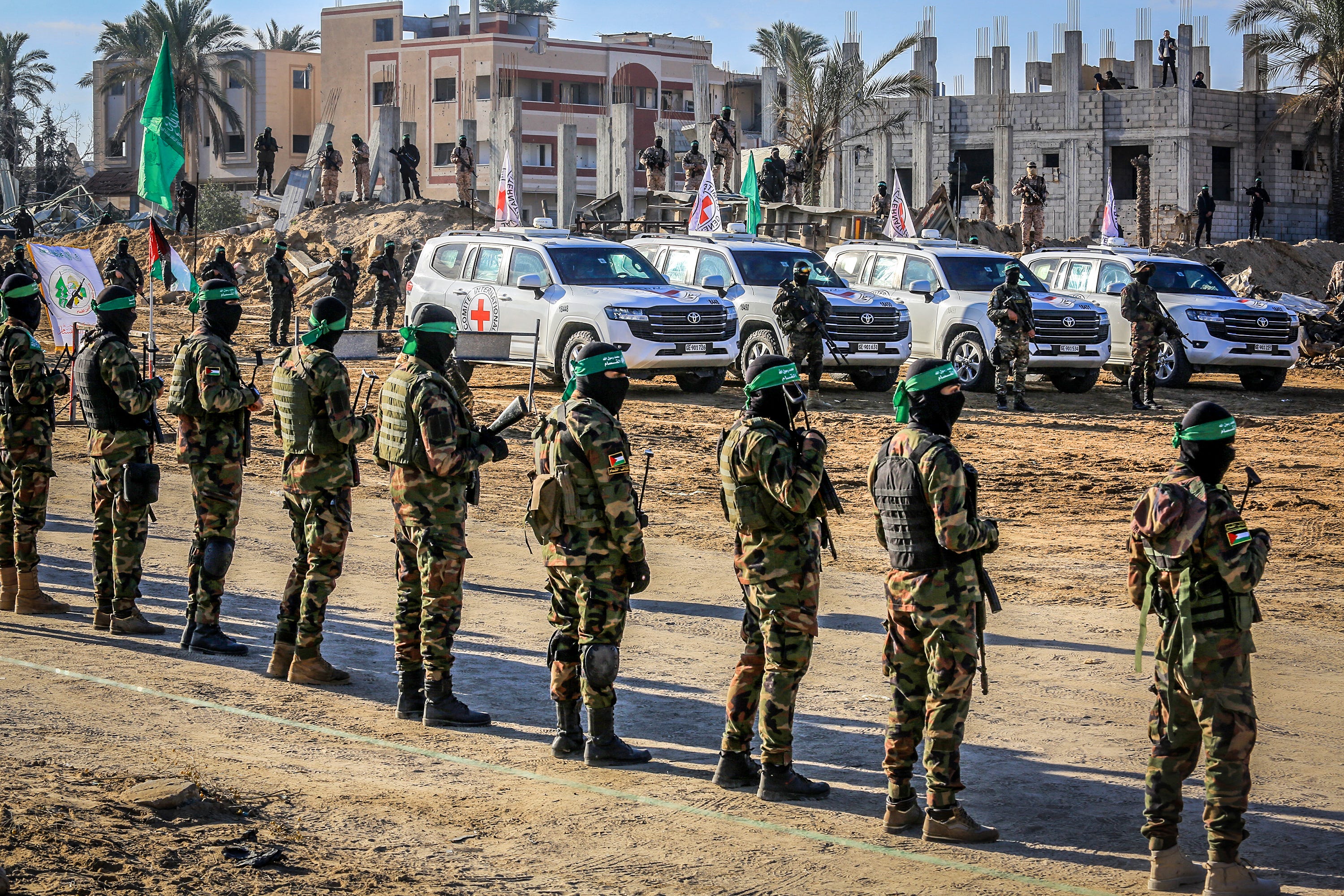
Al-Qassam Brigades hand over Israeli hostages Ofer Kalderon and Yarden Bibas to the Red Cross in Khan Yunis, February 01, 2025. (Abed Rahim Khaatib/Flash90)
It’s Friday, July 31, and “I will tell them no.” That’s what Netanyahu reportedly told his ministers days before flying to Washington, in response to reported U.S. pressure for a “series of withdrawals” across Syria, Lebanon and Gaza. He later denied the issue even came up in the meeting—a denial that now appears to have been a lie.
Yesterday the Board of Peace published its plan. Under the roadmap, Hamas surrenders everything it holds—weapons, light and heavy, tunnels, depots and production facilities. The handover runs in stages beginning within weeks: police weapons first, then the heavy arms and tunnels are decommissioned under the International Stabilization Force, stored in designated sites and taken out of use, while personal weapons fall “under Palestinian law.” None of it goes to Israel. At the end, only the Palestinian technocratic committee administering Gaza holds any authority over arms.
In the board’s words: “At the end of the process, Hamas will have no governing role in Gaza, neither openly nor behind the scenes, and the Gaza Administration Committee will hold full authority in accordance with the principle of one authority, one law, and one weapon.”
For a strip holding more than 60,000 rifles and a perennial smuggling problem, “one weapon” is perhaps overly optimistic. The plan calls for complete disarmament—but the meaning of “decommissioned,” “taken out of use” and “under Palestinian law” is where the Talmudic debate begins. Will the rifles be disabled or merely warehoused? Is Palestinian technocratic custody a genuine handover, or is Hamas’s arsenal relabeled as police stock? And where—under whose lock—do those 60,000 rifles actually end up? Still, fewer weapons in Hamas’s hands are a positive, even if the strip can never be scrubbed of arms entirely. Israel’s largest objection isn’t the scope but the sequence.
The plan builds on Trump’s 20-point framework, which specifies: “As disarmament is completed, Israeli forces will withdraw.”
Israel wants it even more front-loaded: complete disarmament and demilitarization as a precondition before it gives up any territory.
And, as is inevitably the case with Trump’s deals, the other side reads it differently. Hamas has claimed: “We will not take any steps regarding disarmament before Israel withdraws from the Gaza Strip.” Don’t take that at face value—they are almost certainly preparing to give up some portion of their arsenal. Expecting Islamists to publicly announce the end of armed resistance is unreasonable, even once they’ve agreed to it in practice, but don’t read their rhetoric as entirely empty either. Israel has told envoy Tony Blair that the reported 15-point document does not adequately address its demands. Translation: There is a withdrawal somewhere in the agreement before disarmament is completed. Though I doubt it’s total.
More likely this is a fight over symbolism. Hamas will not want a photograph of its men handing weapons to Israel—hence the international forces. Meanwhile, a single foot is 12 inches more than Netanyahu is willing to give back before elections.
My Take: they won’t get every weapon. But so long as Israel doesn’t have to withdraw completely and keeps the freedom to go back in when it needs to, 20,000 disabled rifles are worth entertaining the process.
Footage of the explosion of the Beaufort tunnels.
High on a rocky spur above the Litani River—southern Lebanon on one side, the Galilee Panhandle on the other—sits Beaufort Castle. The Crusader fortress was once the linchpin of Israel’s security zone: taken in a bloody, heroic assault in the opening hours of the 1982 war, then ringed for the rest of the occupation by IEDs and Hezbollah guerrillas until it earned its nickname—the Monster on the Mountain. Forty-four years later there was a new monster: the primary Hezbollah tunnel complex in southern Lebanon, dug into the rock beneath the crumbling ruins.
Slaying it took roughly 700 tons of explosives. The blast was so large that residents of Israel’s north were told to open their windows for fear the glass would shatter.
The trigger was a ceasefire violation. Hezbollah launched an FPV drone at IDF forces on the Ali Taher ridge, striking an engineering vehicle. Rather than answer with a conventional kinetic strike, Israel chose to send a much louder message.
Netanyahu and Katz called it a “powerful operation” answering a “blatant violation,” and warned that any attempt to harm IDF forces or Israeli civilians would exact a heavy price. The two-decade network—built with Iranian funding and North Korean engineering—served as the command center for Hezbollah’s Bader Unit, the force responsible for the plan to invade the Galilee communities: an assault that, had it been executed, could have been many times worse than October 7.
Most of the Beaufort complex is now gone, though several routes remain under IDF surveillance. Whether that is enough to deter further Hezbollah action remains to be seen.
Shas Chairman Aryeh Deri and Shas MKs attend a plenum session and a vote on a bill to split the duties and powers currently held by the attorney general between two separate officeholders, at the assembly hall of the Knesset, July 15, 2026. (Yonatan Sindel/Flash90)
When there was a hole in the bloc, most polls and attention focused on the leakage from Likud and Religious Zionism. The ruling party’s voters who left were disappointed mainly with the makeup of the list; Religious Zionism’s voters who left were disappointed due to the tight alliance with the Haredim.
But there may be another hole. In two studies, by two different parties from different blocs, the ultra-Orthodox Mizrahi (Jews of Middle Eastern origin) party Shas appears to be in acute trouble. In one poll it is at seven seats; in the other—at six. Who are the Shas defectors? After all, the party is composed, historically, of two publics: Sephardi Haredim and traditional Mizrahim. Here the story starts getting more interesting. According to one study, most of the defectors are Haredim disappointed by the party’s inaction in the face of what they see as state persecution of Torah scholars. According to the second study, exactly the opposite: voters who—along with their children—serve in the army and are angry about the draft-dodging and the budgets. The Knesset’s recent legislative push, which cost Likud dearly, was the product of Deri’s persuasion efforts, mainly to signal to the Haredi base that it had not been abandoned—but was damage done to Shas as well?
And to the no-less-important question: where are they migrating? If it is a shift to Ben Gvir or Netanyahu, the bloc will absorb it. But the studies also show, in parallel, a drop in enthusiasm for voting. There is even a claim that a small but significant portion migrated to Gadi Eisenkot, the first realistic candidate of Mizrahi origin in the history of the State of Israel.
If Shas loses seats, the inconceivable gap between the various polls narrows a little. After all, part of it stems from the fact that in the Channel 14 and 24 polls the Haredim hold onto their strength, with the argument being that it is impossible for the group with the largest natural growth in the Western world not only to fail to grow but actually to shrink. Ostensibly, here is an explanation.
And yet, one word of caution: Shas has run in 15 election campaigns. In most of them it finished with a number higher than the polls had predicted. Nearly half a century after its founding, the research institutes still struggle to reach its voters—a years-long Bermuda Triangle that has wrecked more than a few surveys. Since Deri returned to Shas’s leadership more than a decade ago, the party has always beaten the early forecasts. It would be foolish to rush to write it off.
This is an excerpt from my weekly column in Israel Hayom
English Editor: Ari Tatarka
If you enjoy the newsletter, you can show your support by becoming a paid subscriber—it really helps keep this going. I’m also offering a special monthly briefing for a small group of premium members. I’d love to have you join us—just click below to find out more.
Thanks for reading It’s Noon in Israel! Subscribe for free to receive new posts and support my work.


