Quiet in the Middle East
Also, Hamas stands alone, and the man that will decide the election.
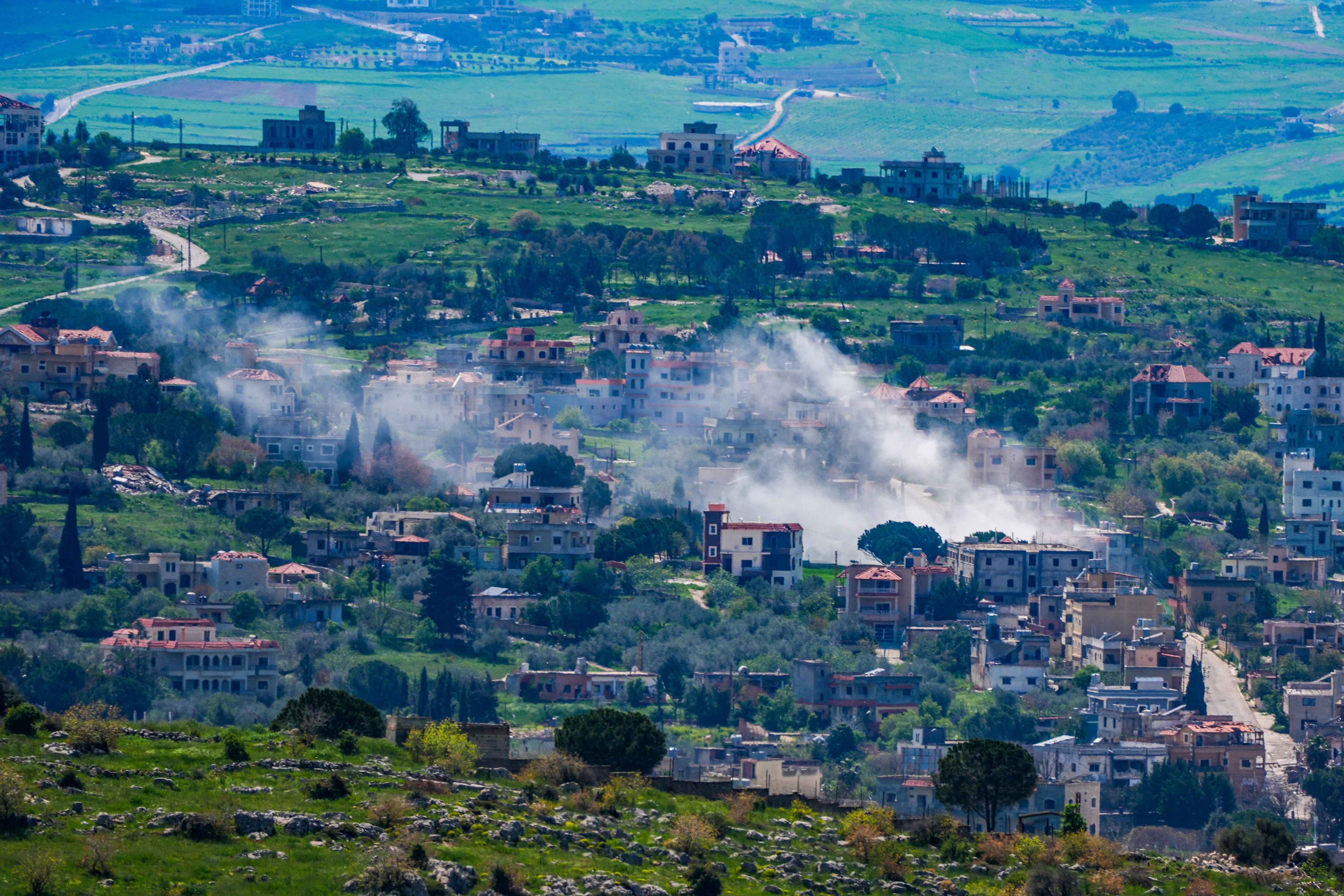
Smoke rises from southern Lebanon during an Israeli military operation. (Ayal Margolin/Flash90)
It’s Friday, April 17, and as of midnight, for the first time since Feburary 28, there is no fighting in the Middle East. While this 10-day ceasefire agreement ostensibly returns the northern front to a pre-Roaring Lion status quo—where Israel can routinely strike Hezbollah targets—it is decidedly not Jerusalem’s preferred outcome.
Nor is it the preference of the Israeli public: 61 percent oppose the current ceasefire deal according to a poll by the Institute for National Security Studies. But if U.S. public opinion wasn’t going to stop Trump, I doubt Israel’s will.
The ceasefire isn’t a sign of realignment, just different priorities and different timelines. The U.S. is looking to extract Iran’s nuclear materials, and Israel’s war in Lebanon was hindering that removal. But the ceasefire was only the first step in Trump’s plan.
The second is the White House meeting between Trump, Lebanese President Joseph Auon, and Netanyahu, expected next week. It is designed to project a united front and avoid unnecessary public escalation—a diplomatic optic Israel accepts as preferable, even as it resents the diversion from its own military objectives.
The third step is an American push to promote a broad political arrangement in Lebanon, an ambition Israel is deeply skeptical of, given Hezbollah’s continued dominance in the country. Furthermore, Hezbollah’s noted preference for maintaining a limited level of friction could preclude a return to full-scale conflict—provided it successfully keeps its provocations below Trump’s threshold of tolerance.
The fourth step involves stabilizing the arena through coordinated, extended ceasefires. Israel is especially unenthusiastic about this outcome. Jerusalem is functioning on a significantly more compressed timeline than Washington. Now that the Strait of Hormuz is at least partially reopened, the immediate pressure on the U.S. has abated somewhat. Meanwhile, the shadow of Hezbollah is still cast over Israel’s north. While Israeli society has miraculously rebounded to normalcy after the war, living for an extended period under the looming threat of escalation isn’t a condition any country accepts joyfully.
The two key questions right now are: What is the effect of the ceasefire in Tehran, and what is its effect in Beirut?
Regarding Iran, the assessment in Jerusalem is that Trump remains firm on the nuclear issue. The diplomatic gestures in the Lebanese arena are intended to clear the board—creating the space for the U.S. to focus less on fielding Iranian complaints over Lebanon, and more on hammering Tehran into surrendering its nuclear program.
In Lebanon, meanwhile, IDF forces remain in place. The immediate question is whether the ceasefire will be extended to maintain the current holding pattern, whether renewed escalation will necessitate further military action, or whether advancing diplomatic talks will require an eventual IDF withdrawal.
Ultimately, the question of whether this ceasefire was worth it can only be answered in Islamabad. If negotiations there are successful and the regime is effectively neutered, Lebanon will have been a small price to pay.
A squad of Hamas fighters. (IDF)
A person who recently participated in talks with Hamas returned somewhat confused. He discovered that the terrorist organization, which has been at the center of global attention for the past two years and sparked a regional war with international repercussions, is led by a mediocre, panicked and inarticulate bunch. All the way home, he wondered whether Yahya Sinwar and Mohammed Deif were of a higher caliber but were eliminated, or if this is merely a collection of local murderers that Israel, through its failures and blindness, turned into a terrifying and sophisticated monster.
The war in Iran seemingly saved Hamas, temporarily. The deadline set for dismantling the organization has passed, 600 trucks loaded with goods enter Gaza every day, and the organization’s terrorists still rule the roost in western Gaza.
Hamas leaders, however, do not think so. In talks in Cairo, terror is evident on their faces. Qatar has abandoned them to their fate, out of fear of Trump and anger over the backing the organization’s leaders gave to Iran while being hosted in Doha’s luxury hotels. With Iran, the situation is even worse. Hamas has repeatedly pleaded with Tehran to be included in the ceasefire agreement, but unlike Hezbollah, the Iranians do not even bother to reply with a negative answer.
Hamas complains in the talks that Israel violated the agreement, yet pays no price for it; quite the opposite. The organization is beginning to internalize that no one will let them off the hook regarding demilitarization, and that even the most basic weapons must be handed over rather than kept for self-defense. The negotiators have identified a change in their strategy, aimed at stalling for time. Perhaps somehow the world will take an interest in them again. In the meantime, even the planned flotilla to Gaza is suffering from sparse registration. Greta’s attention has drifted elsewhere.
Is there a chance Hamas will collapse under the pressure and hand over the tunnel maps and tens of thousands of Kalashnikovs? Here lies a difference between Israel and the U.S. In Jerusalem, they do not believe Hamas will offer more than a symbolic handover, which they will also condition on a deep IDF withdrawal. In the United States, they are much more optimistic. They believe that Turkey and Qatar are operating with different interests than Hamas, and without them, the organization will collapse under pressure. The plan is to demilitarize area after area in Gaza, clear the tunnels, hand over the weapons, and bring in a local police force (so far, a quarter of a million locals have registered). Even if Hamas does not hand over its last weapons, Washington believes its men and armaments will be restricted to a very limited area that will be much easier to conquer.
The great achievement of the war is the dismantling of the Axis of Resistance into its separate components. Hezbollah is alone in Lebanon, Hamas is alone in Gaza, the Houthis are alone in Yemen, and most importantly: the ayatollahs are almost alone in Tehran.
This is an excerpt from my weekly column in Israel Hayom
Naftali Bennett, Yair Lapid, and Gadi Eisnekot. (Yonatan Sindel/Avshalom Sassoni/Flash90)
The most famous promotion in the marketing world is “Buy 1 Get 1 Free”: you buy one product at full price and get the second at no cost. In the opposition’s supermarket, this is the promotion that will decide the battle for the leadership of the bloc.
There are about half a million voters—10 to 12 mandates—who will go with the leader, any leader, to defeat Netanyahu. Whoever creates this lead through an alliance will receive the rest of the bloc’s votes without paying for them. Therefore, it is worth merging another party into yours, even at an exorbitant price.
Almost without being noticed, the dynamics within the bloc have changed. Until two months ago, the decisive question was who would get to unite with Eisenkot: Bennett or Lapid? But the former Chief of Staff strengthened significantly and officially announced his run for Prime Minister. Now the question is who will unite with Lapid: Eisenkot or Bennett?
“n recent polls, Yesh Atid is hemorrhaging three-quarters of its strength, shrinking into the smallest party in the bloc. Yet, its remaining six mandates hold the keys to the kingdom. If they throw their weight behind Eisenkot, it crowns him the bloc’s leader and siphons crucial mandates away from Bennett. If they back Bennett, they decisively settle the leadership battle, effectively forcing Eisenkot to fall in line. It is no wonder the former prime minister is currently the most courted man in Israeli politics, wielding influence entirely disproportionate to his diminished electoral power. Plus, he brings an enormous tactical bonus to any alliance: the state-funded campaign war chest of a 24-mandate party.
Quite the dowry, except Lapid is in no rush to get married. His bloc partners believe that if he doesn’t come to his senses and unite, he will end up like Benny Gantz: below the electoral threshold. Lapid, on the other hand, remembers that in all six previous elections he ran in, he trailed Bennett in the polls but always finished ahead of him on election day. His historical partnership in “Blue and White” drained his desire for alliances, certainly with former Chiefs of Staff. Like a person living alone, he doesn’t particularly miss the days when he had to share an apartment with roommates.
For two years, Lapid has gambled that this election will defy history: the bloc will lack a definitive leader, and four distinct parties will cross the finish line with roughly the same low, double-digit mandate haul. If he is right, his strategy to run independently will be totally vindicated. If he is wrong, he is in serious trouble. But he is already deploying his trump card—the money. In the last month alone, Yesh Atid spent 626,000 NIS on Facebook advertising, triple the combined amount of all other parties in the bloc. One of his rival-partners recently confessed that his absolute nightmare scenario is arriving at the elections facing an electorally weak Yesh Atid that is nevertheless bursting with cash. Right now, that rival is living through the pilot episode.
This is an excerpt from my weekly column in Israel Hayom
English Editor: Ari Tatarka
If you enjoy the newsletter, you can show your support by becoming a paid subscriber—it really helps keep this going. I’m also offering a special monthly briefing for a small group of premium members. I’d love to have you join us—just click below to find out more.
Thanks for reading It’s Noon in Israel! Subscribe for free to receive new posts and support my work.


The second largest American embassy is in Beirut with 15,000 employees and sits on 40 acres and extends five floors underground, for decades they couldn't capture / locate the two wanted islamics that Israel vaporized several years ago, still awaiting that cash reward ceremony 🤔🙄🤷🏼♂️
Being that France controls much of the economics of Lebanon and usaid's role in funding the Vatican and other entities that islamically deflect and enable Islam I speculate that Obama's embassy and it's staffing is part of the systemic bureaucratic rot that enables talking Lebanese to yap incessantly as Islam dominates that formerly Christian Nation 🤔
How much monetization occurred from the captagon industry out of Syria that fueled the hez' b' byebyeballz or hez b' ballznomore did entities from France or connected to America or usaid profiteer from?
Did the captagon industry move to Turkey or did the Russians take the formulas home for jihadi's love their captagon 🤗😵
Brigitte Gabriel
@ACTBrigitte
Subscribe
Lebanon was the only Christian-majority nation in the Middle East.
It's where I was born.
We prided ourselves on inclusivity. Always welcoming Arab Muslim refugees from all over the Middle East.
We had the best economy despite having no natural oil. The best universities.
They called Beirut the "Paris of the Middle East" and the Mountains of Lebanon was a tourist destination.
My early childhood was idyllic, my father was a prosperous businessman in town and my mother was at home with me, an only child.
Slowly, the Arab Muslims began to become the majority in Lebanon and our rights began to wither away.
Soon, we would find ourselves unable to leave our small Christian town without fear of being stopped and killed by Arabs. In Lebanon your religion is on your government issued ID.
As the war intensified and the radical Islamists made their way south, my home was hit by an errant rocket and my life was forever changed.
We spent the next almost decade in a bomb shelter, scraping together pennies and eating dandelions and roots just to survive.
If it was not for Israel coming in and surrounding our town, I do not know If I would be here today.
Lebanon is now a country 100% controlled and run by Hezbollah. I lost my country of birth.
I thank God every single day I was able to immigrate to America and live out the dream that BILLIONS of people only dream of having.
Now here in America, my adopted country that I have come to love so much, I see the same threats and warning signs happening now that took place in Lebanon when I was a child.
This is my warning to you, America, reverse course now while you still can.
It's not too late to save our freedom and preserve it for the next generation.
Jonathan Conricus on Lebanon accuseing Israel of violating 10-day ceasefire – CNN
https://www.youtube.com/watch?v=nQVF5fGaEL0
Apr 17, 2026
Jonathan joins CNN to analyze the latest developments in the 10-day Israel-Lebanon ceasefire as Lebanon accuses Israel of violating the ceasefire and Hezbollah remains an aggressor in the Middle East.