
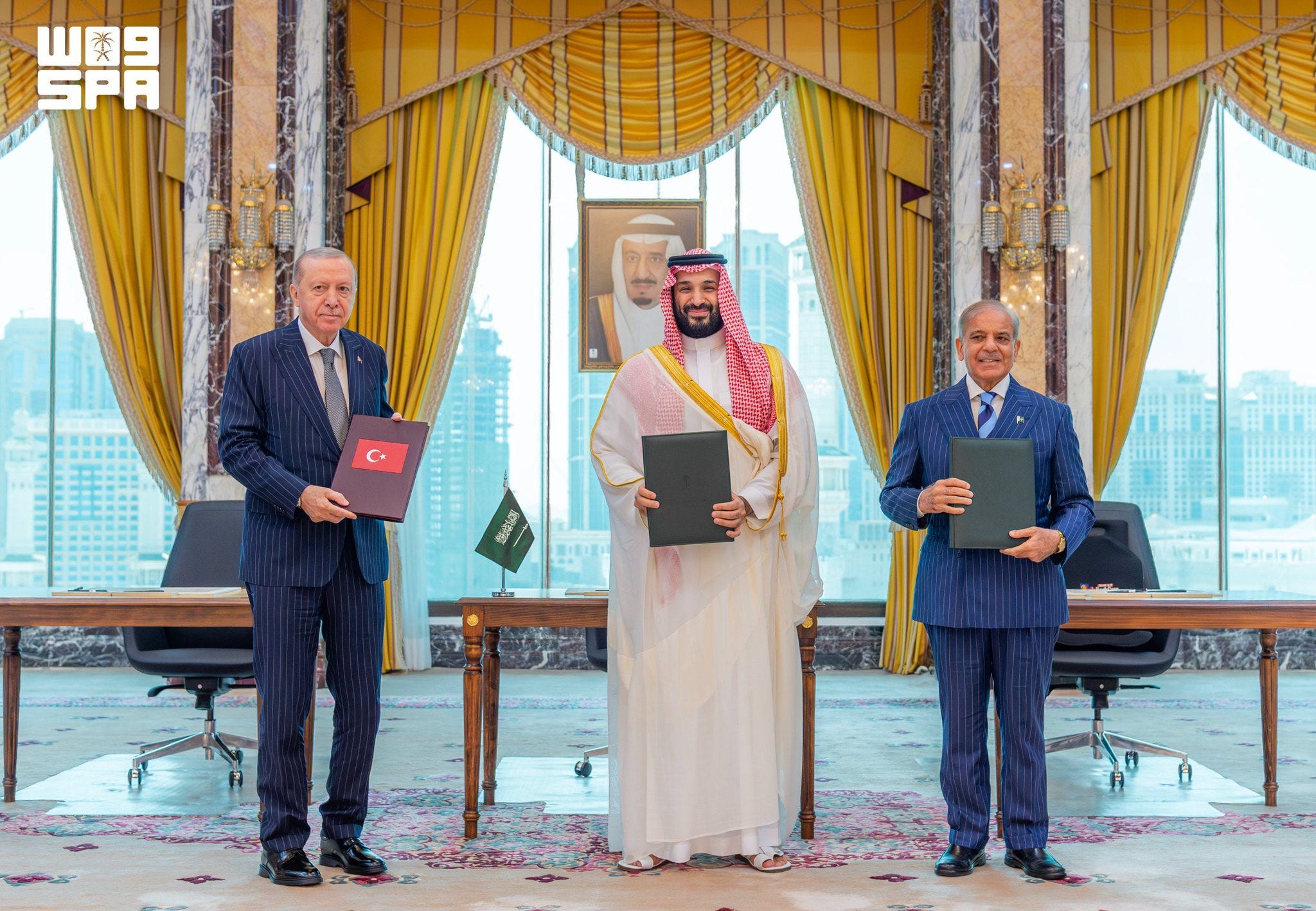
Saudi Crown Prince Mohammed bin Salman, President of Türkiye Recep Tayyip Erdoğan, and Prime Minister of Pakistan Shehbaz Sharif sign the Mecca Joint Defence Agreement. (Saudi Foreign Ministry/X)
It’s Wednesday, September 16, despite a month of non-stop catastrophizing in the media, the Mecca Defense Pact—much like the Memorandum of Understanding—has proven short-lived. When the Saudis, custodians of the holy cities, prayed for help in their hour of need, they faced Jerusalem.
First, some context.
The Mecca Pact, a defense agreement signed between three of the largest Muslim nations (Pakistan, Saudi Arabia and Turkey), was meant to be a “shield of peace” that would “last for generations,” according to the Pakistani prime minister. It achieved neither, but to be fair, that rhetoric was always empty. The pact was a triangulation: a signal to Washington that Riyadh had options, and an attempt to build a non-aligned pole in the Middle East to counter both Iranian and Israeli ambitions. Yet the rubber met the road almost immediately, and promptly swerved out of control.
Last week, Houthi missiles and drones hit four Saudi cities, wounding 73 civilians and halting operations at energy facilities, all while a Houthi offensive in Yemen seized much of the Red Sea coast and closed in on the Bab al-Mandeb. But never fear: Turkey’s foreign minister strongly condemned the attacks and reaffirmed Ankara’s support for the kingdom, warning that the strikes undermined diplomatic efforts to end the Yemen conflict through a lasting political solution. He then called on the Houthis to cease their aggression. Translation: no help is coming.
Saudi Arabia’s Houthi problem got the European Hamas treatment, and when you have a Hamas-shaped problem, you call the experts. So far, Israel has publicly committed to sharing intelligence on the Houthis, though I suspect the real cooperation runs considerably deeper. The Saudis, as far as anyone knows, have promised nothing in return.
If that sounds unfair, it’s because it is. For decades the Arab world has treated Israel like a mistress: the rendezvous were frequent and kept firmly out of sight. One might argue that Israel should now demand Riyadh take the UAE path and make the relationship official before it deepens any further. That would be a mistake.
Israel wants a warm peace with Saudi Arabia, not a forced détente. Demanding public normalization now won’t produce a treaty; the situation isn’t desperate enough that the kingdom would risk ignoring the Palestinians. Instead, such a demand would only cost Israel friends in the long run. Long before any official ties with the Gulf were announced, Israel had built thousands of smaller connections through intelligence-sharing and cooperation. Israel and Saudi Arabia already have a long history together, but there is no such thing as too strong a foundation.
For now, it is sufficient for Riyadh to know that if it is looking for a protector, it will not find one in Ankara.
Fearing he would antagonize Iran and spoil a useful relationship, Turkish President Recep Tayyip Erdoğan has squandered his chance to consolidate a bloc. In keeping Tehran’s favor, he left an opening for the very adversary he signed the treaty to hedge against to step into the gap.
Washington may have let a similar opportunity slip: the chance to bear-hug a frightened ally. In the immediate aftermath of the attack, CENTCOM wisely reasserted the strength and cohesion of their bloc, convening a meeting in Germany with representatives from Israel, Saudi Arabia, the United Arab Emirates, Bahrain, Kuwait, Qatar, Jordan and Egypt. But as in the Iran war, military competence was undercut by political mixed messaging.
Mohammed bin Salman asked Trump to strike the Houthis and was repeatedly rebuffed. Trump went further, claiming the terror group “called us, and they let us know that they don’t want to fight with us.” He is unlikely to stay so magnanimous once the Houthis grow less discriminating, but by then it will be too late.
The Saudi fear has never been that the US military couldn’t protect them, but that the US political class wouldn’t. They didn’t sign the Mecca Pact in the immediate aftermath of the war; they signed only after a month of Trump’s bi-polar messaging on negotiations. Even if Washington eventually launches Operation Rough Rider 2 against the Houthis, Riyadh will remember who was there by choice and who had to be forced.
The signals coming from Washington and Ankara contrast nicely with the voice emanating from Jerusalem.
That voice soothes Saudi fears, whispering that there is one country that, unlike the United States, is not going anywhere; that, unlike Turkey, also counts Iran as an enemy; and that, unlike any of the region’s smaller states, has a proven ability to strike the Houthis. We are still far from a public embrace, but this will not be the last time Saudi Arabia prays for Jerusalem in its hour of need.
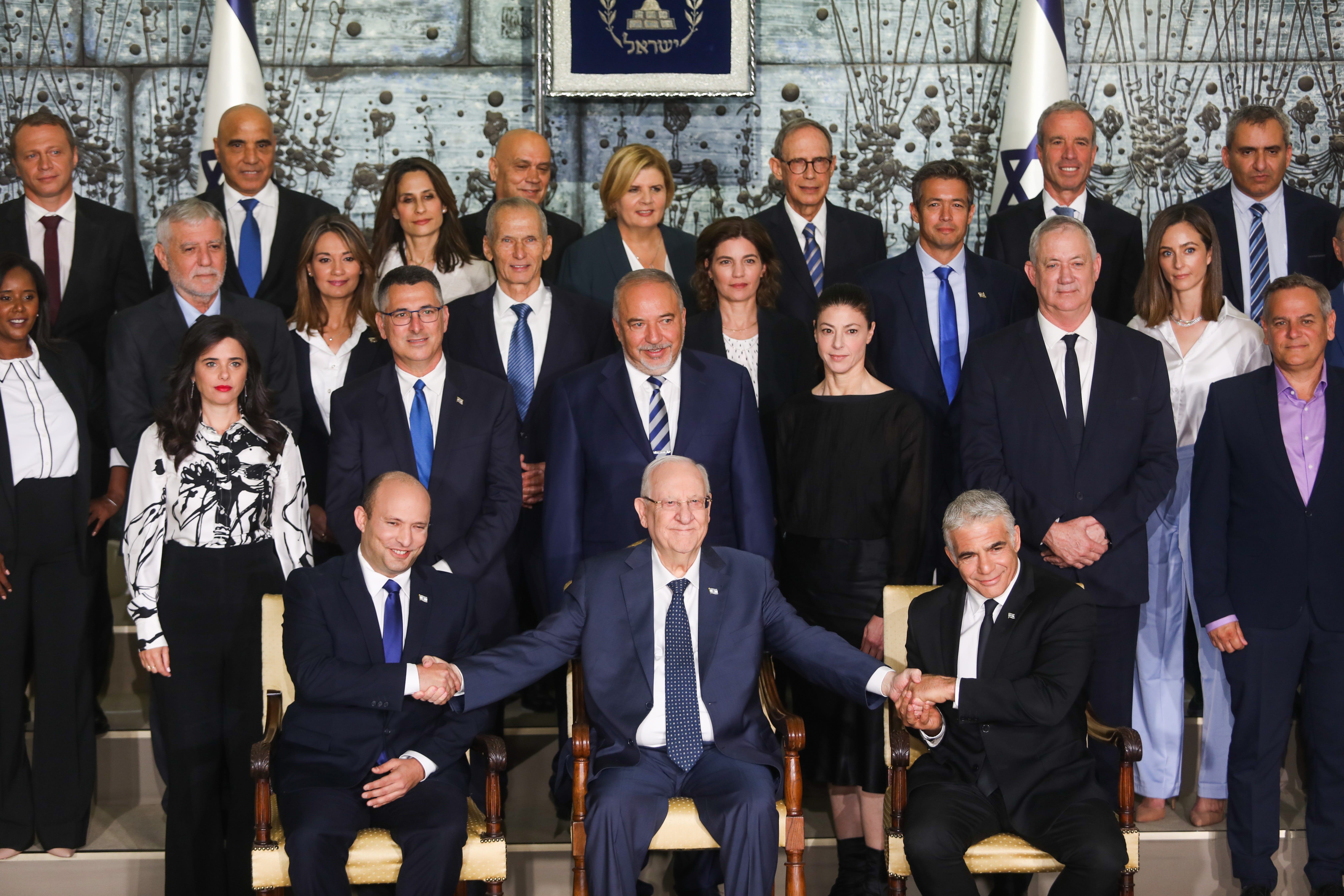
Israeli Prime Minister Naftali Bennett, Foreign Minister Yair Lapid, President Reuven Rivlin and Israeli ministers pose for a group photo of the newly sworn-in Israeli government, at the President’s Residence in Jerusalem on June 14, 2021. (Yonatan Sindel/Flash90)
The change government came about thanks to some 20 right-wing mandates: Gideon Sa’ar and New Hope ran an entire campaign on sovereignty, judicial reform and settling the Golan. Bennett attacked Netanyahu from the right, and Lieberman was Lieberman.
Since then, natural growth has done its part; so have mortality and emigration. As the famous joke from the ‘70s had it, in every ambulance on the street there’s either a Likudnik on the way to be born or a Labourite on the way to die. So the road to reproducing the upset runs through a strong right wing, even more than it did five years ago.
That’s why there’s something baffling about the change bloc’s collective decision to go, of all directions, the other way. Lieberman is still the same Lieberman with the same number of mandates. But Bennett (who ran with Ayelet Shaked, Nir Orbach and Amichai Chikli, the national-religious Yamina cohort, several of whom would later blow up his government from its right) this week unveiled a list without a single religious figure. In their place, on the joint “Together” slate he now shares with Lapid’s Yesh Atid, sit a good many of the Kaplan crowd: Noam Tibon, the reserve general lionised for driving south to rescue his son’s family on October 7; Ram Ben Barak, the former Mossad deputy chief and Yesh Atid MK; Keren Terner, the technocratic ex-director general of the Finance and Transportation ministries; and a bench drawn from the veterans of the 2023 anti-overhaul protests. Eisenkot, admittedly, is careful to stress his opposition to a Palestinian state, and half of his first dozen candidates are religious, but this looks more like Gantz’s Blue and White of back then than like Sa’ar. Not to mention Yair Golan, who puts off the right far more than Michaeli and Horowitz, the last Labor and Meretz leaders, did in their day.
Maybe that’s the reason the gaps in the polls narrowed over the past two weeks. Ofer Winter brought back to the right coalition voters who’d been thinking of wandering off, simply because he’s right-wing and new. The change camp doesn’t have enough attractive options for the voter who recoils from a Palestinian state, believes in settlement and wants changes to the judicial system.
And so, as of now, instead of an election about change versus stagnation, it’s become a battle between the blocs again. Netanyahu will be happy for it to stay that way; his rivals will have to rethink how to rearrange the board. The problem is that because the fight within the bloc hasn’t yet been settled, and because the bloc partly comes from the center-left, the parties are chasing the easy votes there rather than the hard votes that went to Likud and are wavering right now over whether to cross the lines.
This is an excerpt from my weekly column in Israel Hayom.
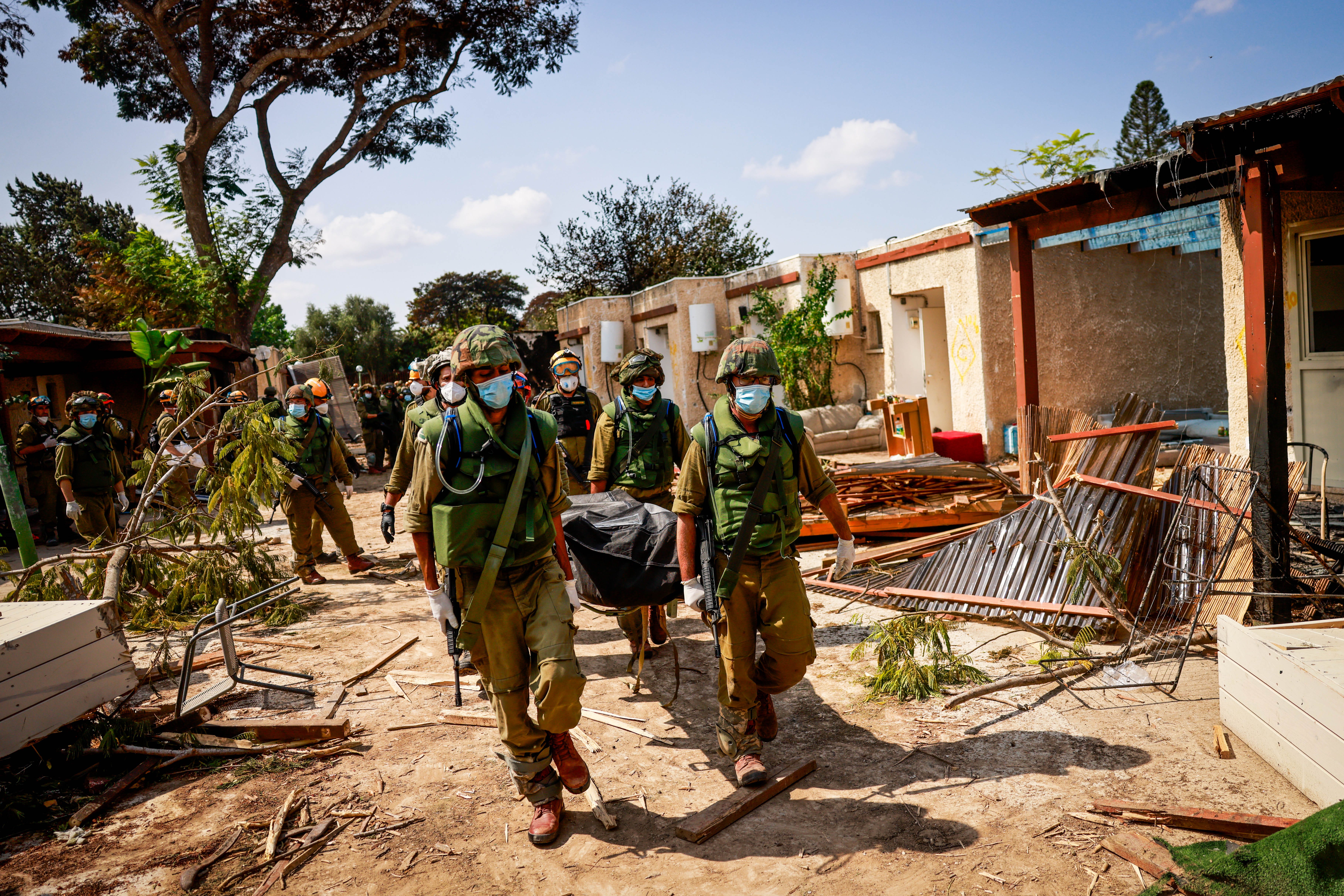
Israeli soldiers around the destruction caused by Hamas Militants in Kibbutz Kfar Aza, near the Israeli-Gaza border, in southern Israel, October 10, 2023. (Chaim Goldberg/Flash90)
“If I’m taken alive, everyone knows I have to be killed,” the senior commander in Israel’s internal security service, the Shin Bet, said. After nearly two years, Channel 12 is revealing a secret of October 7. On that fateful morning, a senior intelligence officer was living on a kibbutz on the Gaza border, caught behind enemy lines.
The security service faced a nightmare scenario. One of its most knowledgeable officers was trapped metres from the terrorists, and there was a real fear she would be taken alive. A former head of the Shin Bet’s Southern District puts it bluntly: “Losing her would be like a military intelligence division chief falling into enemy hands.”
They were desperate to retrieve her.
And yet, even with a captured intelligence officer in play, the unit did not run to her first. Across the kibbutz, families were pressed against the handles of their safe-room doors, fighting off terrorists trying to break in. The order of operations, the Shin Bet special forces fighter insists, was never in doubt: the families came first. “We fight for people’s lives first.”
The full story will be broadcast tonight on Channel 12.
English Editor: Ari Tatarka
If you enjoy the newsletter, you can show your support by becoming a paid subscriber—it really helps keep this going. I’m also offering a special monthly briefing for a small group of premium members. I’d love to have you join us—just click below to find out more.
Thanks for reading It’s Noon in Israel! Subscribe for free to receive new posts and support my work.


So long as it does not become a chimera of a peace deal or the Molotov-Ribbentrup Pact.....alliances come in all shapes and flavors and alas are very mercurial.