Schrödinger’s Ayatollah: Is Mojtaba Dead or Alive?
Also, a new ally against Hezbollah, a twenty-year Mossad agent revealed, and more.
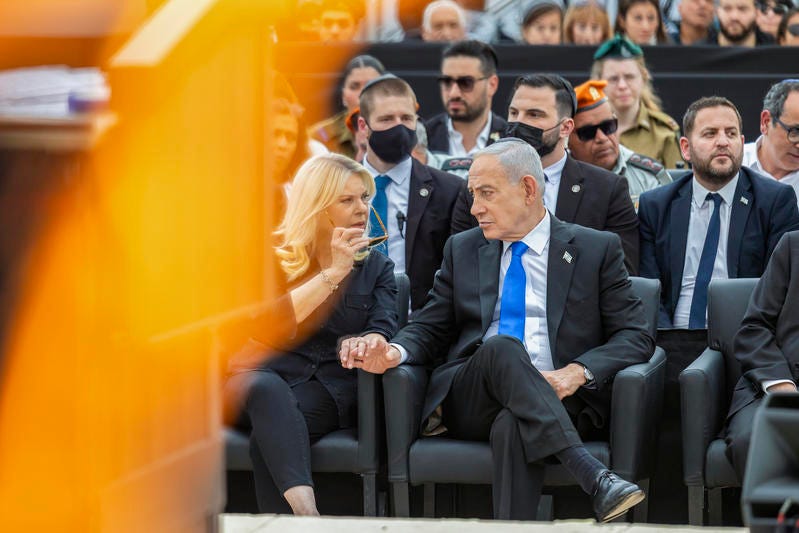
Israeli Prime Minister Benjamin Netanyahu and his wife Sara attend a state memorial ceremony for victims of terror, at Mount Herzl military cemetery in Jerusalem. (Dor Pazuelo/Flash90)
It’s Friday, April 24, and before we dive into today’s analysis, a shocking letter has just been released by the Prime Minister’s Office. It was revealed that in late 2024, Benjamin Netanyahu secretly underwent surgery to remove a cancerous prostate tumor and has been quietly receiving radiation treatment ever since. His medical team has just released a signed statement confirming that he is now cancer-free.
Now, on to today’s insights.
Supreme Leader Mojtaba Khamenei.
At 9:32 a.m., February 28, Mojtaba Khamenei stepped outside of the family compound to “do something.” Seconds later, the compound was struck, and he vanished.
Confirmed dead from that strike was his father, Supreme Leader Ali Khamenei, abruptly leaving the top job open for the Islamist nepo baby. Still missing, Mojtaba ran a highly successful campaign—bolstered, naturally, by his campaign managers, the IRGC. Despite Israeli kinetic arguments to the contrary, on March 8, the Assembly of Experts—with many members voting safely online—declared him the new Supreme Leader in a “unanimous vote.”
In lieu of an inauguration speech, four days after his appointment, a written message attributed to Khamenei was read on state TV. No audio. No video. The next day, the son of President Masoud Pezeshkian assured the public that despite the glaring lack of proof of life, the leader was “safe and sound.” Meanwhile, Iranian officials spun a tale of minor facial and foot injuries, insisting he remained entirely lucid.
The narrative has essentially frozen there. For the last month and a half, the regime has subsisted entirely on ventriloquism—statements attributed to the new Supreme Leader without a single visual confirmation—while foreign reports have described his condition as ranging between severely mutilated and dead.
In early April, a joint U.S.-Israeli diplomatic memo, reported by The Times, claimed that Mojtaba is physically incapacitated, completely unconscious, and hidden in a specialized hospital. The memo also noted ongoing preparations for a massive mausoleum in Qom—a subtle hint that the regime is preparing for a funeral.
This week, The New York Times published a detailed investigation based on leaks from “senior Iranian insiders,” claiming the Supreme Leader is sequestered in a highly secure medical hideout. These officials concede he is severely mutilated—awaiting a prosthetic after three leg surgeries and suffering from facial burns that render him largely mute—but insist he remains “mentally sharp.” Conveniently, because all modern electronics are banned around him to prevent Israeli tracking, he is entirely isolated, relying on a slow human chain of motorcycle couriers to communicate with the IRGC generals who are now effectively running the state.
But within Israeli intelligence, a much colder, simpler theory is taking root: Mojtaba is already dead. All that fantastic, detailed intel—even the candid admissions of severe injury in The New York Times—is carefully calibrated Iranian disinformation.
There is a precedent for this vanishing act: the ultimate messianic figure in Shiite theology is, after all, the Hidden Imam. The irony here is rich. The entire theological foundation of the Iranian regime rests on the idea of earthly “stewardship” until this Hidden Imam reappears. Now that Mojtaba has seemingly joined him in hiding, the regime is left stewarding a doubly empty chair.
This theological cosplay not only buys the regime time to prevent an all-out succession war but also explains why the political echelon is suddenly allowing itself to compromise far more than the directives supposedly coming down from the “Supreme Leader” would plausibly allow. If the Supreme Leader is already pushing up Iranian daisies, he may remain in a bureaucratic state of life until it becomes in someone’s political interest to pull the sheet off the body.
The answer to “Where in the world is Mojtaba Khamenei?” may very well be underground—just in a fashion that doesn’t necessitate bunker busters.
Syrian President Ahmed al Sharra. (AH_AlSharaa/X)
Yesterday, Donald Trump announced that the ceasefire between Israel and Lebanon will be extended by three weeks. Meanwhile, on the ground, Hezbollah continued to target Israeli forces in southern Lebanon for the third consecutive day, prompting the IDF to retaliate against the recent launches with a series of airstrikes across the south.
Just another peaceful day in the ceasefire.
Israel’s presence in southern Lebanon has two objectives: protect northern residents from direct rocket fire and choke Hezbollah’s “logistical oxygen line.” But to fully strangle the organization, Israel needs—and has received—the help of another pair of hands: those belonging to Syrian President Ahmed al-Sharaa.
In the eighteen months since his ascent to power, al-Sharaa has been guided by one instinct: survival. In the “New Syria,” that survival is defined by three pillars: centralization of power, international legitimacy and a desperate need for financial rehabilitation. These interests have converged into a singular, pragmatic mission: the expulsion of Iran and its proxy, Hezbollah, from Syrian soil. In a recent visit to the Chatham House research institute in London, al-Sharaa stated that Syria “paid a heavy price for Hezbollah’s involvement” and that his duty now is to “cut the lifeline” of the organization passing through his territory.
Analysis by the Institute for the Study of War points to a dramatic change in Syrian behavior. Recently, Syrian forces exposed a massive smuggling tunnel in the Homs area and intercepted a shipment of 6,000 explosives and missile components hidden inside a “humanitarian aid” truck. Videos are also circulating on Telegram showing Syrian soldiers manning roadblocks near the Lebanese border, searching Hezbollah trucks and tearing down posters of Nasrallah. In one video, a Syrian officer is heard telling a Hezbollah operative, “The days when Syria was your backyard are over; now we are the ones in charge here.”
The crackdown has even escalated into direct military disruption. Between April 15 and 19, Syrian security forces thwarted several rocket attacks directed at Israel by seizing a truck containing ready-to-fire rocket launchers and arresting members of a Hezbollah-linked cell.
These actions are hardly the result of al-Sharaa’s secret Zionism. Rather, by persecuting the network, he is proving to the international community and the Trump administration that Syria is no longer a forward base for Iran.
The Syrians aren’t doing this for free, either. In addition to an American rehabilitation package and the removal of sanctions, President al-Sharaa received a significant political and economic boost from the European Union this week. The EU mission proposed a full renewal of the 1978 cooperation agreement with Syria—a dramatic step providing the country access to development budgets, technical assistance and trade concessions. Alongside this, the EU announced a support package of 620 million euros for 2026-27, part of a wider rehabilitation plan expected to reach 2.5 billion euros. Outside of the West, al-Sharaa received a royal welcome in the Gulf. While Israel celebrated its Independence Day on Wednesday, the Syrian president arrived for an official visit to Saudi Arabia and met with Crown Prince Mohammed bin Salman.
Hezbollah was a key pillar of support for Ahmed al-Sharaa’s predecessor, Bashar al-Assad, and it was ultimately Israel’s crippling of the terror group that afforded the former jihadi the sudden opportunity to race for the grand prize in Damascus. While Israel rightly remains deeply distrustful of its operation’s beneficiary, it’s nice to see the new regime pay us back for the favor.
A man views a message published on the Mossad website, Israel’s secret intelligence service, on a computer screen. (Nati Shohat/Flash90)
To the residents of the quiet Overijssel province in the northeastern Netherlands, “Jonathan Moore” was nothing more than a shrewd businessman, an exemplary family man, and the manager of a successful local hotel. However, a new exposé by the Dutch Telegraaf and Moore’s upcoming book, The Mossad Spy, reveal that he was leading a double life: for fifteen years, Moore served as one of Israeli intelligence’s most import strategic assets in Europe, operating deep within the shadow war against the Iranian nuclear program.
Moore’s path to the world of espionage began with a childhood obsession. Growing up near the German border, he meticulously collected news clippings of IDF operations, hiding them in secret panels in his attic. This early fascination led him to immigrate to Israel, live on a kibbutz and eventually convert to Judaism. While he initially intended to join an elite commando unit, he was quickly flagged by Israel’s military intelligence. They recognized him as an invaluable strategic asset: a multilingual European who could travel seamlessly across the globe without raising the immediate suspicions that a native-born Israeli might face.
Following the September 11 attacks, Moore transitioned to full-time work for the Mossad, using his legitimate career in the European hotel industry as his primary cover. It was from this unassuming base that he helped launch “Operation Koppelaar” (The Matchmaker). Active until 2022, the operation centered on a groundbreaking artificial intelligence system designed to map Iran’s complex sociopolitical networks. The AI autonomously filtered and contacted potential informants, allowing the Mossad to manage a flood of data and pinpoint optimal candidates to serve as Israel’s “eyes and ears” inside the Islamic Republic.
Operating under the guise of a wealthy international investor, Moore recruited officials at the highest echelons of the Iranian nuclear program and the Revolutionary Guards. His operations often played out in luxury venues worldwide. In one notable instance, operating under the cover of a humanitarian NGO in Hong Kong, Moore cornered a relative of senior Iranian nuclear scientist Saeed Borji. He delivered an ultimatum: cooperate or be eliminated.
The hotelier’s intelligence gathering extended far beyond the nuclear portfolio. Moore participated in high-stress field reconnaissance for the targeted assassinations of senior weapons smugglers, famously recalling drinking tea with a target just minutes before the man’s vehicle was obliterated by a UAV. Crucially, the intelligence Moore gathered also laid the groundwork for the January 2020 assassination of Quds Force commander Qasem Soleimani in Baghdad.
Over the past year, Israel has been reaping the fruits of its intelligence operation, and the now-retired “Moore,” the little boy from the German border, feels an immense sense of pride in his contribution to these achievements and to the security of Israel.
English Editor: Ari Tatarka
If you enjoy the newsletter, you can show your support by becoming a paid subscriber—it really helps keep this going. I’m also offering a special monthly briefing for a small group of premium members. I’d love to have you join us—just click below to find out more.
Thanks for reading It’s Noon in Israel! Subscribe for free to receive new posts and support my work.


I wished we had many more like Jonathan Moore around!
May he be blessed for his missions
So many interesting points in this bulletin .. thank you