
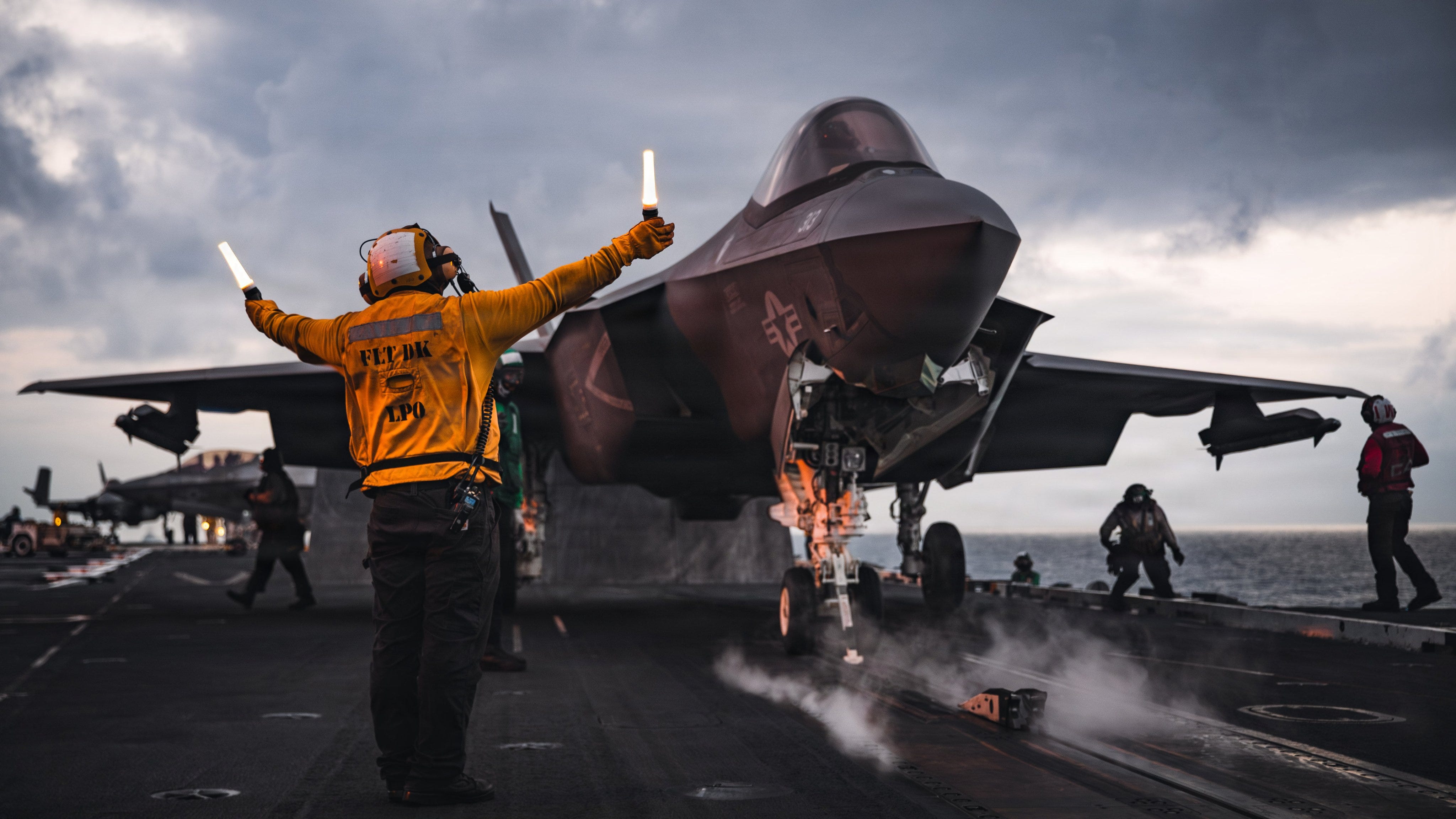
A U.S. Sailor signals an F-35C Lightning II as it prepares to take off from the flight deck of USS George Washington. (CENTCOM/X)
It’s Wednesday, October 21, and according to the Financial Times, Benjamin Netanyahu attempted what many suspected he might: start a war before the election. Three people familiar with the matter told the paper that Donald Trump shut down a multi-day campaign set for the weekend of October 10. “We will not be attacking Iran at any time prior to the midterms,” Trump has declared, and he seems to be sticking by it.
This would undoutbly be a story about a rift if Trump hadn’t spent Sunday writing Netanyahu an endorsement that made the most ardent Bibi supporter blush. Add Secretary of War Pete Hegseth’s visit to Israel on Monday, and it is clear that Washington and Jerusalem are in lockstep on everything but timing.
If Netanyahu did float an earlier date, I doubt he meant it in earnest. For a man with his ear firmly pressed to White House grounds, I doubt he would have missed Trump’s clear timing preferences. If it happened, Netanyahu was testing the waters, not drawing a line.
The plan the FT describes is roughly what many expect: a multi-day bombing campaign over a weekend, before markets reopen, hitting nuclear sites, the regime’s apparatus of repression and its energy infrastructure. Though not stated in the report, the plan afterward is likely to maintain the blockade and wait for the streets to fill with protesters.
The smooth plan obscures what will be far from a clean process. The fallout will send energy prices soaring, as the regime tries to take as much of the world’s energy capacity down with it. Meanwhile, whatever spring arrives to the streets would be far from bloodless.
But the enemy also gets a vote, and I doubt Iran is casting it for Trump. If Tehran takes his many statements at face value, or reads anything into the third aircraft carrier on its way, it knows an attack is coming and that it can do little to stop it. Waiting politely until every vote is counted and the markets close for the weekend buys it only a few more days of slow strangulation. The price of that reprieve is the initiative, and after twice seeing what Israel and the U.S. can do with it, Tehran knows exactly what waiting costs.
There is a week between Israel’s election and the midterms; there’s a good chance the Iranians won’t let it go to waste.
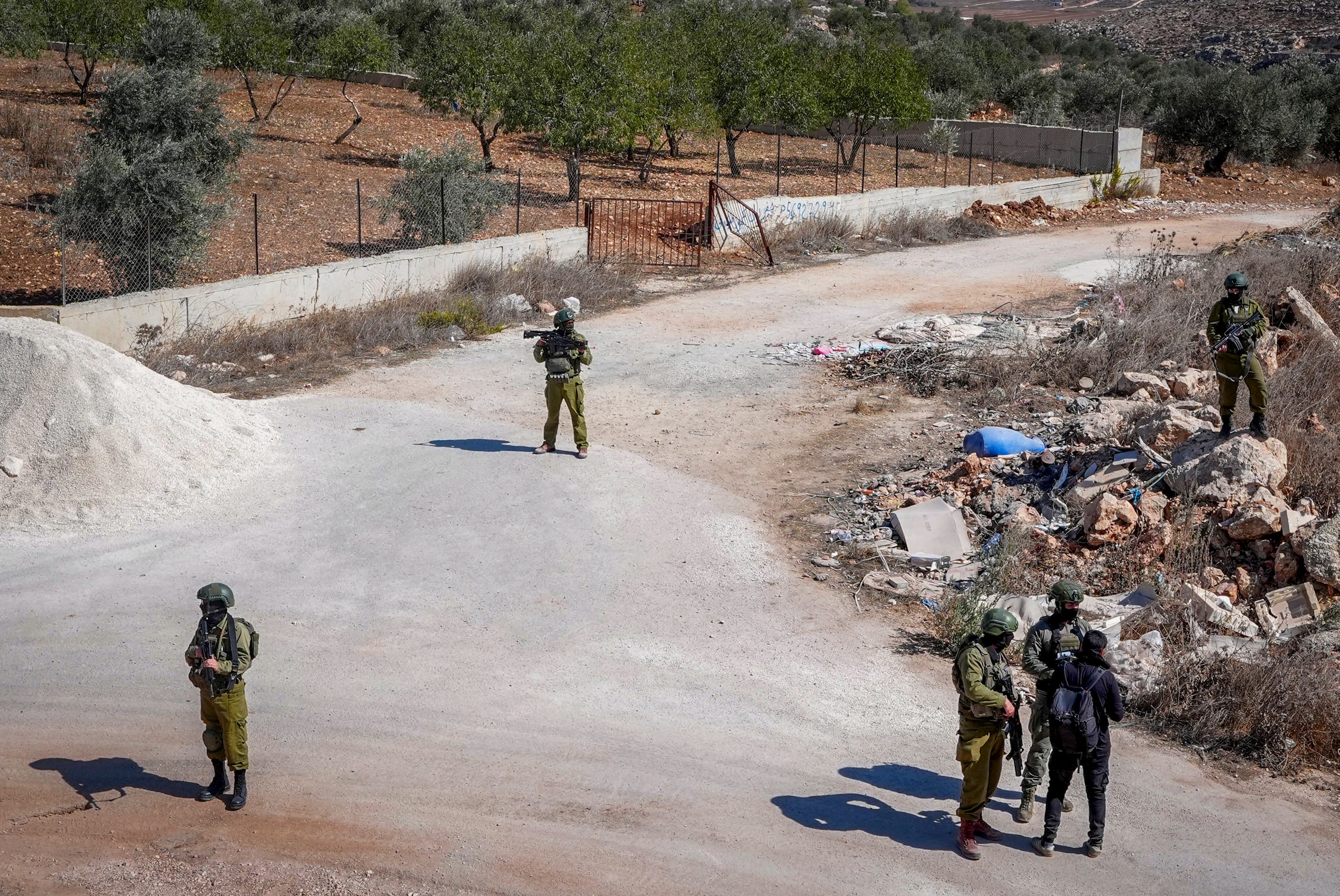
Israeli soldiers gather on a road near an olive grove following a reported attack by extremist Jewish settlers on a Palestinian home in the West Bank village of Turmus Ayya, October 19, 2026. (Flash90)
How many Israelis support settler violence? Very few. How many think the security forces are too harsh on the settler groups involved? According to an Israel Democracy Institute survey, about a quarter.
The two shouldn’t be conflated. Israelis are statists on principle; you don’t pray for a state for 2,000 years only to sidestep it at the first opportunity. But they are also fiercely protective of that state, and many see the “settler violence” narrative as a false campaign concocted to delegitimize it. Besides, once your home has been declared illegal, your presence illegitimate and your life more or less forfeit by the international community, declaring more things in Judea and Samaria illegal is a high priority.
Where there are several mandates’ worth of people against the current enforcement, there’s an opening for politicians. Israel Katz, a self-styled “real right-wing defense minister,” has crowned himself defender of the settlers. His tenure has been a string of bellicose advances and quiet retreats: announcing a return of settlements to Gaza, then backing off; firing the Central Command chief on live TV, then retreating under a hail of criticism. The one hilltop he’s still holding is administrative detention.
Nationalist crimes are hard to prove. They’re usually committed at night, by masked suspects who know to hide their activities. The Shin Bet often knows who did it but can’t prove it in court without exposing its sources. Administrative orders solve that problem: they let the state act on what it knows rather than what it can prove. Detention, which Katz calls “draconian,” is the harshest and most controversial of these orders, and the only one he has banned outright. In the past the net has caught innocents, and the military treatment for Israeli citizens rubs many the wrong way.
After Saturday’s attacks on European diplomats, and the American pressure that followed, Katz has stood firm. “Administrative orders are not the solution—effective police enforcement is,” he said. The IDF, he added, “should not and cannot engage in civilian law enforcement” and should instead “fight Palestinian terrorism and defend the country’s borders.” He’s right that Palestinian terror is the far larger threat. But shunting nationalist violence onto an already understaffed and overstretched police force is not the solution. Then again, administrative detention may not be either.
Beyond its moral and enforcement challenges, settler violence is a political problem. Every aspect of it is disputed, but one thing is certain: it features heavily in every attack on Israel’s legitimacy. The counterargument is that attacks on Israel are Mad Libs: if it weren’t settler violence, they’d fill in the blank with something else. After three years of libels, that view isn’t without grounds.
If it were only Amnesty and the U.N. reciting the phrase, I’d be more inclined to agree. But there are farmers in the depths of Samaria less pro-settlement than Mike Huckabee, the U.S. ambassador to Israel, and Israel has no more important ally than the Trump administration.
This problem needs to be hit with the kitchen sink. Administrative detention may be part of that or it may not, but we should worry less about the exact dimensions of the sink, and more about actually throwing it. It doesn’t matter what tools are at hand if there is no will to use them. Whether a violent individual is confined at home or in an IDF cell matters less than the fact that he is confined. That may come at a political cost for some, but refraining comes at a higher political cost for Israel.
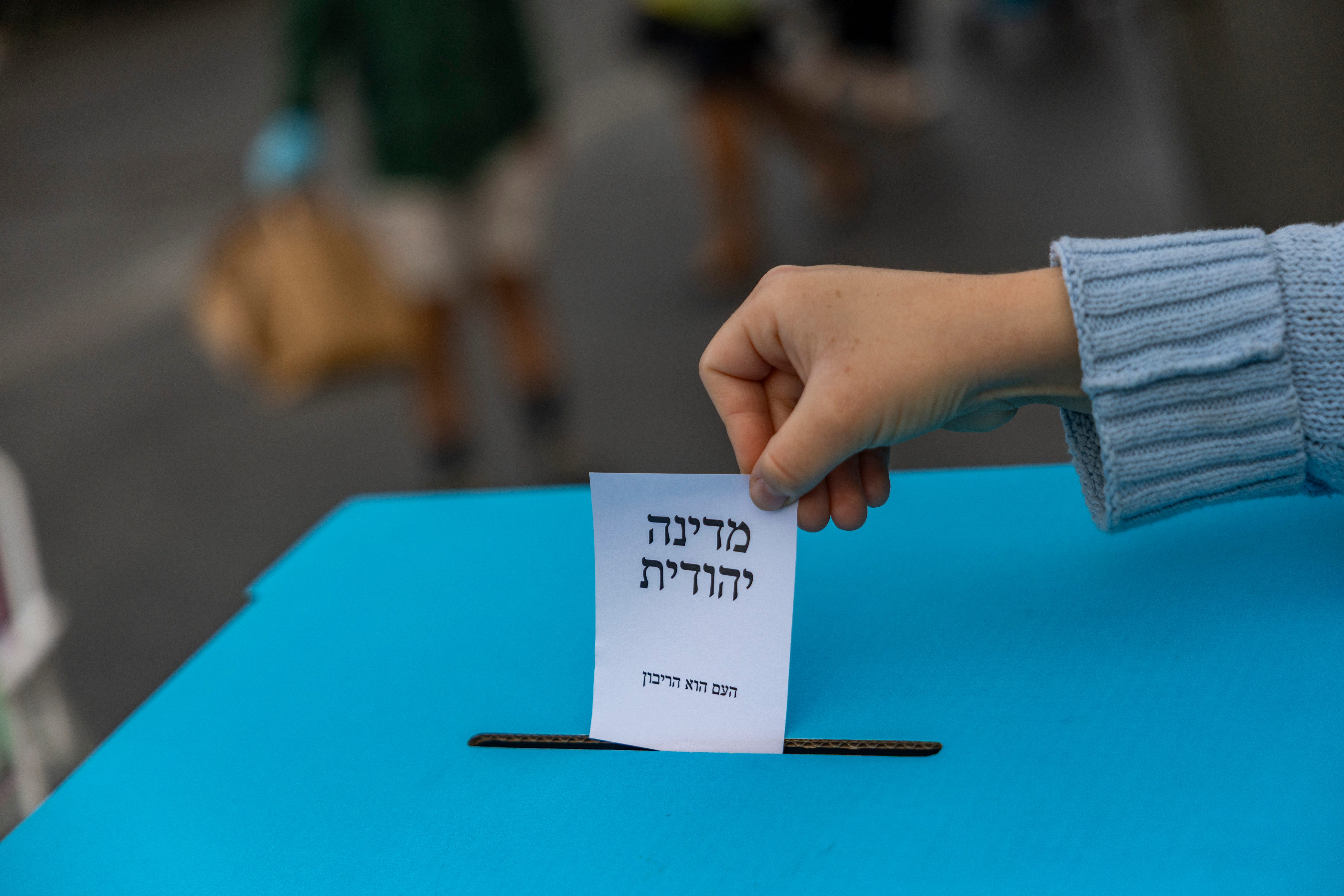
People participate in a street poll ahead of Israel’s upcoming general elections at the Mahane Yehuda market in Jerusalem, October 20, 2026. (Chaim Goldberg/Flash90)
Hope is always nice, but fear is the real engine that gets people out to the ballot box on election day.
That fear exists, in abundance, in every sector and every bloc on the eve of October 27. Only 11 percent of the population say that a victory for the rival bloc would be an ordinary democratic loss they would accept easily. Twenty percent would see it as a bitter disappointment but would live with it. A third of the public, 34 percent, would be very worried about the direction the country would take, and a quarter would fear personally for their own fate, for their family’s and for Israel’s.
That last figure is especially high among Israel’s Arabs, perhaps because they fear another term of blood in the streets and gunfire into homes, but it is clearly present among both opposition and coalition voters too.
One can assume that voters for the Change Bloc have been persuaded by the scare campaign about harm to personal and democratic rights, and voters for the Netanyahu bloc by the scare campaign about harm to social media, a freeze in Judea and Samaria, the shutting down of channels and, if you are Haredi, arrests and sanctions as well.
This of course also ties into the question of whether the country is heading in the right direction. In principle, upheavals happen in countries where the public is unhappy with the direction the country is taking.
The caveat “in principle” is there because in a parliamentary democracy with a coalition system, you can vote for the government, be unhappy with the country’s direction and still blame other parties. National Security Minister Itamar Ben Gvir, for example, has made a career of it.
Well, most of the Israeli public thinks Israel is not heading in the right direction, 53 percent to 36 percent. Here too, of course, there is a gap between coalition supporters, who are more optimistic (71 to 16 percent), and opposition supporters, with an almost inverted figure (15 to 77 percent).
Next week, if there is an upheaval, this will flip. And if there is a paralyzing tie and yet another election, perhaps a worrying consensus will take hold that the country is not only heading in the wrong direction, it is stuck halfway down the road.
English Editor: Ari Tatarka
If you enjoy the newsletter, you can show your support by becoming a paid subscriber—it really helps keep this going. I’m also offering a special monthly briefing for a small group of premium members. I’d love to have you join us—just click below to find out more.
Thanks for reading It’s Noon in Israel! Subscribe for free to receive new posts and support my work.


The settler violence is a myth and Gadi Taub proved that this week with a video showing exactly how the NGOs, leftists, anarchists, and Islamic terrorists insight violence by throwing stones and other means that require a response from the Jews living there in order to preserve their lives.
Israel is a beautiful and brilliant shirt, and settler violience is a small but ugly stain chest high right in the front that most people don't want to ignore, both supporters and detractors. I hope in this next election Israelis select leaders that will clean up this stain, and do what is needed to stop creating further stains.
It's one thing to have many detractors, we're used to it. It's another to lose the few remaining supporters.