The Battle Over the Mossad: A Succession Crisis
Also, Israel's island ally under threat, and the myths surrounding settler violence.
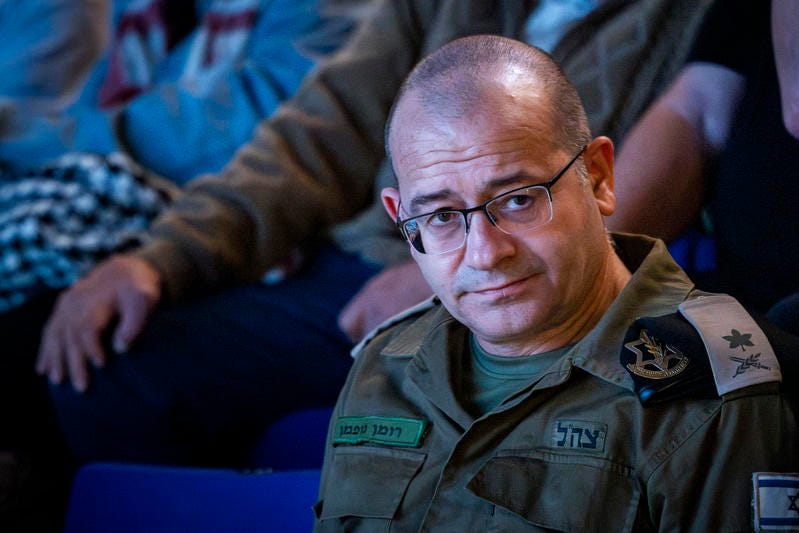
Incoming Mossad Director Maj. Gen. Roman Gofman in 2025. (Chaim Goldberg/Flash90)
It’s Monday, May 11, and in one of the most famous scenes in cinematic history, Jack Nicholson’s Colonel Nathan Jessep snarls at Tom Cruise’s Lieutenant Daniel Kaffee from the witness stand: “You can’t handle the truth!” The truth Jessep is fiercely defending is the brutal, extrajudicial cost of national security—the dark, unseemly work required by the men who “stand on that wall” so a polite society can sleep safely. That same tension between the rule of law and the shadowy demands of state survival is at the center of a fierce battle over the leadership of Israel’s legendary spy agency, the Mossad.
In the sweeping overhaul of Israel’s defense and intelligence establishment since October 7, the Mossad has been the sole agency to retain its chief. Now, current Director David Barnea is slated to be replaced by Prime Minister Benjamin Netanyahu’s new pick: Maj. Gen. Roman Gofman. A former combat commander and the prime minister’s military secretary, Gofman would be the first outsider to take the helm since Meir Dagan in 2002. While Netanyahu has authorized the move and the Advisory Committee for Senior Appointments has cleared it by a majority vote, the transition has hit a roadblock. As is often the case with executive power in Israel, the appointment cannot proceed until Attorney General Gali Baharav-Miara has her say, which is almost always no.
So why is Gofman on the stand?
Baharav-Miara argues that the committee’s approval of Gofman is legally flawed because it contained a flaw “in the factual basis on which the committee majority’s opinion relied.”
That factual basis is the 2022 Elmakayes affair.
While commanding the 210th Regional Division on the Syrian border, Gofman oversaw the unauthorized recruitment of 17-year-old Ori Elmakayes to run an online influence campaign against enemy states. Bypassing the Shin Bet—the only agency legally authorized to handle civilian proxies—IDF officers fed the minor classified intelligence to post on social media.
When the Shin Bet detected the unauthorized data transmissions, they arrested Elmakayes for espionage. Unaware he was an IDF asset, the state held the teenager in harsh isolation for two months, followed by 18 months of restrictive house arrest. The charges were only dropped in late 2023 when the military’s involvement was finally exposed. However, the core of the outrage against Gofman stems from his conduct following the arrest. He reportedly disavowed the teenager to investigators, denying knowledge of the boy’s age, his recruitment, or the use of classified materials, effectively abandoning his own operative to the Shin Bet’s interrogators.
It is difficult to cast Baharav-Miara as the crusading Kaffee in Israel’s version of A Few Good Mefakdim (commanders). After all, her opposition to Netanyahu’s executive decisions is hardly selective. But the attorney general is not the only one standing against the appointment; the man Gofman is slated to replace is also opposing the move.
The traditional narrative in Jerusalem is that the Mossad simply despises outsiders, and that institutional bias is likely part of the friction. However, in his letter submitted to the High Court hearing regarding the appointment, Barnea made no mention of “stranger danger.” Instead, he issued a stark warning about the architecture of Israeli intelligence: the Mossad functions outside the law. Because it has “no minister to supervise or a committee to be accountable to,” and answers solely to the prime minister, Barnea argued that its director must be a figure guided by rigid “self-criticism, warning signs, and clean hands.”
The argument of those standing with Barnea in opposing the appointment would sound as follows: Stripped of its diplomatic veneer, the Mossad operates much like a state-sanctioned crime family—an organization that tracks, smuggles, and assassinates enemies of Israel. The only safeguard preventing it from devolving into a rogue cartel is the internal moral compass of its leader. The fact that Gofman allegedly failed to oversee or take accountability for an off-the-books intelligence operation may suggest he lacks the ironclad ethical boundaries necessary to rein in one of the world’s most lethal espionage agencies.
Gofman maintains that he was unaware of the asset’s age or civilian status, believing the operation relied entirely on open-source information. In this view, the decision to utilize a minor and classified intelligence was an unauthorized initiative taken by junior officers. While this does not remove his ultimate command responsibility, it might be unreasonable to expect a division commander to vet the tactical details of every minor operation on a broad front. The affair is undeniably a black mark on his record, but whether it is truly disqualifying remains debatable. Ultimately, it will be up to the court to decide who stands on that wall.
The flags of the U.S., United Arab Emirates, Israel and Bahrain seen on the side of a road in the Israeli city of Netanya, 2020. (Flash90)
On the surface, Bahrain is the perfect Abraham Accords ally. Relations between the small island monarchy and Israel are officially described as “excellent” and have developed steadily since the agreements were signed in 2020. Even today, a large portion of the Bahraini public shows genuine interest in expanding business ties with Israel.
But according to Yedioth Ahronoth’s Smadar Perry, a threat is quietly boiling beneath the surface. Roughly two-thirds of Bahrain’s 1.6 million residents belong to the Shia majority—a demographic reality that the Sunni-led government of King Hamad bin Isa avoids highlighting with updated, accurate data. The internal tension is stark: despite 523 drones and 190 missiles falling on Bahraini territory during the war, wild flash protests supporting Iran’s Ayatollah regime continue to erupt on the streets.
In response, a covert crackdown against the Shia community has been underway for three months. In March, seven local residents were sent to detention centers and effectively vanished. Two weeks later, a larger group was arrested, including 20 locals and five Afghans. By April, the situation escalated further when the state revoked the citizenship of 69 Shia residents; it remains unclear if they will be deported or if they will ever manage to restore their status.
Last week brought another severe escalation when Bahraini authorities arrested 41 leading Shia clerics and sent them to prison incommunicado. With no visits or outside information allowed, they face the State Security Court on charges of maintaining secret ties with the Iranian Revolutionary Guard Corps.
This friction is hardly unprecedented. Since the 1980s, Tehran has actively interfered in Bahrain—sponsoring militant groups and pushing political narratives that question the island’s sovereignty. Iran does not hide its ultimate goal: to topple the “first among equals” and strike a fatal blow to Bahrain’s Sunni population.
Perry reports that, in intelligence circles, Bahrain is widely considered the “front yard” of the Kingdom of Saudi Arabia, separated by only a 20-minute, barrier-free drive from the mainland. It is an incredibly convenient setup for an intelligence agency seeking a secure, deniable channel to Riyadh without the glare of public diplomacy. Yet, the Israelis, who appreciate the quiet of Bahrain’s unmarked offices, may be dangerously ignoring the reality outside. The Abraham Accords may have secured the kingdom’s elite, but the street may attempt to guide Bahrain in a different direction.
A Palestinian inspects the damage to a sanitary warehouse following an attack by Jewish settlers in the town of Deir Sharaf, west of Nablus, in Judea and Samara, 2025. (Nasser Ishtayeh/Flash 90.)
Ask 100 people to name the primary accusation leveled against Israel, and “genocide” would likely top the list, with “settler violence” a close second. Much like the first, it is a shame that an issue of such weight is so often defined by mistruths and exaggerations.
Before proceeding, it is important to state clearly: settler violence does exist, it is a serious problem, and it must be dealt with accordingly. However, as with much in the region, the reality and the narrative are simply miles apart.
Let’s begin with the data. The most often cited number comes from the UN Office for the Coordination of Humanitarian Affairs, which recorded 2,047 incidents of violence against Israelis and 6,285 against Palestinians between April 2023 and January 2026. A closer examination of these numbers reveals that the majority of the latter do not actually involve violence, and many don’t even include settlers.
Of the 6,285 alleged incidents against Palestinians, 1,704 occurred in Jerusalem, not in settlements. Another 1,361 relate either to Jewish visits to the Temple Mount or to clashes there between security forces and rioting Muslim worshipers. Neither settlers nor violence feature in these instances. Yet, in the UN’s ledger, a Jewish visit to Judaism’s holiest site is automatically classified as settler violence.
Of the remaining 3,220 reported incidents in Judea and Samaria, many consist of generalized complaints—such as “trespassing” during tours or hikes—involving no assault or damage to persons or property. Another 96 cases relate to state projects, like road and infrastructure construction, which involve neither violence nor settlers. 2,039 of the complaints allege property damage or assault without bodily harm; while unacceptable, this hardly aligns with the violent image frequently depicted in the media.
Beyond these questionable classifications, there is a fundamental problem with how data on these incidents is collected. This was highlighted in a 2024 defamation case involving the left-wing NGO B’Tselem. According to the testimony of a B’Tselem field researcher with 20 years of experience, the organization operates under a protocol where Palestinian accounts are not independently verified beyond a site visit and discussions with additional “eyewitnesses” (who may or may not have actually seen the event). In the specific episode at the center of the case, the “facts” published by B’Tselem were directly refuted by the victim’s medical files and contemporaneous IDF reports.
In this regard, B’Tselem is not unique. Most NGOs and UN agencies claiming to perform fact-finding in the Arab-Israeli conflict operate similarly. They frequently base their publications on hearsay and second-hand accounts without properly verifying the allegations. (Even if they intended to, these NGOs generally lack the tools, expertise, and access required for rigorous verification.)
Israel Police data shows that between 2014 and 2024, approximately 1,356 complaints of “Jewish violence” in Judea and Samaria were filed. Only about 40 percent (roughly 537 cases) met the threshold to open an investigation. Furthermore, a substantial share of these cases involved property offenses, vehicle theft, drug possession, and other criminal incidents entirely unrelated to nationalist violence.
A clear example of a false complaint generating headlines occurred in February 2026 regarding a fire in a sheep pen. The media widely reported that “settlers burned a sheep pen, killing dozens of animals,” and politicians leveraged these reports to make serious accusations that were amplified internationally. Within a day, Israel Police released its findings: the fire was actually caused by an illegal electrical connection installed by the owner himself.
Similarly, in 2024, the central investigator for Judea and Samaria testified that in the South Hebron Hills, roughly 90 out of 191 cases filed since the start of the October 7 war (nearly 50 percent) were found to be false complaints. In the Jordan Valley, a comparable half of all complaints proved to be false.
When exaggerations eclipse the facts, we sacrifice truth for impact. This does not solve the issue; it merely weaponizes it. It alienates those in the middle seeking practical change, while handing extremists on the fringes the perfect excuse to further entrench themselves. Ultimately, we cannot address a problem if we are fighting a narrative instead of reality.
We are taking a break; we will be back on Wednesday.
English Editor: Ari Tatarka
If you enjoy the newsletter, you can show your support by becoming a paid subscriber—it really helps keep this going. I’m also offering a special monthly briefing for a small group of premium members. I’d love to have you join us—just click below to find out more.
Thanks for reading It’s Noon in Israel! Subscribe for free to receive new posts and support my work.


