Stranger than Fiction
The Mossad recruited Israel's arch enemy, Trump takes an page from the Iranian playbook, and more.
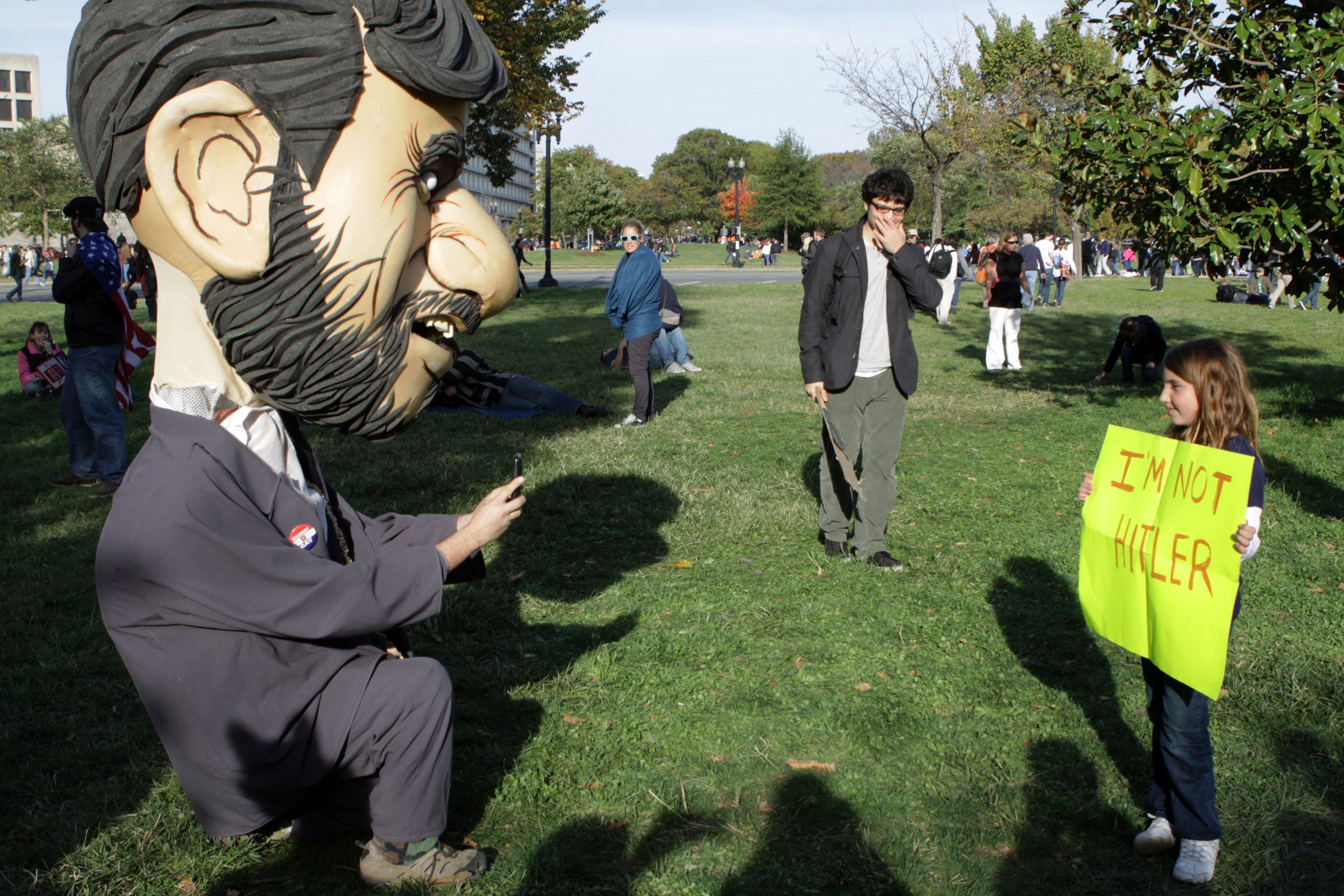
A participant in a giant Mahmoud Ahmadinejad caricature head photographs a young girl holding an “I’M NOT HITLER” sign at the Rally to Restore Sanity and/or Fear on the National Mall, October 30, 2010. (Rachael Cerrotti/Flash90)
It’s Tuesday, July 14, and according to Mark Twain, “Truth is stranger than fiction, but it is because fiction is obliged to stick to possibilities; Truth isn’t.” Yesterday delivered two such truths.
The first: Israel spent years recruiting the man most famous for calling it a filthy bacteria and demanding it be erased from the page of history, Mahmoud Ahmadinejad. The second: Trump, apparently dissatisfied with merely opposing Iran’s toll scheme, has announced his own—declaring himself Guardian of the Hormuz Strait and invoking, with characteristic solemnity, the principle of “FAIRNESS.”
The first revelation is strange on several levels.
The most obvious: the man who called Israel a “filthy bacteria” was a Mossad asset. According to the New York Times, the operation began in 2022, was briefly interrupted by October 7, and then accelerated as Israel and Iran hurtled toward war. Mossad chief David Barnea personally oversaw it—at one point skipping a security consultation with Netanyahu to attend to developments on the Ahmadinejad file, and flying to Budapest to meet the Iranian former president directly. Israel reportedly covered Ahmadinejad’s housing and travel expenses for the trip.
The second level of absurdity is the trust Israel placed in a man who had to be persuaded, over years, that he might benefit from the relationship. According to the New York Times, Ahmadinejad eventually concluded that he could not return to power under the existing regime and that foreign intervention was his only path back. A close associate told the Times he saw himself as a reformer—and that when he came to power, Iran would recognize Israel and join the Abraham Accords. This is the same man who, as recently as 2012, was calling for the annihilation of the Zionist regime as a precondition for world justice. On the bright side, the episode at least raises the intriguing possibility that Zohran Mamdani is also a Mossad asset. One hopes.
The campaign culminated on the first day of the war: a strike on Ahmadinejad’s residential compound, targeting his bodyguards and armored vehicle, after which a car secreted him to an Israeli safe house inside Iran. He left shortly afterward, reportedly disillusioned with Israel’s vision for his return to power—and was not seen again until he appeared at Khamenei’s funeral, masked, heavily jacketed in ninety-degree heat, flanked by what appeared to be guards.
Haaretz reports that IDF Military Intelligence assessed the war’s chances of toppling the regime as low, the Mossad’s installation plan as unworkable, and the entire enterprise of predicting political outcomes in wartime chaos as fundamentally futile. Their skepticism centered on the Ahmadinejad endgame—and on that point, they were vindicated.
What is perhaps most staggering is not the operation itself but its exposure. Senior Israeli intelligence officials spoke to Haaretz on the record—or near enough—about an active asset in a hostile state. American officials did the same with the New York Times. The material passed Israel’s military censor. Whatever editorial judgment drove that decision, the practical result is that the Islamic Republic now has, in print, a detailed account of its former president’s cooperation with the Mossad, sourced from the governments that ran him. Ahmadinejad’s office called it Hollywood fiction. The regime has executed thousands on less.
The longer damage may be institutional. This debacle will give any future defector serious pause before trusting an intelligence service that cannot keep their conspiracy out of the headlines if it fails.
Donald Trump at the 2026 NATO Summit. (White House)
Meanwhile, Trump is playing tit-for-tat with a bewildering twist. Iran closes the strait—Trump imposes a blockade. Iran announces service fees on passage through its corridor—Trump announces a 20 percent fee on passage through the American one. He has even given himself a title: Guardian of the Hormuz Strait. Iranian Foreign Minister Araghchi, apparently constitutionally incapable of recognizing irony, responded on X: “20 percent is of course too much. We will be fair.” The two powers are now negotiating competing toll booths on the same chokepoint—which is either the most creative geopolitical standoff in recent memory or a particularly expensive episode of The Apprentice.
The bigger story is the reimposition of the blockade itself—because the first one worked. Mojtaba Khamenei approved the original MoU grudgingly, publicly, with his reservations on the record—only after President Masoud Pezeshkian, terrified of the blockade’s economic consequences, accepted personal responsibility for the outcome and committed to safeguarding the supreme leader’s red lines. It was not diplomacy that brought Iran to the table. It was the prospect of an economy that, by one senior intelligence official’s estimate relayed to me during the original blockade, would not have survived 2026 intact. Khamenei left no ambiguity about where the blame would fall if the deal collapsed. Ahmadinejad may not be the only one with his head on the block.
Accelerating the potential collapse are two factors: the resurrection of Operation Economic Fury and the resumption of strikes. The sixty-day oil sanctions waiver the Treasury issued June 22 made it less than halfway before it was withdrawn—staff who spent last month unfreezing assets are now reimposing sanctions. Meanwhile, US strikes have continued for a third consecutive night, for now focused on military capacity around the strait, though economic infrastructure sits well within the realm of possibility.
As for the American toll, I’ll believe it when I see it. The notion that the only thing separating the US Navy from opening the strait has been a missing financial incentive strains credulity. Unless Trump takes further inspiration from the Iranian playbook—strike ships first, then demand protection money—the US must actually provide a service to collect a fee. During the war, the Navy quietly moved vessels through the Omani corridor; recently even that route has come under fire, and there are conflicting reports about whether sufficient escort capacity exists. If it does, the toll is worth watching.
For a summary of the last 48 hours, I refer you to the British pop-rock duo Tears for Fears: it’s a mad world.
Secretary of State Marco Rubio at the first game of the FIFA World Cup 2026. (@SecRubio/X)
Buried in the 2002 American Servicemembers’ Protection Act is a provision known as the Hague Invasion Act. It authorizes the president to use “all means necessary and appropriate”—including military force—to liberate any US citizen or allied personnel detained by the International Criminal Court. Rather than redeploy forces from Iran to patrol the Belgian coast, the administration has opted for diplomacy.
Yesterday, Secretary of State Marco Rubio announced a sweeping campaign to dismantle the ICC “brick by brick, if necessary.” The toolkit involves visa revocations, travel bans, expanded sanctions, and diplomatic pressure on Rome Statute signatories to withdraw. The Secretary himself, along with his deputy and US ambassadors across the globe, is calling governments directly, urging non-member states to leverage their own networks in parallel. The message, as Rubio put it in a Wall Street Journal op-ed, is simple: “sovereign states over globalism.”
It is perhaps fitting that America chooses its 250th birthday to remind the world that it has never much liked foreign powers exercising jurisdiction over its citizens.
When Rubio warns that US officials and soldiers risk being left at the “mercy of foreign judges, thousands of miles away—facing the constant risk of prosecution and even imprisonment for the so-called ‘crime’ of defending their own country,” he is not primarily thinking about American servicemen. No US citizen has ever faced ICC prosecution—the court being acutely aware of the risk of provoking Washington too directly. The men he likely had in mind are Benjamin Netanyahu and Yoav Gallant, against whom warrants remain active. In that framing, one hears the ghost of Lindsey Graham, who said when the warrants were first issued: “If they do this to Israel, we’re next.”
The risk in Rubio’s campaign is a repeat of the UN Human Rights Council experience. When Washington withdrew in 2018, the Council did not collapse—it simply continued its work, with marginally less friction. The legitimacy of that body derived not from its members but from its name and the deference that attaches to supranational bodies with reassuring words like “justice” and “human rights” in their titles. The ICC may prove similarly resilient. The story may not be “biased international body defeated” but rather “the United States dismantles international justice”—with the possible addition, in smaller print, “at Israel’s behest.”
English Editor: Ari Tatarka
If you enjoy the newsletter, you can show your support by becoming a paid subscriber—it really helps keep this going. I’m also offering a special monthly briefing for a small group of premium members. I’d love to have you join us—just click below to find out more.
Thanks for reading It’s Noon in Israel! Subscribe for free to receive new posts and support my work.


