Commandment III: Jewish or Israeli
The fundamental tension at the core of Israeli society.
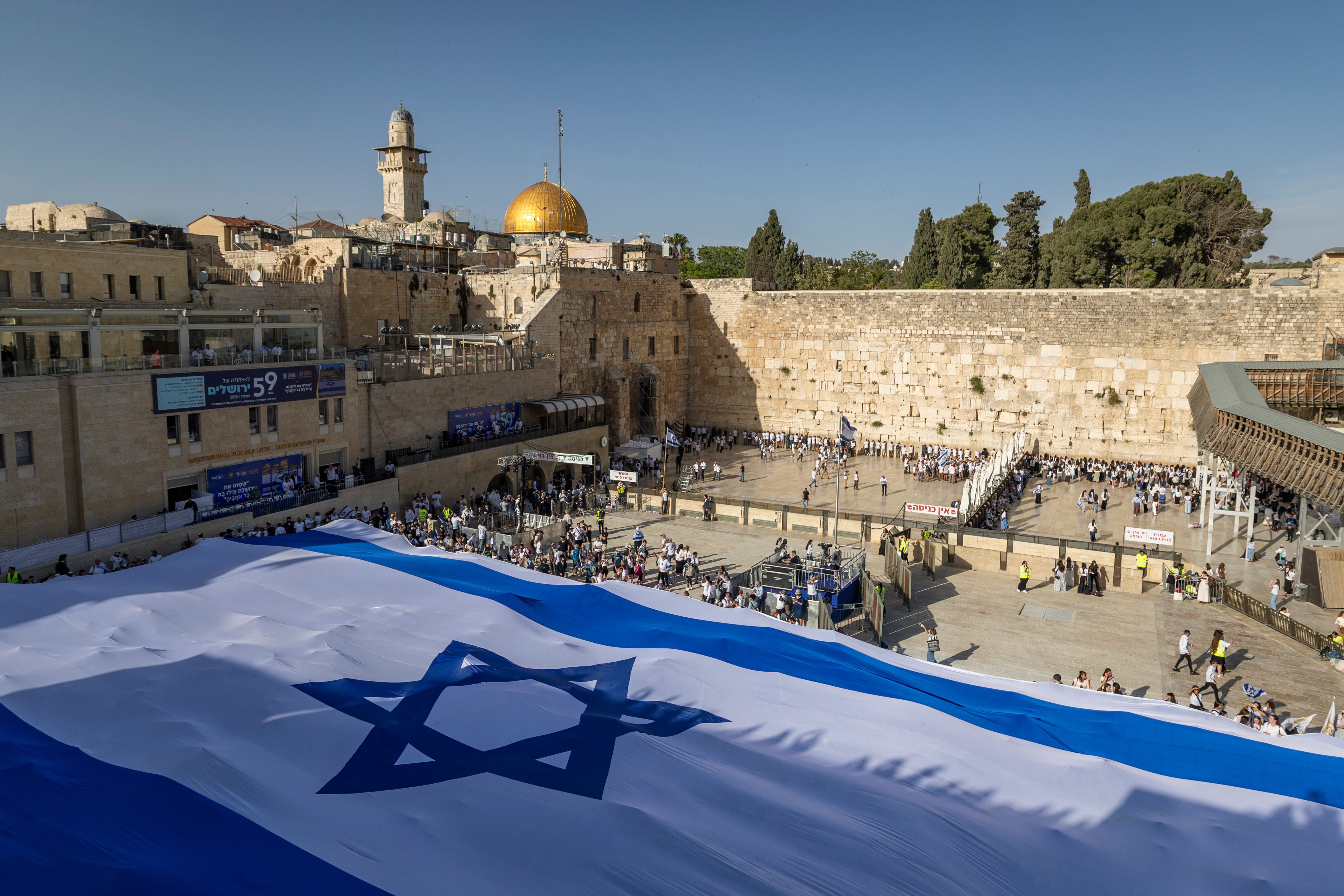
A large Israeli flag at the Western Wall Plaza, Judaism's holiest prayer site, during the annual Jerusalem Day, in Jerusalem's Old City, 14 May 2026 (Yonatan Sindel/Flash90)
It’s Wednesday, June 16, and the bearded man in the black suit signaled the waitress and ordered coffee with milk, perhaps adding a “please.” Time passed; no coffee arrived. When the waitress finally returned, her eyes downcast, she apologized for imposing a kosher diet: he had just eaten goulash. The date was June 1, 1949, and the setting was the oldest and best-known culinary establishment in Israel—a restaurant in no danger of closing despite dubious reviews, a customer base that hasn’t grown in 70 years and no takeout option: the Knesset cafeteria.
The man at the table was Eri Jabotinsky, a member of the First Knesset representing the right-wing Herut and the son of the founding ideologue of Israeli nationalism, Ze’ev Jabotinsky. His late father had been a literary genius, a statesman and a proud secularist. “Prayers and religious customs did not touch my heart,” Eri recalled of his childhood. “The essence of Judaism cannot be boiled down to halakha and the separation of kitchen utensils into meaty and milky tools,” he wrote. His whole life, he was much stricter about separating religion and state than meat and milk. Lurking behind his request for coffee with milk straight after meat was probably something more fundamental than a craving for caffeine.
The State of Israel—and the small Herut faction with it—was born into an identity crisis, torn between two values that each demand primacy over the other. Nationalism treats the state as a technical, secular entity. “The Prayer for the Welfare of the State of Israel,” by contrast, calls it “the beginning of the flowering of our redemption.” One vision is democratic and Israeli; the other is religious and Jewish. The 70 years of Israeli politics that followed are, at bottom, a long argument over which of the two comes first.
The alliance between nationalist and religious parties—some of which are now both at once—has obscured how unfriendly the two once were. Jabotinsky, who imbibed Italian nationalism in his youth, warned of an unavoidable “culture war” with the Haredi element and noted with regret that among Jews “who cling onto difference, many primitive customs have been preserved”—a woman, for instance, “to whom a man does not extend his hand.” David Ben-Gurion’s Mapai, by contrast, understood its limits, and instead of debating theology preferred good old-fashioned compromises: the famous “status quo,” draft exemptions for yeshiva students, government funding for religious institutions—the entire machinery by which a secular state agreed to keep its Jewish question permanently unanswered. “I don’t go to synagogue,” Ben-Gurion said, “but the synagogue that I don’t go to is Orthodox.”
Early Herut chose the opposite. It was bourgeois, extremely Ashkenazi, quite secular and ideologically purist; its founding charter spoke of “the unity of the homeland, the ingathering of exiles, social justice and human liberty” without a single religious tenet, and every one of its representatives in the First Knesset was born in Europe. It did not pay at the polls—it is hard to believe now, but for years the free-spirited Tel Aviv was the stronghold of the right-wing opposition. Menachem Begin himself was the exception inside his own party. Most voters had no idea he never smoked on Shabbat and ate only kosher food; unlike most of his friends he never turned his back on tradition, nor could he understand why Zionism and Judaism were supposed to be in tension. Jabotinsky had treated religion and nationalism as rival values; in Begin’s mind they simply coexisted. Many in his movement thought he reconciled them through cheap populism—”like the screeching of a door,” Jabotinsky said of one of his speeches—but the man who once went on the run from the British disguised as a rabbi named Israel Sassover slipped into the role easily.
A Yemenite family walks through the desert to a reception camp set up by the American Jewish Joint Distribution Committee (JDC) near Aden, 1949. (Zoltan Kluger/Wikimedia Commons.)
For now, none of it mattered: Ben-Gurion ruled from the center, and Herut was beyond the pale, its leader dismissed as “a clearly Hitlerian type.” Begin had not a single supporter among the country’s elite—even in 1977, not one professional broadcaster would appear in the Likud’s election ads. That exclusion mattered more than it looked, because the people the establishment shut out would soon recognize themselves in the man it shut out with them. They were already on their way. Those voters arrived “on eagles’ wings,” as the young country described Jewish immigration from Arab lands. One day in 1965, a Jew stepped off a boat from Morocco—no festive ceremony, his name a mystery to this day—and triggered a quiet upheaval: when he sailed into the harbor, Ashkenazi Jews were still a majority; the moment he disembarked, they became a minority. Israel was still trying to transform these Mizrahim in its great Ashkenazi melting pot. They would soon transform Israel instead.
The seeds had germinated early. When votes were counted for the First Knesset, Mapai was rocked by a scandal: in 10 Mizrahi neighborhoods in Tel Aviv, Herut had won 2,500 of 3,300 votes. The Histadrut declared a day of mourning. To its credit, Mapai did not play politics and continued facilitating the immigration of hundreds of thousands of Mizrahi Jews. To its discredit, it did nothing to curb the racism—a Haaretz article called these immigrants “extremely primitive,” their education bordering on “complete ignorance,” with “no ability whatsoever to absorb anything spiritual.” Once, as a young Army Radio reporter, I asked the first Mizrahi president, Moshe Katsav, for a personal story. He told me how officials threw his family into a transit camp near Haifa in the pouring rain, promised to return the next day for permanent housing and never came back. The president burst into tears and disappeared into his chambers.
Begin’s coalition was built on an axis older and deeper than left and right, and the quickest way to see it is a fact that breaks the usual model. To this day most Mizrahim vote right and most Ashkenazim left, and since 1955 Mizrahi Jews have made up at least 55 percent of Herut and Likud voters—yet in the Sixth Knesset only two of the party’s 26 seats went to Mizrahi lawmakers. For anyone raised on identity politics, where people supposedly vote for people like them, this is baffling. Most right-wing voters come from the Middle East; most right-wing leaders, from the east of Europe. The Likud’s rise to power did nothing to raise the number of Mizrahi ministers, and that fact did nothing to erode Mizrahi support. They were never voting for faces that looked like theirs. They were voting for a story about who they were.
The transit camps explain why. Israel was planned on a European drawing board, a German-speaking, opera-loving extension of Europe in the Levant, and Jabotinsky shared its aversion to all things Eastern. In the ma’abarot there was no electricity and no public library; the residents had never read a word of him. But they loved Begin—not because they imagined he was born in Meknes, but because he did not talk down to them and because they saw in his exclusion the establishment’s contempt for them too. “Yaish Begin! Yaish Begin!” they cheered during his first election campaign. “Don’t they know my name’s Menachem?” wondered Begin, until someone explained that yaish is Arabic for “long live.” They never saw themselves as a “sector,” in any case. In their eyes they are the society. “They don’t want to be liberated from anything,” explained the sociologist Nissim Mizrachi. “They came to Israel because they harbor deep feelings for the Jewish people.”
That was the sentence Labor could never absorb. When it lost these voters it kept changing its faces—the kippah-wearing Avraham Burg, the Moroccan-born Amir Peretz, Avi Gabbay of the transit camp—without ever changing its offer, and Benjamin Netanyahu answered the whole project in a single stroke. The melting pot, he said, was never a neutral civic exercise: it meant boiling and blending every community “until a uniform Israeli pops out.” Then, leaning into the microphone as if sharing a secret: “In fact, you know what they wanted? They wanted us all to be Ashkenazi.” Strip away the joke and the claim is exact—a demand to dissolve the Jewish particular into a generic Israeli.
Celebrations after the Likud’s first victory in 1977, the celebrants are seen holding up a portrait of Menachem Begin. (GPO)
That is the axis Begin organized, and it is why “right-wing” misses it. The phrase surfaces in the newspapers only in the 1980s; had you used it on Begin at a rally he likely would not have known what you meant, his only association with “right” being Betar’s anthem’s promise to reclaim the other bank of the Jordan. When he finally found his story in the early 1970s, it ran along neither the economic axis nor the territorial one. He spoke of a generation unashamed to be Jewish, united by pride, tradition and Jerusalem, and described the nation as a family that welcomed its religious-Zionist relatives, its Haredi relatives and the largest, most silenced branch—those who were simply traditional. In 1973 he gave the family a name that did not merely describe it but shaped it: “the national camp.” A grid of millions who had no idea they belonged to one movement was suddenly electrified.
A generation later the pollster Arthur Finkelstein proved it with arithmetic. Ask where a voter served in the army and a draft exemption could mean an Arab party or a Haredi one—opposite ends of the map. Ask where she lives, and even Tel Aviv gave a third of its votes to the Likud. Ask what she thinks of Netanyahu, and the entire Likud faction except Netanyahu himself would read as far left. Every conventional question fails. Only one works: “How would you define yourself—Jewish or Israeli?” Fully 95 percent who answer “Jewish” are right-wing, and 95 percent who say “Israeli” are on the left.
This is the master key. “Jewish” and “Israeli” are simply the two tenets of Israel’s self-definition as a Jewish and democratic state—not in open contradiction, since most Israelis hold both, but forever rubbing against each other. Like asking whether strawberry-banana yogurt is more strawberry or banana, Israelis are endlessly asked, in one disguise or another, whether they are slightly more Jewish than democratic or the reverse. Once you see it, most of the news in the country—most push notifications, most studio shouting matches—dissolves into that same question, with a thin veneer of fresh event on top.
The 34th Israeli government in the presence of President Reuven Rivlin and Prime Minister Benjamin Netanyahu. (Avi Ohayon/GPO Israel)
Watch it surface. In October 2020, Israel became the first country in the world plunged into a second coronavirus lockdown. Only to an untrained eye did the news debate public health. On the surface it argued about banning protests outside the prime minister’s residence, the Haredi pilgrimage to Uman and mass prayer over the High Holy Days; underneath ran a single question of which value was supreme—the democratic freedom of protest, or the Jewish freedom of worship. Before the pandemic, three consecutive Knessets had crashed over Haredi enlistment, which was never really about manpower but about which value outranks the other: Torah study, in whose name yeshiva students are exempted, or equality, in whose name they would be conscripted. The 2018 Nation-State Law set off the same firestorm—did it grant the state’s Jewishness legal precedence over its democratic character, or was it merely the right’s belated entry onto a constitutional field still controlled by the left and an activist Supreme Court? Even the parties’ names give the game away: on the right, “Jewish Home” and “United Torah Judaism”; on the left, the Democratic Front for Peace and Equality and the Democratic Union. Could anything be clearer?
The geography says it too. During the endless election cycle of 2019–2021, my colleague Avishay Ben-Haim noticed that the close national results hid a chasm: in Beit She’an, Netivot, Dimona and Kiryat Shemona the right won crushing majorities near 90 percent, while in Ramat HaSharon, Raanana and north Tel Aviv the center-left enjoyed the same dominance in reverse. He concluded that Israel is already “two states for two peoples”—a secular, established, Ashkenazi “First Israel” that loathes Netanyahu, and a poor, Mizrahi, religious “Second Israel” that reveres him. The theory is elegant but leaks: the Arabs are hardly Ashkenazi and live deep in the periphery, yet vote the opposite way; the religious-Zionist community is mostly Ashkenazi, well-off and central, yet has anchored the right since 1977; and if distance from Tel Aviv were the variable, why is Sderot solidly right-wing while the kibbutzim beside it are strongholds of the left? The cleaner variable is not class or geography but attachment to Judaism. The more strongly Jews in Israel identify as religious, the more firmly they sit in the national camp—Haredim first, then religious Zionists, then Likud and Yisrael Beiteinu, with Meretz at the far end. Put it as a hypothesis: the more synagogues in a neighborhood, the more right-wing voters live there. In Bnei Brak, a synagogue on every corner, almost 100 percent side with the national camp; in Umm al-Fahm, which has none, the left won 99.63 percent of the vote in 2020.
Anti-judicial overhaul demonstrators block a road during a protest against the judicial overhaul near Yokneam, July 18, 2023. (Anat Hermony/Flash90)
And then came the loudest disguise of all. Seventy-five years after the founding, with five elections in four years behind them, many Israelis began to wonder aloud whether the country could remain one country. The spark was a judicial reform—the courts’ power to strike down government decisions as “unreasonable,” the makeup of the committee that picks the judges—technical stuff that had until then interested a few dozen lawyers. Yet the Ayalon, Tel Aviv’s main artery, was blocked nearly every night; reservists threatened to stop showing up; capital fled the country; protest met furious counterprotest. What was all that hatred about—not only between supporters and opponents of the reform, but between religious and secular, right and left, Jerusalem and Tel Aviv? The same thing it is always about. This was simply the question at full volume, and it is worth hearing both sides make their case, because each is genuinely persuasive.
To the right, democracy is only the operating system; the content is what matters, and the content is that Israel is the one Jewish state on earth—the reason Jews came to the land of the Bible rather than take up the offers of Uganda or Argentina, both once seriously entertained. Dilute that even slightly—a bus running on Shabbat, one more step toward becoming a generic liberal democracy like Sweden or Finland—and you risk the fate of the Crusaders, who also arrived from Europe driven by faith, also fought off Islamic armies for two centuries and then broke and sailed home. The difference, the right warns, is that no continent is keeping a place for our return. Convincing? Certainly. But so is the opposing view.
Of course we are Jewish, the left answers—the flag is essentially a prayer shawl, the emblem is the Temple menorah, every kindergartner comes home Friday with a challah—but that is the décor, not the purpose; the purpose is to be the only democracy in the Middle East. Compromise that, strip the reasonableness doctrine, let religion set the terms of belonging, and the cautionary tale is not the Crusaders but Lebanon, once the “Switzerland of the Middle East,” with its ski slopes and fine restaurants while Israel still had transit camps and camels—until it slid toward fundamentalism and the rest is history. Two warnings, two Europes that came to the Levant and fell, the same dread aimed in opposite directions.
A campaign poster from the 1996 election that reads “Netanyahu – Making a Secure Peace.”
None of this was new. When Netanyahu first rose in 1996, he drove a retrofitted car built on Begin’s frame. His tested slogan, “Making a Secure Peace,” is forgotten; the one that actually won was never run past a focus group—”Netanyahu: Good for the Jews,” an impromptu Chabad initiative from the campaign’s last week. The morning after his razor-thin victory, Shimon Peres arrived at the office at 7 a.m. and summed up the night in five words: “The Jews defeated the Israelis.” He understood that the Oslo Accords and the suicide bombings were only disguising the real contest. The accords’ own architect, Ron Pundak, admitted it: “I want peace because I want there to be a sense of Israeliness… the Israelization of our society instead of its Judaization.” A decade later Yair Lapid wrote the same of the Gaza disengagement: “It was not despite the settlers but because of them. It was never about the Palestinians.”
Begin had grasped all this a generation earlier, and in 1977 he built for permanence. The costs were high. For the first time the education portfolio—the ministry that forms the next generation’s sense of who it is—went to a religious party. The Haredim, kept out of coalitions since 1951, were brought through the front door; in exchange Begin scrapped the cap on yeshiva exemptions and grounded El Al on Shabbat. Overnight they became kingmakers, and Israeli elections became, in time, a contest over who would get to govern with them. Asked, before taking office, what kind of prime minister he meant to be, Begin gave the answer that named the whole project: “The good Jewish kind.”
The camp would later adopt a son Begin never met: 1 million immigrants from the former Soviet Union. They complicated the picture precisely because they scrambled the two axes. Intensely nationalistic—opposed to withdrawals, distrustful of the Arabs—they were also emphatically secular, championing civil marriage and Shabbat buses and driving a surge in pork sales. They were far more Israeli than Jewish in Finkelstein’s sense, which is why their loyalty to the camp was always conditional. Jabotinsky would have felt at home among them; his religious heirs less so. When the territorial argument faded and a personal feud with Netanyahu pushed Avigdor Lieberman out, he took 150,000 voters with him, and they have drifted toward the secular Lapid ever since—proof that the camp coheres around Jewishness, not nationalism alone. For 30 years, whoever won the Russian vote won the election, because the Russians are the one bloc that sits astride the fault line rather than on one side of it.
Begin’s national camp outlived him, and outlived even the alliance it had formed against. It also outlived what looked like its load-bearing wall: opposition to territorial concessions. Begin himself pulled out of Sinai; Netanyahu signed at Wye River; the Likud divided Hebron and uprooted settlements in Gaza and northern Samaria. The camp absorbed every one of these without collapsing—because the territories were never the foundation. They were a consequence. The right’s attachment to Judea and Samaria flows from a powerful sense of Jewish identity, not the reverse, and an identity can survive the loss of any particular piece of ground in a way that a coalition built on the ground itself could not.
Opponents and supporters judicial reform can be seen holding hands in solidarity, 2023.
The contradictions were always there—the demand that the state stay out of private life sits awkwardly beside budgets for synagogues and the rabbinate’s monopoly on marriage—but Begin dissolved them by force of personality, just as he outflanked Labor on the right with the free market and on the left with welfare. Internal contradictions do not always sink a winning coalition. When the thing holding it together is an answer to “Jewish or Israeli,” they can even be its signature.
If all of this holds, it tells you something about the leader Israel will eventually turn to. I cannot predict who will lead Israel through the long healing after the trauma of October 7, the war and the societal rift. But like in police work, I can at least sketch a profile, and the profile is almost defiantly unglamorous: unremarkable, low on charisma and boring—more radish than cilantro. Right-leaning on security, capitalist on the economy, traditional in observance, liberal in civic outlook and an enthusiast of broad governments where minority shareholders cannot seize control of the company. A center-right or right-center figure, in other words, sitting exactly where most Israelis already sit.
Take the two men now circling the job. Gadi Eisenkot—son of Moroccan immigrants, raised in a development town on the periphery before rising to chief of the general staff—sits on the center-left. Netanyahu—the most patrician quarter of Jerusalem, the son of a Hebrew University professor—leads the national camp, and with it the very periphery Eisenkot was born into. On the old ethnic map the two are standing on each other’s squares. The Mizrahi general from the edge of the country and the professor’s son from the capital were never going to be sorted by their grandfathers. They are sorted by the one question that has ever counted—Jewish or Israeli.
English Editor: Ari Tatarka
If you enjoy the newsletter, you can show your support by becoming a paid subscriber—it really helps keep this going. I’m also offering a special monthly briefing for a small group of premium members. I’d love to have you join us—just click below to find out more.
Thanks for reading It’s Noon in Israel! Subscribe for free to receive new posts and support my work.


The most absolutely brilliant summation, that must be read and debated in the hearts of every Jew who looks to Israel as our heart, and Zionism as our salvation in the antisemitic diaspora. And painful to listen to, while being totally captivating. It’s painful to this New Jersey diaspora Jew, who still dreams the Zionist dream of the pioneers of the Palmach, of the hero’s of ‘48 and ‘67. But I’m also a conservative Jew who was a militant secular Zionist as a teenager and now in middle age beginning to go to my conservative shul on Shabbat, study Tanya with the local Chabad Rabbi and occasionally even lay tefillin. The Zionist dream of the pioneers that I was raised on may have been a mirage, propaganda taught to us. The reality was the Altadena, whose painful fault line is so brilliantly told in Amit’s incredible, insightful, writing. I will listen and read everything this man says - on Call me Back, in his books, and his daily It’s Noon in Israel. Kol Ha Kavod Amit. Yasher Koach!!!
thank you for explaining this so well.
its actually the same tension diaspora jews are feeling right now.
its not easy to be a jew connected to Torah but that is our destiny as nation. Fighting it rather than trying to embrace it is not working out too well.
im not advocating for a theocratic government.
what one does in private is between that person and God
the public face reflects on Jews in Israel and around the world
before Yom Kippur I see the pride on social media when Ben Gurion Airport closes for 25 hours.
God promises us prosperity in all things if we sanctify the Sabbath every week
that in no way means forcing ppl to keep the Shabbat completely
the tension between the two will have to be resolved somehow- I guess that's the leap of faith
maybe it can be done by some other mechanism in addition to the elections
we jews are our own worst enemies and that's saying a lot