The 10 Commandments of Israeli Politics: Commandment II: Thou Shalt Not Ignore the Russians
The overlooked kingmakers who permanently reshaped the balance of power in the country and the region.
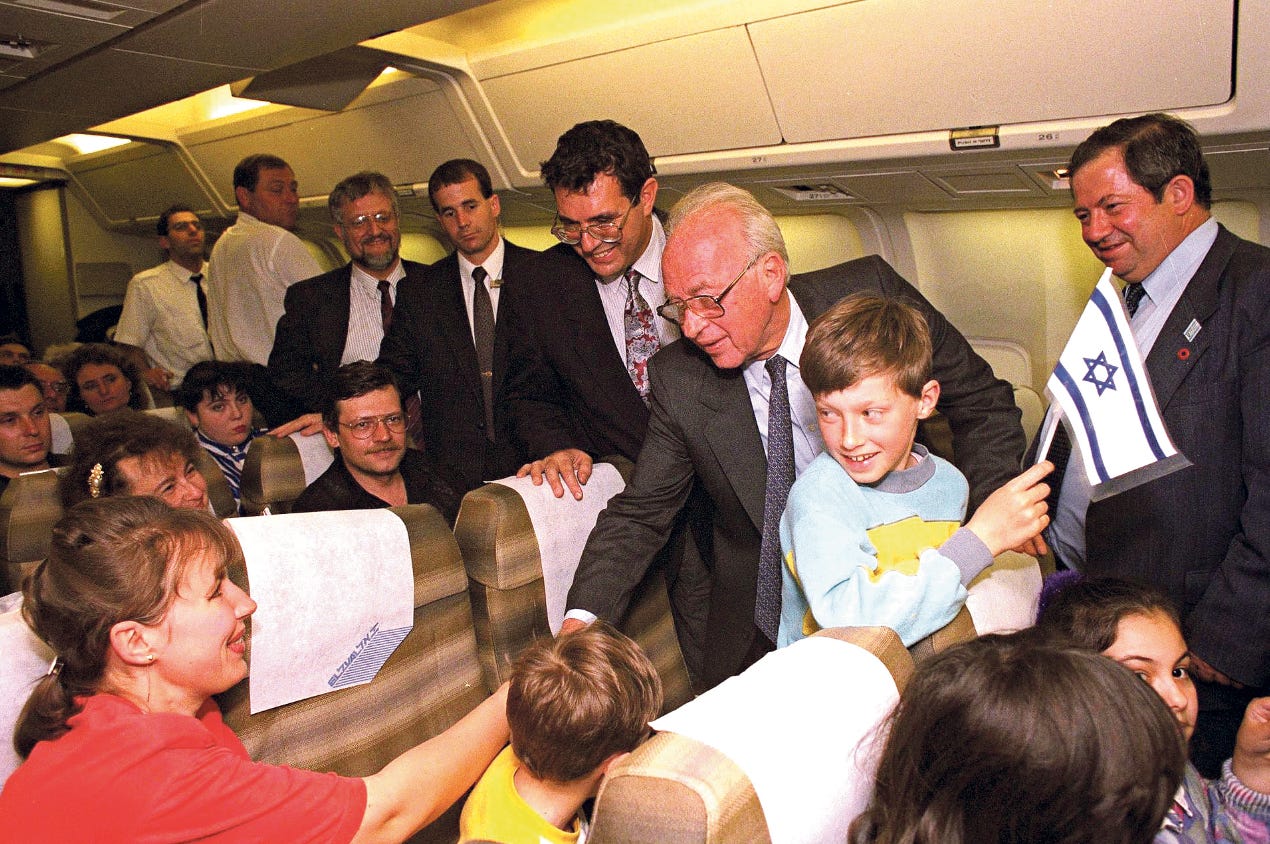
Prime Minister Yitzhak Rabin welcomes Russian immigrants in April 1994.
It’s Wednesday, May 27, and we're taking a quick break from our usual format to continue our series: The 10 Commandments of Israeli Politics.
I want to take you back to what it felt like growing up as a child when the massive wave of immigration from the former Soviet Union broke over Israel. At the beginning of the 1990s, it felt as if someone had abruptly switched on a giant air conditioning system in the middle of the country, blowing in an entirely different kind of air. During that first winter, when so many new immigrants arrived, it also happened to snow across the entire country. It was as if someone had orchestrated a festive, freezing welcome just to help them acclimate, so they wouldn’t realize that under normal circumstances Israel’s usual weather hovers around 35 degrees Celsius with 90 percent humidity.
Suddenly, entirely different sounds and melodies filled the country. Russian subtitles started appearing on television. Until then, everything had been broadcast in Hebrew, Arabic, and occasionally English, but suddenly Russian characters and speech occupied storefront signs, television screens, and radio waves. A Russian-language radio station appeared out of nowhere. New and strange products appeared on supermarket shelves.
Then the children arrived at the schools—two in a class, three in a class, sometimes a lone child in a classroom or two in a kindergarten, arriving from a completely different world with entirely different customs. It is incredible to look back and remember how some of them spoke no Hebrew at all; they would sit quietly on the side while everyone rallied to help them. Even if it did not always look smooth from the outside, with historical perspective we can state that the immigration from the former Soviet Union was the most successfully integrated wave of aliyah in the history of the state.
The first generation always faces an uphill battle. Every Israeli is familiar with the classic, painful stories of the Soviet engineer who had to work as a security guard, the doctor who became a cleaner or the first chair in the Moscow Orchestra teaching children out of their government-sponsored apartment. Yet, in the blink of an eye, the per-capita income of this community caught up with the general population, and in some sectors, surpassed it. One of the most astonishing statistics about modern Israel is that today, the demographic group with the highest rate of homeownership in the entire country is post-Soviet immigrants. The very first thing they did upon landing was buy a home. Thirty years have passed, the mortgages are paid off, and suddenly they possess generational wealth, completely outpacing the veteran lineages that preceded them.
On the political stage, the impact of this immigration was even more dramatic. It begins with a historical decision that reshaped Israel’s entire defense paradigm: Yitzhak Shamir’s determination to bring over 1 million Soviet Jews.
When a prime minister assumes office, the most vital skill they must possess is the ability to distinguish between what is crucial and what is trivial. That sounds remarkably easy in theory, but when you sit in the Prime Minister’s Office, the “trivial” side of the ledger often consists of highly dramatic, high-stakes events. A leader must look at things that are superficially critical and deliberately decide they are secondary to the supreme national mission.
As a modern parallel, Prime Minister Benjamin Netanyahu would argue that he released over a thousand terrorists in the Gilad Shalit deal because his primary focus had to remain squarely on the Iranian nuclear threat. For Yitzhak Shamir, the single most important mission of his entire life was the absorption of immigration—the historic opportunity to bring 1 million Jews from the crumbling Soviet Union to Israel.
How do you pull off a feat like that? Israel in the early 1990s was an underdeveloped economy with virtually no supermarkets, a low GDP, and truth be told, very little material comfort to offer. This was especially challenging given the historical precedent of massive waves of Russian migration heading directly to the United States. Why wouldn’t a Soviet immigrant simply board the first available flight and head for New York?
The remarkable answer, beyond raw Zionism, is that they were structurally prevented from doing so. Shamir quietly coordinated with the U.S. government to ensure Washington would not grant them refugee status. Consequently, nearly 1 million people were directed to Israel. While a large portion would have chosen Israel regardless, Shamir’s maneuver ensured almost the entire wave arrived on Israeli shores.
Achieving this required maintaining pristine relations with Washington. However, the United States soon demanded something more dramatic from Shamir. When the Gulf War erupted following Iraq’s invasion of Kuwait, the Bush administration was desperate to stop Saddam Hussein. To do so, Washington assembled an unprecedented international coalition that included Britain, France, Belgium, Germany, and, significantly, Arab nations like Syria and Egypt. This marked the first time in history that Arab states participated in a military campaign against another Arab state. Their non-negotiable condition for joining? The State of Israel could not be part of the coalition.
Patriot missiles being launched to intercept an Iraqi Scud missile over Tel Aviv. (GPO)
Soon after, Saddam Hussein began launching Scud missiles directly at Israeli cities. At the time, Israel had no Iron Dome, Arrow, or David’s Sling defense systems. As the missiles fell, domestic pressure on the government reached a boiling point. Yet, Yitzhak Shamir chose a policy of absolute restraint. He absorbed savage criticism in the press, furious pushback from inside his own cabinet, and open revolt from his ministers and voters. Many political analysts still argue that this restraint was the primary reason Shamir lost the election two years later; the Likud—whose entire brand was built on slogans like “Only Likud Can” and “Strong on Security”—appeared to have folded under fire.
What Shamir never told the public was that there was a grand strategic calculation behind his restraint. He endured the short-term political bleeding to secure the long-term demographic balance of the State of Israel once and for all. A country that experts predicted would have an Arab majority by the year 2000 was permanently saved by the arrival of 1 million people who fundamentally transformed the Middle East. This influx forced the surrounding Arab world to internalize that Israel was not a transient phenomenon; it was a permanent fixture capable of receiving a massive, high-caliber injection of engineers, doctors, and technicians that propelled its society forward.
Shamir’s government collapsed in 1992, and he was sent home. Who voted him out? Ironically, it was the very Soviet immigrants he had worked so hard to bring to the country. During that historic political upheaval, legendary pollster Mina Tzemach printed a portion of her exit poll ballots in Russian. She colored them distinctively so she could track exactly how this largely un-sampled, unpredictable, and newly arrived million-strong electorate was voting. The result was an overwhelming landslide: the post-Soviet community voted decisively for Yitzhak Rabin and the Labor Party, handing them the largest electoral victory in their history—and effectively their last major triumph.
This outcome introduces an incredible historical irony, but it also reveals a fascinating sociological pattern regarding political behavior. Generally speaking, individuals fleeing left-wing authoritarian regimes tend to vote for the political Right, while those fleeing right-wing dictatorships gravitate toward the Left.
Every prominent Argentinian-born Israeli politician to sit in the Knesset—figures like Haim Jelin or Manuel Trajtenberg—joined the Labor Party or Yesh Atid. They arrived with scars from a right-wing military junta, carrying a firm conviction that right-wing nationalism is inherently dangerous. Conversely, the vast majority of those fleeing a left-wing totalitarian system like the Soviet Union naturally lean toward the nationalist Right—much like how Cuban refugees in the United States overwhelmingly anchor the Republican Party in Florida.
By that logic, the post-Soviet electorate in Israel should have been natural voters for the political Right from day one. But the defining question of Israeli political history is: what exactly constitutes the “Right”?
The bellwether of modern Israeli politics is the post-Soviet immigrant community. If you want to know who will win an election in Israel, you simply check which way this community is leaning. It functions like clockwork, yet this electorate remains a strange, unacknowledged kingmaker.
In 1992, they voted overwhelmingly for the Labor candidate Rabin because they did not see a leftist ideologue; they saw the legendary IDF Chief of Staff from the Six-Day War—the ultimate, trusted security figure. Between 1992 and 1996, however, the Oslo Accords shattered that security paradigm.
To understand what changed, we must analyze the structural foundations of the Israeli Right. Nominally, the right-wing camp is organized around hawkish defense policies and territorial maximalism. But when Menachem Begin founded the modern national bloc in 1977, he introduced a deeper element, declaring that he would lead the country “in a good Jewish style.”
Begin signaled that the true gravity of the Israeli Right was not merely about borders or the future of the settlements; it was anchored fundamentally to traditional identity. The metric of the Right became less about your distance from Yasser Arafat and more about your proximity to the local synagogue.
Celebrations after the Likud’s first victory in 1977, the celebrants are seen holding up a portrait of Menachem Begin. (GPO)
The national camp that Begin constructed relied on three specific demographic pillars: the ultra-Orthodox, the religious Zionists, and the traditionalist working-class voters of the periphery. When the post-Soviet immigrants arrived, they shared almost nothing with this traditionalist, religious identity. The vast majority of these immigrants held deeply secular, civic, and socially liberal views that sat far to the left of the Israeli mainstream. The fierce domestic culture wars over the sale of non-kosher meat or public transportation on the Sabbath expanded in direct proportion to the growth of the community.
Why, then, did this deeply secular community align with Benjamin Netanyahu in 1996, allowing him to defeat Shimon Peres by a fraction of a percent? Why did the famous refusenik Natan Sharansky’s Russian immigrant party, Yisrael BaAliyah, hitch its wagon to the religious Right?
The answer is that in the Israel of the 1990s, the post-Soviet community viewed the territorial and security crisis as the supreme, immediate issue facing the state. To secure the country in the wake of devastating suicide bombings, they were entirely willing to sacrifice their secular lifestyle preferences on the altar of hawkish defense policy.
Yet this alignment remained volatile. In 1992, they voted for Rabin on security grounds. In 1996, amid terror waves, they swung to Netanyahu. But between 1996 and 1999, Netanyahu delivered a period of remarkable security. In politics, when you successfully resolve an existential problem, you rarely receive long-term credit for it; the problem is simply forgotten by the electorate. If a leader breaks a hyperinflationary spiral, handles an intifada, or imports millions of vaccines during a pandemic, the public immediately pivots to the next grievance. Because of the security quiet of 1999, the post-Soviet community felt safe enough to prioritize their secular civic grievances, and Labor’s candidate, Ehud Barak, ran a brilliant campaign targeting those exact vulnerabilities.
Barak promised them sweeping reforms on religion and state, vowing that the ultra-Orthodox party, Shas, would no longer hold the keys to the government. Sharansky, sensing his base’s frustration, launched his famous, hyper-aggressive campaign slogan: “Shas Control or Nash Control?” The slogan was so culturally resonant that Tel Aviv DJs turned the campaign audio into a popular electronic remix played in nightclubs. Sharansky was effectively declaring that while his party belonged to the right-wing camp, they were its fiercely independent, secular stepchildren.
Palestinian rioters confronting security forces, at “Ayosh” Junction, near Ramallah. (IDF)
By 2003, with the Second Intifada raging in the streets, the pendulum swung violently back to security. The community abandoned the Left, backing Ariel Sharon and aligning with Avigdor Lieberman’s Yisrael Beiteinu, which ran on a joint ticket with the hard-line National Union—factions that included the ideological forebears of today’s radical religious right. I vividly remember riding in a campaign car with Lieberman in 2003; the vehicle contained Lieberman, two Orthodox rabbis, and a collection of Druze activists, all campaigning for a party founded by the heterodox nationalist Rehavam Ze’evi. It was a bizarre sociological mixture, made possible exclusively because the overriding national issue was the war on terror.
When Sharon split the Likud to form the centrist Kadima party in 2006, he recognized this dynamic perfectly. He delivered his very first major policy address not in Hebrew, but in Russian, declaring that Kadima would become the permanent political home of the immigrant community, reserving seven of the top 27 spots on his legislative list for them. Sharon understood that just as traditionalists anchored the Likud, immigrants were the indispensable pivot of Israeli governance. But when Sharon fell into a coma, his successor failed to grasp this delicate chemistry, stripping the community of senior ministerial portfolios and abandoning the sector, with predictable electoral results.
U.S. Secretary of State Condoleezza Rice (R) meets Israel 's Minister of Strategic Affairs Avigdor Lieberman, 2007. (Orel Cohen/Flash90)
From 2009 onward, the post-Soviet community voted overwhelmingly and consistently for the right-wing bloc, anchoring Netanyahu in power for over a decade. This combination—the three religious-traditionalist pillars plus the massive immigrant vote—created an invincible electoral fortress. It looked like political checkmate; the Left simply had no mathematical path to victory.
But then, a profound shift occurred within the defense paradigm. A decade of relative security quiet convinced the Israeli mainstream that the historic debate over the Israeli-Palestinian conflict had been decisively settled. The public no longer believed in the viability of a peace agreement; a conventional war, two bloody intifadas, and the catastrophic structural failures of the unilateral withdrawals from Lebanon and Gaza had pushed the entire country to the right. 70 to 75 Knesset seats now routinely identified as hawkish. To put this ideological consensus in perspective, data from the Central Bureau of Statistics reveals that more Israelis identify as vegan (9 percent) than as politically left-wing (7 percent)—meaning there are tens of thousands of cauliflower-loving voters anchoring the national center-right.
In conventional life, when a bitter argument is finally settled, the parties shake hands and grab a beer. In politics, the moment one great debate dies, an entirely new conflict immediately rushes to fill the vacuum. Writing about this transition was the ultimate challenge of my book, because if you only watch the nightly news, you can easily fall into the trap of believing that modern Israeli politics is merely a soap opera of toxic personal vendettas: Avigdor Lieberman hates Netanyahu, Netanyahu loathes Naftali Bennett, Bennett is furious with Yair Lapid, and Lapid is fighting with everyone else.
While political science texts will point to deep ideological currents running through the historic Labor and Likud movements, the truth is a volatile combination of both. The raw personal hatreds dominating the headlines are simply the visible tips of deep, tectonic plates grinding against one another underneath Israeli society. The political evolution of the post-Soviet community is the textbook proof of this phenomenon.
The moment the security debate faded into a consensus, it became clear that despite a shared hawkishness on foreign policy, Israel was plunging into a paralyzing political vacuum. The country endured five consecutive election campaigns in less than four years, entirely unable to form a stable government.
The superficial explanation is to blame it entirely on the polarizing persona of Benjamin Netanyahu. But Netanyahu and his opponents are merely vessels for much deeper social currents. The structural collapse of the political system began precisely five years ago, when Avigdor Lieberman walked away from Netanyahu’s right-wing coalition, triggering the endless cycle of repeat elections.
Did the entire state slide into chaos because Lieberman believed Netanyahu had hired private investigators to tail his children, or because Netanyahu believed Lieberman had cut a backroom deal with the State Attorney’s Office to destroy him? Absolutely not. When Naftali Bennett later abandoned Netanyahu to form the “Change Government,” his voters felt betrayed and abandoned him; he did not even dare run in the subsequent election because he knew he would fail to cross the electoral threshold. But when Lieberman abandoned Netanyahu, his poll numbers actually went up, and his base solidified behind him. Why? Because of the shift in the core issue.
Lieberman looked at his community and changed the target. To speak bluntly, under the old political paradigm, the post-Soviet secular community and the traditionalist Right shared a common adversary in the Arab national movement. But with that debate paused, the old alliance evaporated, and the new target became the structural privileges of the ultra-Orthodox.
Translated into polite political prose, the defining issue of the state had officially shifted from borders and defense to the battle over religion and state. The secular immigrant woke up, looked around the right-wing coalition cabin, and asked: What on earth do I have in common with the ultra-Orthodox, the religious Zionists, and the Hassidim?
On the burning issues of civic marriages, public transit on Shabbat, and universal conscription, they shared absolutely no common ground. Sociologically and culturally, they felt an infinitely more natural alignment with secular center-left figures like Yair Lapid, and Labor’s Merav Michaeli.
This explains why, when the country split wide open over the judicial reform, Avigdor Lieberman immediately positioned himself at the absolute forefront of the anti-reform protests. Lieberman is certainly no historical champion of the Israeli judiciary; alongside Netanyahu, he is the most heavily investigated public figure in the history of Israeli law enforcement. But his base understood that the battle over the High Court was never actually an abstract debate over constitutional jurisprudence or institutional checks and balances. It was a proxy war over core civilizational values: whether Israel will evolve into a more liberal, democratic, secular state, or a more traditional, insular, religious one.
Recently resigned from the Defense Ministry, Avigdor Liberman, and Prime Minister Benjamin Netanyahu seen at the Israeli parliament on November 19, 2018. (Hadas Parush/Flash90)
The moment Lieberman walked away, the traditional Right lost its mathematical path to a stable majority. Then came the cataclysm of October 7. The historic seesaw of the post-Soviet voter remains the ultimate engine of our political reality: voting for Rabin in 1992, swinging right to Netanyahu in 1996, reverting to Barak in 1999, backing Sharon in 2003, moving left with Kadima in 2006, anchoring Netanyahu in 2009, and crossing over to the opposition with Lieberman.
Today, as the nation stands deep in the post-October 7 landscape, this community faces its most decisive choice. Even though the original generation is aging and the younger, “one-and-a-half” and second generations have completely integrated as native-born sabras who no longer watch Russian television or read immigrant newspapers, their unique sociological values still hold the keys to the kingdom. Whether this decisive electorate prioritizes the grim, hawkish security imperatives of the right-wing camp, or determines that the existential battle over the internal identity of the state must take precedence, will ultimately dictate who leads the State of Israel into the future.
English Editor: Ari Tatarka
If you enjoy the newsletter, you can show your support by becoming a paid subscriber—it really helps keep this going. I’m also offering a special monthly briefing for a small group of premium members. I’d love to have you join us—just click below to find out more.
Thanks for reading It’s Noon in Israel! Subscribe for free to receive new posts and support my work.


"while everyone rallied to help them"
One sentence that crystallizes the extraordinary solidarity built into Israeli society and explains how the Israeli people were able to recover and respond to Oct 7 in such an... extraordinary way.
Might also make mention of the fight over "Loan Guarantees" and the "cool" relations between Bush and Shamir (and Sharon). And in part Yitzhak Rabin's win over Shamir was due to Israelis' concern over the US-Israel relationship.