


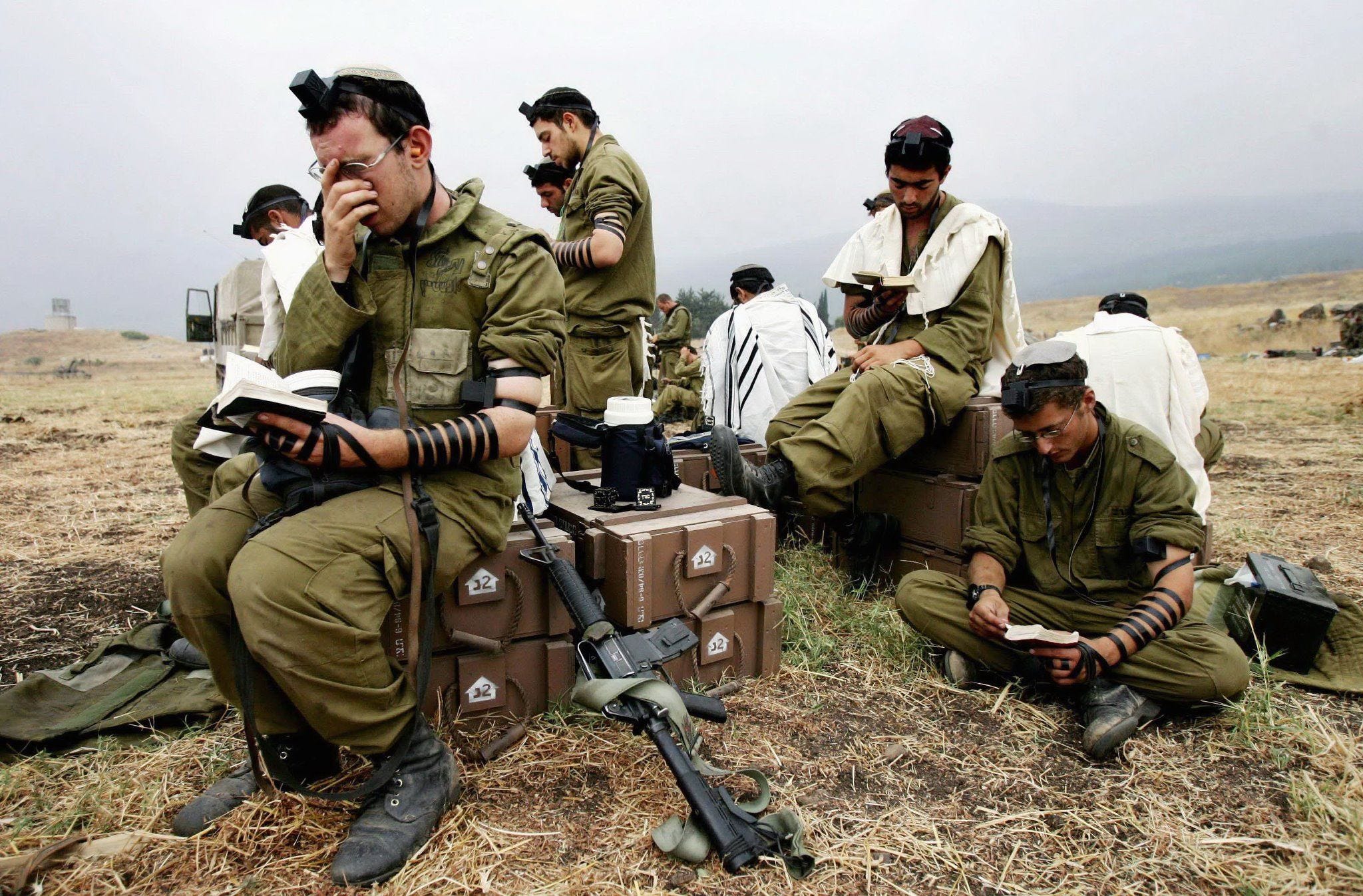
Israeli Defense Forces soldiers pause for morning prayers in a field during the 2006 Second Lebanon War. (Yoav Lemmer/AFP)
It’s Wednesday, October 14, and on the night of November 29, 1947, Jerusalem celebrated. Despite war clearly visible on the horizon, the United Nations had voted to partition the Land of Israel, and after nearly 1,900 years the Jews were getting a state. Thousands filled the streets.
The head of the Jewish government, David Ben-Gurion, was sitting quietly in a hotel by the Dead Sea, alone with his thoughts and a diary, thinking of the struggle to come. Meanwhile, Rabbi Tzvi Yehuda Kook, son of the first chief rabbi of Mandatory Palestine and one of the founding fathers of the religious Zionist movement, wandered through the Jerusalem celebrations like a man at a funeral, muttering a verse from the prophet Joel over and over: “they divided my land.”
Twenty years later, his land would be reunited. Seven years after that, his students went out to settle it, against the will of the government, the army and much of the country. Within another decade they had helped topple the party that founded the state, and the decade after that, they went to war with the state itself.
The knitted-kippah-wearing movement has morphed significantly throughout the state but not in the way most would assume. On the land question, the movement barely moved in 70 years: it wanted all of it in 1947, and it wants all of it now. What truly changed, violently and repeatedly, was the movement’s relationship to the state itself, to the secular elite that built it and to its own leaders.
At the core of the movement is an observation made by Tzvi Yehuda’s father, Abraham Isaac Kook, in the 1920s: there are three forces wrestling within the Jewish camp—the Orthodox, the nationalist and the universalist. Religious Zionism is the only Israeli sector that feels the pull of all three at once. The Haredim live with one pole, and secular Israelis are pulled by two, whereas religious Zionists face a three-body problem.
Precisely because they hold all three poles, religious Zionists view themselves as the UberZionists. Secular Zionism forgot the tradition that kept the longing for Zion alive through two millennia of exile. The Haredim had never cared for nationalism or the wider world. Who, then, is best suited to lead?
Their ambition is belied by their history; for decades religious Zionists were a marginal partner in a Zionist project led by secular socialists, and they knew it. They were junior in settlement, junior in security, junior in culture. Today, although they make up only around 10 seats’ worth of voters, six leaders of the major parties in the upcoming election wear the knitted kippah—where they once lamented the lack of representation on Likud’s list of top 30 spots, they now constitute almost all of former IDF chief of staff Gadi Eisenkot’s top 10; yet they still suffer from feelings of inadequacy.
The political history of religious Zionism is a long attempt to maximize the three poles of its identity. In practice, one pole, the nationalist, has been the center of gravity while the other two take turns pulling on the movement’s shirt sleeve weakly in the other direction. But that nationalism has taken multiple forms, tinged by religious passion; the actions of religious Zionists have often been defined by how they relate to the state: whether it is sacred, conditional or simply suspect. As they increasingly make up the elite of the state, how they answer this question will affect far more than those whose kippot are knitted.
Let us start at the beginning.
The movement was born in dissent. Breaking from the majority Orthodox opposition to the Zionist movement, the founders of Merkaz Ruchani (“Spiritual Center,” shortened to Mizrachi) believed that building the land alongside heretical secular Zionists was permitted and perhaps required as part of God’s plan for history.
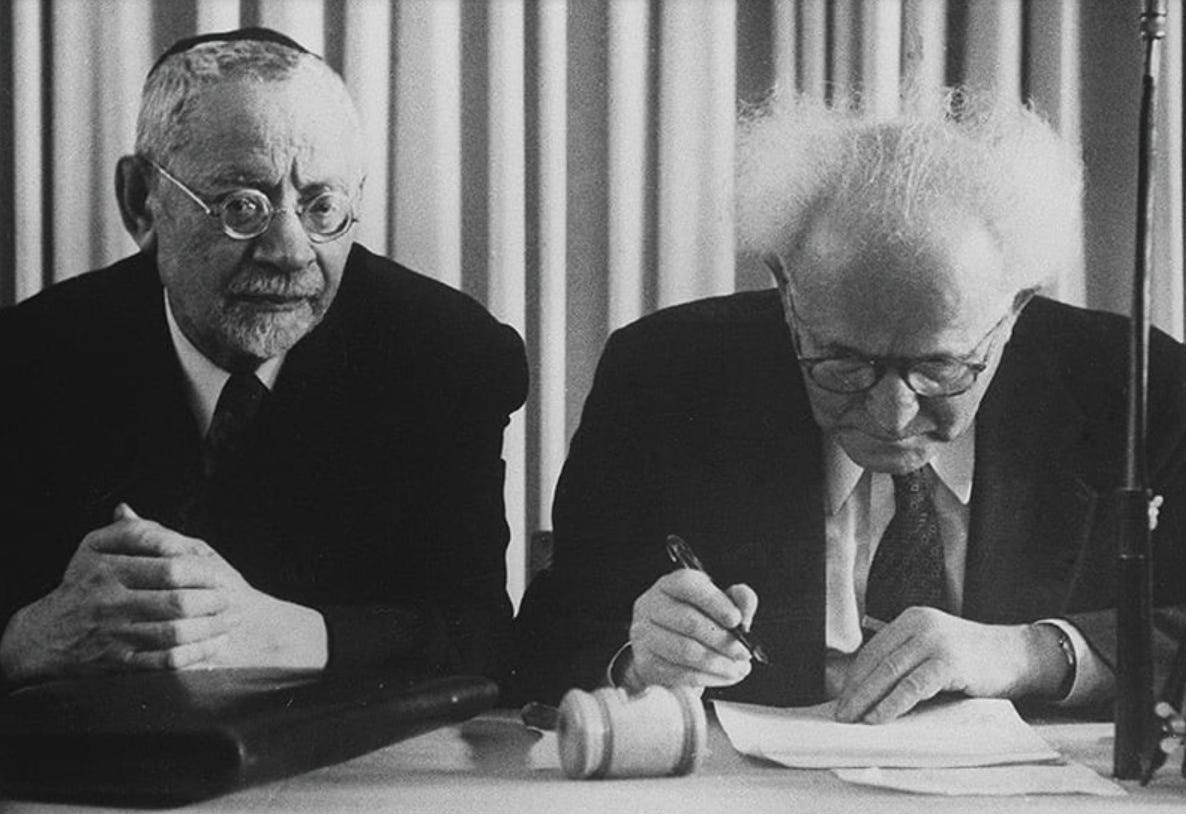
David Ben-Gurion signs the Declaration of Independence on May 14, 1948. Sitting beside him: Rabbi Yehuda Leib Maimon. (GPO)
As such, they worked well with Mapai in the days preceding and following the establishment of the state. In Israel’s first two decades, religious Zionists happily rode in the kosher-supervisor’s carriage of Israeli politics. Their job was to keep the state Jewish enough for its religious citizens to live in it, and to secure budgets for religious schools and synagogues. They were not expected to drive the train, and for the most part they didn’t try.
The arrangement suited David Ben-Gurion. He understood that a state built entirely by secular socialists would alienate the Jewish masses in Israel and abroad. When Ben-Gurion finished reading the Declaration of Independence on May 14, 1948, a representative of the Religious Zionists seated beside him recited the Jewish blessing of gratitude, a sanctification of the ostensibly secular ceremony. When it came to signing the Declaration of Independence, vexed by the lack of an explicit mention of God in the document, that same rabbi snuck God’s name into his signature.
Religious partners were a legitimacy asset. Ben-Gurion answered the philosopher Yeshayahu Leibowitz’s demand for a separation of religion and state: “I will never agree to separate religion from the state. I want the state to keep religion in a grip.”
The religious parties were more than happy to be held. In the state’s first election, the Religious Zionists and the Haredim ran together in the United Religious Front. The bloc netted 16 seats, the third-largest party, and promptly joined the ruling Mapai coalition. But when it came to the matter of female national service, the front was not united: the religious kibbutzim supported military service for girls; the ultra-Orthodox did not. The Haredi welfare minister, Yitzhak-Meir Levin, declared in a cabinet meeting, “If we face the choice of transgressing the laws of Moses or the laws of the state, we will violate the laws of the state, not those of Moses.” They left the coalition, not to return to government for another 20 years, but the National Religous Party, also known as Mafdal, did not follow their coreligionists’ principled resignation.
Mafdal certainly cared for the law of Moses; it simply cared for the laws of the state as well. At that juncture and well into the future, the National Religious Party would try to compromise between the two, pushing for religious pragmatism in the public square, only to be undermined by the unyielding ultra-Orthodox. As they grew further from their black-and-white-clad brethren, they grew closer to their nationalist comrades in Labor. The “natural partnership” between spiritually diverging nationalists made it a fixture of every Labor government until 1991.
To the question of more religious or more nationalist, the movement answered concisely: nationalist. But there was a further question: were they Zionists who happened to be religious or Religious hyphen Zionists?
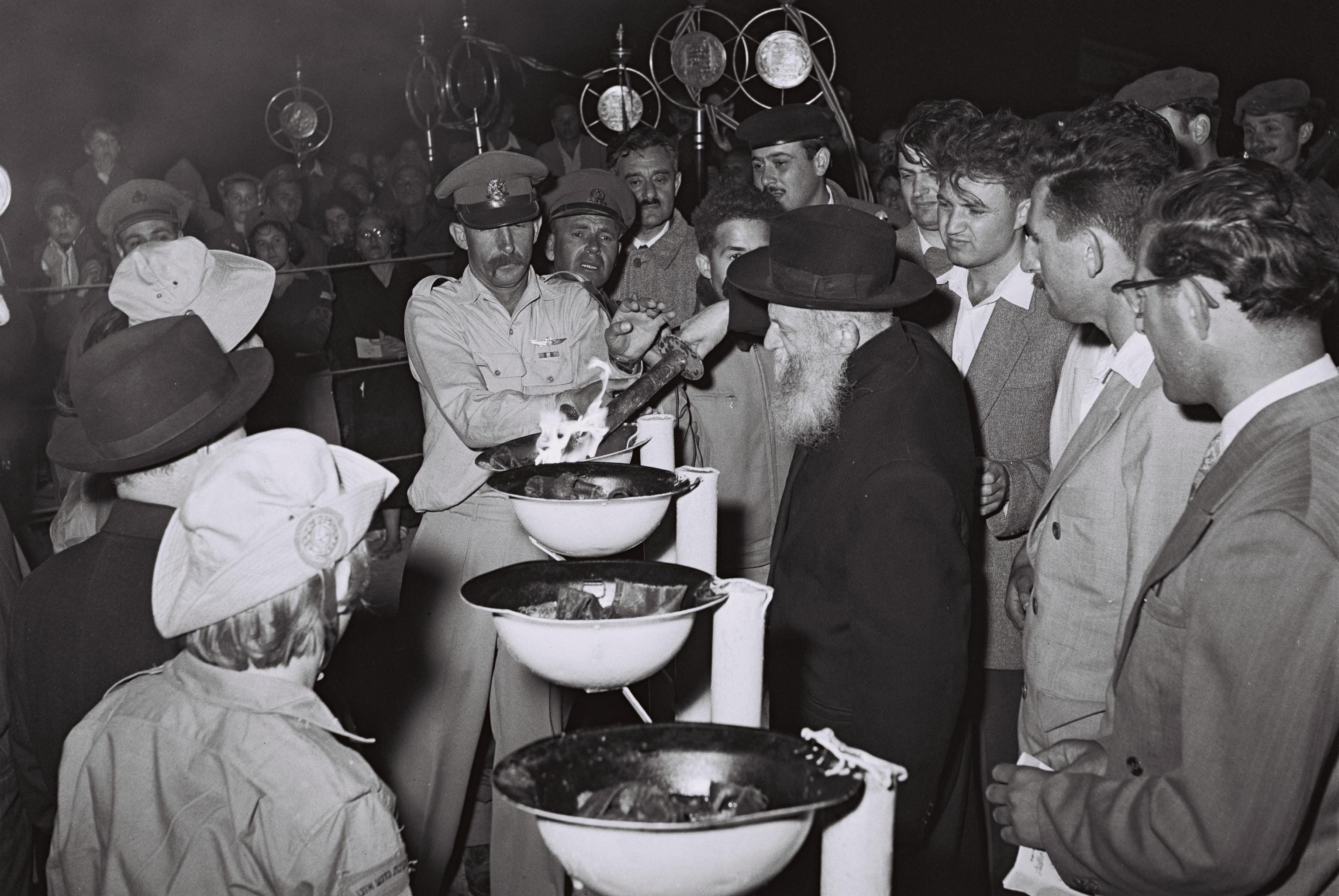
Independence Day eve 1957. Israel’s representative, Rabbi Tzvi Yehuda Kook, lights the torch. (GPO)
The greatest proponent of the latter was Rabbi Tzvi Yehuda Kook, who taught that everything connected to the state, above all the army, was holy. The soldiers were holy, and so were the rifles and the tanks. When one of his students, then the air force’s chief rabbi, arrived at his own wedding in uniform, some guests muttered that it was no way for a groom to dress. Tzvi Yehuda silenced them, declaring that there was nothing holier than an IDF uniform. His philosophy and his strict observance drew the most religious of the religious Zionists to his study hall, forming the movement’s right wing. Unusually for a religious movement, greater deference to God meant greater deference to the secular authority. If the state is sacred, then defying it is blasphemy. They saw their synthesis as a bridge between Zionism’s nationalist and religious poles, and as Tzvi Yehuda put it, sometimes bridges get stepped on.
The mainstream was similarly meek but for more secular reasons. Rather than a synchronist approach, it treated religion and Zionism like Orthodox Jews treat meat and milk: in the same kitchen but separated. Its politicians stood guard over Shabbat and school budgets but left the steering to the secular Mapai. The movement’s youth, desperate to join the new state’s secular elite, celebrated mixed society and Labor Zionism’s “new Jew,” whose head was more likely to be covered by a keffiyeh than by a kippah.
All that changed in 1967.
On the eve of Israel’s 19th Independence Day, two events took place a few streets apart in Jerusalem. At the national song festival, a young soldier named Shuli Natan premiered the songwriter Naomi Shemer’s “Jerusalem of Gold.” It was an instant classic. For the first time since 1948, a state ceremony openly longed for the places Israel had seemingly given up on—the Old City, the Temple Mount and the road to Jericho.
A day earlier, at the annual celebration in the most important religious Zionist learning institution, Merkaz HaRav, the headmaster, Tzvi Yehuda, surprised his students with a cry of anguish: “Where is our Shechem, our Hebron, our Jerusalem?” he asked the enraptured crowd. “Have we forgotten them?” It sounded detached from reality. Three weeks later it sounded like prophecy.
The Six-Day War more than tripled Israel’s territory and returned the biblical heartland to Jewish hands. The question was what to do with these newly acquired territories. The religious answer, at first, came from the IDF’s eccentric chief rabbi, Shlomo Goren.
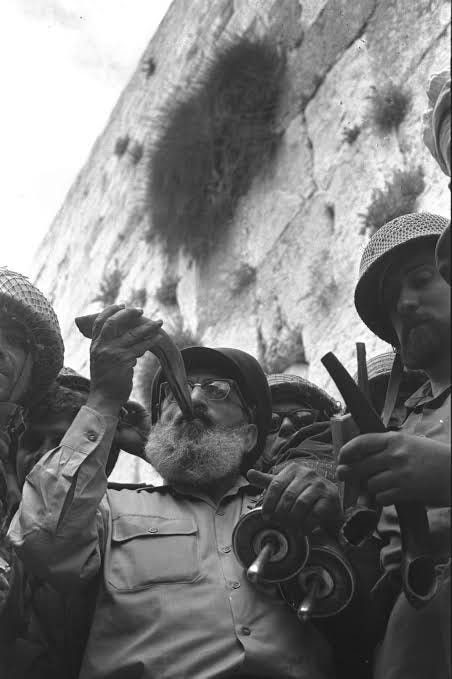
Rabbi Shlomo Goren at the Western Wall beside the Paratroopers, 1967. (GPO)
In utter disregard for the danger, the 50-year-old Goren stormed the Old City alongside the paratroopers; seconds after the iconic photo of troops looking awestruck at the liberated wall, Goren blew the shofar in a city that had not been in Jewish hands for almost 2,000 years. He toured the Temple Mount, suggesting to Central Command’s Uzi Narkiss that the army seize the moment and remove the Dome of the Rock with a controlled explosion. Narkiss, horrified, refused on the spot. But even with his proposal shot down, nothing could dampen the rabbi’s enthusiasm. After reciting prayers with the paratroopers, Goren boarded a jeep and charged into Judea and Samaria. Unknowingly outpacing the army, Goren accidentally conquered Hebron and the Cave of the Patriarchs, accepting the city’s surrender by himself.
The students of Tzvi Yehuda would soon follow Goren’s charge. Weeks after the war, Merkaz HaRav students and graduates met to plan mass settlement along the central mountain ridge of Judea and Samaria, the biblical spine running from Shechem through Beit El and Jerusalem to Hebron. The plan went nowhere. They still revered the Labor founders, and nobody contemplated rebelling against a government that had just won the most improbable victory in Jewish history. Instead, they poured their energy into the government’s map, the Allon Plan, which avoided the densely populated spine, permitting settlement only in areas deemed essential to security or sparsely populated by Palestinians.
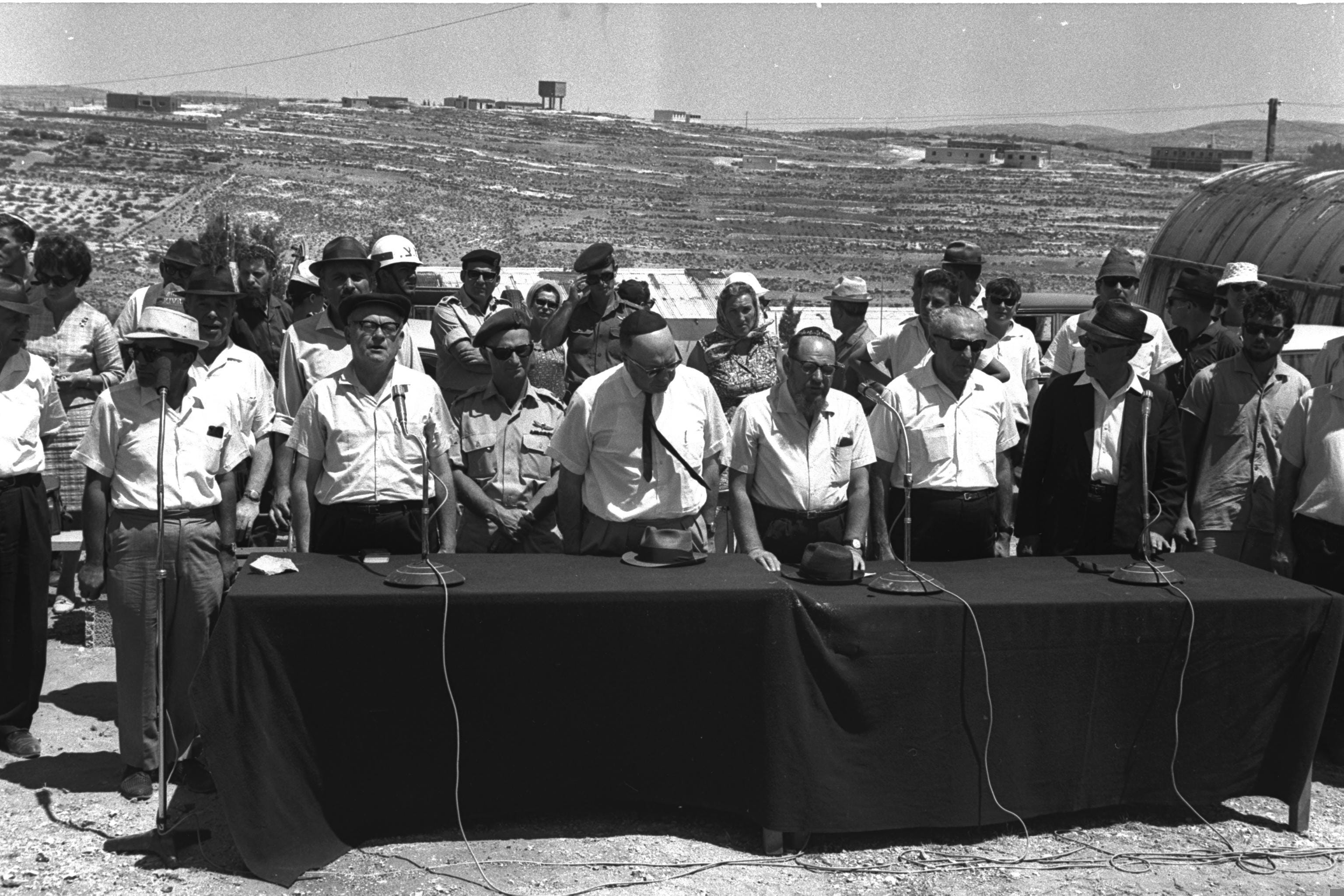
Veterans of the Etzion Block settlements gathering on the former site of Kibbutz Kfar Etzion in the Hebron Hills, in memory of its fallen settlers, 1967. (GPO)
The first Jewish settlement in Judea and Samaria, and the first to break the Allon Plan, was the religious town of Kfar Etzion. The settlement had fallen a day before independence, its defenders massacred after surrendering. For 19 years its orphans had gazed across the armistice line at the lone oak marking the ruins. One of the children, Hanan Porat, was among the paratroopers who had liberated Jerusalem and a student at Merkaz HaRav; in the summer of 1967, he went door to door persuading reluctant widows to let their sons go back. The government, which remembered the massacre as well as anyone, could not refuse. On September 27, less than four months after the war, as Jeremiah had predicted, “the sons returned to their borders.”
But the pioneer crown had not yet passed from the secular to the religious. Of the 39 settlements founded in the new territories between 1967 and 1973, 11 were religious, almost all within the Allon Plan. As the expert Yair Sheleg puts it, the Six-Day War provided the anvil. The movement still needed a hammer.
The Yom Kippur War killed 2,656 Israeli soldiers, in a country of about 3 million. The kibbutz movement, 3 percent of the population, accounted for 18 percent of the dead. One northern settlement, Kibbutz Givat Haim Ihud, lost eight sons.
One of its members, Arnon Lapid, published a lament in the national Davar titled “Invitation to Weeping.” He invited readers to weep together for the dead, for the dreams they had woken from, for the gods that had failed and the false prophets who had risen. It ended by calling his generation lost. The kibbutz establishment was more shaken by the lament than by the war.
Hanan Porat saw in the lament a prophecy fulfilled. The elder Rav Kook had written that secularism was needed to start the national revival but would eventually be unable to carry the torch. When that moment came, it would have to pass into religious hands. For Porat and his friends, 1973 was that moment.
On Tu B’Shvat 1974, four months after the war had sunk into an uneasy cease-fire, a conference at Kfar Etzion established Gush Emunim, Bloc of the Faithful. The manifesto made clear its ambitions went far beyond settlement. It aimed at a great awakening to fulfill the Zionist vision in full, rooted in Jewish heritage, with the goal of complete redemption for Israel and thereby the world. Despite the prominent note of messianism, early Gush Emunim was not purely religious. Its leadership included several prominent secular figures; senior Labor figures praised their pioneering spirit even as they opposed their religious politics.
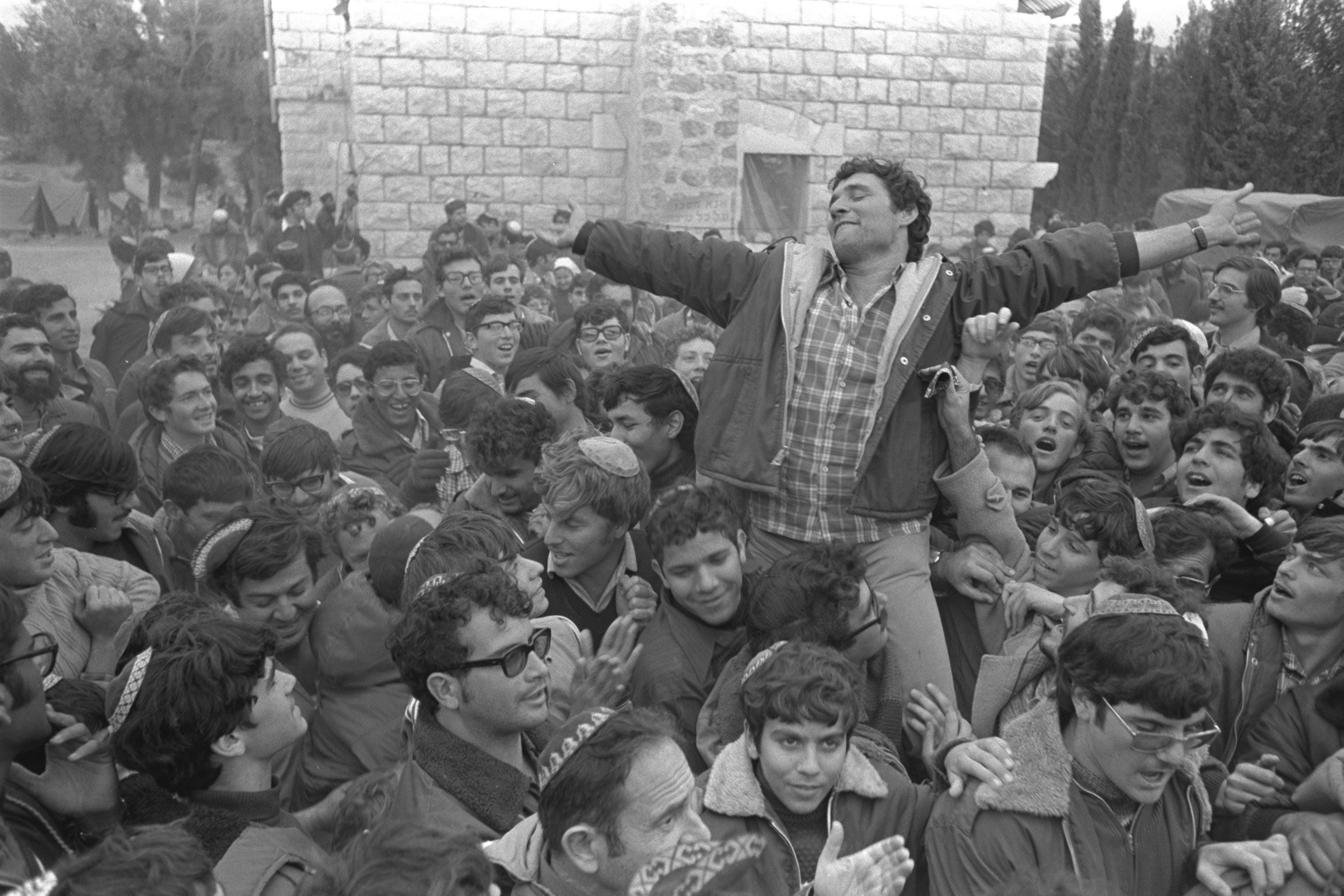
Rabbi Moshe Levinger, Gush Emunim leader Hanan Porat and fellow activists, celebrate the government’s agreenment which allows all settlers to relocate to a military camp near the arab village of Sebastia and additional locations in the Samaria region. (GPO)
The first test of their faith was Sebastia. Overlooking the Palestinian city of Nablus stood the ruins of an Ottoman railway station. In the summer of 1974, a group of settlers ascended the hill with the intention of living in the abandoned station but were promptly removed. Soon they went up again, and again, seven times in all, and each time the army carried them down. On Hanukkah 1975, they went up an eighth time, and tens of thousands came with them. Yitzhak Rabin’s cabinet could not decide whether to use force. Shimon Peres negotiated a compromise: 30 families would move into the nearby Kadum army camp, pending a decision that never came. The camp became the town of Kedumim. The bloc had just had its faith rewarded for the first time.
In the halls of power, the party that claimed to speak for these young pioneers was intentionally running a lap behind them. The NRP was led by moderates, not fools. When Judea and Samaria were conquered, they saw the messianic flood coming and attempted to dam it. Chaim Moshe Shapira, leader of Mafdal until his death in 1970, was among the most dovish ministers in any Israeli cabinet. In May 1967, as the country waited for war, he advocated caution, reportedly telling Chief of Staff Rabin that even Ben-Gurion had not gone to war without a great-power ally. After the successful war, he and the party’s veterans opposed the first Jerusalem Day celebrations, for fear of irritating Washington.
But this dovishness would be their downfall. The Young Guard, an influential youth, political and social branch of the movement led by Zevulun Hammer, had been plotting to take over the party since the early 1960s, and found in Greater Israel the means to do so. Hammer gave the settlers offices, budgets and a voice in the Knesset. During the stand at Sebastia in 1974, he told the plenum that Labor’s contempt for the settlers meant he could no longer sleep at night. But he never quite joined them, and a year later he gratefully accepted a ministerial position in Rabin’s government. But such a balancing act could not be sustained.
In December 1976, the Israel Air Force received its first delivery of its first F-15s. They flew in from the United States and landed at Tel Nof on a Friday afternoon. Conditions were favorable. There was no enemy fire. The aircraft failed their first mission anyway: they arrived 20 minutes late, and the welcoming ceremony ran into Shabbat.
For the rest of his life, Rabin would claim that yes, he was at the airbase at 4 p.m. But 17 minutes later, when Shabbat began in Tel Aviv, he was already home. Nobody was interested. The NRP abstained on a motion of no confidence, and Rabin resigned. The next morning’s cartoon showed a fighter jet with an NRP logo dive-bombing a horrified Rabin.
When did the American South go from deep blue to dark red? Historians and political theorists have been arguing about it for half a century. Some say 1948 and the Dixiecrats, others 1964 and the Civil Rights Act, still others insist it was Nixon’s 1968 Southern Strategy. The answer depends on who is asking and what they want it to prove.
Religious Zionism’s turn to the right has a date: May 17, 1977.
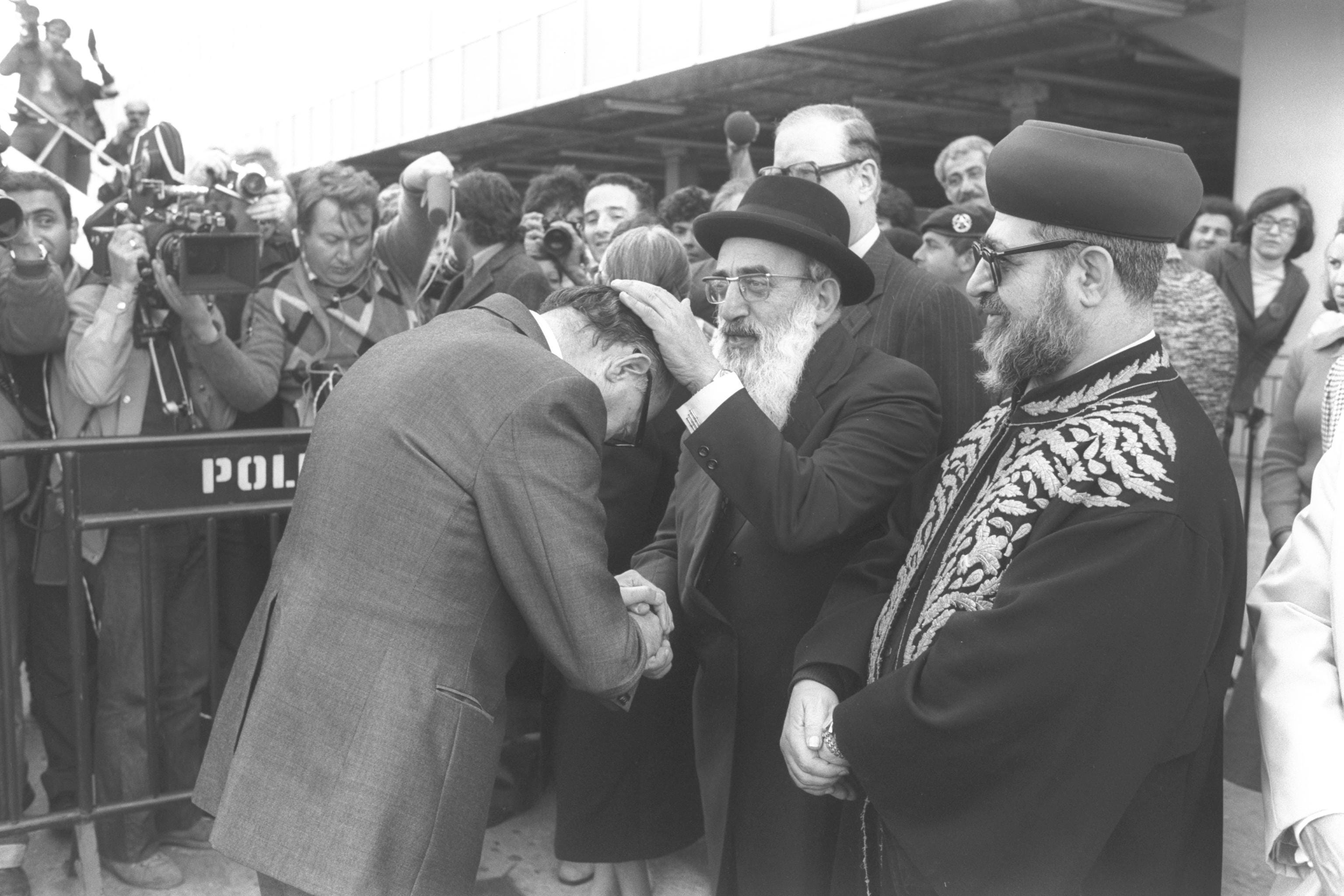
Ashkenazi Chief Rabbi Shlomo Goren blessing Prime Minister Menahem Begin upon his return from Ismailia, with Sephardi Chief Rabbi Ovadia Yosef smilingly looking on, Ben-Gurion Airport, December 1977.
That night the Likud took 43 seats and the rebranded Labor Alignment fell to 32. Menahem Begin had spent four years building something he was the first to name: the national camp. Revisionists, Mizrahim and the Haredim, held together by something entirely new yet entirely obvious: Jewish identity. It fit religious Zionists, both intensely Jewish and nationalist, like a glove. In the new government, knitted kippot and head-covered women filled corridors of power they had never walked before. Begin gave the NRP something no Labor prime minister would have dared to in their days of cultural hegemony: the Education Ministry.
The truth is the “natural partnership” between Labor and the NRP had come to a natural end. Their alliance rested on the sole principle the two sides shared: nationalism. When Arnon Lapid invited the kibbutz movement to weep over its false dreams, he was telling his generation to go and find new ones. The kibbutzniks found theirs in universal values, human rights and peace, distancing themselves from the pioneering and settlement that had taken hold of Religious Zionist imagination.
The next 15 years in power would be the movement’s most successful. Nearly 100 settlements were established across Judea, Samaria and Gaza, and in 1979 the Yesha Council was established to unite and manage them.
But not all was bliss in the national camp. As part of the historic Camp David Peace Accords with Egypt, Israel had to return the Sinai, settlement-free. The decision split the NRP. The veterans from the party’s more moderate days voted for the treaty. The Young Guard faction abstained, torn between peace and settlement. Only three voted against.
The pioneer wing met the withdrawal with a withdrawal of its own. Breaking with the NRP, it founded Tehiya with Likud rebels Geula Cohen and Moshe Shamir, a religious-secular partnership bound by a platform of Greater Israel. In 1981, it won three seats, and the NRP collapsed from 12 seats to six.
Israel had gone 30 years with the religious Zionists living in one party, but the question of territory had finally broken the unity of the camp, and they would spend the next 40 years endlessly splitting. The truth was that the soft-spoken, suited NRP had lost touch with a large portion of its increasingly hawkish, khaki-clad constituency. Besides withdrawal from Sinai, the party also opposed bombing the Iraqi reactor and entering Beirut, and its ministers voted for the Kahan Commission to investigate the Sabra and Shatila massacres against the position of Chief Rabbi Goren and most religious Zionist rabbis.
On Purim 1982, weeks before the evacuation of the largest Sinai settlement, Yamit, Tzvi Yehuda died. To his students, the old rabbi had chosen to die rather than witness Jews dismantling Jewish homes.
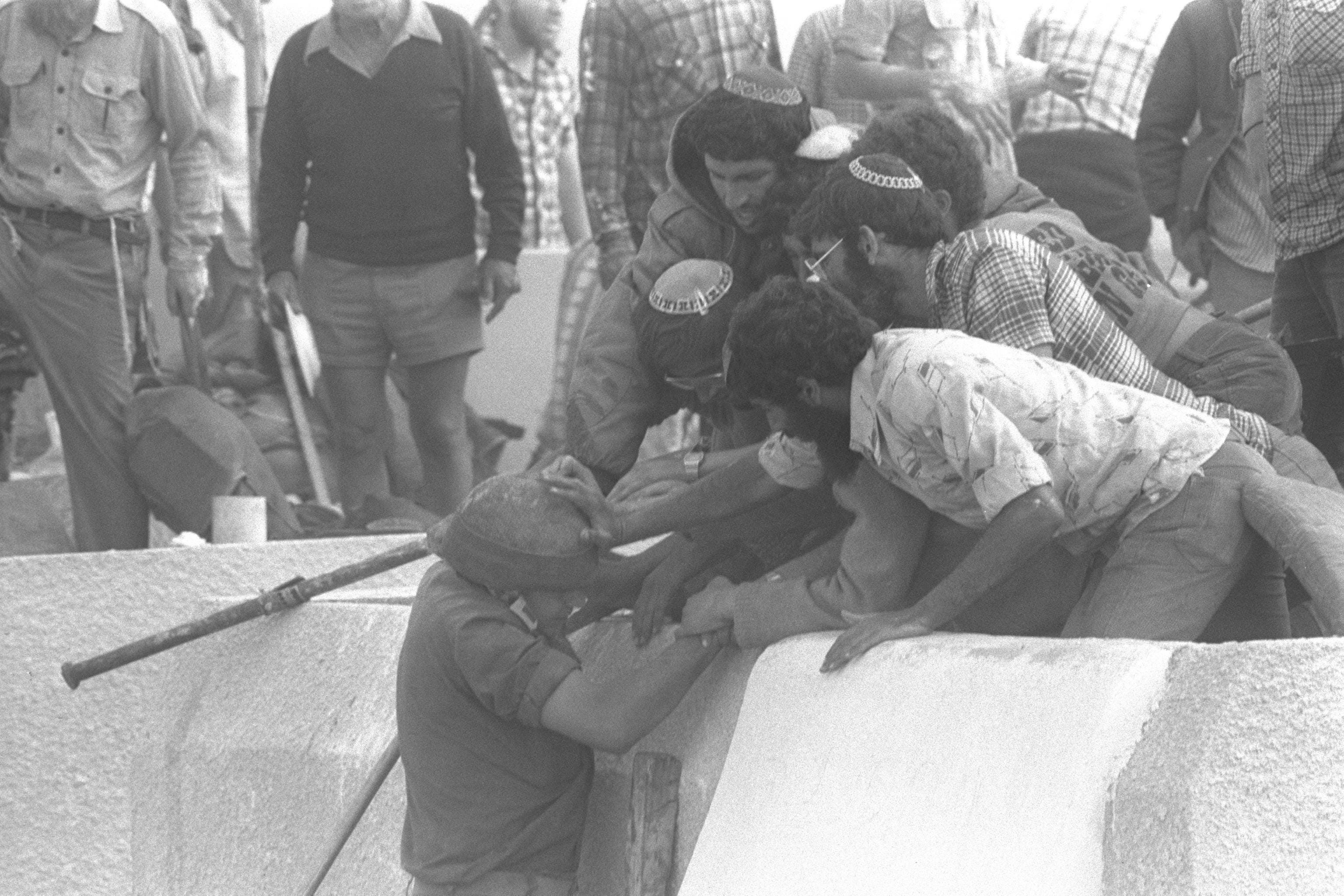
Settlers resisting evacuation from Yamit trying to force a soldier down from the rooftop, April 22, 1984. (GPO)
But when it came to the fateful day, religious Zionists were not the ones fending off the army on Yamit’s rooftops. Most of the holdouts were secular students led by the future Likud leader Tzachi Hanegbi, and the gas-canister bunker belonged to young Kahanists. Rabbi Tzvi Tau kept his students in Jerusalem altogether, for fear they would clash with soldiers. But a few religious Zionists were fighting the withdrawal, just not in Sinai. Yehuda Etzion, a founder of Ofra, had worked out that the treaty could not be stopped at Yamit, only at the Temple Mount. Blow up the Dome of the Rock, and no Israeli government would be handing anything to an Arab state for a generation. The explosives were ready, but several of the plotters couldn’t go through with it.
Almost every religious Zionist leader condemned the Underground. Yoel Bin-Nun, one of the paratroopers who had liberated Jerusalem and one of the founders of Kfar Etzion, argued that settlement served the state or it served nothing. The lone voice of dissent came from another of Gush Emunim’s secretaries, Moshe Levinger, who backed them unconditionally. The fight between the two founders broke up the Gush Emunim secretariat. The movement that meant to rebuild Israel on religious foundations disappeared, leaving behind only its settlement arm. Years later, Bin-Nun identified the Underground as the moment the settlement enterprise lost the Israeli public.
Every poll suggested that the Alignment’s seven years in the wilderness, since the upheaval of 1977, were about to come to an end. The last polls predicted 53 seats for Shimon Peres’s Alignment and a landslide over the Likud. “Why were the pollsters wrong?” wondered a newspaper headline two days after the elections, and not for the last time in Peres’s career. Israel is the only country in the world, Peres later complained, where people say the truth in polls and lie at the ballot box. When the last votes were counted, it turned out that while the Alignment had pulled ahead of the Likud by three seats, there was a perfect tie between the blocs: It was 60-60. The public had strong-armed them into working together to try to dislodge the ship of state, which was mired deep in the mud.
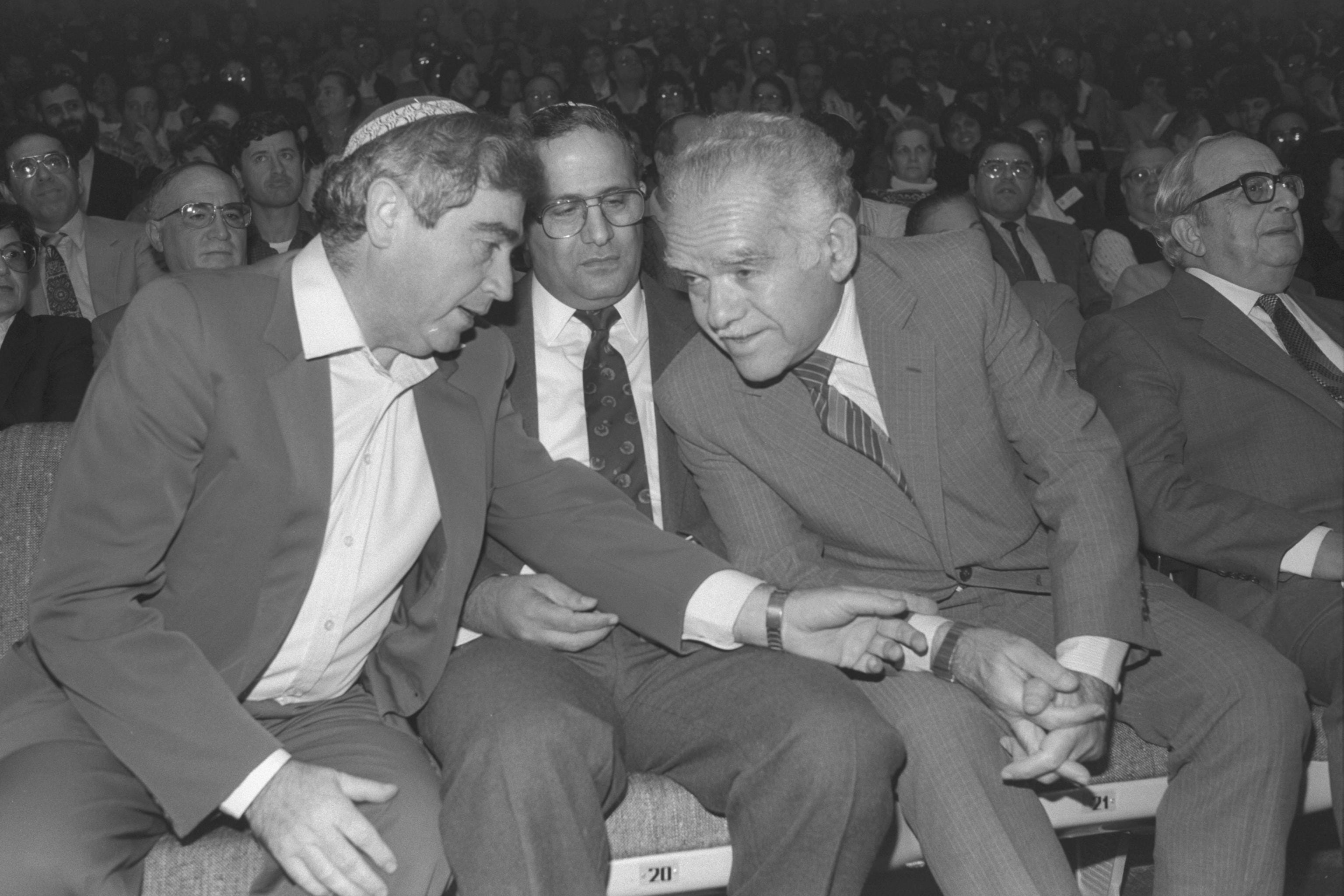
Prime Minister Yitzhak Shamir and Minister of Religious Affairs Zevulun Hammer (left) exchanging remarks during the ninth convention of religious teachers at the Jerusalem Theatre, 1986. (GPO)
But who would head the government? Likud leader Yitzhak Shamir loathed Peres, and Peres despised Shamir. The solution came from an NRP minister named Zevulun Hammer, on holiday in Switzerland after the campaign, who ran to a payphone with an idea for the president’s office. If rotations worked for NRP hacks in local council deals, why not for the premiership? Everyone was appalled, which is usually how you know a compromise has worked. One journalist suggested they settle it with a penalty shootout instead.
Six of the Likud’s first 15 years in power were spent in that unity government, and religious Zionism lost nothing by it. Hammer was moved out of the Education Ministry to make room for a former president, Yitzhak Navon, and took it back the moment unity collapsed in 1990. The settlements, meanwhile, kept growing, now with a broad national consensus behind them.
The comfortable position allowed the religious Zionists to start indulging in splits. Tehiya had broken from the NRP, and shortly afterward the ultra-Orthodox Zionists walked out as well, forming Morasha. With the first intifada raging, the dovish wing ran alone as Meimad and failed to clear the threshold.
In 1990, Peres pulled the “dirt trick,” toppling the unity government and attempting to build a narrow one with the Haredim in its place. His maneuver ended with a whiff of cow dung, as two of the Haredi representatives didn’t appear at the signing ceremony, later found hiding in a cowshed.
Yitzhak Shamir formed a narrow right-wing government instead, but when forced to the Madrid Conference under American pressure, the Greater Israel Tehiya brought it down. Recognizing the PLO as the legitimate representatives of the Palestinians was a “slippery slope,” Tehiya’s leader would later say, but in the end her attempt at stopping the fall only pushed Israel down faster.
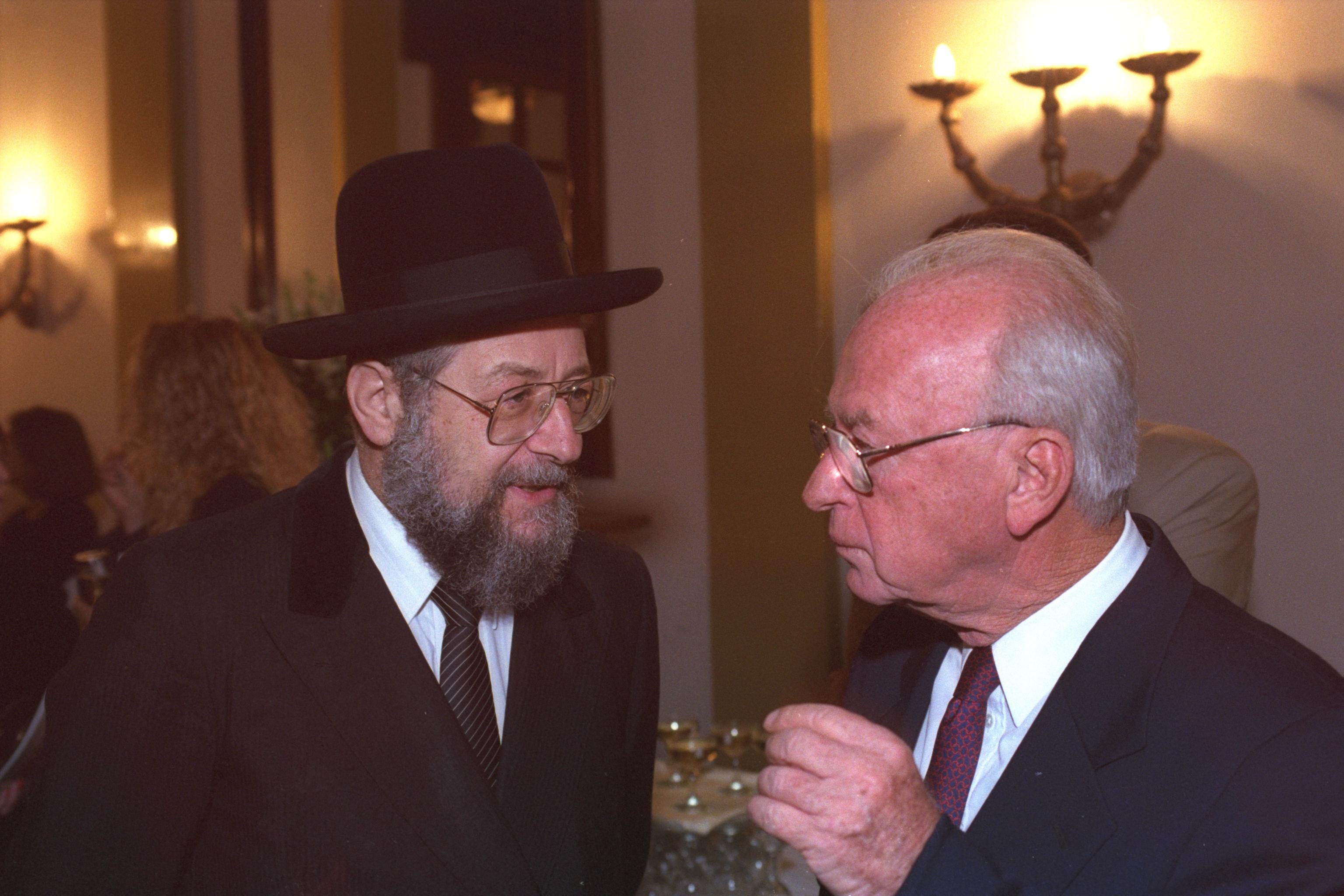
Prime Minister Yitzhak Rabin conferring with Ashkenazi Chief Rabbi Yisrael Meir Lau, September 1994. (GPO)
In the following election, Yitzhak Rabin, campaigning as a security hawk, won 44 seats; the further-left Meretz won 12. The years of unbroken religious Zionist ascent screeched to a halt and began to be rolled back.
Rabin’s second term opened with a freeze on settlement funding. Even before the 1976 fighter debacle, the general had never been a fan of the settlements. He called Gush Emunim a cancer in Israel’s democratic social fabric. He dismissed Kedumim as a bloated fart, which is the politest translation available, and mocked the isolated settlements as “Beit El, Emmanuel and Schlemiel,” two of which exist. When his defense minister, Shimon Peres, planted a tree in Ofra, probably to annoy him, Rabin was livid.
He wanted a different religious partner, and he found one in the relatively new Sephardic ultra-Orthodox party Shas. When Shas’s voters wore kippot, they were not knitted, and rather than consult rabbis, they simply placed them in the Knesset, but otherwise, the party resembled the original Mafdal: Orthodox but not messianic, right-wing in temperament but open to territorial compromise.
The Oslo Accords were signed in September 1993. The religious Zionist camp was furious. The first grievance was the future surrender of most of Judea and Samaria. The second, more immediate, was the plan to arm the PLO and bring it into the territories. The campaign’s slogan was borrowed from the famed poet Natan Alterman: “Don’t give them rifles,” though in the line’s original pacifist context it was referring to everyone, settlers included.
The violence came quickly. In December 1993, Mordechai Lapid and his son Shalom, of Kiryat Arba, were murdered by a Palestinian gunman. About two and a half months later, on Purim, Mordechai Lapid’s close friend Dr. Baruch Goldstein entered the Cave of the Patriarchs and gunned down 29 Palestinian worshippers before being killed himself.
Hamas’s spiritual leader, Sheikh Ahmed Yassin, soon responded by permitting suicide bombings against Israeli targets. The violence of the first intifada had been restricted to the territories; now, during Israel’s greatest push for peace, buses were exploding in central Tel Aviv. Within a year the anti-Oslo campaign expanded, while religious Zionists remained Oslo’s most staunch opponents; almost half the country was with them. As the government hurtled toward Oslo II, cities were plastered with posters calling Rabin a traitor, often depicting him wrapped in Yasser Arafat’s black-and-white keffiyeh. In the official halls of religious Zionism, the rabbis ruled that soldiers could refuse orders to evacuate settlements and even army bases. Most controversially in retrospect, some labeled Rabin a rodef, a halachic category of the pursuer, whom one is allowed to kill.
A different path was possible, at least on paper. In 1993, a group of mostly Gush Etzion settlers founded a political circle called Tchelet. A poll they commissioned in January 1993 surprised even its sponsors, finding that a substantial minority of settlers thought the Yesha leadership too hawkish. Tchelet wanted to discuss maps with the government rather than wage total opposition.
A warmer government could have split the camp. Instead, the government’s public message was contempt. Rabin called the settlers “ayatollahs” and “the Jewish Hamas,” justifying his actions on the basis that he was responsible for the security of the “98 percent” of Israelis who did not live in the settlements.
Meretz, led by Shulamit Aloni, held the Education Ministry. In the summer of 1995, Aloni, as communications minister, moved to confiscate the equipment of Arutz 7, the settlers’ pirate radio station. The moderates joined the protests while quietly disagreeing with the more extreme elements of the anti-Oslo movement.
In October 1995, the Oslo II agreement came to the Knesset. Shas had left the coalition. Two Labor MKs had defected. Even with the support of the Arab parties, the government bought two votes from the opposition, infamously offering one MK a ministerial car. Oslo passed on the “tip of a Mitsubishi” without a Jewish majority.
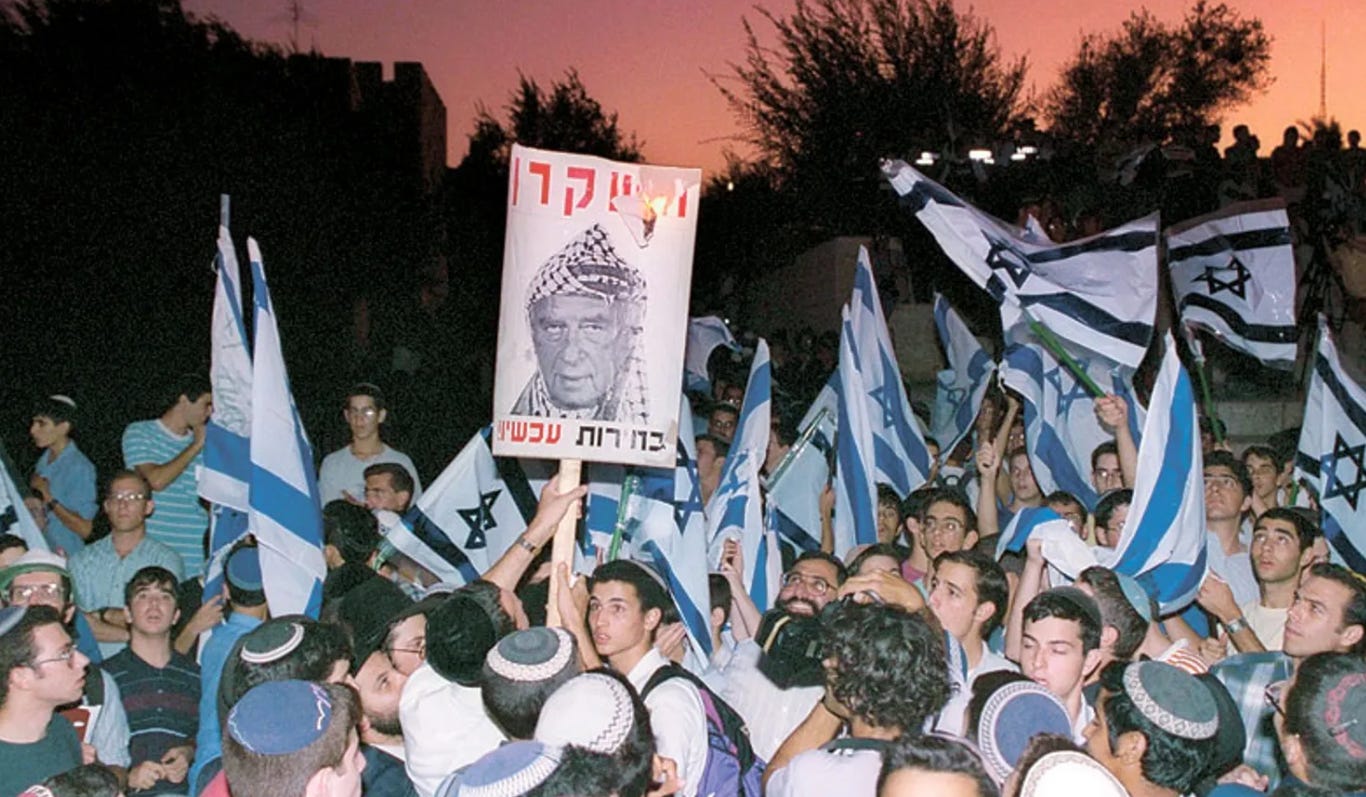
Anti-Rabin protest from 1990s, featuring sign depicting him as an Arab and calling him “the liar.” (GPO)
The street grew darker. Posters of Rabin in an SS uniform were handed out at a rally in Zion Square. In Jerusalem, a young follower of the extremist American rabbi Meir Kahane tore the emblem off Rabin’s car and boasted that just as they had reached the emblem, they would reach Rabin. The follower’s name was Itamar Ben-Gvir.
On November 4, 1995, after a peace rally in Tel Aviv’s Kings of Israel Square, Yitzhak Rabin was gunned down by Yigal Amir, a law student at the religious Zionist Bar-Ilan University. Amir grew up in Haredi schools and sneered at his religious Zionist peers for being too statist to stop Oslo. But the public had no patience for such biographical nuance, and many religious Zionists felt none either.
The movement that saw itself as the most loyal and patriotic had one of its sons murder the state’s highest authority. Days after the assassination, the hawkish Yesha Council and the dovish Meimad held a joint soul-searching conference. On the night of the murder, the settler leader Israel Harel had already spoken of a moral stain on his camp. The most dramatic speaker was Bin-Nun. If, God forbid, there were another murder, he warned, it was doubtful the State of Israel would survive, and certain there would be no more religious Zionism.
Tau, who had never tolerated attacks on the state’s symbols, spoke of a virus spreading among his flock. There was one who shot the prime minister, he told his students, many who cursed him, and even more who killed him in their hearts. In the weeks after the murder, many knitted-kippah wearers reported hostility from neighbors and strangers. Some took off their kippot. Others, infuriated by the collective blame, put back on the kippot they had long abandoned. Among them was a young officer named Naftali Bennett.
The assassination did not change the movement’s direction but significantly slowed its momentum. Before Rabin’s murder, religious Zionism spoke openly of moving from kosher supervisor to locomotive driver. After it, that ambition became taboo.
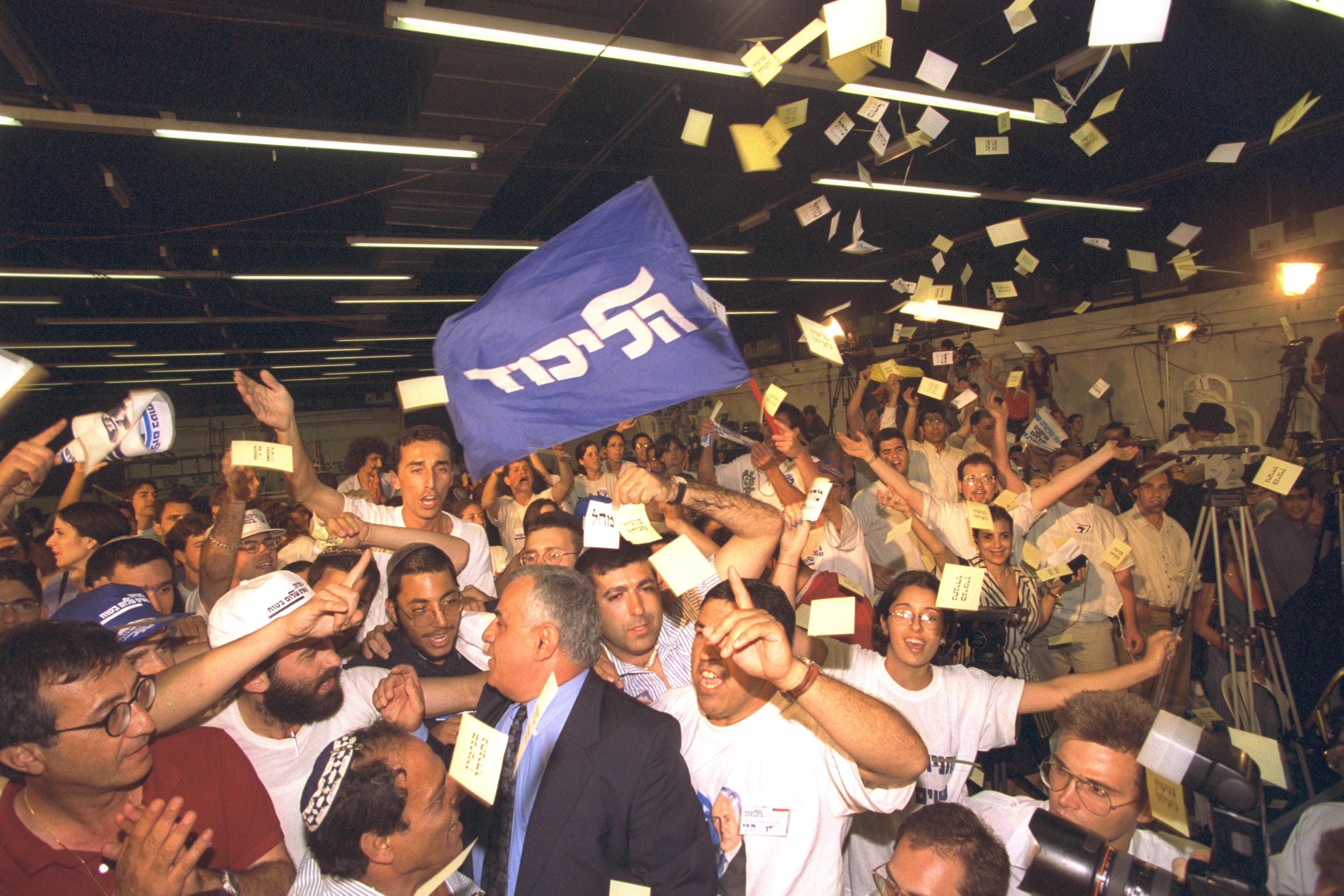
Newly elected MK Yitzhak Mordechai celebrating with enthusiastic supporters at Likud headquarters after the closing of the polls on election day, 1996. (GPO)
Benjamin Netanyahu’s narrow victory in 1996 and the NRP’s gains calmed the camp. The national camp had won, and even if the new government made concessions, at least they would not come with generous helpings of contempt. In January 1997, when most of Hebron was handed to the Palestinian Authority, it was met with thunderous silence. When bombs went off in Jerusalem that summer, public reaction was subdued, in stark contrast to the years before.
The energy went elsewhere. On November 15, 1998, days after helping negotiate the Wye River Memorandum and while publicly defending it, Foreign Minister Ariel Sharon told settlement leaders to push out the boundaries of their settlements without asking anyone’s approval. They needed no further encouragement.
One of these settlements contained a new breed of settler. They were not Gush Emunim pioneers in a checked shirt and sandals, nor the more religious Merkaz HaRav students in gabardine trousers. These settlers wore large coarse-knit kippot, sweatshirts and jeans, closer to backpackers who just wandered in from India than to anything a yeshiva had produced. Rav Kook, the spiritual spine of the enterprise since its first day, barely featured in their world, if he featured at all. In his place, religious texts jumbled together with Eastern spirituality, the spiritual tunes of the singer-rabbi Shlomo Carlebach alongside Israeli pop. Their quarrel with Israeli society was not only political; it was a revulsion at Western urban life as such. They saw themselves in the mold of Abraham and Isaac, herdsmen in the Judean hills, with an anarchist twist rebelling against the state that to them had not a speck of holiness. They would later become known as the Hilltop Youth.
Even if the mainstream religious Zionists acquiesced to the peace process, Bibi’s own party did not; his government collapsed with Likud initiative and NRP support.
Labor’s Ehud Barak swept the next election; in a move unthinkable half a decade before, the NRP sat in his peace camp. So deep was the demoralization after the assassination of Rabin that Barak even reached an agreement with the Yesha Council to remove a batch of illegal outposts shortly after coming to power.
While the politicians sleepwalked, religious Zionist society was hyperactive. From the mid-1990s, a new generation stopped merely consuming Western culture and began producing it, in journalism, film, poetry and fiction. Pre-military academies multiplied, and many talented religious youth chose full army service over the “hesder” track, which shortens military service to make room for yeshiva study.
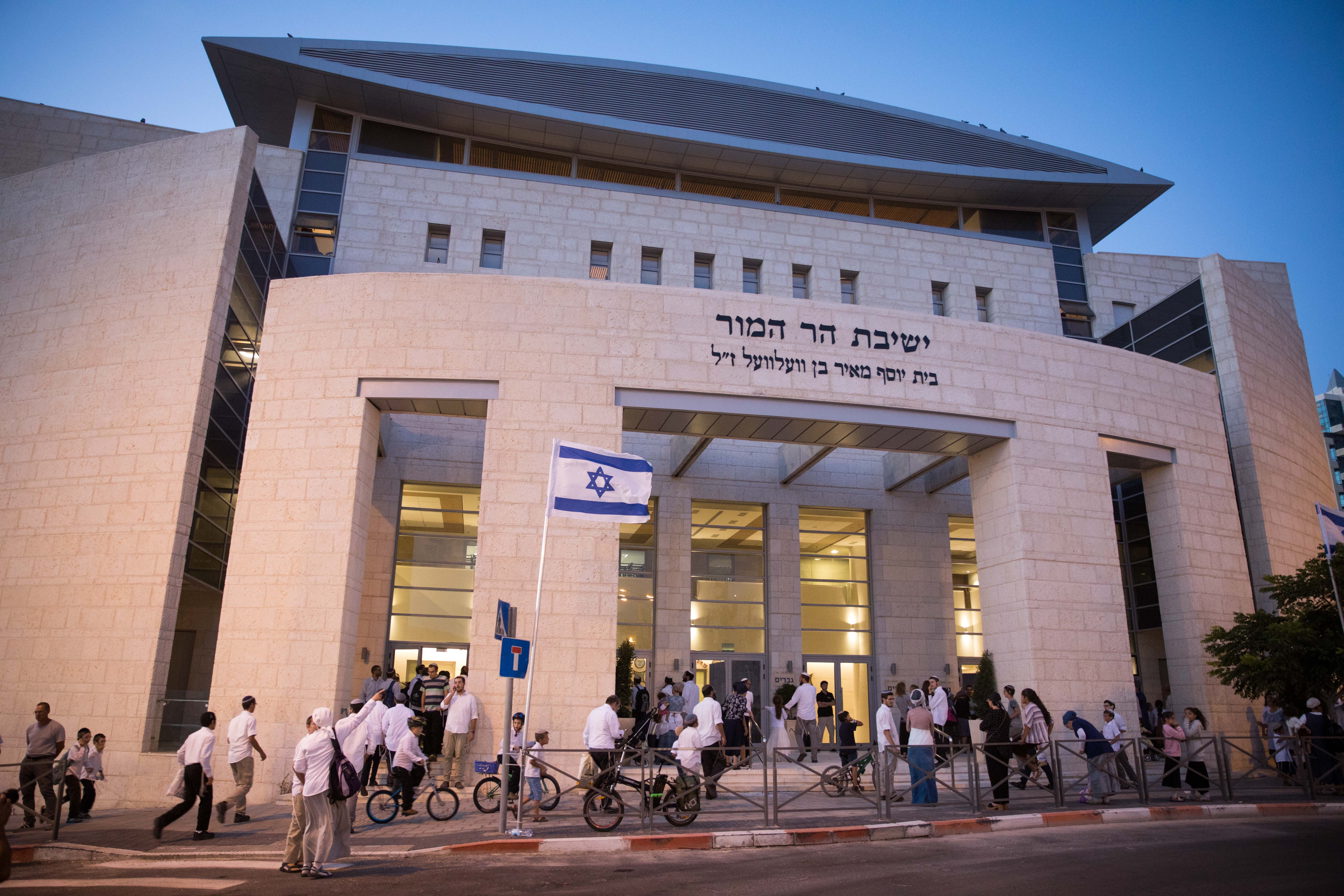
People outside the new building of Har Hamor Yeshiva in the neighborhood of Har Homa, Jerusalem, August 22, 2017. (Yonatan Sindel/Flash90)
The Hardal camp, meanwhile, split. In 1997, 15 uneasy years after the death of Rabbi Tzvi Yehuda Kook, Rabbi Tzvi Tau broke with the leadership of Merkaz HaRav over an accreditation program. For Tau, secular pedagogy inside the yeshiva was an idol in the sanctuary. He and his loyalists left and founded Har HaMor, its name an unsubtle acronym for Hemshech Merkaz HaRav, “the continuation of Merkaz HaRav.” Tau claimed to carry on the line the Kook dynasty had set, and his institutions became known as “the Kav” (the line), his followers as “Kavnikim.”
The split reveals a paradox that confounds outside observers. Tau’s camp, the more “messianic,” was the more moderate in its political methods. Because it regarded the state itself as holy, it could not attack its symbols. Because it believed redemption irreversible, it saw any withdrawal as temporary. Meanwhile, the more pragmatic camp saw the state as judged by its deeds and redemption as uncertain. It was therefore willing to authorize open refusal.
By the turn of the century, the religious Zionist community was more religiously diverse than ever: from Hardal schools stricter than some Haredi ones to “dati-lite” youth whose small kippot were often invisible in thickets of hair. Yet about 90 percent still identified as right-wing. As ever, the national pole dominated, and on the matter of territory too many religious families have children and friends in Judea and Samaria to consider recanting.
In 2001, Barak returned from Camp David without peace and without a coalition: Natan Sharansky’s Yisrael B’Aliyah had walked out, followed by Shas, and only then by the NRP.
But while the settlements rang with celebrations of the death of Oslo, a bulldozer could be seen on the horizon: his name was Ariel Sharon.
The old general who rose from Barak’s ashes and the explosion of the second intifada had been the settlement enterprise’s chief contractor and its greatest champion: he had joined them on the ascent to Sebastia and celebrated with them at Kedumim. But as one adviser put it, “Smash the terrorists and withdraw from the settlements.” In late 2003, he was all out of terrorists.
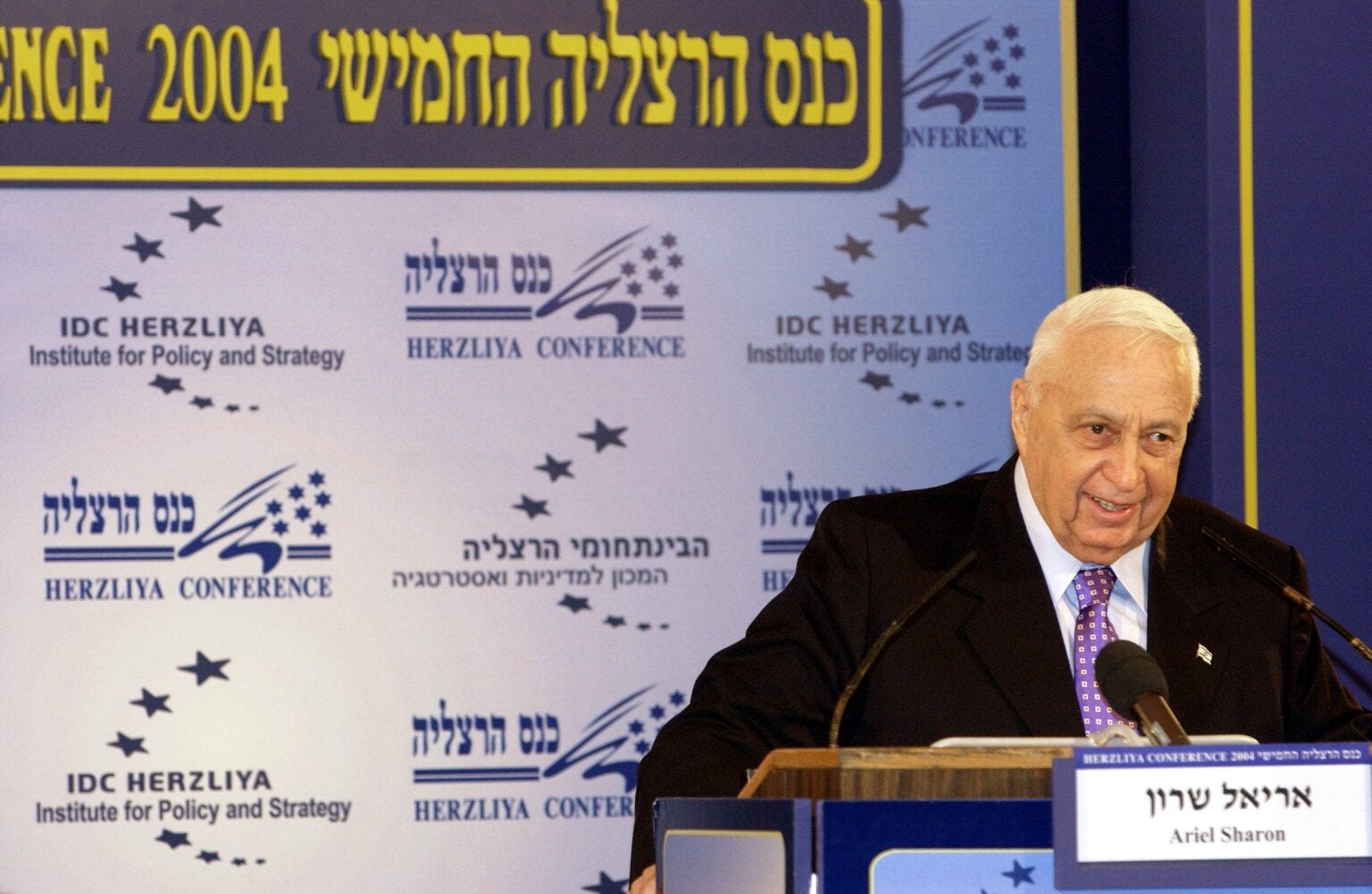
Prime Minister Sharon’s Address on Gaza Withdrawal at Herzliya Conference, 2004. (GPO)
The organizers of the annual Herzliya Conference were instructed to schedule the prime minister precisely in time for the evening news. Two paragraphs in, he declared he did not intend to wait for the Palestinians indefinitely; Israel would take the unilateral step of disengagement. He then refused to name a single settlement. “I know you would like to hear names,” he told an eager crowd, “but we should leave something for later.” He was enjoying himself. The whole country spent the following weeks guessing: Gaza, all of Gaza, parts of the West Bank, in stages or at once. The answer turned out to be all 21 of the Gaza communities plus four in northern Samaria.
Months earlier, Sharon had campaigned against Labor’s Amram Mitzna for proposing a Gaza withdrawal that was, if anything, more limited, and had told voters that unilateral separation without an agreement meant disaster. Religious Zionists, who made up the vast majority of the Gaza settlers, felt stabbed in the back.
But they were far from subdued. Facing revolt in his own party against disengagement, Sharon offered an internal Likud referendum, promising to abide by the result. Religious Zionist activists went door to door.
On the morning of the vote, Tali Hatuel and her four daughters were on their way to campaign against the withdrawal outside a Likud polling station in Ashkelon, when they were gunned down by a Hamas terrorist. She was eight months pregnant, and the bullet-riddled car still carried its sticker: “A Jewish heart does not disengage.” At the funeral that evening, with the polls still open, NRP leader Effie Eitam told Likud voters to fulfill Tali’s last wish.
Sharon said the attack was an attempt to destroy his plan, and that this was why he would fight for it regardless of the outcome. Convenient, because he lost the referendum by close to 20 points. That night he announced he would not resign, and the Likud’s lawyer produced an opinion holding that the referendum bound nobody. The chairman had wanted to know what the rank and file thought, the explanation ran, and now he knew. He passed the disengagement with support from the left.
The rhetoric on both sides was apocalyptic. Even moderates on the religious Zionist side called for breaking the disengagement law and declared they were prepared to die to stop it. On the other side, calls grew to proceed with the evacuations, even if it involved spilling what would inevitably be religious Zionist blood.
Yet the movement largely spared Sharon himself. Still bearing a Rabin-shaped scar, no matter how militant voices grew, it was terrified of another Yigal Amir; posters of Sharon in a keffiyeh were seen but were few and far between.
The NRP, waking from its years of stupor, quit the government in protest. Sharon, who needed religious parties to maintain his legitimacy, promptly fired the ministers of the militantly secular Shinui, paving the way for the return of the Haredim he had thrown out years before.
The climax came two weeks before the evacuation. Tens of thousands marched toward Gush Katif to break the army’s siege and stop the pullout with their bodies. The army and police halted the column at Moshav Kfar Maimon and funneled the marchers inside. Then they sealed it, leaving one exit open, that which led back home.
All night, leaders and marchers argued about whether to break the cordon or accept the ruling and go home quietly. The Yesha Council, in a unanimous decision, decided not to confront the security forces, on the grounds that a physical clash could cost lives and set off a civil war. Within months, the decision would be denounced as collaboration.
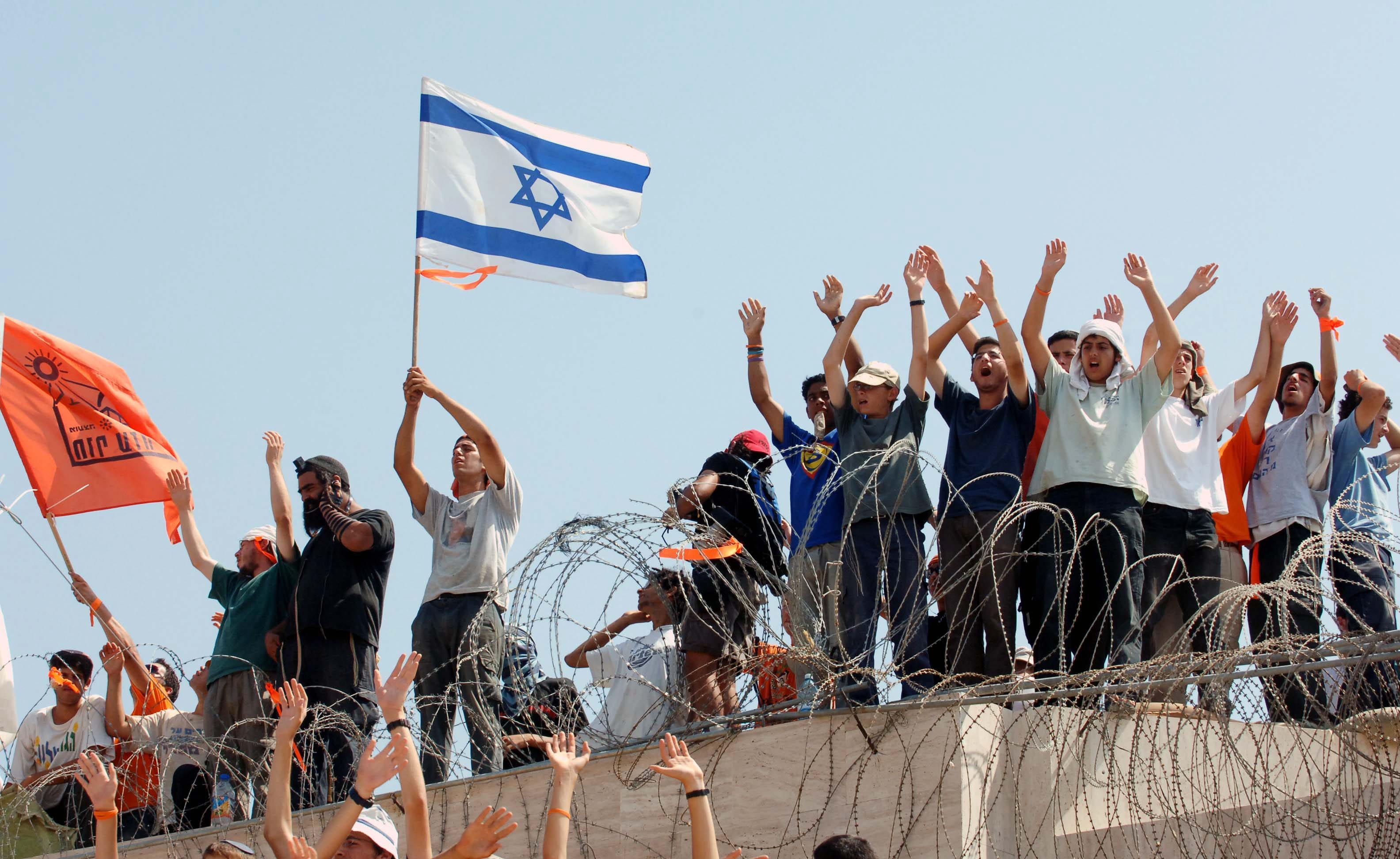
Israeli anti-disengagement protesters resist the army on a razor-wire-encircled roof during the 2005 Gaza withdrawal. (GPO)
On August 15, 2005, the 10th of Av (postponed so as not to demolish Jewish homes during the days of mourning for the Temple), the evacuation began. In six days, 25 communities, home to some 9,300 people, were emptied. There were painful scenes of settlers dragged from their homes, and youths on rooftops throwing rocks at soldiers. No one was killed.
Religious Zionists watched the videos with tears of mourning; the rest of Israel, though empathetic, cried tears of relief: there would be no civil war.
In the months after the event, the movement’s worst fear was confirmed: the withdrawal would be remembered as a fight against settlers, not the state against itself. In October 2006, a young columnist named Yair Lapid wrote that the disengagement was not despite the settlers but because of them. It was “never about the Palestinians,” he wrote; Israelis simply don’t like being anyone’s mules, no matter who is riding them.
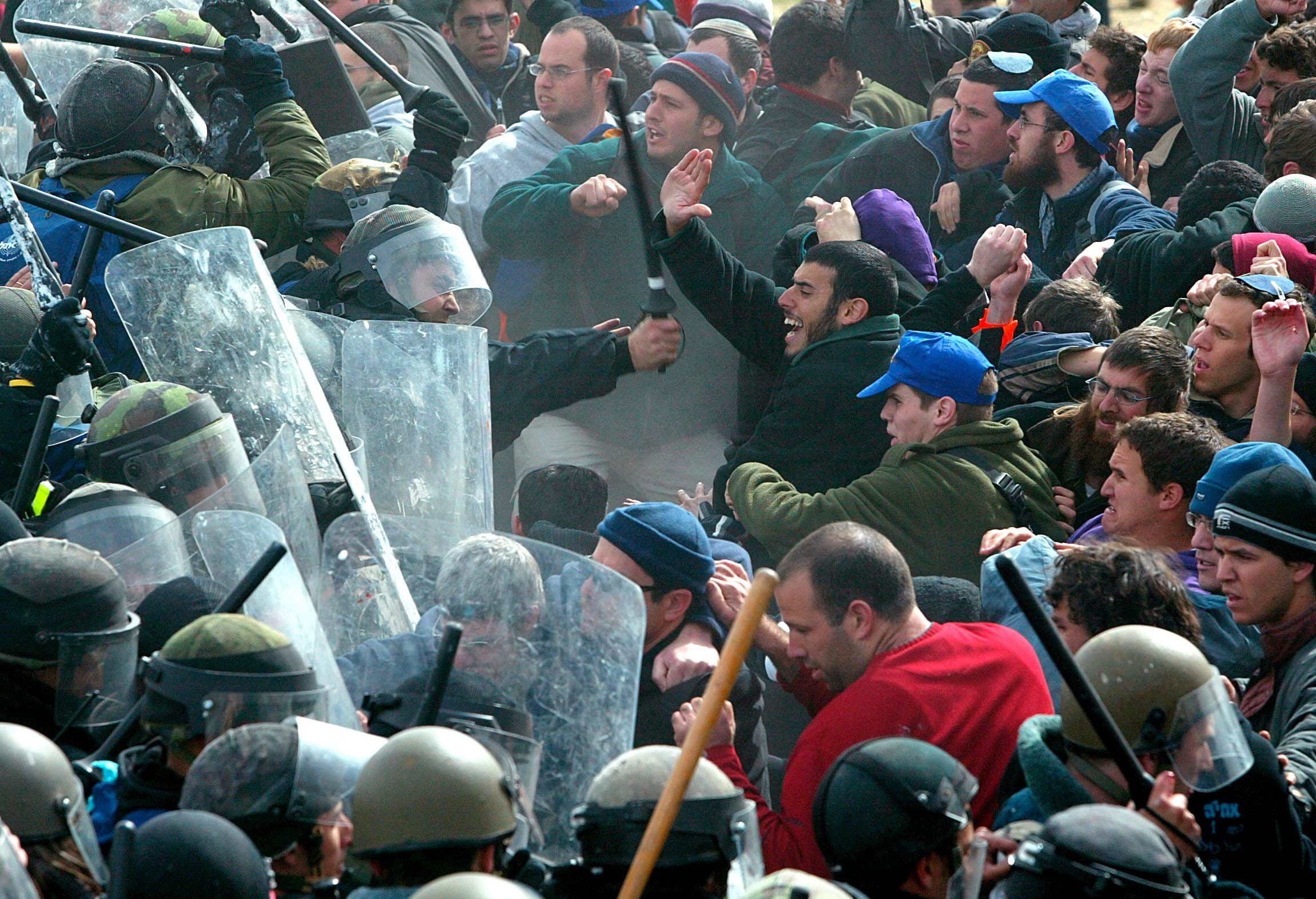
Israeli policemen clash with Jewish settlers in the unauthorized outpost of Amona, close to the West Bank Jewish settlement of Ofra, January 1, 2006. (Nati Shohat/Flash90.)
Meanwhile, many saw it as an ignominious surrender; the ease of it was what enraged the young. Less than a year after the disengagement, when the High Court ordered nine houses in Amona demolished because they stood on private Palestinian land, the fight over them was more violent than the entire Gaza evacuation. Settlers spoke of having erased, at Amona, the disgrace of Atzmona, a settlement in Gush Katif.
A separatist mood took hold of the community. “HaShem Hu HaMelech” (God is the King) stickers appeared on cars and shirts, declaring that only divine authority counted. People said they would no longer recite the Prayer for the Welfare of the State. Some joked they would amend it to ask God to protect the state from its leaders. Some spoke of the movement divorcing the secular elite and marrying the Haredim. Some talked of not enlisting, or at least not volunteering for elite units.
Tzvi Yehuda’s grand phrases about the state’s holiness disappeared from the discourse. The distinction between the state and its conduct, which Merkaz HaRav had once refused to draw, became common sense. Meanwhile, rabbinic support for ascending the Mount grew as a response to Oslo. After the disengagement, a smaller group went beyond prayer rights and began demanding the Third Temple. If even Sharon abandoned his ideology in power, the reasoning went, only an explicitly religious vision could sustain Jewish nationalism.
Though the battle for Gush Katif was over, the war with the Israeli establishment had just begun. In the autopsy of the trauma, many religious Zionists saw the fingerprints of the High Court. Time and time again they had attempted to appeal to the infamously activist court, only to receive a message that no one was home.
Evacuees believed the courts and prosecutors treated them with political hostility. The court had created a generation of religious Zionists who were as unsympathetic to its appeals as it was to theirs.
Hostility spilled over to Arabs; with the community’s trust in the state greatly eroded, vigilante violence increased. Mainstream religious Zionists condemned the attacks, but more quietly, partly out of reluctance to “collaborate” with a left and a media they saw as hostile to the community.
Yet the religious Zionists could as easily become separatist as the Haredim could give up Orthodoxy. Zionism was always the core pillar of their identity, routinely eclipsing religion and universalism; mass withdrawal from the state was never possible or desired. Even teenagers with criminal records from the withdrawal fiercely fought the army’s refusal to draft them.
Post-withdrawal, religious Zionism held on to its idealism, but much of it became less ideological. It had gone through what the Laborites went through after the failed attempt at peace, and what the Sephardim went through when they were sprayed with DDT and shoved into transit camps on arrival. It arrived where the Haredim had begun: a more businesslike, less romantic relationship with the state.
That was perfect for Benjamin Netanyahu. The prime minister who returned to power in 2009 had courted the community from his first day in politics. He often joked at staff farewells that he only works with people who wear a kippah, used to wear one or will one day wear one.
The alliance was one of compatible interests rather than full confluence. Netanyahu believed in speeches and treaties; Gush Emunim believed, in the old Mapai way, in facts on the ground. He shared their nationalism and their view of the Palestinian national movement. He did not share their religion and was appalled by their vision of annexing everything. In 2007, still as opposition leader, Netanyahu stood on a lookout in Samaria with his chief of staff. “See these hills?” he said. “From here you could fire rockets at Ben-Gurion Airport.” His chief of staff, a kippah on his head, answered: “See these hills? This is where our forefather Abraham walked.” The chief of staff was the same soldier who had donned a kippah after Rabin’s assassination, Naftali Bennett.
Netanyahu was fond of his father’s description of the group: big hearts, small brains; there were good religious Zionists, who were discreet and loyal, and bad ones, who were ambitious.
By that metric, Naftali Bennett was the worst there has ever been.
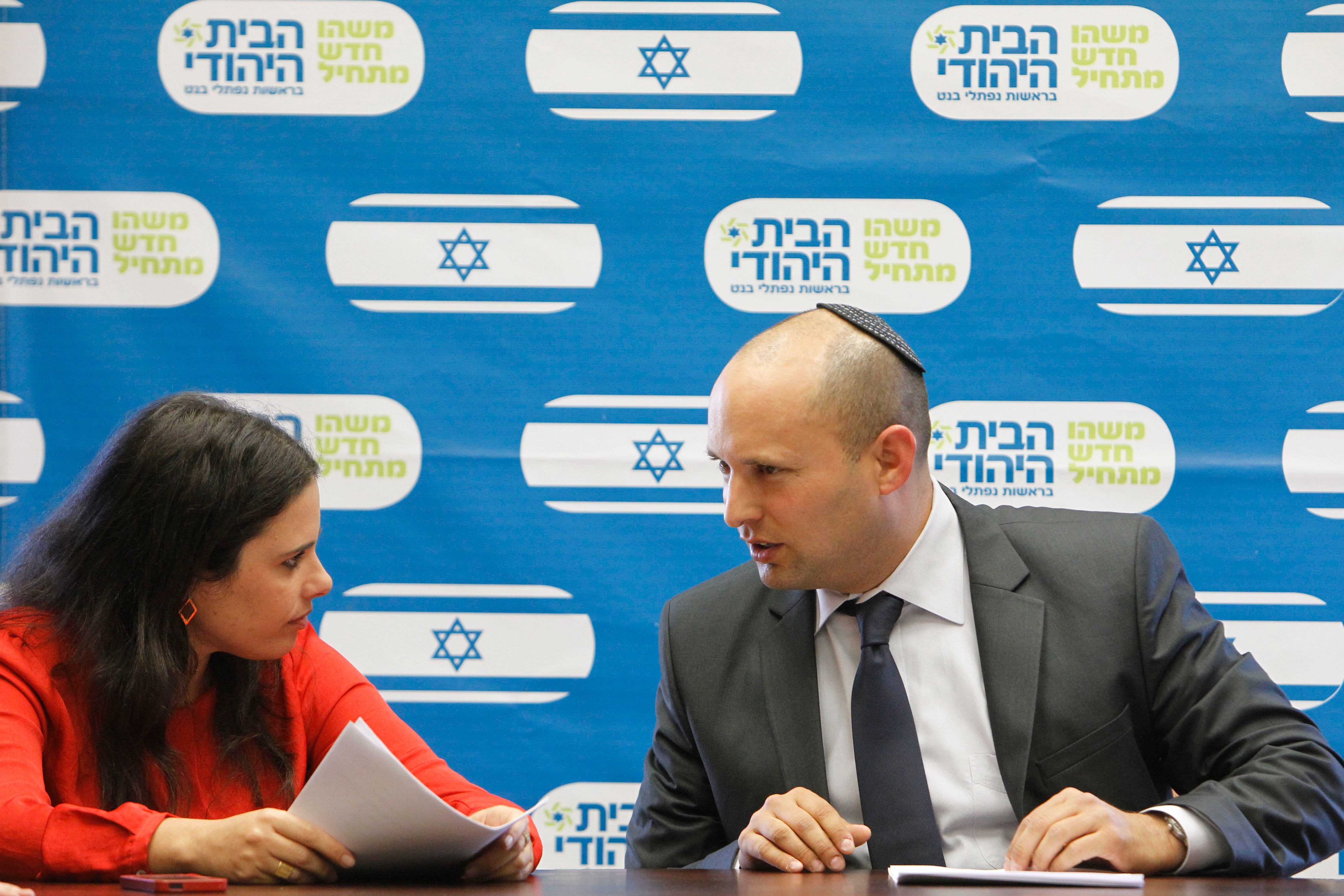
Naftali Bennett, leader of the Jewish Home party, and MK Ayelet Shaked attend a meeting of their faction at the Israeli parliament on October 28, 2013. (Miriam Alster/FLASH90)
There is a famous question asked in the religious Zionist youth movement Bnei Akiva: “Which group do you feel closer to, the Haredim or the secular?” Bennett’s answer was firmly the latter. He married a secular woman and worked with left-wing partners in high-tech. After a short stint running the Yesha Council, he and his secular partner Ayelet Shaked set out to take over the religious Zionist community’s “shelf company,” the NRP, by then renamed the Jewish Home.
On November 6, 2012, while Americans chose between Barack Obama and Mitt Romney, a few thousand religious Zionists voted in synagogues for their party’s leader. Netanyahu was rooting for Romney and for the veteran Jewish Home MK Zevulun Orlev. At dawn, Obama and Bennett gave victory speeches.
The Jewish Home became a threat overnight, pitching to secular right-wing voters with a combination of hard-line security and economic policy; it had a habit of calling the Likud left-wing. It won 12 seats in 2013. Bennett then formed a surprise “alliance of brothers” with Yair Lapid to force Netanyahu to govern without the Haredim. It was a religious-secular partnership built on a free market, Haredi enlistment, conversion reform and a friendlier rabbinate, rather than on the territorial question. The alliance made for strange bedfellows: the only place where former Shin Bet director Yaakov Peri and Hebron settler Orit Strock might previously have met was a Shin Bet interrogation facility. But Netanyahu was not a fan of a coalition with two ambitious princes vying for his crown, collapsing the government.
In 2015, the party fell to eight seats. Bennett called his father to report the disappointment. Jim Bennett asked how many seats the bloc had won. Bennett’s ambitions and his party’s were increasingly at odds. He wanted the Defense Ministry; they wanted the Education Ministry. He courted secular voters; they wanted a religious agenda. On the first Saturday night of the 2019 election campaign, Bennett bolted from the Jewish Home in favor of another ambitious startup: the New Right.
It would be a party in which, he hoped, he would no longer be shackled to the rabbis and political operatives who were so easily swayed by Netanyahu or to a conservative agenda on matters of religion and state. His co-leader, Ayelet Shaked, still had serious doubts the moment he switched his phone off as Shabbat came in. He charged secular emissaries with texting her messages of reinforcement for the whole day, while he observed the Jewish day of rest. It was no use. On Saturday afternoon, Shaked knocked on the door of Bennett’s home in Raanana for several more hours of indecisive deliberations. When Shabbat ended, Bennett made Shaked an offer: to drive to their press conference, where reporters were already waiting, and continue their discussion there. That conversation never happened. Nobody who knows Bennett from the high-tech world was surprised: As the CEO of Cyota, he had scrapped the cybersecurity product that the firm had worked on for two years and invented a brand-new product that everyone thought was a fool’s errand.
Three months later, in April 2019, when the last ballot slip was emptied from the last ballot box, it turned out that this time she was right, and he was wrong. Only 1,451 votes stood between their new party and the electoral threshold. The Likud’s brutally effective campaign had hoovered up their voters at the last minute. Netanyahu’s victory had been so total it became Pyrrhic, and Bennett, at the age of 47, found himself in early retirement.
By failing to win any seats, the New Right deprived Netanyahu of the right-wing votes that he needed to form a government when Yisrael Beitenu bolted his coalition, plunging Israel into another election, then another, and then another. Bennett turned out to be the Bitcoin of politics: skyrocketing one day, crashing the next and fluctuating wildly—not for the fainthearted.

Chairman of the New Right party Ayelet Shaked, Naftali Bennett and Bezalel Smotrich attend the campaign launch of the right-wing Yamina party, ahead of the Israeli general elections, February 12, 2020. (Tomer Neuberg/FLASH90)
This time, Netanyahu’s hostility and suspicion were an asset: He was so afraid that Bennett might defect and join a coalition headed by opposition chief Benny Gantz that he quickly promoted him to the second-most important role in the government, the Defense Ministry.
This same suspiciousness meant that half a year later, when Netanyahu formed a unity government with Gantz’s center-left party during COVID-19, he banished Bennett from the Defense Ministry to the opposition at the first opportunity.
Instead of talking about annexation and security, Bennett pivoted to talking about epidemiological investigations and reducing unemployment. He was not the only person whose life was transformed by the coronavirus pandemic, but he was probably one of the few whose lives it changed for the better.
In June 2021, Bennett became Israel’s first kippah-wearing prime minister, heading one of its most secular coalitions and relying on the Islamist Ra’am. It was the first government since 1977 formed without the Likud or the Haredim, and the first time the Likud had lost power to another right-wing party. To many in the movement, the prodigal son of the religious Zionist movement had turned traitor: after promising not to unify with the Arabs, he had done so, all to take the crown from a head they wanted it to rest on. But it did not rest easily on Bennett’s head either.
Despite the centrality of nationalism in the movement, it was religion that ultimately felled his coalition. When Health Minister Nitzan Horowitz of Meretz enthusiastically defended bringing chametz into hospitals over Passover, it proved to be a bridge too far for the religious Zionist lawmaker Idit Silman, and his coalition collapsed.
In the 2022 election, Bennett’s Yamina imploded, and the newly formed Religious Zionist Party under Bezalel Smotrich, running jointly with Ben-Gvir’s Otzma Yehudit, exploded to 14 seats.
October 7 confirmed much of the religious Zionist identity. By December 2023, 40 percent of the fallen came from religious Zionist backgrounds, close to four times the community’s share of the Jewish population. Almost exactly 50 years after the war in which the fallen had come disproportionately from the kibbutzim, religious Zionism had inherited that tragic honor.
But with its increased presence and power, religious Zionism has been splitting into two distinct camps. Neither departs from the central tenet of nationalism; they simply define it differently.
One reading defines nationalism as control of the land from the sea to the Jordan, paired with security hawkishness. The other defines it as mamlachtiyut, a commitment to the state’s institutions and national unity. The first camp sees religious Zionism as a vanguard guarding the purity of the national camp. The second sees it as a bridge, uniquely able to connect Israel’s sectors because it carries so many of their values. The first camp’s champion is Bezalel Smotrich. The second’s remains Naftali Bennett.
The 2023 fight over the judicial overhaul laid the split bare. From the justice minister to the head of the judicial selection committee, the vanguard of the war on the judiciary wore knitted headgear. Meanwhile, the second camp attempted to broker compromise.
The community, at the tip of the settlement spear, has a disproportionate say over the future borders of the state, and over whether any other state will arise in the territory. But the fundamental split in the religious Zionist camp, between the sanctity of the land and the sanctity of the state, reverberates far beyond the study halls and the settlements. Israel itself is divided along the same line, between its larger national aspirations and the increasingly difficult task of holding the nation together.
Those who identify with Religious Zionism make up almost a quarter of the Jewish population, and it supplies far more than its share of the combat soldiers, the volunteers, the politicians and the public servants. The community no longer has to pine for the driver’s compartment. It is holding the wheel, and it has to decide where to steer.
As Yair Sheleg puts it:
“Religious Zionism can become the greatest disaster of the State of Israel and the Jewish people, or their greatest source of hope.
“Its power makes both scenarios possible.
“The choice is in its hands.”
English Editor: Ari Tatarka
If you enjoy the newsletter, you can show your support by becoming a paid subscriber—it really helps keep this going. I’m also offering a special monthly briefing for a small group of premium members. I’d love to have you join us—just click below to find out more.
Thanks for reading It’s Noon in Israel! Subscribe for free to receive new posts and support my work.


Amit, thank you for such a detailed article on Israel’s political history. Hard to digest and remember, but it shows the spectrum that has been present over the decades.
Joel 3:2 states: “I will gather all the nations and bring them down to the Valley of Jehoshaphat. Then I will enter into judgment with them there on behalf of My people and My inheritance, Israel, whom they have scattered among the nations; and they have divided up My land” (Joel 3:2). This verse emphasizes that dividing Israel’s land is a direct offense against God’s ownership and covenant, and it carries divine judgment.
Micah 2:5 reinforces this principle: “Therefore you will have no one who divides the land by lot in the assembly of the LORD”. Here, God condemns unjust division of the land, highlighting that only His guidance ensures proper allocation and inheritance. The verse underscores that dividing the land outside God’s instructions violates His sovereignty and disrupts the intended order.
Ezekiel 47:13–23 and related passages provide instructions for distributing the land among the twelve tribes of Israel, showing that God’s allocation is deliberate and must follow His boundaries and plan. ANY attempt to divide the land outside this divinely ordained system contravenes God's authority. WOE to ANY who divided God's Land Israel. AM YSRAEL CHAI - God will ALWAYS protect His Land and His People. THAT IS WRITTEN (using my best Peter O'Toole T.E. Lawrence utterance).
Everything is falling into place and being fulfilled at lightning speed now, as Yeshua and the 40 men He chose to write His Word stated. Dry Bones of Ysrael in Ezekiel 37? accomplished in 1948. Coming to a valley near all left behind - Ezekiel 38-39. Don't be left behind. Choose Life. Choose Yehoshua/Yeshua/Jesus.