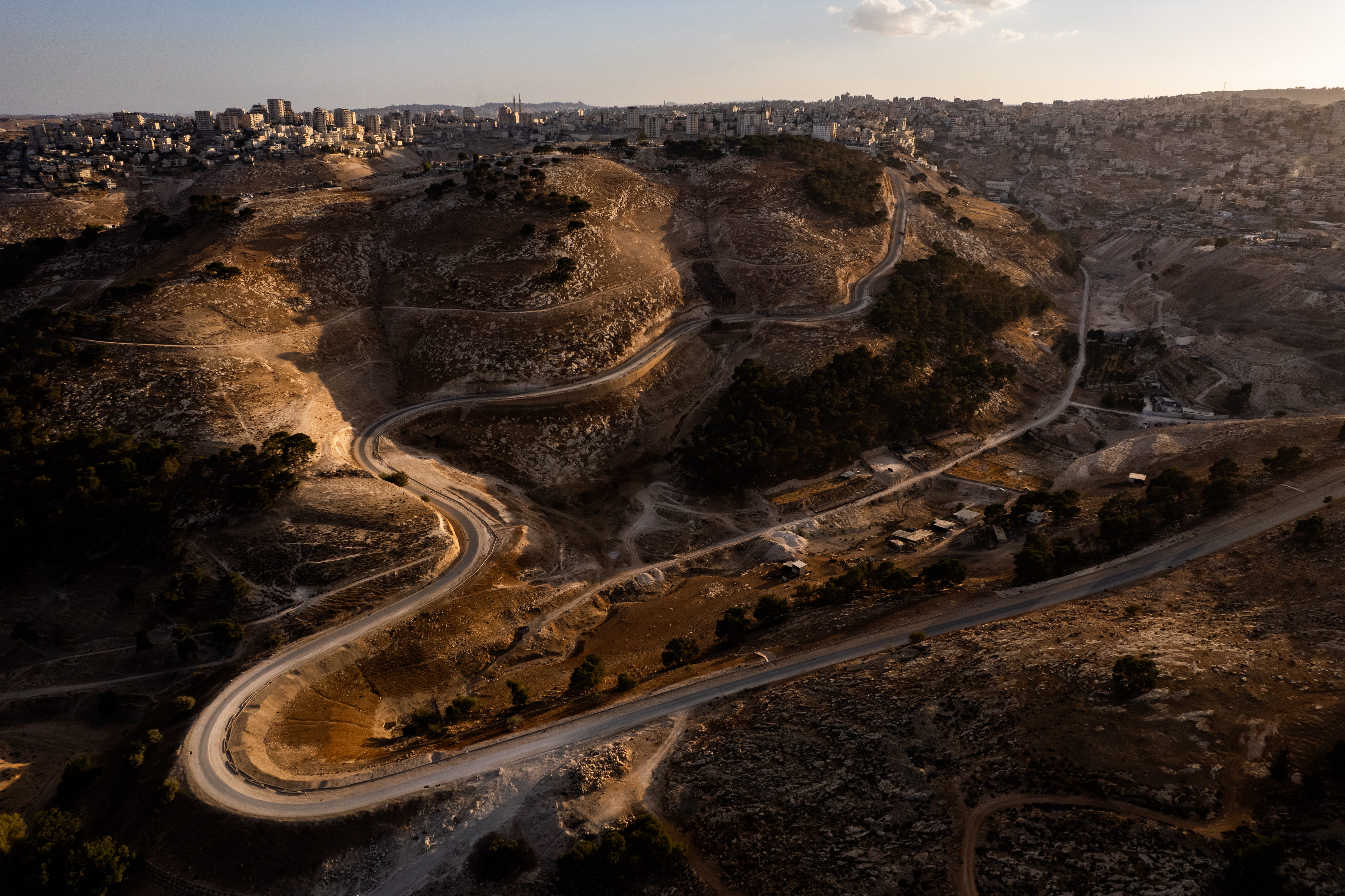
Aerial view of the E1 area, outside Maale Adumim, October 25, 2025. (Yaniv Nadav/FLASH90)
It’s Thursday, August 27, and Al Jazeera calls it “the final nail in the coffin of the two-state solution.” Finance Minister Bezalel Smotrich, of all people, agrees: construction in the E1 corridor east of Jerusalem, he says, “buries the idea of a Palestinian state.” The question is whether it will put the final nail in Israel’s relations with the EU as well.
First, a bit of history.
E1 is a 12,000-dunam tract, about 12 square kilometers, on the hills between Jerusalem and Ma’ale Adumim, one of the largest Jewish cities in Judea and Samaria. It is also the corridor connecting East Jerusalem—the intended capital of a Palestinian state—to the rest of the Palestinian territories. The area has served as the stage for a long-practiced dance, one Israel and the international community have been performing for more than three decades.
The first to try was Europe’s favorite Israeli prime minister, Yitzhak Rabin, who in April 1994—in the thick of the Oslo negotiations—handed the mayor of Ma’ale Adumim the documents for E1’s annexation to his town. Rabin feared that without a continuous ribbon of Jewish building, Ma’ale Adumim would become another Mount Scopus—the isolated Israeli enclave of 1948 to 1967, reachable only by a single road and dependent on Jordanian and UN goodwill. Subsequent leaders on both left and right—Peres, Barak, Olmert, Netanyahu—reaffirmed Israel’s interest in E1 as the tie binding Jerusalem to Ma’ale Adumim, for reasons of “security and settlement.”
Even Ehud Barak, who offered East Jerusalem as a Palestinian capital, warned that unless Israel built the link it risked losing Ma’ale Adumim outright; Olmert envisioned Jerusalem and Ma’ale Adumim as “a single urban continuity”; and Reuven Rivlin insisted a living Rabin “would give an unequivocal order to implement E1.” But diplomacy kept winning out. Washington’s objection hardened across administrations—rooted in the early-1990s showdown over loan guarantees for Soviet immigrants, and made explicit in 2005, when Secretary of State Condoleezza Rice told the Senate that building there “would contravene American policy.” Each time the plan advanced, pressure refroze it.
The truth is that everyone benefited from the performance. Israeli leaders got to look hardline at home while privately assuring Washington they would not actually build; meanwhile, Washington and Europe got to look like they were saving peace in the Middle East. Rabin quietly held off under an understanding with the Clinton administration; Olmert went furthest, publicly conceding that Israel had “made a commitment to freeze construction” and that to build would be irresponsible.
Even the uncompromising Ariel Sharon tried and ultimately failed. As he prepared the Gaza disengagement in 2005, Ariel Sharon prioritized Ma’ale Adumim’s expansion. To placate settlers and solidify the new unilateral border, Israel began infrastructure work in E1: roads and a police headquarters that, to this day, remains virtually the only building on the entire tract. The station still has no sewage line, and a truck comes every few weeks to empty its septic tank.
The pattern held through the sharpest confrontation of all. In late 2012, days after the UN General Assembly upgraded Palestine to non-member observer state status, a forum of nine ministers voted to renew planning, approval, and construction in E1 as retaliation. Netanyahu was defiant: Israel would press ahead “even in the face of international pressure,” and there would be “no change in the decision.” Europe answered within hours—Britain, France, Sweden, Denmark, and Spain summoned Israeli ambassadors, others followed the next day, and London and Paris were reported to be weighing the recall of their envoys. Netanyahu was true to his word. There was no change in the decision; it was simply frozen—for eight years.
Israel’s Finance Minister Bezalel Smotrich attends a press conference announcing his plans to approve more than 3,000 housing units in the E1 settlement project between Jerusalem and Ma’ale Adumim, August 14, 2025. (Yonatan Sindel/Flash90)
It did not resurface in earnest until Netanyahu approved it “for deposit” on the eve of the 2020 election. It kept inching forward under the Bennett-Lapid “government of change,” the objections subcommittee holding hearings—but the third and final hearing, scheduled for 10 January 2022, was postponed to an unknown date under American pressure.
That held until Smotrich took up the challenge. Possessing no interest in tangoing with the international community, he approved 3,400 housing units and, recently, opened the tender process for construction.
Now the question is whether the EU is serious about consequences. Foreign Secretary Ed Miliband said Britain would unveil a comprehensive package within weeks, including targeted sanctions on those involved in illegal settlement expansion, though none has yet been named. Brussels, for its part, is reportedly readying a broader, cross-industry package that would reach past the settlements—labeling all Israeli products, scaling back academic collaboration, and suspending some security and diplomatic ties—but only if construction actually begins, presumably not the tender process alone.
Israel has answered in kind. Foreign Minister Gideon Sa’ar announced Tuesday, with Netanyahu’s approval, the immediate expulsion of Dutch representatives from the US-led Gaza coordination center in Kiryat Gat over the Netherlands’ ban on products from Judea and Samaria and the Golan Heights, and Jerusalem is weighing the same against Britain, Germany, and Italy—echoing March, when it evicted Spain after Madrid pulled its ambassador and legislated an arms embargo.
The tension comes down to a conflict of visions. The EU still believes a two-state solution is possible and—characteristically for the region’s former paternalistic colonisers—that it can save Israel from itself and lead it down the path of righteousness. A majority of Israelis, meanwhile, see clearly that a Palestinian state is nowhere near the horizon, with blatant support for terror and the enduring popularity of Hamas rife in Palestinian society.
The difficult truth is that 12km of land is not what is blocking a two-state outcome, and European sanctions won’t bridge that divide.
MK Mansour Abbas attends a plenum session at the assembly hall of the Knesset, July 15, 2026. (Yonatan Sindel/Flash90)
Imagine an American congressman who said the country’s founding creed had been “imposed” on him and he disagreed with it on principle, but that he’d tolerate it to serve his constituents. Mainstream voters would find him hard to sit with, the more so if he were an Islamist whose party colleagues had downplayed 9/11. Now transpose that to a state defined not by a constitution but by its Jewish character, add a desperate desire on the lawmaker’s part to join a government, and you have the predicament of Ra’am leader Mansour Abbas.
Since his breakup with the Arab Joint List in 2021, Abbas has been trying to merge into the mainstream of Israeli politics—first through negotiations with Netanyahu, who was open to an alliance but was blocked by Smotrich, and then settling for membership in Naftali Bennett and Yair Lapid’s short-lived government. In 2021 he took the unprecedented step, for an Arab politician, of declaring that “Israel was born as a Jewish state and will remain so.” That wasn’t enough to stop Bennett’s right flank from defecting and collapsing the government, but Abbas was undeterred.
Since that government’s collapse, he has been working harder to rebrand Ra’am as moderate enough to be accepted by even Israel’s right: breaking last year from its Muslim Brotherhood–affiliated parent organization, and reportedly even planning to run a Jewish candidate—former senior police commander Yoav Segalovich—in the coming election.
The trouble is that it’s lipstick on a pig and Jews don’t like pork. Abbas’ ideology is essentially inherited from his teacher, Abdullah Nimr Darwish, who preached a kind of neutral Islamist ideology. He taught that Israel is inalienable Muslim property, so Zionist aspirations to Jewish self-determination in the land are fundamentally illegitimate and immoral in principle; but since the reality of Israel’s existence shows no sign of changing, it is acceptable to participate in the illegitimate entity to improve the lot of its Arab citizens. That has been Ra’am’s fundamental since the 1990s, expressed in varying registers of moderation and militancy.
But Israeli Jews don’t love the idea that you refrain from nullifying their state purely out of pragmatism. Abbas has been doing everything he can to avoid saying so explicitly—and last night he slipped, calling Israel’s Jewish character “an existing reality that was imposed upon us and was not something we chose,” and adding that “our position regarding the Palestinian people’s right to self-determination and recognition of a Palestinian state alongside the State of Israel is well known.” As he said, it is well known—none of it is new—but it cuts against the moderate notes he has been sounding lately, and it makes Eisenkot’s plan for a 58-seat majority, with Abbas lending him the additional five from the outside, significantly harder to sell.
Still, Abbas’ pitch remains the same: ignore my ideology regarding Israel’s Jewish character—I’m not going to change it, my priority is civil rights. I have a feeling it will work on Eisenkot, but with security questions front and center and increasing calls of Palestinian statehood abroad, will it work for anyone else?
English Editor: Ari Tatarka
If you enjoy the newsletter, you can show your support by becoming a paid subscriber—it really helps keep this going. I’m also offering a special monthly briefing for a small group of premium members. I’d love to have you join us—just click below to find out more.
Thanks for reading It’s Noon in Israel! Subscribe for free to receive new posts and support my work.


Is Israel still considering asking the UK to participate in the international force in the North (to replace UNIFIL?)