The Art of a Bad Deal: Part II
Also, Israel's flawed strategy in Iran, and streaming comes to southern Lebanon.
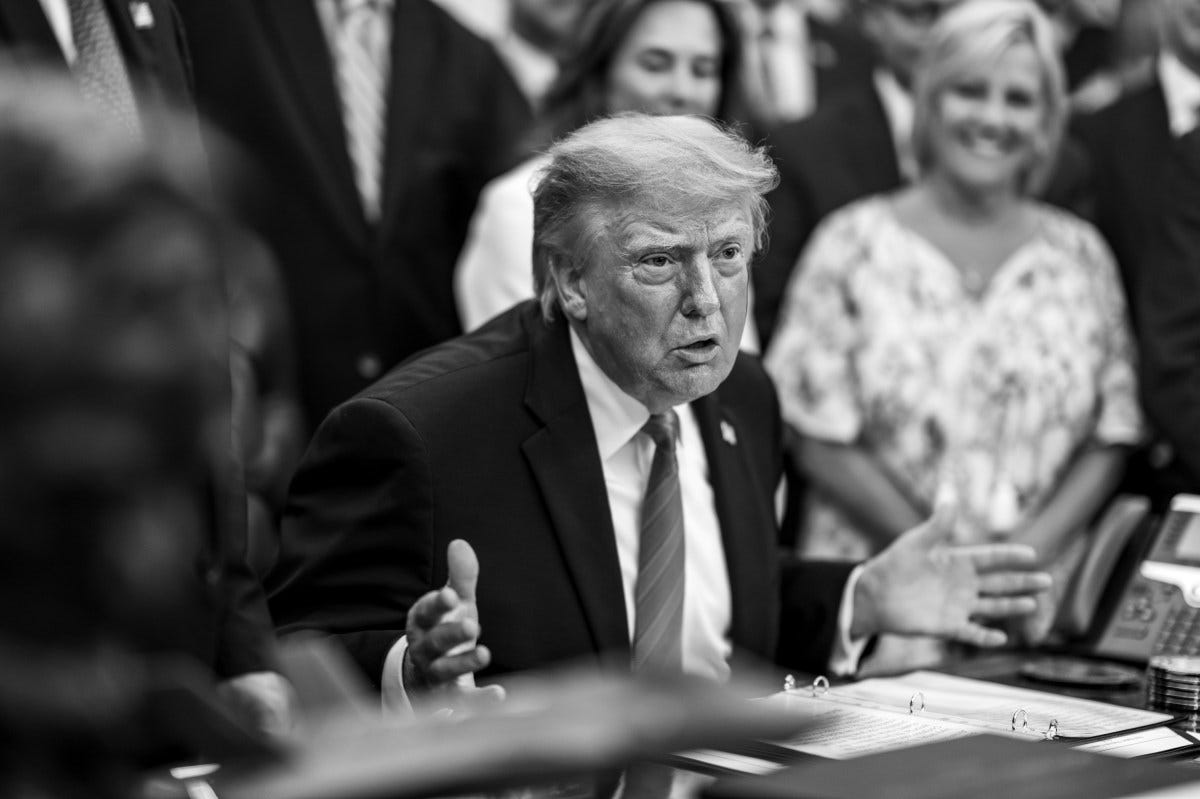
President Donald Trump signs the Secure America Act in the Oval Office. (White House)
It’s Friday, June 12, and in comedy nothing is more basic than the bait-and-switch: the audience builds expectation, the climax arrives, and at the last moment Lucy yanks the football and Charlie Brown crashes to the ground. It’s a comedy mainstay—and lately, it seems to have crept into geopolitics as well.
This week saw multiple cases of the trope. On Sunday, we were supposedly so close to a deal that Trump demanded Israel take a direct Iranian attack on the cheek. Then, at the last moment, a U.S. helicopter was downed by Iranian fire, and the president declared they’d been “playing us for suckers.” Deal’s off.
What followed was a night of strikes, plans for another, even a declaration that “in the not too distant future, we will be taking Kharg Island.” Then, at the last moment—crash. “Discussions and final points have been, in both concept and great detail, approved by all parties involved,” according to the White House, and Trump called off the strikes.
Charlie Brown isn’t the only one with a headache, and no one—except the Iranians—is laughing.
But much like the devil, the fate of this deal is in the details—and so far, the details look familiar. This MOU appears nearly identical to the disastrous deal floated in late May, the one Trump abandoned after Republicans had an allergic reaction to it, while Iran reportedly concluded he was simply too desperate for a deal and they could wait him out.
Rather than a full agreement, what’s on the table is an MOU extending the ceasefire for 60 days while nuclear negotiations continue—and, despite the steep costs Israel recently paid to sever the two fronts, this one appears to fold Lebanon back in as well. On the nuclear file, the text lays out a framework for addressing Iran’s enriched uranium stockpile, though any actual action would wait on a second, more detailed accord.
Worse is the financial relief: according to the report, after reopening the strait, Iran would be given temporary sanctions waivers allowing it to sell oil for 60 days, generating precious revenue for Tehran. That relief would expand if Iran complies with the initial agreement and shows “good faith” in subsequent negotiations—though, as one diplomat put it, “there is no set date for sanctions relief, and it will be tied to the implementation of the deal.”
Less clear is what happens to the billions in Iranian funds frozen overseas. Iran has insisted it must receive some money immediately upon signing any initial deal, while the U.S. has said release would come in tranches based on compliance. Separately, the U.S., Iran and Qatar have reportedly discussed a mechanism letting Iran access some of its frozen funds in Qatar for humanitarian purchases. I’m not sure if Qatar is simply trying to make its terrorism support tax-deductible, but these payments are humanitarian in name only—just ask Hamas. Money is fungible, and the regime still controls imports, so it can either redirect funds from what little it gives its own population now that it is being covered by Qatar, or simply sell the humanitarian goods to its own population and pocket the revenue.
This deal can be judged by a simple test: does it merely pause the regime—leaving Iran roughly where it’s been since the blockade began—or does it rewind the clock, leaving Tehran better off than before? If sanctions are eased and frozen assets unlocked, it’s definitely the latter.
As one very senior Israeli official put it to me this morning, the deal is “shit.”
The bad news is that Trump paused operations when the deal hasn’t even been ratified yet. As of last night, the line was that “the U.S. and Iran have agreed on the text of a deal,” with the caveat that it still needs final sign-off. Trump said he expected a signing ceremony over the weekend. Iran’s foreign ministry, for its part, said only that Tehran had “not yet reached a final decision.”
The good news is that nothing’s locked in—the gaps between the parties remain huge—and given how fond Trump has grown of yanking the football away at the last second, maybe this time it’s the Ayatollah who ends up flat on his back.
IDF forces operating in the area of southern Lebanon in February. (IDF)
It wasn’t October 7, but June 7 that threatened to become the gravest threat to Benjamin Netanyahu’s future. Iran attacked with missiles, Trump demanded no retaliation and backed this up, in his usual fashion, with a barrage of phone calls, interviews and tweets. And then came the phone call. “A man’s gotta do what a man’s gotta do,” the prime minister told the president. Shortly thereafter, the planes were en route east.
Until April, Netanyahu enjoyed a massive advantage over his rivals regarding his relationship with Trump and the dividends it paid. The achievements of Operation Rising Lion in June 2025 were a matter of consensus, and near-total support accompanied the first weeks of Roaring Lion. When a ceasefire was declared, completely contrary to Israel’s position, that advantage evaporated. The heavy toll in blood in southern Lebanon, the return of the state of emergency in the north, and growing Iranian audacity threatened to turn it into a liability. Opposition leaders are relentlessly hammering him over the lack of a strategy.
According to their logic, was Netanyahu supposed to say “no thank you” to a U.S. president eager to act together against the most formidable enemy Israel has known since its founding? To refuse the stripping of 300 billion dollars from Iran’s assets, including most of its military assets, nuclear facilities and missile factories? One can also be skeptical of the claim that Israel should have destroyed the Hezbollah stronghold of Dahiyeh at all costs, especially when it comes from those who suggested throughout most of the Gaza war to fold, halt and bow to every American dictate.
There is, however, one critical turning point where things could—and should—have gone differently. This concerns the choice of the primary objective of the latest operation. Israel went to war after war to stop Iran’s nuclearization process; toppling the regime was merely a welcome byproduct.
“We should have pushed much harder,” two senior defense officials—one former, one current—said this week regarding a military operation to seize the enriched uranium. It was possible, it was well within our grasp, and it was on the drawing board. Instead, we spread ourselves too thin across massive, destructive strikes that failed to deliver total victory. Moreover, because we kept waiting for the possibility that such an operation would be approved, we refrained from other actions that would have damaged the nuclear program. Thus, we ended the war with the assassination of a few more nuclear scientists—undoubtedly important, but not a game-changer—yet without a massive, irreversible achievement. In that case, criticism over the inability to topple a regime from the air, along with talk of various Kurdish uprisings, sounds entirely reasonable.
Imagine if we had done that, they say, and then ended the war with the sanctions in place, the Strait of Hormuz closed, and Samson’s locks thoroughly shorn.
Is the window closed? Operationally, no. The obstacle was and remains the Republican PTSD over boots on the ground. But the impossible limbo in which the president finds himself—between a justified and absolute refusal of an agreement that includes lifting sanctions and paying billions, and an understandable reluctance to resume fighting—could lead him to say that the uranium operation is a go.
This is an excerpt from my weekly column in Israel Hayom.
The World Cup qualifier soccer match between Italy and Israel at Nagyerdei Stadion, 2025. (Flash90)
In lighter news, the World Cup kicked off last night. Even though Israel didn’t make the cut, that didn’t stop the entire country from tuning in. Even combat deployment wasn’t an excuse to miss the opening matches. For soldiers stationed in the trenches of southern Lebanon, the IDF’s C4I and Cyber Defense Directorate streamed the games using “Z-TUBE”—a highly secure, encrypted military intelligence platform, just to bring the pitch to the front lines.
This isn’t even the first time Israel has pulled something like this. The 2014 World Cup happened to coincide exactly with the buildup and execution of Operation Protective Edge in Gaza, and to keep morale up among the tens of thousands of reservists and active-duty soldiers staged along the border, the IDF set up mobile screens and logistics tents so troops could catch matches between operational briefings and combat deployments.
This does appear to be the first time the IDF has gone the streaming route. Z-TUBE is an advanced military network designed to rapidly distribute operational footage—according to published reports, “from the moment footage is captured until it is viewed, no matter the location, the image will be displayed on a screen within 300 milliseconds to half a second.” So if you’re looking for the best World Cup screening in Israel, try southern Lebanon.
English Editor: Ari Tatarka
If you enjoy the newsletter, you can show your support by becoming a paid subscriber—it really helps keep this going. I’m also offering a special monthly briefing for a small group of premium members. I’d love to have you join us—just click below to find out more.
Thanks for reading It’s Noon in Israel! Subscribe for free to receive new posts and support my work.


Typical Trump. Whether you are an enemy or a friend he can’t be trusted. But the scariest part of this is he is likely the best friend Israel will have in the White House for ages.
Israel must understand the political winds in the US and those winds are anti-Semitic.
Israel must figure out how to manufacture her own weapons and buy from sources outside the US as the next congress and administration will call for reduced aid to Israel and an embargo on offensive weapons.
It’s a scary time for Israel but the sooner she faces reality, not the reality as she wants it to be, the better off she will be in the long run.
Would Israelis propose their boots on the ground protected by US and Israeli air power? Maybe the UAE would add some of their troops too. Then, the losses, if any, would be Israeli.
If combined with giving Iranian people weapons, the IRGC and Baseej could be spread thin. And Trump could get Jolani to attack Hezbollah, which will pull Iraqi militias out of Iran. Let them fight on several fronts and decide what to protect: Keep Hezbollah alive? Prevent revolts in the regions? Keep the dust.
Does Israel have the right drone defense? That is likely the key to preventing mass casualties.