The Art of a Bad Deal
Trump’s proposed deal threatens to leave Iran stronger than it was before Operation Epic Fury.
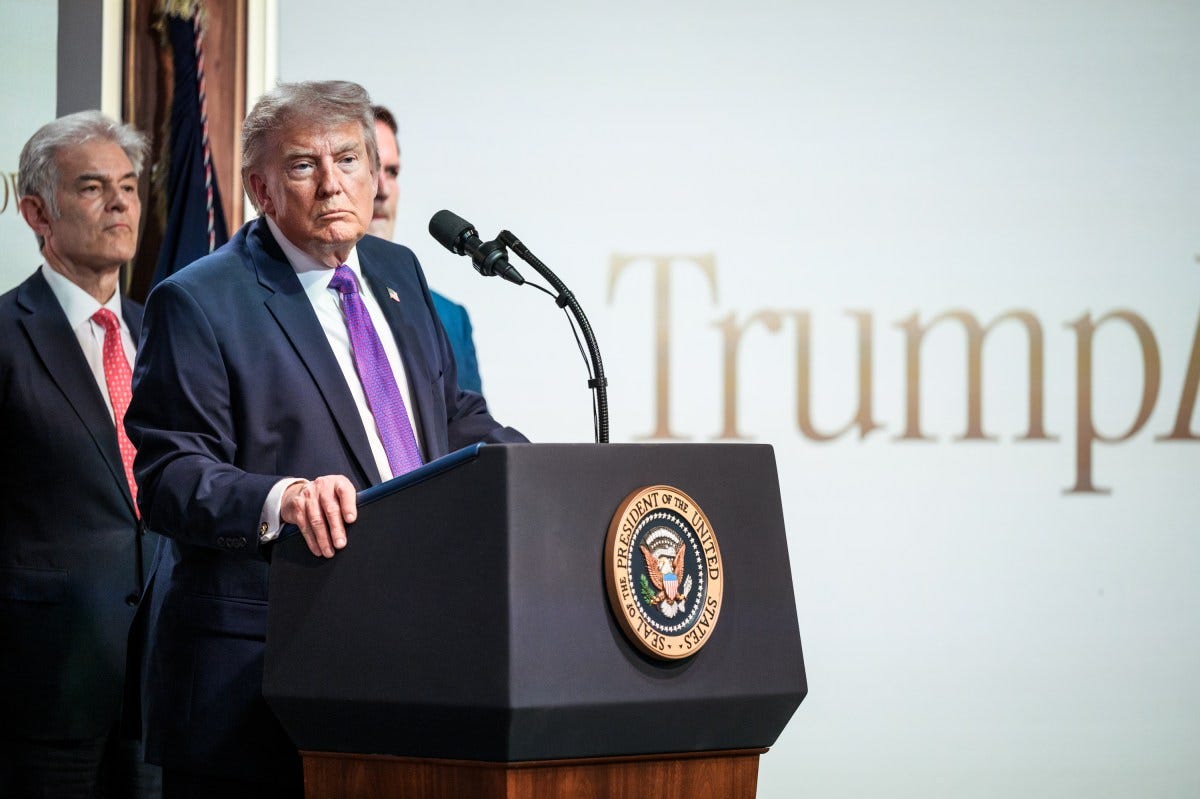
Donald Trump participating in a TrumpRx event last week. (White House)
It’s Sunday, May 24, and at the outset of Operation Roaring Lion, there were two definitions of victory on the table: capturing Iran’s enriched uranium or toppling the regime altogether. Given that regime change does not appear to be materializing and one of the parties appears hesitant to make the necessary investments for such an outcome, the sole remaining path to victory appears to be securing the uranium.
The most recent proposal—which Donald Trump claims is already “largely negotiated”—seemingly attempts to follow this path. According to a report from Channel 12, the agreement would reopen the Strait of Hormuz in exchange for the lifting of the naval blockade and substantial financial relief. However, the core issues regarding the nuclear program and the extraction of Iran’s enriched uranium stockpile would not be resolved upfront; instead, they would be deferred for separate negotiations over a 60-day period. Critically, Senior Iranian sources speaking with The New York Times said the deal would release $25 billion in Iranian assets frozen overseas. They added that the agreement “would halt fighting on all fronts, including in Lebanon.”
If the enriched uranium is indeed surrendered to the United States, it is indeed a notable achievement, but there are two caveats:
The first caveat concerns the actual scope and reality of the nuclear concessions. According to current reports, the negotiations slated to follow the reopening of the Strait of Hormuz will focus exclusively on uranium enriched to 60 percent—the roughly 440 kilograms currently believed to be buried beneath the rubble of the Natanz facility. Meanwhile, the tons of uranium enriched to three percent appear destined to remain inside Iran, with any future restrictions on its enrichment left dangerously ambiguous. Compounding this uncertainty, a senior Iranian official bluntly told Reuters today that Tehran has not actually agreed to hand over any material at all, emphasizing that the preliminary agreement does not even formally address the nuclear issue.
The second caveat is procedural, but no less critical. The framework currently on the table is not a finalized treaty, but merely a temporary Memorandum of Understanding meant to serve as a baseline for future talks. All the thorny details regarding the nuclear stockpile are slated to be ironed out over a 60-day negotiation window. The official justification for this delay is logistical—that safely extracting highly enriched uranium from bombed-out, irradiated rubble is a highly complex operation. In practice, however, it is far more likely a calculated delay, offering Tehran an extended opportunity to rest and recover before entering their next phase of nuclear intractability.
Donald Trump and Benjamin Netanyahu hold a joint press conference announcing the U.S. peace plan for Gaza, October 2025. (White House)
Israel has greeted the news with deep skepticism and more than a touch of fear. The reported memorandum makes zero mention of ballistic missile restrictions. What began largely as a defensive shield for Iran’s nuclear ambitions has mutated into a formidable threat in its own right. Even without the ultimate deterrent of a nuclear warhead, an Iranian ballistic arsenal numbering in the tens of thousands is more than sufficient to paralyze any military action against the Islamic Republic. According to Channel 12, this critical issue—whether through an immediate American concession or a simple lack of interest—never even made it to the negotiating table.
The current form of the deal also leaves the Islamic Republic holding another critical asset: the Strait of Hormuz. While the strategic waterway is slated to reopen, it does so not by virtue of an American victory, but rather by Iran’s sufferance. The current framework temporarily ensures toll-free passage, but absolutely nothing in the agreement guarantees that Tehran won’t eventually set up a toll booth—or abruptly choke off shipping the moment they feel the subsequent 60-day negotiations are stalling.
A secondary, but equally pressing concern in Jerusalem is that the regime has not yet fallen. While never explicitly declared as a military objective, regime change has been the unofficial policy undercurrent of the entire conflict. So far, Tehran has successfully managed to cling to power. Yet, senior Israeli intelligence officials maintain that a collapse from within remains a distinct possibility—provided the crippling economic blockade is sustained through the end of 2026. If the blockade and economic warfare are traded away for a partial agreement today, that window permanently closes. Meanwhile, domestic repression continues apace; just this morning, Iran executed a man accused of sending information to the US and Israel during the war. Cutting this deal now would not just throw Tehran a financial lifeline—it would constitute a total abandonment of the Iranian protesters who began this entire conflict.
A signature on the dotted line, however, does not automatically underwrite the long-term survival of the Islamic Republic. If this 60-day window serves merely as a temporary pause button on the naval blockade rather than a total rewind of broader U.S. economic pressure, Israel and the United States will likely redouble their efforts toward the alternative path to victory: regime change. Without a comprehensive withdrawal of core sanctions, Iran’s baseline economic reality will continue to make Weimar Germans look prosperous, providing fertile ground to foment widespread domestic revolt.
This is precisely where the $25 billion in unfrozen assets reported by The New York Times becomes the deal’s most critical variable. It acts as a vital liquidity bridge, allowing the Islamic Republic to safely span the economic chasm it is currently teetering over. That massive cash injection provides exactly what Tehran needs: a way to keep its domestic security apparatus paid and loyal while illicit oil flows to China stabilize. In a very literal sense, that $25 billion could spell the difference between collapse and survival.
An Israeli soldier is seen during an Israeli military operation in Ayta ash Shab, southern Lebanon. (David Cohen/Flash90)
The most concerning element, however, pertains to the war in Lebanon. Leaks regarding the current agreement point to a halt in fighting across all fronts, including with Hezbollah. Since April 8, Israel’s primary goal has been to decouple Lebanon from the broader Iranian conflict. They temporarily achieved a separation in the immediate aftermath of the ceasefire, until Iranian pressure successfully convinced the United States that larger geopolitical considerations were at stake. More recently, the conflict has been escalating, with the possibility of a major offensive becoming clearer on the horizon. Until now, the mere prospect of a negotiated deal has served as Iran’s primary leverage to hold Israel back, though that leverage seemed to be disintegrating along with Trump’s patience. If Tehran now manages to use this agreement to formally lock the two fronts together, it would constitute a major strategic defeat for Israel.
If an agreement materializes, the ensuing ceasefire—like almost every recent truce—will raise the million-dollar question: who has to stop, and who gets to keep firing?
The reality on the ground could mirror the late-2024 model, where Hezbollah was forced to stand down while Israel proactively maintained the operational initiative, striking their infrastructure. Alternatively—and more likely—it could devolve into the current war of attrition, with Hezbollah launching opportunistic strikes while the IDF’s responses remain tightly constrained. There is also the danger of regressing to a pre-October 7 “hot peace”—a nominal truce that simply grants Hezbollah the quiet it needs to rearm and rebuild. Finally, the arrangement could fail entirely on day one, serving as nothing more than a cosmetic pause in a de facto, ongoing war.
For a leader who has spent decades building his brand as the sole guarantor of Israeli security, accepting a deal that leaves the regime intact, Hezbollah armed, the ballistic missile program recovering, and Tehran flush with sanctions relief is electoral assisted suicide for Netanyahu. Hanging in the balance of these negotiations is the fate of more than one regime.
English Editor: Ari Tatarka
If you enjoy the newsletter, you can show your support by becoming a paid subscriber—it really helps keep this going. I’m also offering a special monthly briefing for a small group of premium members. I’d love to have you join us—just click below to find out more.
Thanks for reading It’s Noon in Israel! Subscribe for free to receive new posts and support my work.


“Bad deal” is a gross understatement. Trump is doing more than surrendering. Trump is making Iran the regional hegemon, while effectively preventing any expansion of the Abraham Accords (if not killing them outright). Iran will be infused with cash to restart its nuclear program and fund the ring of fire. Iran has learned that threatening to close or closing the Strait of Hormuz is the ultimate “trump” card. Trump’s deal is so bad it makes Chamberlain’s Munich Agreement look like diplomatic brilliance.
The $25B refers to Iran's frozen assets, not necessarily the amount that will be unlocked.
This deal is also a disaster for President Trump: the anti-Israel groups in the US won't forgive him for going to war with Iran and he will lose support from pro Israel groups. The neutral isolationists won't accept that he went to war and came back with nothing to show.
Trump seems to gain nothing, not even the illusion of victory and he has his legacy to think of, more than the midterm elections the party in power usually loses anyhow.